
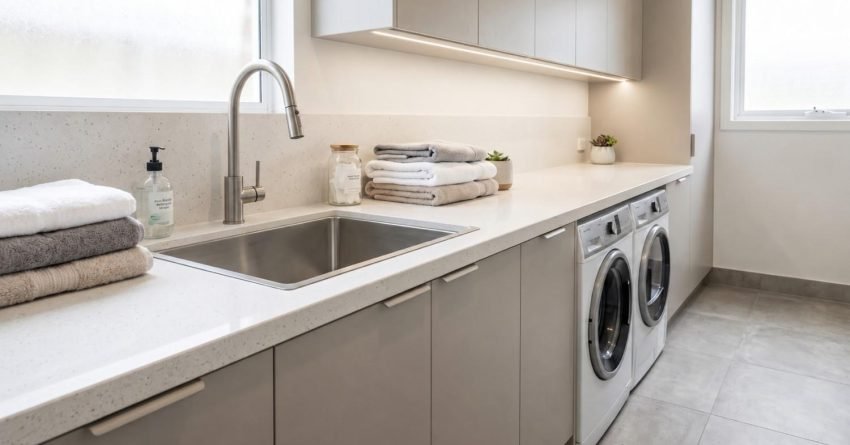
A laundry renovation transforms one of the most hardworking rooms in a home, upgrading its layout, fixtures, storage, and finishes to create a space that functions better, looks better, and adds measurable value to the property. Whether the project involves a cramped laundry nook, a combined bathroom-laundry, or a dedicated utility room, the decisions made around planning, budgeting, design, and trade selection determine whether the renovation delivers lasting results or costly regrets.
For Sydney homeowners, first-time renovators, and property investors, getting a laundry renovation right means understanding the full picture before a single tile is laid or cabinet is ordered. This guide covers everything: what a laundry renovation involves, how to plan and budget for one, design and layout options, storage and cabinetry, fixtures and fittings, flooring and tiles, which trades are needed, and how to maximise return on investment.
What Does a Laundry Renovation Actually Involve?
A laundry renovation is the partial or complete upgrade of a laundry room covering its layout, plumbing, electrical, waterproofing, cabinetry, fixtures, flooring, and wall finishes. The scope varies significantly depending on whether the work involves cosmetic improvements or a full structural reconfiguration.
Scope of Work: What Gets Replaced or Upgraded
Most laundry renovations involve some combination of the following:
- Removal and replacement of existing cabinetry, benchtops, and storage
- Replacement or repositioning of the laundry trough or sink
- Plumbing upgrades including tapware, waste connections, and hot and cold water supply
- Electrical work including power points, lighting, and appliance connections
- Waterproofing of wet areas in compliance with Australian Standard AS 3740
- New flooring and wall tiles
- Fresh paint or wall cladding
The extent of each trade’s involvement depends on how much of the existing infrastructure is being retained versus replaced.
Structural vs. Cosmetic Renovations
A cosmetic laundry renovation focuses on surface-level improvements: new tiles, fresh paint, updated tapware, and replacement cabinetry without altering the existing plumbing layout or structural walls. These renovations are faster, less disruptive, and significantly less expensive.
A structural renovation involves repositioning plumbing, moving walls, reconfiguring the layout, or upgrading the waterproofing membrane. These projects require licensed tradespeople, require council approval in many cases, and carry higher costs and longer timelines.
Waterproofing is a non-negotiable requirement for any laundry renovation that involves wet areas. Under the National Construction Code, wet area waterproofing requirements must comply with AS 3740, and this work must be completed by a licensed waterproofer using an approved membrane system, either sheet membrane, liquid-applied membrane, or a combination of both. The waterproofing must be inspected and signed off before any tiling begins; proceeding without that inspection creates a compliance failure that voids the warranty on the finished work and creates liability for the homeowner.
Understanding the full scope of work is the essential first step. Every stage of the process from setting the brief and establishing priorities to sequencing trades and managing the project timeline flows from that initial scope decision.

How to Plan a Laundry Renovation in Sydney
Effective planning is what separates a renovation that runs on time and on budget from one that stalls, blows out, or delivers disappointing results. For Sydney homeowners, planning a laundry renovation involves three interconnected workstreams: defining goals, understanding approval obligations, and building a realistic project timeline.
Setting Renovation Goals and Priorities
Before engaging any trades or requesting quotes, it pays to define what the renovated laundry needs to achieve. Common renovation goals include:
- Improving storage capacity and organisation
- Upgrading fixtures and finishes for a more contemporary look
- Reconfiguring the layout to improve workflow and usability
- Increasing the property’s appeal for sale or rental
- Addressing maintenance issues such as damaged waterproofing or outdated plumbing
Prioritising these goals early helps allocate the budget to the upgrades that matter most and avoids spending on elements that do not serve the primary objective.
Permits, Approvals, and Council Requirements
Not all laundry renovations require council approval, but understanding when approval is needed is essential before work begins. In New South Wales, most cosmetic laundry renovations fall under exempt development and require no formal approval. Renovations that involve structural changes, plumbing alterations, or work in strata-titled properties require a Complying Development Certificate (CDC) or a Development Application (DA).
Most laundry renovations in Sydney fall under complying development, but the documentation required, including a BASIX certificate for certain works and a licensed contractor’s compliance certificate, varies by council and scope. Confirming approval obligations before work begins is a non-negotiable step.
Strata Properties: Additional Approval Requirements
For homeowners in strata-titled apartments and townhouses, laundry renovations involve an additional layer of approval beyond council requirements. Most strata schemes require owners corporation (OC) consent before any renovation work begins, particularly work that involves plumbing, waterproofing, or structural changes to common property or shared walls as part of the strata renovation approval process in NSW.
The process typically involves submitting a renovation application to the strata manager, including a scope of work, trade licences, and insurance certificates. Some schemes also require a by-law to be registered before work proceeds. Engaging the strata manager early, before finalising the scope or booking trades, avoids delays and ensures the renovation proceeds within the scheme’s rules.
Renovation Timeline: What to Expect
A straightforward cosmetic laundry renovation typically takes between one and two weeks from trade commencement to completion. A full structural renovation involving plumbing relocation, waterproofing, tiling, cabinetry installation, and electrical work takes three to five weeks depending on trade availability and the complexity of the scope.
The most common cause of timeline blowouts is poor trade sequencing. Trades must be scheduled in the correct order: demolition first, then rough-in plumbing and electrical, then waterproofing and tiling, then cabinetry and fixtures, then final connections and commissioning. Skipping or overlapping stages creates rework and delays that compound quickly on a small project.
How Much Does a Laundry Renovation Cost in Sydney?
Laundry renovation costs in Sydney vary widely depending on the size of the space, the scope of work, the quality of materials and fixtures selected, and the complexity of the plumbing and electrical requirements. Understanding the cost tiers and what drives pricing up or down is the foundation of a realistic renovation budget.
Budget Tiers: Entry-Level, Mid-Range, and Premium
Sydney laundry renovation costs generally fall into three tiers:
| Budget Tier | Typical Cost Range | What It Includes |
| Entry-Level | $5,000 – $10,000 | Cosmetic refresh: new tapware, paint, flat-pack cabinetry, basic trough replacement, vinyl flooring |
| Mid-Range | $10,000 – $20,000 | Full fitout: semi-custom cabinetry, quality trough or sink, porcelain tiles, updated plumbing and electrical, new waterproofing |
| Premium | $20,000 – $35,000+ | Custom joinery, stone benchtops, designer fixtures, full structural reconfiguration, premium tiles, full trade coordination |
These ranges reflect typical Sydney market pricing as of 2025. On a per-square-metre basis, mid-range laundry renovations in Sydney typically cost between $2,500 and $4,500 per square metre of finished space, depending on the material and fixture selections. Actual costs depend on the specific scope, the condition of existing infrastructure, and the trades and materials selected.
What Drives Laundry Renovation Costs Up
Several factors push laundry renovation costs above the base tier estimates:
- Plumbing relocation: Moving the trough, waste outlet, or water supply connections requires a licensed plumber and adds $1,500 to $4,000 to the project cost depending on the complexity of the relocation.
- Waterproofing: Full wet area waterproofing to AS 3740 standard typically costs $800 to $2,000 for a standard laundry, depending on the area being treated and the membrane system used.
- Custom cabinetry: Custom-built laundry joinery costs significantly more than flat-pack alternatives. A full set of custom overhead and base cabinets ranges from $3,000 to $8,000 or more depending on the material, finish, and configuration.
- Structural changes: Any work involving wall removal, floor penetrations, or changes to the building structure requires a licensed builder and engineering sign-off in most cases, adding both cost and time to the project.
- Tile selection: Premium large-format porcelain tiles cost more per square metre than standard ceramic tiles and require more skilled installation, increasing both material and labour costs.
Hidden Costs to Budget For
Many homeowners underestimate their laundry renovation budget because they focus on visible costs tiles, cabinets, fixtures and overlook the hidden costs that emerge once work begins:
- Waterproofing membrane replacement: If the existing membrane is damaged or non-compliant, it must be replaced before tiling proceeds.
- Asbestos testing and removal: Homes built before 1990 contain asbestos in wall sheeting, floor adhesives, or ceiling materials in many cases. Testing costs $200 to $500; removal adds significantly more.
- Subfloor repairs: Damaged or uneven subfloors must be repaired before new flooring is installed.
- Electrical upgrades: Older homes require switchboard upgrades or additional circuits to support modern appliance loads in many cases.
- Contingency budget: A 10 to 15 percent contingency allowance is standard practice for any renovation. On a $15,000 project, that means holding $1,500 to $2,250 in reserve.
According to Houzz’s 2024 Australian Renovation Trends Study, cost overruns affect more than 40% of Australian home renovation projects, with inadequate contingency budgeting cited as the primary contributing factor.
For a complete breakdown of every cost category, including labour rates, material allowances, fixture pricing, and contingency budgeting, the detailed financial framework Sydney homeowners need is built around understanding all three tiers before committing to a scope.

Laundry Design Ideas and Layout Options
The design of a laundry renovation determines how well the space functions day-to-day, how much storage it provides, and how it looks and feels as part of the home. For Sydney homes where laundry spaces are often compact, awkwardly shaped, or combined with other functions, layout decisions are particularly important.
Common Laundry Layouts for Sydney Homes
The four most common laundry layouts in Sydney residential properties are:
- Single-wall layout: All appliances, cabinetry, and fixtures are arranged along one wall. This is the most space-efficient configuration for narrow laundries and laundry nooks.
- Galley layout: Cabinetry and appliances are arranged on two parallel walls, creating a corridor-style workspace. This layout works well in dedicated laundry rooms with sufficient width.
- L-shaped layout: Cabinetry and fixtures are arranged along two adjacent walls, creating a corner workspace. This layout maximises bench space and storage in a square or near-square room.
- Combined laundry-bathroom: The laundry is integrated into the bathroom, with appliances concealed behind cabinet doors or in a dedicated alcove. This configuration is common in apartments and smaller Sydney homes.
The right layout depends on room dimensions, the position of existing plumbing and drainage, the appliance configuration, and storage requirements.
Choosing Your Appliance Configuration
Appliance selection shapes the entire layout of a laundry renovation, so it needs to be confirmed before cabinetry or plumbing positions are finalised. Front-loading washing machines and dryers are the most layout-flexible option;; they allow a full-depth benchtop to be installed above them, which is the single most effective way to add usable workspace in a compact laundry.
Top-loading washing machines require clear overhead access and cannot have a benchtop above them, which limits layout options significantly in small spaces. Stacked washer-dryer configurations free up floor space and suit narrow single-wall layouts, but they require a dedicated stacking kit and limit the dryer to a front-loading model. Side-by-side configurations give easier access to both appliances and allow a continuous benchtop run, but they require more floor width, typically a minimum of 1,200mm for two standard 600mm appliances.
Confirming the appliance configuration at the planning stage before any cabinetry is ordered or plumbing rough-in is completed avoids costly repositioning later.
Design Principles for Small Laundries
Small laundry design ideas and layouts benefit from a set of design principles that maximise function without sacrificing aesthetics:
- Use vertical space with overhead cabinets that extend to the ceiling
- Choose a front-loading washing machine and dryer to allow a benchtop above
- Select light-coloured tiles and cabinetry to make the space feel larger
- Incorporate recessed shelving or niches where wall depth allows
- Use a wall-mounted trough or sink to free up floor space
Space-saving layouts, compact fixture selections, and clever storage configurations make the most of limited square metres, and the right appliance choice is the starting point for all of them.
Lighting Design for Laundry Rooms
Lighting is one of the most underinvested elements in a laundry renovation, yet it has a disproportionate impact on how functional and finished the space feels. The most effective approach combines ambient lighting, typically LED downlights on a dimmer, with task lighting positioned directly above the benchtop or trough to eliminate shadows during detailed work like stain treatment or hand-washing.
Natural light, where available through a window or skylight, reduces the need for artificial lighting during the day and helps with moisture management by improving air circulation. Where natural light is limited, a well-positioned LED strip under overhead cabinets provides practical task illumination at low cost. Motion-sensor switches are a practical addition in laundries that are accessed frequently, but briefly; they eliminate the habit of leaving lights on in a room that is used and vacated quickly.
Laundry Storage and Cabinetry Solutions
Storage is one of the most important functional outcomes of a laundry renovation. A well-designed storage system keeps cleaning products, linen, and laundry supplies organised and accessible while maintaining a clean, uncluttered appearance.
Built-In Cabinets vs. Freestanding Storage
Built-in laundry cabinets, whether custom-built or flat-pack, offer the most efficient use of space and the most polished finished result. They are configured to fit around appliances, plumbing, and architectural features, and they provide a seamless, integrated look.
Freestanding storage units offer flexibility and lower upfront cost, but they are less space-efficient, harder to keep clean around, and less visually cohesive. For most laundry renovations, the range of built-in laundry cabinetry options delivers better long-term value.
The key cabinet types in a laundry renovation include:
- Overhead cabinets: Mounted above the benchtop or appliances; ideal for storing cleaning products, detergents, and infrequently used items
- Base cabinets: Positioned below the benchtop; used for appliance housing, waste bins, and general storage
- Tall pantry-style cabinets: Full-height units that maximise vertical storage; useful for linen, ironing boards, and bulk supplies
- Open shelving: Cost-effective and accessible; best used for frequently accessed items in a well-organised laundry
Benchtop Materials: Laminate, Stone, and Engineered Options
The benchtop is one of the most used surfaces in a laundry and needs to withstand water exposure, cleaning chemicals, and the weight of wet laundry. Laminate benchtops are the most cost-effective option; they are water-resistant, easy to clean, and available in a wide range of finishes that convincingly replicate stone and timber. They are the standard choice for entry-level and mid-range laundry renovations.
Engineered stone benchtops offer a premium finish with excellent durability and stain resistance, but they require careful sealing around the sink cutout to prevent water ingress at the edges. Solid timber benchtops are occasionally used in contemporary laundry designs but require regular oiling and are not recommended for high-moisture environments without a robust sealing regime. For most Sydney laundry renovations, a quality laminate or engineered stone benchtop delivers the best balance of durability, aesthetics, and cost.
Maximising Storage in a Small Laundry
In a small laundry, every centimetre of storage counts. The most effective strategies include using full-height overhead cabinets, incorporating pull-out drawers rather than shelves in base cabinets, and using the space above the washing machine and dryer for a dedicated cabinet or open shelf.
From overhead cabinets and base units to custom joinery and open shelving, every storage format and configuration strategy serves the same goal: a laundry that stays organised long-term without requiring constant effort to maintain.

Laundry Fixtures and Fittings: Troughs, Sinks, and Tapware
The fixtures and fittings in a laundry renovation the trough or sink, tapware, and appliance connections are the functional core of the space. Selecting the right fixtures for usage patterns, plumbing layout, and budget is one of the most important decisions in the renovation process.
Laundry Trough vs. Sink: Which Is Right?
A laundry trough is a deep, utility-grade basin designed for heavy-duty tasks: soaking, hand-washing, cleaning mops and buckets, and washing pets. Laundry trough and sink options include: troughs are typically made from polyurethane, stainless steel, or stone resin, and they are available in a range of sizes from 35 litres to 70 litres or more.
A laundry sink is shallower and more aesthetically refined than a trough, making it better suited to laundries that double as utility rooms or that are visible from living areas. Sinks are available in undermount, inset, and wall-hung configurations.
The right choice depends on how the laundry is used. Households with children, pets, or active outdoor lifestyles benefit from the depth and capacity of a trough. Homeowners prioritising aesthetics or working with a compact space prefer the cleaner profile of a sink.
Tapware, Appliance Connections, and Plumbing Considerations
Tapware selection for a laundry renovation involves choosing between wall-mounted and deck-mounted configurations, and between single-lever mixers and separate hot and cold taps. Wall-mounted tapware keeps the benchtop clear and is easier to clean around; deck-mounted tapware is simpler to install and replace.
Appliance connections including the washing machine cold water inlet, hot water connection (if applicable), and waste outlet must be positioned correctly during the rough-in plumbing stage. Repositioning these connections after tiling is complete is expensive and disruptive, so their placement must be confirmed before any tiling begins.
Energy-Efficient Appliances and Water-Saving Fixtures
Energy and water efficiency are increasingly important considerations in a laundry renovation both for running cost savings and for meeting the expectations of buyers and tenants in Sydney’s property market. When selecting a washing machine, the WELS (Water Efficiency Labelling and Standards) star rating is the most reliable guide to water consumption: a 4-star or higher rated front-loader uses significantly less water per cycle than a standard top-loader.
Heat-pump dryers are the most energy-efficient drying option available; they use approximately half the electricity of a conventional vented dryer and do not require external venting, which simplifies installation in apartments and enclosed laundries. Cold-wash capable washing machines reduce energy consumption further by eliminating the need to heat water for most standard loads. Specifying WELS-rated tapware for the laundry trough or sink adds a further layer of water efficiency at minimal additional cost.
Laundry Flooring and Tiles: Choosing the Right Materials
Laundry flooring must withstand water exposure, heavy foot traffic, cleaning chemicals, and the vibration of appliances. Selecting the right material requires balancing durability, slip resistance, waterproofing performance, ease of maintenance, and aesthetics.
Best Flooring Types for Laundry Rooms
The most commonly used flooring materials in Sydney laundry renovations are:
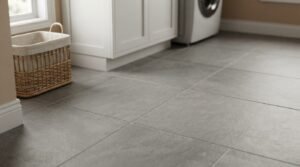
- Porcelain tiles: The most popular choice for laundry floors. Porcelain is dense, non-porous, highly durable, and available in a wide range of sizes, finishes, and colours. Rectified porcelain tiles with a matte or textured finish provide excellent slip resistance.
- Ceramic tiles: A cost-effective alternative to porcelain. Ceramic tiles are suitable for laundry floors but are less dense and more prone to chipping than porcelain. Best suited to lower-traffic laundries.
- Luxury vinyl plank (LVP): A waterproof, resilient flooring option that is warmer underfoot than tiles and easier to install. Modern LVP products are highly durable and available in realistic timber and stone finishes. Not suitable for areas with direct water pooling.
- Polished concrete: A premium option for contemporary laundries. Polished concrete is durable and easy to clean but requires sealing to prevent water absorption and staining.
Tile Selection: Practical and Aesthetic Considerations
When selecting tiles for a laundry renovation, the key practical considerations are:
- Slip resistance rating (R-rating): Laundry floor tiles need a minimum R10 slip resistance rating; R11 is recommended for wet areas with frequent water exposure
- Tile format: Larger format tiles (600x600mm or 600x1200mm) create a cleaner, more contemporary look and require fewer grout lines; smaller tiles (300x300mm) are easier to install on uneven floors
- Grout selection: Epoxy grout is more stain-resistant and easier to clean than cement-based grout; recommended for laundry floors and wet area walls
For homeowners working through a laundry tile selection guide focused specifically on format sizes, finishes, grout options, and where to source quality tiles in Sydney, the key decision points are slip resistance, format size, and grout type, in that order of priority.
Selecting the right floor material for a wet area requires balancing durability, slip resistance, waterproofing, and aesthetics, and the right choice depends as much on how the space is used as on how it looks.
Which Trades Do You Need for a Laundry Renovation?
A laundry renovation is a multi-trade project. Understanding which licensed tradespeople are required, what each one does, and how their work must be sequenced is essential for managing the renovation efficiently and avoiding costly mistakes.
Plumber, Electrician, Tiler, and Carpenter Roles
- Plumber: Required for all work involving water supply, waste connections, and drainage. This includes installing or relocating the trough or sink, connecting appliances, and completing any rough-in plumbing work. All plumbing work in NSW must be completed by a licensed plumber.
- Electrician: Required for power point installation, lighting upgrades, appliance circuit connections, and any switchboard work. All electrical work in NSW must be completed by a licensed electrician.
- Waterproofer: Required for the application of waterproofing membranes in wet areas. In NSW, waterproofing must comply with AS 3740 and must be completed by a licensed waterproofer. This work must be inspected and signed off before tiling begins.
- Tiler: Required for the installation of floor and wall tiles. A skilled tiler prepares the substrate, applies adhesive, and grouts and seals the finished tiling. Tiling quality has a significant impact on the final appearance and durability of the renovation.
- Carpenter or cabinet maker: Required for the installation of cabinetry, benchtops, and any custom joinery. Flat-pack cabinet installation is completed by a skilled handyperson in many cases; custom joinery installation requires a qualified carpenter or cabinet maker.
- Builder or renovation contractor: For full structural renovations involving wall removal, floor penetrations, or significant layout changes, a licensed builder is required to oversee and coordinate the project.
Trade Coordination and Project Management
The sequence in which trades complete their work is critical. The correct order for a laundry renovation is:
- Demolition and strip-out
- Rough-in plumbing and electrical
- Waterproofing (inspection required before proceeding)
- Tiling (floor and walls)
- Cabinetry and benchtop installation
- Fixture and tapware installation
- Final electrical connections and commissioning
- Painting and finishing
Disrupting this sequence, for example, installing cabinetry before tiling is complete, creates rework, delays, and additional cost. A licensed renovation contractor in Sydney who manages trade coordination reduces this risk significantly.
When obtaining quotes, it pays to request a written scope of work from each contractor that specifies which trades they supply, which the homeowner sources independently, and what the payment schedule looks like. Comparing quotes on scope, not just on price, is the most reliable way to identify the best value. Verifying a contractor’s licence through NSW Fair Trading’s licence check takes two minutes and eliminates the most common source of renovation disputes.
Does a Laundry Renovation Add Value to Your Property?
A well-executed laundry renovation delivers measurable returns both in terms of daily liveability and long-term property value. For owner-occupiers, the primary return is functional: a better-organised, more efficient space that makes everyday tasks easier. For property investors, the return is financial: increased rental appeal, reduced vacancy, and improved resale value.
ROI Benchmarks for Laundry Renovations in Sydney
Laundry renovations are not typically cited as standalone value-adding projects in the same way that kitchen and bathroom renovations are. However, a dated, poorly functioning laundry is a known detractor in property appraisals and rental assessments. Upgrading a laundry from entry-level to mid-range standard improves a property’s overall presentation and supports a stronger sale or rental outcome.
According to CoreLogic’s 2024 Renovation Value Report, properties with recently renovated utility spaces including laundries achieve sale prices between 3% and 8% higher than comparable unrenovated properties in the same suburb, depending on the overall renovation quality and market conditions.
For investment properties, understanding laundry renovation ROI for investment properties is essential when evaluating a mid-range laundry renovation costing $12,000 to $18,000, which supports a rental increase of $20 to $50 per week in Sydney’s competitive rental market, delivering a payback period of four to eight years on the renovation spend alone before accounting for capital value uplift.
Upgrades That Add the Most Value
The upgrades that deliver the strongest return in a laundry renovation are:
- Cabinetry and storage: Buyers and tenants consistently rate storage as a top priority; well-designed cabinetry has a strong impact on perceived value
- Trough or sink replacement: A modern, clean fixture significantly improves the room’s presentation at low relative cost
- Flooring: New tiles or quality vinyl plank flooring transforms the visual quality of the space and signals a well-maintained property
- Lighting: Improved lighting makes the space feel larger and more functional; a relatively low-cost upgrade with high visual impact
Understanding which upgrades deliver the strongest financial return requires looking at the renovation through the lens of the buyer or tenant, and in Sydney’s market, storage, presentation, and condition consistently outrank cosmetic style choices in purchase and rental decisions.

Common Laundry Renovation Mistakes (and How to Avoid Them)
Even well-intentioned laundry renovations go wrong when planning is rushed, budgets are underestimated, or design decisions are made without considering the practical realities of the space. Understanding the most common mistakes and how to avoid them is one of the most valuable things a homeowner can do before the renovation begins.
Planning and Budget Mistakes
- Underestimating the total cost: The most common mistake in laundry renovations is budgeting only for visible costs tiles, cabinets, and fixtures without accounting for labour, waterproofing, plumbing, electrical, and contingency. A realistic budget includes all trade costs and a 10 to 15 percent contingency allowance.
- Skipping the planning stage: Proceeding directly to purchasing materials or engaging trades without a clear scope of work, layout plan, and trade schedule leads to scope creep, rework, and budget blowouts. Investing time in planning before spending money on execution is the single most reliable way to protect the budget.
- Not confirming approval requirements: Commencing work that requires a CDC or DA without obtaining the necessary approval creates legal liability and results in orders to demolish non-compliant work in the worst cases. Confirming approval obligations before work begins is non-negotiable.
- Choosing the cheapest quote without checking credentials: The lowest quote is rarely the best value. Unlicensed or underqualified tradespeople create compliance risks, quality failures, and warranty voids that cost significantly more to rectify than the initial saving.
Design and Layout Errors
- Ignoring workflow: A laundry that looks good but does not function well is a failed renovation. Designing the layout around how the space is actually used, where sorting, washing, drying, folding, and storing happen, must come before any aesthetic decisions.
- Undersizing storage: Insufficient storage is the most frequently cited complaint in completed laundry renovations. Designing for more storage than seems necessary is always the right call; the cost difference between adequate and generous storage is relatively small.
- Selecting the wrong tile finish: Glossy tiles on laundry floors are a safety hazard when wet. A minimum R10 slip resistance rating for floor tiles in wet areas is the standard; R11 is better.
- Positioning appliance connections incorrectly: Washing machine and dryer connections must be positioned before tiling begins. Moving them after tiling is complete requires tile removal, additional plumbing work, and retiling a costly and entirely avoidable mistake.
- Neglecting ventilation: A laundry without adequate ventilation accumulates moisture, leading to mould growth, paint failure, and structural damage over time. A properly sized exhaust fan rated for the volume of the space, typically 10 air changes per hour for a standard laundry, is a mandatory inclusion in any renovation that involves a wet area. Where a window is present, cross-ventilation supplements mechanical extraction and reduces the load on the fan. Neglecting ventilation is one of the few renovation mistakes that creates ongoing structural damage rather than just a cosmetic problem.
Real Sydney projects where smart planning, material selection, and trade coordination delivered outstanding results demonstrate that the difference between a renovation that works and one that disappoints almost always comes down to decisions made in the planning stage, not on the tools.
Conclusion
A laundry renovation brings together planning, budgeting, design, trade coordination, and material selection into a single project that transforms one of a home’s most functional spaces. Every decision from layout and cabinetry to flooring and fixtures shapes the long-term performance and value of the result.
The guidance throughout this resource covers every dimension of the renovation process, from the first scope decision through to trade sequencing, material selection, and compliance. The detail in each section is designed to give homeowners, renovators, and investors the information they need to make confident decisions at every stage.
At Sydney Home Renovation, we deliver end-to-end laundry renovation in Sydney from initial design consultation and cost planning through to trade coordination, quality finishes, and project handover. We are ready to help plan, budget, and build a laundry renovation that delivers quality results, stays on schedule, and adds lasting value to the home.
Frequently Asked Questions
How much does a laundry renovation cost in Sydney?
Laundry renovation costs in Sydney range from $5,000 to $10,000 for an entry-level cosmetic refresh, $10,000 to $20,000 for a full mid-range fitout, and $20,000 to $35,000 or more for a premium renovation with custom joinery and structural changes.
Do I need council approval for a laundry renovation in Sydney?
Most cosmetic laundry renovations in Sydney fall under exempt development and require no formal approval. Renovations involving structural changes, plumbing relocation, or work in strata properties require a Complying Development Certificate or Development Application.
How long does a laundry renovation take?
A cosmetic laundry renovation typically takes one to two weeks from trade commencement. A full structural renovation involving plumbing, waterproofing, tiling, and cabinetry generally takes three to five weeks depending on scope and trade availability.
What trades do I need for a laundry renovation?
A laundry renovation typically requires a plumber, electrician, waterproofer, tiler, and carpenter or cabinet maker. For structural renovations involving wall removal or layout changes, a licensed builder is also required to oversee the project.
What is the best flooring for a laundry room?
Porcelain tiles with a matte or textured finish and a minimum R10 slip resistance rating are the most popular and practical choice for laundry floors in Sydney. Luxury vinyl plank is a warmer, cost-effective alternative for lower-traffic laundries.
Does a laundry renovation add value to a property?
Yes. A well-executed laundry renovation improves a property’s overall presentation and supports stronger sale and rental outcomes. Mid-range laundry renovations in Sydney support rental increases of $20 to $50 per week and contribute to capital value uplift of 3 to 8 percent in comparable property assessments.
What is the difference between a laundry trough and a laundry sink?
A laundry trough is a deep, utility-grade basin designed for heavy-duty tasks like soaking and cleaning. A laundry sink is shallower and more aesthetically refined, better suited to laundries where appearance is a priority or space is limited.
Do I need to waterproof my laundry?
Yes. Any laundry renovation involving a wet area requires waterproofing to AS 3740 standard, completed by a licensed waterproofer. The waterproofing must be inspected and signed off before tiling begins.
What is the best benchtop material for a laundry?
Quality laminate is the most practical and cost-effective choice for most laundry renovations. Engineered stone is the premium option, offering excellent durability and stain resistance at a higher price point.


