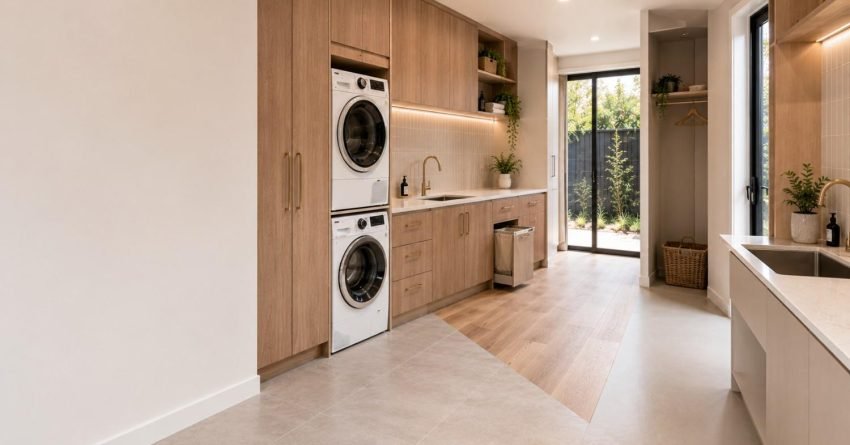
The three strongest laundry flooring options for Sydney homes are porcelain tiles, luxury vinyl, and waterproof hybrid floors like SPC. Each balances moisture resistance, durability, and budget differently, so the right choice depends on how hard your laundry works and how long you want the floor to last.
Laundries are small, high-moisture rooms that take constant punishment from spills, footfall, heavy appliances, and humidity. Choosing the wrong floor leads to lifting, swelling, mould, or costly early replacement.
This guide compares tile, vinyl, and waterproof flooring across cost, durability, slip resistance, and installation, so you can match the right material to your laundry and budget.
Why Laundry Flooring Choice Matters in Sydney Homes
Laundry floors face conditions almost no other room deals with daily. Constant water exposure from washing machines, detergent spills, damp linen baskets, and humidity from dryers all stress the surface continuously.
Every flooring decision in a laundry connects to layout, drainage, and appliance placement; getting the material right from the start means every other renovation decision builds on a solid foundation.
Moisture, Spills, and Daily Wear
Laundry flooring must handle pooled water, dropped pegs, dragged baskets, and the weight of a fully loaded front-loader. Materials rated for wet areas resist swelling, warping, and grout failure far better than standard living-area floors.
That daily punishment adds up fast. A floor that performs well under those conditions for 20 years is a fundamentally different investment than one that starts failing at year seven.
Resale Value and Long-Term Cost
A laundry floor that lasts 20 years costs less per year than one replaced every 7. Buyers in Sydney’s competitive market also notice quality finishes in service areas, especially in apartments and townhouses where the laundry doubles as a utility hub.
Tile Flooring for Laundries
Tiles remain the most specified laundry flooring in Australia for one reason: they are virtually impervious to water when installed correctly over proper waterproofing membranes.
Porcelain vs Ceramic Tiles
Porcelain tiles are denser, less porous, and harder-wearing than ceramic. For a laundry, porcelain is the safer pick because it absorbs less than 0.5% moisture and resists chipping from dropped items.
Ceramic is cheaper but better suited to walls and lower-traffic areas. In a wet zone that takes daily punishment, the density difference between porcelain and ceramic matters more than the price gap.
Pros, Cons, and Cost Range
Porcelain tiles offer a fully waterproof surface, a 25+ year lifespan, heat resistance, easy cleaning, a wide design range, and compatibility with underfloor heating systems. The trade-offs are real: tiles are cold underfoot, unforgiving on dropped glassware, and require grout sealing every few years.
Installation labour is the highest of the three options. Tile supply typically runs $30 to $90 per square metre, with laying labour adding $45 to $75 per square metre in Sydney. Waterproofing membrane and screed preparation add further cost on top of those figures.
Best Tile Use Cases
Tiles suit owner-occupied homes planning to stay long term, properties with floor wastes, and renovations where the laundry connects to a bathroom or external drying area. The same porcelain products used in bathrooms perform equally well in laundries; slip ratings, sizing, and grout type all carry across directly.
For small laundries under 5 square metres, larger-format tiles (600×600mm or 600×300mm) reduce grout line frequency and make the space read as larger. Tiles also pair well with electric underfloor heating mats, which sit between the membrane and the tile bed a combination vinyl and hybrid floors cannot match.
Vinyl Flooring for Laundries
Vinyl is the most cost-effective laundry flooring and has improved dramatically over the last decade. Modern vinyl is quiet, warm, and far more water-tolerant than older versions.
Sheet Vinyl, Vinyl Plank, and LVT
Sheet vinyl comes in one continuous piece with no seams, making it the most leak-resistant vinyl format. Vinyl planks click together to mimic timber, while luxury vinyl tiles (LVT) replicate stone or ceramic patterns with realistic texture.
Each format suits a different situation. Sheet vinyl is the safest choice where water pooling is a real risk; LVT and planks suit laundries with good drainage and moderate moisture exposure.
Pros, Cons, and Cost Range
Vinyl is soft underfoot, warm, quiet, low-cost to install, fast to lay, and forgiving on dropped items. The limitations are worth knowing: lower-grade products can be punctured by sharp objects and may discolour under prolonged moisture exposure.
Lifespan typically runs 10 to 20 years depending on wear layer thickness and traffic. Vinyl supply ranges from $25 to $70 per square metre for quality products, with installation around $25 to $50 per square metre the most affordable installed cost of the three options.
Best Vinyl Use Cases
Vinyl suits rental properties, investor renovations, budget-conscious owner-occupiers, and laundries where comfort underfoot matters. The key decision within the vinyl category is wear layer thickness; a 0.5mm wear layer handles light residential traffic, while 0.7mm or above is the right call for a laundry that sees heavy daily use.

Waterproof Flooring Solutions (SPC, WPC, Hybrid)
Waterproof hybrid flooring is the newest category and combines the look of timber with the wet-area performance of vinyl. The two main types are SPC (stone-plastic composite) and WPC (wood-plastic composite).
How Waterproof Flooring Works
SPC uses a rigid limestone-based core that cannot swell when wet. WPC uses a softer wood-polymer core that feels warmer underfoot but is slightly less impact-resistant. Both lock together with a click system over a sealed subfloor.
Even a fully waterproof core relies on a properly sealed substrate underneath. Australian Standard AS 3740 governs wet area waterproofing in laundries; it requires a compliant membrane around floor wastes, at wall junctions, and wherever plumbing penetrates the slab. That membrane requirement applies regardless of which floor product sits on top.
Pros, Cons, and Cost Range
Hybrid flooring offers a 100% waterproof core, dimensional stability, realistic timber or stone aesthetics, floating installation, and no grout lines to maintain. Quality products carry a 20+ year wear layer. The trade-offs: hybrid costs more than vinyl, the click joins are water-resistant but not seamless, and the surface is firmer underfoot than vinyl.
Hybrid flooring supply typically costs $55 to $110 per square metre, with installation around $30 to $50 per square metre. That positions it between vinyl and tiles on total installed cost.
Best Waterproof Use Cases
Hybrid suits homeowners who want timber aesthetics in a wet zone, open-plan laundries that flow into kitchens or living areas, and renovations seeking a long lifespan without tiling labour costs.
Comparing Tiles vs Vinyl vs Waterproof Flooring
| Factor | Porcelain Tiles | Vinyl (Plank/Sheet/LVT) | Waterproof Hybrid (SPC/WPC) |
| Supply cost (per m²) | $30–$90 | $25–$70 | $55–$110 |
| Install cost (per m²) | $45–$75 | $25–$50 | $30–$50 |
| Lifespan | 25+ years | 10–20 years | 20+ years |
| Waterproof rating | Excellent | Very good | Excellent |
| Slip resistance | High (with correct rating) | Medium-high | Medium |
| Comfort underfoot | Hard, cold | Soft, warm | Firm, moderate warmth |
| Underfloor heating | Compatible | Not compatible | Not compatible |
| Resale appeal | High | Medium | High |
Cleaning and Maintenance by Material Type
Long-term satisfaction with a laundry floor depends as much on maintenance requirements as on upfront cost. Each material has a different upkeep profile.
Porcelain tiles are the easiest surface to clean; a damp mop handles most spills, and the tile face itself never needs sealing. Grout is the maintenance point: unsealed grout absorbs detergent residue and moisture over time, leading to staining and eventually grout failure. We recommend sealing grout lines at installation and resealing every two to three years in a laundry environment.
Vinyl requires almost no maintenance beyond regular sweeping and damp mopping. Avoid abrasive cleaners and steam mops, which can lift the wear layer on lower-grade products. Sheet vinyl’s seamless surface means there are no joints for detergent or water to penetrate, which makes it the lowest-maintenance format in the vinyl category.
Hybrid flooring is similarly low-maintenance: no grout, no sealing, and the rigid core means spills sit on the surface rather than penetrating. The click joints are the one area to watch: standing water left in the joints over extended periods can eventually work its way to the subfloor if the substrate waterproofing is not fully compliant. Wipe spills promptly, and the floor will perform for decades.
Key Factors When Choosing Laundry Flooring
The best material depends on more than upfront cost. Five factors shape long-term satisfaction with a laundry floor.
Waterproof Rating and Subfloor Prep
Tile installations need a fully compliant waterproof membrane for wet areas underneath; AS 3740 sets the minimum standard, and skipping it voids most tile warranties. Vinyl and hybrid floors need a perfectly level, dry, clean subfloor: most manufacturers specify a maximum deviation of 3mm over 1.8 metres.
Subfloor preparation is the single biggest source of premature floor failure across all three material types. A moisture test before installation is standard practice on concrete slabs, and any reading above the manufacturer’s threshold requires a moisture barrier before laying begins. Budget for levelling compound if your existing subfloor has high spots or dips; it is far cheaper to fix before installation than after.
Slip Resistance and Safety
Wet laundry floors are genuine slip hazards. In Australia, slip resistance is measured using two systems: the R-rating (ramp test, used for tiles) and the P-rating (pendulum test, used for smooth surfaces). Tiles should carry a minimum R10 rating for a laundry, with R11 preferred where the floor is regularly wet underfoot.
For vinyl and hybrid, look for a textured wear layer and a P-rating of P4 or above on the product specification sheet. Polished or high-gloss finishes in any material reduce grip significantly when wet; matte and textured surfaces are the safer choice for a laundry regardless of material type.
Installation Complexity and Labour
Tiles require the most skilled labour, including a licensed waterproofer and a tiler working in sequence. That two-trade requirement adds time and cost. Vinyl and hybrid can often be installed in a single day by a flooring contractor, with no waterproofing trade required if the subfloor membrane is already compliant.
Labour is typically the largest line item in any laundry flooring quote. Always request itemised quotes that separate waterproofing, levelling, supply, and installation; it makes comparing quotes across contractors far more straightforward.
Budget Allocation and Hidden Costs
Hidden costs include floor levelling, removal of existing flooring, waste disposal, skirting replacement, and door undercuts. These line items are rarely included in a per-square-metre supply price and can add $300 to $800 to a small laundry job depending on the existing conditions.
Getting flooring costs into a realistic renovation budget means accounting for every trade, not just the floor itself. A detailed budget that separates waterproofing, levelling, supply, installation, and finishing gives you a far more accurate picture of total project cost before work begins.
Underfloor Heating Compatibility
This is a factor most laundry flooring guides skip, but it matters for Sydney homes with tiled laundries. Electric underfloor heating mats install between the waterproof membrane and the tile bed, adding warmth to what is otherwise the coldest floor type. Porcelain tiles conduct and hold heat efficiently, making them the best-performing surface over a heating mat.
Vinyl and hybrid flooring are generally not compatible with underfloor heating; the heat can cause expansion, joint failure, and in some products, off-gassing from adhesives. If underfloor heating is part of your laundry plan, tiles are the only material that supports it reliably.
Laundry Flooring Installation Costs in Sydney
For a typical Sydney laundry of 4 to 6 square metres, expect total installed costs of approximately $700 to $1,600 for quality vinyl, $1,200 to $2,400 for hybrid waterproof flooring, and $1,500 to $3,500 for porcelain tiling including waterproofing.
Those ranges reflect supply, installation labour, and basic waterproofing. They do not include floor levelling, removal of existing flooring, or waste disposal, which together can add $400 to $900 on a small laundry depending on existing conditions. Larger laundries, custom tile patterns, complex cuts around cabinetry, and significant subfloor remediation push pricing toward the top of each range.
Per-trade labour rates in Sydney currently run at $65 to $95 per hour for licensed tilers and waterproofers, and $45 to $70 per hour for vinyl and hybrid flooring contractors. A full laundry renovation cost breakdown that separates each trade gives you the clearest picture of where your budget is going before you commit to a material.
Conclusion
Tiles, vinyl, and waterproof hybrid each solve the laundry floor problem in a different way, balancing cost, comfort, and lifespan against how hard the room is used every week. The right choice comes from matching your budget, design intent, and time horizon to the strengths of each material, not from defaulting to the cheapest or most familiar option.
Maintenance requirements, subfloor condition, slip ratings, and underfloor heating compatibility all shape the decision as much as the upfront price. Getting those factors right at the planning stage prevents the costly mistakes that come from choosing on price alone.
At Sydney Home Renovation, we help Sydney homeowners make that decision with confidence, combining honest cost guidance, compliant installation, and skilled tradespeople so your laundry floor performs exactly as it should for decades to come. Get in touch to discuss your project.
Frequently Asked Questions
What is the best flooring for a laundry room in Australia?
Porcelain tiles lead on longevity and waterproofing. Waterproof hybrid flooring matches that durability with a warmer, timber-look finish. Vinyl is the best value option for budget-conscious renovators.
Is vinyl flooring suitable for laundries?
Yes. Quality vinyl resists moisture, is soft underfoot, and installs quickly. Sheet vinyl is the most leak-resistant format because its seamless surface leaves no joints for water to penetrate.
Does laundry flooring need waterproofing underneath?
Yes. Australian Standard AS 3740 requires waterproofing in laundries around floor wastes, wall junctions, and appliance connections regardless of whether you install tiles, vinyl, or hybrid flooring.
How much does it cost to re-floor a laundry in Sydney?
A typical 4 to 6 square metre Sydney laundry costs around $700 to $1,600 for vinyl, $1,200 to $2,400 for hybrid, and $1,500 to $3,500 for tiles installed, including basic prep and waterproofing.
Can you put waterproof hybrid flooring in a wet laundry?
Yes. SPC and WPC hybrid floors have fully waterproof cores designed for wet areas. The subfloor must still be waterproofed to AS 3740 and all plumbing penetrations sealed correctly.
What slip rating should laundry tiles have?
Laundry tiles should carry a minimum R10 slip resistance rating, with R11 preferred. Matte and textured finishes provide better grip than polished surfaces when the floor is wet.
How long does laundry flooring last?
Porcelain tiles typically last 25 years or more. Waterproof hybrid floors last 20-plus years. Quality vinyl lasts 10 to 20 years depending on wear layer thickness, traffic, and care.