A small laundry renovation can completely transform one of the hardest-working rooms in your home. In Sydney, a well-planned laundry upgrade typically costs between $8,000 and $20,000 depending on scope, finishes, and whether plumbing needs to move. The return is real: functional storage, durable finishes, and a space that actually works for your household.
For homeowners and property investors, getting the laundry right matters more than most people expect. A poorly planned laundry creates daily frustration, while a smart renovation adds genuine liveability and long-term property value. This guide covers layout ideas, storage solutions, benchtop and splashback options, flooring, appliance selection, plumbing considerations, and a clear breakdown of what a small laundry renovation actually costs in Sydney.
Why Small Laundry Renovations Are Worth the Investment
The laundry is often the last room homeowners think about renovating, and the first one buyers notice when it’s done poorly. In Sydney’s competitive property market, a functional, well-finished laundry signals quality throughout the home. A renovated laundry improves daily workflow, reduces clutter, and creates a space that handles the real demands of household life.
Small laundry renovations are also among the most cost-effective upgrades you can make. Because the footprint is compact, you’re working with less material, shorter labour hours, and a tighter scope, which means a well-managed renovation delivers strong value relative to spend.
How a Laundry Renovation Adds Value to Your Sydney Home
In Sydney’s property market, buyers and renters increasingly expect a laundry that functions as a proper utility room, not just a cupboard with a washing machine shoved in it. A renovated laundry with built-in cabinetry, a stone or laminate benchtop, quality tapware, and durable flooring reads as a finished, considered space. That perception translates directly into buyer confidence and rental appeal.
For property investors, a laundry renovation is one of the lower-cost upgrades that consistently improves rental yield and tenant retention. Tenants in Sydney’s competitive rental market actively compare laundry quality, and a well-finished utility room reduces vacancy periods and supports higher asking rents. For owner-occupiers, the daily quality-of-life improvement is immediate: organised storage, a proper folding bench, and a clean, waterproof finish make a genuine difference to how the room functions every single day.
What a Realistic Budget Looks Like for a Small Laundry Renovation
A realistic budget for a small laundry renovation in Sydney sits between $8,000 and $20,000 for a full renovation, covering demolition, plumbing, electrical, tiling, cabinetry, benchtop, tapware, and appliance connections. Basic cosmetic refreshes (new paint, shelving, tapware swap) can come in under $3,000 to $5,000. Mid-range renovations with new cabinetry, tiling, and a benchtop typically land between $8,000 and $14,000. High-end finishes, plumbing relocation, or a combined laundry-bathroom configuration push costs toward $18,000 to $25,000 or beyond.
The key variables are whether plumbing moves, what cabinetry and benchtop materials you choose, and the condition of the existing space. We break all of this down in detail throughout this guide.
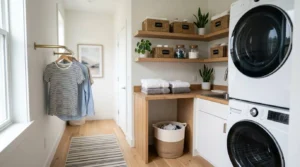
Smart Layout Ideas for Small Laundry Rooms
Layout is the foundation of every successful small laundry renovation. Get the layout right and everything else storage, workflow, appliance placement falls into place. Get it wrong, and no amount of beautiful tiling will fix the daily frustration of a space that doesn’t function.
In small laundries, the goal is to maximise every linear metre of wall space while keeping the workflow logical: dirty clothes in, washed, dried, folded, stored. The four most practical layouts for compact Sydney laundries are stacked configurations, side-by-side arrangements, nook or cupboard conversions, and combined laundry-bathroom configurations.
Stacked Washer and Dryer Configurations
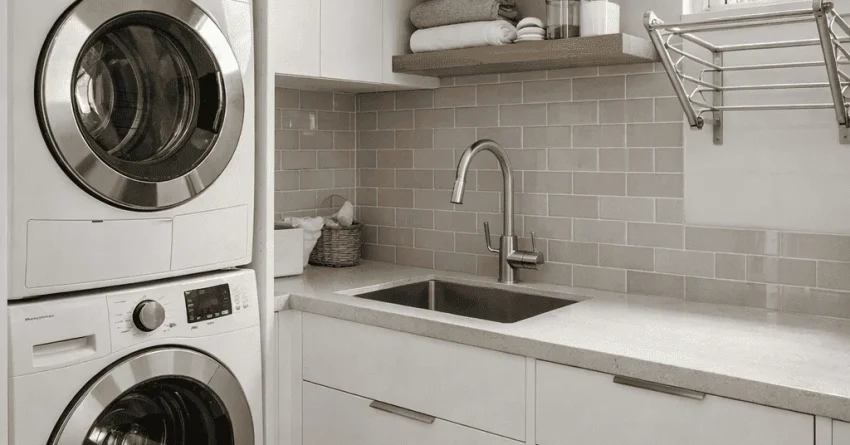
Stacking your washer and dryer is the single most effective way to reclaim floor space in a small laundry. A standard front-loader washing machine and matching dryer stacked vertically occupy roughly 600mm of floor width, freeing up the remaining wall space for cabinetry, a benchtop, or a linen storage tower.
This configuration works particularly well in narrow laundries, hallway laundries, and combined bathroom-laundry spaces common in Sydney apartments and older terrace homes. The trade-off is ergonomics: loading and unloading a top-mounted dryer requires reaching overhead, which some households find inconvenient. A stacking kit from your appliance manufacturer keeps the units secure and is a non-negotiable safety requirement.
Stacking is almost always the right call for a Sydney apartment or a home with a narrow utility corridor. It opens up enough space to include a proper benchtop and storage, turning a cramped cupboard into a functional room.
Side-by-Side Laundry Layouts with Built-In Storage
Where floor space allows, a side-by-side layout washer and dryer positioned next to each other creates the opportunity for a continuous benchtop above both appliances. This is one of the most practical and popular configurations in Sydney home renovations because it delivers a full-width folding surface, integrated cabinetry above and below, and a clean, built-in aesthetic.
A standard side-by-side configuration requires a minimum of 1,200mm to 1,400mm of wall width. In a laundry with 1,800mm or more, you can add a tall storage tower or linen cupboard alongside the appliances without the space feeling cramped.
The benchtop above the appliances is one of the highest-value elements in this layout. A 600mm-deep stone, laminate, or engineered stone benchtop gives you a proper folding and sorting surface, something most small laundries lack entirely.
Laundry Nook and Cupboard Conversions
Many Sydney homes, particularly terrace houses, semi-detached homes, and older brick homes, have laundry facilities tucked into a hallway cupboard, under a staircase, or in a narrow nook off the kitchen. These spaces are often underutilised and poorly finished, but they’re excellent candidates for a laundry nook conversion.
A laundry nook conversion typically involves installing a stacked washer-dryer unit, a compact benchtop, overhead cabinetry, and proper waterproofing and ventilation. The result is a fully functional laundry in a footprint as small as 900mm wide by 600mm deep.
The critical considerations for nook conversions are ventilation (dryers need adequate airflow or a condenser/heat pump model), waterproofing (even a small water leak in a cupboard can cause significant structural damage), and electrical compliance (a dedicated circuit for the washing machine is a standard requirement under Australian wiring rules). A licensed renovation contractor manages all of these requirements as part of the scope.
Combined Laundry and Bathroom Renovations
A combined laundry-bathroom renovation is one of the most space-efficient solutions for Sydney apartments, terrace homes, and older properties where separate rooms aren’t feasible. By integrating the laundry into the bathroom footprint, you gain a fully functional utility space without sacrificing a dedicated room.
The key design challenge is separating wet zones from the laundry appliances and ensuring waterproofing covers the entire floor area. A full-height tiled wet room with a floor waste, a concealed washer-dryer behind a joinery panel, and a wall-hung vanity is the most popular configuration in Sydney combined renovations. Costs for a combined laundry-bathroom renovation typically sit at the higher end of the renovation range, between $18,000 and $30,000, reflecting the additional plumbing, waterproofing, and joinery complexity.
Storage Solutions That Maximise a Small Laundry Space
Storage is where most small laundry renovations either succeed or fall short. In a compact space, every centimetre of wall height and every unused corner is an opportunity. The best small laundry storage solutions are built-in, purpose-designed, and integrated into the renovation from the start, not added as an afterthought.
The goal is to create a system where everything has a place: detergent, cleaning products, linen, ironing equipment, and laundry baskets.
Overhead Cabinetry and Floating Shelves
Overhead cabinetry is the most effective storage upgrade in a small laundry renovation. Cabinets installed above the washer, dryer, and benchtop utilise wall height that would otherwise go to waste, and in a small room, that vertical space is genuinely valuable.
Standard overhead laundry cabinets are typically 300mm to 400mm deep and can be built to ceiling height to maximise storage volume. Soft-close hinges, moisture-resistant board (MR board or similar), and a durable laminate or painted finish are the standard specifications for laundry cabinetry in Sydney renovations. These materials handle the humidity and temperature fluctuations that laundry rooms experience better than standard kitchen-grade materials.
Floating shelves are a lower-cost alternative to full cabinetry and work well for open storage of frequently used items: detergent, fabric softener, and cleaning products. The trade-off is that open shelves accumulate dust and require more active tidying. For most homeowners, a combination of closed overhead cabinets and one or two open shelves strikes the right balance.
Pull-Out Drawers, Laundry Hampers, and Hidden Storage
Below-bench storage in a small laundry is where clever joinery makes a real difference. Pull-out laundry hampers, built into the cabinetry below the benchtop, eliminate the need for freestanding laundry baskets that take up precious floor space. A double-hamper configuration (one for lights, one for darks) is a practical and popular choice in Sydney laundry renovations.
Pull-out drawers below the benchtop provide organised storage for ironing accessories, cleaning cloths, and small appliances. Deep drawers with full-extension runners are more functional than standard hinged doors in tight spaces because they allow full access to the contents without requiring you to crouch or reach awkwardly.
Toe-kick drawers, shallow drawers built into the kick space at the base of the cabinetry, are a clever way to add storage for flat items like spare linen or ironing board covers. They’re a detail that experienced renovation joiners include as standard in well-designed laundry cabinetry.
Wall-Mounted Drying Racks and Fold-Down Ironing Boards
In a small laundry, floor space is too valuable to dedicate to a freestanding drying rack or ironing board. Wall-mounted alternatives solve this problem cleanly.
A retractable wall-mounted drying rack folds flat against the wall when not in use and extends to provide multiple drying rails when needed. Quality stainless steel models are durable, rust-resistant, and hold a substantial load of wet laundry, making them particularly useful in Sydney apartments and homes without outdoor drying space.
A fold-down ironing board mounted to the wall or integrated into a cabinet door is one of the most practical space-saving additions in a small laundry renovation. When folded away, it’s completely invisible; when open, it provides a full-size ironing surface at the correct working height. These units are available as standalone wall-mount fixtures or as integrated cabinet inserts, with the latter being the more polished, renovation-grade option.
Choosing the Right Appliances for a Small Laundry
Appliance selection is one of the most consequential decisions in a small laundry renovation, yet it’s often left until after the cabinetry is designed. Getting the appliance dimensions and power requirements confirmed before joinery is ordered avoids costly rework.
Front-Loader vs Top-Loader Washing Machines
Front-loader washing machines are the standard choice for small laundry renovations in Sydney. They’re designed to be stacked with a matching dryer; they fit neatly under a benchtop in a side-by-side configuration, and they use significantly less water and energy than top-loaders. Standard front-loaders are 600mm wide, 600mm deep, and 850mm tall, which aligns with standard cabinetry dimensions.
Top-loader washing machines require clear overhead access for the lid, which rules out stacking and limits benchtop placement. In a small laundry, this is a significant constraint. Top-loaders are generally better suited to larger laundry rooms where floor space is not the primary concern.
For most Sydney small laundry renovations, a 7kg to 10kg front-loader is the right capacity. Larger drums (12kg+) are available but add depth and weight that can complicate installation in tight spaces.
Dryer Types and Heat Pump Efficiency
The three main dryer types for small laundries are vented, condenser, and heat pump. Vented dryers are the lowest-cost option but require an external duct for exhaust, which is not always feasible in apartments or enclosed nooks. Condenser dryers collect moisture in a reservoir (no external duct required) but are less energy-efficient than heat pump models.
Heat pump dryers are the premium choice and the fastest-growing category in Australian laundry renovations. They use significantly less electricity than vented or condenser models, operate at lower temperatures (which is gentler on fabrics), and require no external ducting. The upfront cost is higher, typically $1,200 to $2,500, but the running cost savings are substantial over the appliance’s lifespan. For a small laundry in a Sydney apartment where ducting is not practical, a heat pump dryer is the most sensible long-term investment.
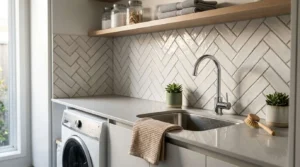
Benchtop and Splashback Ideas for Small Laundries
The benchtop and splashback are the two most visually prominent elements in a small laundry renovation, and they’re also the elements that most directly affect how the room functions day to day. Choosing the right materials means balancing durability, water resistance, maintenance requirements, and budget.
Choosing the Right Benchtop Material for a Laundry
Laundry benchtops are exposed to water, cleaning chemicals, heat from dryers, and the general wear of daily use. The material you choose needs to handle all of that without deteriorating quickly.
Laminate is the most common benchtop material in laundry renovations across Sydney. It’s cost-effective (typically $150 to $400 per linear metre installed), available in a wide range of colours and finishes, and performs well in wet environments when properly sealed at the edges and joins. Postform laminate, with a rounded front edge and integrated splashback, is a practical, low-maintenance option for budget-conscious renovations.
Engineered stone (such as Caesarstone or Silestone) is the premium choice for laundry benchtops. It’s non-porous, highly durable, and delivers a high-end aesthetic that elevates the entire room. Installed costs typically range from $600 to $1,200 per linear metre depending on the stone selected and the complexity of the cut. For homeowners investing in a mid-to-high-range renovation, engineered stone is worth the additional spend.
Solid surface materials (such as Corian) offer seamless, integrated sink options, where the sink and benchtop are formed from a single piece of material with no joins. This is a practical choice for laundries because it eliminates the water ingress risk at the sink-benchtop junction. Costs are comparable to engineered stone.
Timber is occasionally used in laundry benchtops for a warm, natural aesthetic, but it requires careful sealing and ongoing maintenance to resist moisture damage. It’s not the most practical choice for a high-use laundry environment.
Laundry Sinks and Tapware
A dedicated laundry sink is one of the most practical additions in a small laundry renovation. The standard choice is a laundry tub in a 45-litre or 60-litre capacity, either freestanding or integrated into the cabinetry below the benchtop. Undermount sinks, set below the benchtop surface, create a seamless finish and are easier to wipe clean than drop-in models.
Tapware for laundry sinks prioritises function over aesthetics. A mixer tap with a high-arc spout gives you the clearance needed for filling buckets and soaking items. Matte black and brushed nickel finishes are popular in Sydney renovations for their durability and contemporary look. Budget $150 to $500 for quality laundry tapware, with installation included in your plumber’s scope.
Splashback Options That Balance Style and Practicality
The splashback in a small laundry serves a functional purpose first, protecting the wall behind the sink and benchtop from water and splashing, and an aesthetic purpose second. In a small room, the splashback also has a significant visual impact because it occupies a prominent section of wall.
Ceramic and porcelain tiles are the most popular splashback choice in Sydney laundry renovations. They’re waterproof, easy to clean, durable, and available in an enormous range of sizes, colours, and finishes. Subway tiles (75x150mm or 100x200mm) remain a consistently popular choice for their clean, timeless look. Large-format tiles (300x600mm or larger) create a more contemporary aesthetic and have fewer grout lines to maintain. Budget $80 to $250 per square metre for tiles, plus tiling labour.
Glass splashbacks are a sleek, seamless option that works particularly well in small laundries because the reflective surface makes the room feel larger and brighter. They’re available in virtually any colour, are easy to wipe clean, and have no grout lines. Installed costs typically range from $300 to $600 per square metre.
Laminate splashbacks, matching or complementing the benchtop, are a cost-effective option for budget renovations. They’re not as durable as tile or glass in high-moisture environments and require careful installation to prevent water ingress at joins, but they’re a practical choice when budget is the primary constraint.
Flooring and Wall Finish Ideas for Small Laundry Renovations
Flooring and wall finishes in a small laundry need to be waterproof, slip-resistant, durable, and easy to clean. These are non-negotiable functional requirements, but that doesn’t mean you have to sacrifice style. The right material choices deliver both performance and a finish that looks considered and intentional.
Best Flooring Options for Laundry Rooms in Sydney Homes
Porcelain tiles are the gold standard for laundry flooring in Sydney. They’re fully waterproof, extremely durable, slip-resistant when specified with an appropriate surface texture, and available in a wide range of sizes and finishes. A matte or textured surface finish (with a slip rating of P3 or higher for wet areas) is the correct specification for a laundry floor. Porcelain tiles typically cost $60 to $180 per square metre for the tile itself, with tiling labour adding $60 to $120 per square metre depending on tile size and substrate condition.
Vinyl plank flooring (luxury vinyl plank or LVP) is an increasingly popular choice for laundry renovations, particularly in apartments and homes where tiling is not practical or where a warmer aesthetic is preferred. Quality LVP products are 100% waterproof, comfortable underfoot, and significantly faster to install than tiles, which reduces labour costs. They’re available in timber-look finishes that work well in laundries connected to living areas or kitchens. Budget $40 to $100 per square metre for materials, with installation adding $30 to $60 per square metre.
Sheet vinyl is the most budget-friendly waterproof flooring option and is still used in entry-level laundry renovations. It’s seamless (which eliminates water ingress risk at joins), easy to clean, and available in a range of finishes. The trade-off is longevity: sheet vinyl is less durable than porcelain tile or quality LVP and may need replacing sooner.
Avoid timber flooring, laminate flooring, and carpet in laundry rooms. These materials are not waterproof and will deteriorate rapidly in a wet environment.
Wall Tiles, Paint, and Cladding for Laundry Spaces
Above the splashback zone, laundry walls are typically finished with paint, wall tiles, or a cladding product. The right choice depends on your budget, the level of moisture in the space, and the aesthetic you’re aiming for.
Wall tiles extending from floor to ceiling create a fully waterproof, easy-to-clean finish that’s particularly well-suited to laundries with high moisture levels or limited ventilation. Full-height tiling is the premium option and is increasingly popular in Sydney renovations where the laundry is positioned adjacent to a bathroom or in a high-humidity environment.
Moisture-resistant paint (a semi-gloss or satin finish in a bathroom-grade formulation) is the standard finish for laundry walls above the tiled splashback zone. It’s cost-effective, easy to apply, and performs well in moderately humid environments when the room is properly ventilated. Light colours, white, off-white, and soft grey, make small laundries feel larger and brighter.
PVC wall cladding (such as Aquapanel or similar products) is a practical alternative to tiles in budget renovations or in situations where tiling is not feasible. It’s fully waterproof, easy to install, and available in a range of finishes including tile-look patterns. It’s not as durable or as premium-looking as real tiles, but it’s a functional and cost-effective solution.
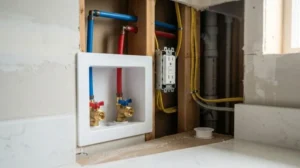
Plumbing and Electrical Considerations for Small Laundry Renovations
Plumbing and electrical work are the two elements of a laundry renovation that most significantly affect both cost and timeline. They’re also the elements that require licensed tradespeople: in New South Wales, all plumbing and electrical work must be carried out by licensed contractors, and relevant compliance certificates must be issued on completion.
Understanding what’s involved before you start planning helps you budget accurately and avoid the most common cost surprises.
Relocating Plumbing in a Small Laundry: What It Costs
Keeping the washer, sink, and tapware in the same position as the existing plumbing keeps costs relatively contained. A plumber will disconnect and reconnect appliances, install new tapware, and connect a new sink, typically a half-day to full-day job costing $400 to $900 in labour, plus materials.
Relocating plumbing, moving the washing machine connection, sink, or waste outlet to a different position, is where costs increase significantly. In Sydney, plumbing relocation in a laundry typically costs $1,500 to $4,000 depending on the distance of the move, the accessibility of existing pipes, and whether the floor or walls need to be opened up to reroute pipework.
In concrete slab homes (common in Sydney’s newer suburbs and apartment buildings), relocating floor waste or waste pipes requires cutting into the slab, a process that adds cost and complexity. In timber-framed homes with a suspended floor, plumbing relocation is generally more straightforward and less expensive. The practical advice is clear: achieve your desired layout without moving plumbing wherever possible, and factor relocation costs into your budget from the start when it’s unavoidable.
Waterproofing Standards and Compliance (AS 3740)
Waterproofing is not optional in a laundry renovation. Under AS 3740 (Waterproofing of Domestic Wet Areas), the floor and lower wall sections of a laundry must be waterproofed before any tiles or finishes are applied. This is a compliance requirement, not a design choice, and it applies to all laundry renovations regardless of scope.
A licensed waterproofer applies a membrane to the floor and wall junctions, which is then inspected and certified before tiling begins. Waterproofing a standard small laundry costs $300 to $600 as part of a full renovation scope. Rectifying failed or inadequate waterproofing in an existing laundry adds $500 to $1,500 to the project cost depending on the extent of the problem.
Skipping or cutting corners on waterproofing is the single most expensive mistake in any wet-area renovation. Water damage behind tiles can go undetected for years and cause significant structural damage to framing, subfloor, and adjacent rooms.
Electrical Upgrades, Lighting, and Ventilation Requirements
A washing machine requires a dedicated 10-amp or 15-amp circuit under Australian wiring rules (AS/NZS 3000). Older Sydney homes without a dedicated circuit need a new circuit run from the switchboard, a job that costs $400 to $800 depending on the distance from the switchboard and the complexity of the run.
A dryer also requires a dedicated circuit. Upgrading from a vented dryer to a heat pump model with different power requirements means your electrician needs to assess and potentially upgrade the circuit before installation.
Lighting in small laundries is often overlooked but makes a significant practical difference. Recessed LED downlights provide even, shadow-free illumination that makes the room easier to work in. Under-cabinet LED strip lighting above the benchtop improves visibility for sorting and folding. Budget $300 to $700 for laundry lighting upgrades including installation.
Ventilation is a compliance requirement in laundries under the National Construction Code. An exhaust fan connected to an external duct is required to manage humidity and prevent mould growth. A laundry with no exhaust fan, or one that vents into the ceiling cavity rather than externally, needs a compliant exhaust fan installation as part of the renovation scope. Budget $200 to $500 for supply and installation.
Laundry Renovation Costs in Sydney: What to Budget For
Cost is the question every homeowner asks first, and it deserves a straight, detailed answer. Laundry renovation costs in Sydney vary significantly based on scope, finishes, and site conditions, but there are reliable benchmarks that help you plan with confidence.
Average Cost of a Small Laundry Renovation in Sydney
| Renovation Tier | Scope | Estimated Cost (Sydney) |
| Cosmetic refresh | New paint, tapware, shelving, minor repairs | $2,000 to $5,000 |
| Mid-range renovation | New cabinetry, benchtop, tiling, tapware, sink | $8,000 to $14,000 |
| Full renovation | All of the above plus new flooring, electrical, plumbing | $12,000 to $20,000 |
| Premium renovation | High-end finishes, plumbing relocation, custom joinery | $18,000 to $30,000+ |
These figures are based on a small laundry footprint of approximately 3 to 6 square metres, typical for Sydney terrace homes, semi-detached homes, and apartments. Larger laundries or combined laundry-bathroom configurations will sit at the higher end of these ranges.
Labour Costs vs. Material Costs: How the Budget Splits
In a typical mid-range small laundry renovation in Sydney, labour accounts for approximately 50% to 60% of the total project cost. This reflects Sydney’s trade labour rates, which are among the highest in Australia.
A rough breakdown for a $12,000 mid-range laundry renovation looks like this:
| Trade / Item | Estimated Cost |
| Demolition and preparation | $500 to $1,000 |
| Plumbing (connections, tapware, sink) | $800 to $1,500 |
| Electrical (circuits, lighting, exhaust fan) | $600 to $1,200 |
| Tiling (floor and splashback) | $1,500 to $3,000 |
| Cabinetry and joinery | $2,500 to $5,000 |
| Benchtop (laminate or stone) | $500 to $1,500 |
| Waterproofing | $300 to $600 |
| Painting | $400 to $800 |
| Appliance connections and finishing | $300 to $600 |
These are indicative figures. Your renovation contractor will provide a detailed, itemised quote based on your specific scope, site conditions, and material selections.
Hidden Costs That Catch Homeowners Off Guard
The most common budget surprises in small laundry renovations fall into a predictable set of categories. Knowing them in advance means you can either budget for them or make design decisions that avoid them.
Waterproofing deficiencies. Inadequate or failed waterproofing must be rectified before new finishes are applied, a non-negotiable compliance requirement under AS 3740. Rectifying failed waterproofing adds $500 to $1,500 to the project cost depending on the extent of the problem.
Asbestos. In Sydney homes built before 1990, asbestos-containing materials may be present in wall sheeting, floor tiles, or ceiling materials. Asbestos identified during demolition must be removed by a licensed asbestos removalist before work can continue. Budget a minimum of $1,500 to $3,000 for asbestos removal.
Structural surprises. Opening walls or floors sometimes reveals unexpected issues: rotted framing from historic water leaks, undersized drainage, or non-compliant previous work that needs rectification. A contingency budget of 10% to 15% of your total renovation cost is the standard recommendation.
Appliance upgrades. A renovation is a natural time to replace end-of-life appliances. Factor appliance costs into your overall budget: a quality front-loader washing machine costs $900 to $2,000, and a heat pump dryer costs $1,200 to $2,500.

How to Plan a Small Laundry Renovation Without Blowing the Budget
The difference between a renovation that stays on budget and one that blows out almost always comes down to planning quality. Homeowners who invest time in clear scope definition, realistic budgeting, and the right contractor selection consistently achieve better outcomes than those who rush into a renovation with a vague brief and an optimistic number in mind.
Setting Priorities: What to Spend On and What to Save On
Not every element of a laundry renovation delivers equal value. Knowing where to invest and where to economise is the skill that separates a well-executed renovation from an expensive one.
Spend on: Cabinetry quality and layout (this determines how functional the room is every day), waterproofing (this protects your home from water damage), plumbing and electrical compliance (non-negotiable for safety and resale), and benchtop material (a durable benchtop lasts decades and is used constantly).
Save on: Decorative accessories (hooks, baskets, and organisers can be added later at low cost), appliance brands (mid-range appliances perform comparably to premium brands for most households), and tile patterns (a simple, well-installed tile in a classic format looks better than a complex pattern installed poorly).
The most common budget mistake in laundry renovations is over-investing in visible finishes while under-investing in the structural and functional elements: waterproofing, cabinetry construction quality, and plumbing. A beautiful splashback on a poorly waterproofed wall is a problem waiting to happen.
Working with a Renovation Contractor in Sydney
A small laundry renovation involves multiple licensed trades: plumber, electrician, tiler, and joiner, coordinated within a tight space and a defined timeline. Managing these trades independently as an owner-builder is time-consuming and carries real risk when coordination breaks down.
Working with an experienced renovation contractor in Sydney who manages the full scope, from initial design and quoting through to trade coordination, compliance, and final handover, removes that complexity. You get a single point of contact, a fixed or clearly defined price, and accountability for the outcome.
A typical mid-range small laundry renovation runs one to two weeks from demolition to completion. More complex scopes involving plumbing relocation, custom joinery, or asbestos removal extend to two to three weeks. Confirming your contractor’s trade availability and material lead times (particularly for custom cabinetry, which can take two to four weeks to fabricate) before signing a contract keeps the timeline realistic.
When selecting a renovation contractor in Sydney, look for a contractor who provides a detailed, itemised written quote (not a ballpark figure), holds a current NSW contractor licence, carries appropriate insurance, and can provide references from completed laundry or bathroom renovation projects. Transparency at the quoting stage is the clearest indicator of how a contractor will behave throughout the project.
Conclusion
A small laundry renovation is one of the most practical and value-adding upgrades you can make to a Sydney home. With the right layout, smart storage solutions, durable finishes, and a clear understanding of real costs, from cabinetry and tiling through to plumbing and electrical, you can transform a cramped, underperforming space into a room that works hard and looks great.
The decisions that matter most are the ones made before a single tile is laid: layout, appliance selection, cabinetry design, and waterproofing. Get those right, and the rest of the renovation falls into place. Get them wrong, and no amount of premium finishes will compensate for a space that doesn’t function.
At Sydney Home Renovation, we specialise in end-to-end laundry and bathroom renovations across Sydney, combining transparent cost planning, skilled trade coordination, and quality finishes to deliver renovations that stay on budget and on schedule. Contact us today for a detailed consultation and written quote, and take the first step toward a laundry that finally works the way it should.
Frequently Asked Questions
How much does a small laundry renovation cost in Sydney?
A small laundry renovation in Sydney typically costs between $8,000 and $20,000 for a full renovation including cabinetry, tiling, plumbing, electrical, and a new benchtop. Cosmetic refreshes come in under $5,000, while premium renovations with plumbing relocation and custom joinery can exceed $25,000.
Can I renovate a laundry without moving plumbing?
Yes, and in most cases, keeping plumbing in its existing position is the smartest budget decision you can make. Retaining the current location of the washing machine connection, sink, and waste outlet avoids plumbing relocation costs of $1,500 to $4,000 and keeps the project timeline shorter.
What is the best flooring for a small laundry room?
Porcelain tiles are the best flooring choice for a small laundry room: fully waterproof, extremely durable, slip-resistant when correctly specified, and easy to clean. Luxury vinyl plank (LVP) is a strong alternative, particularly in apartments or where a warmer aesthetic is preferred. Avoid timber, laminate, and carpet.
How do I maximise storage in a small laundry?
The most effective storage upgrades are overhead cabinetry built to ceiling height, pull-out laundry hampers integrated into below-bench cabinetry, and wall-mounted retractable drying racks. A continuous benchtop above the washer and dryer adds a folding surface that most small laundries lack. Planning storage as part of the renovation delivers the best result.
How long does a small laundry renovation take?
A small laundry renovation in Sydney typically takes one to two weeks from demolition to completion for a mid-range scope. More complex renovations involving plumbing relocation, custom joinery, or asbestos removal may take two to three weeks. Trade availability and custom cabinetry lead times are the most common timeline variables.
Do I need council approval for a laundry renovation in Sydney?
Most small laundry renovations in Sydney are classified as exempt development under the State Environmental Planning Policy (Exempt and Complying Development Codes) 2008 and do not require council approval. All plumbing and electrical work must be carried out by licensed contractors who issue the relevant compliance certificates. Heritage-listed properties or renovations involving structural changes may require council approval.
What adds the most value in a laundry renovation?
The upgrades that add the most value are built-in cabinetry with a quality benchtop, durable waterproof flooring, a functional layout that maximises storage and workflow, and compliant plumbing and electrical work. These elements improve daily liveability for owner-occupiers and signal quality to buyers and tenants.
What is the best dryer type for a small laundry?
A heat pump dryer is the best choice for most small Sydney laundries, particularly apartments where external ducting is not practical. Heat pump models use significantly less electricity than vented or condenser dryers, require no external duct, and are gentler on fabrics. The higher upfront cost is offset by lower running costs over the appliance’s lifespan.