
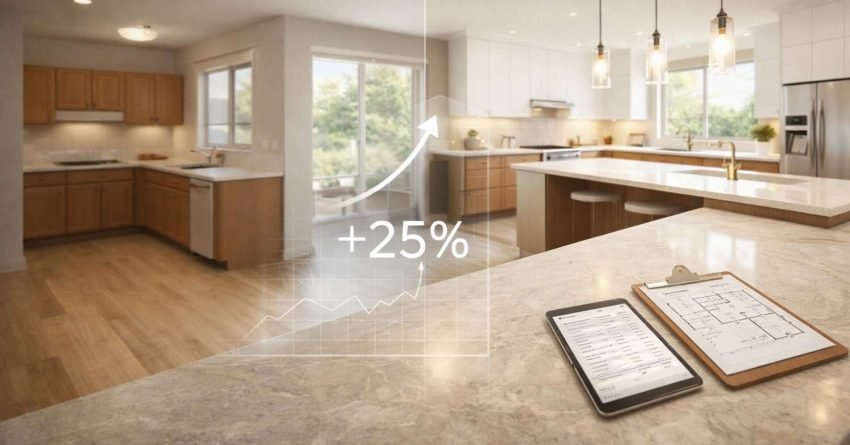
A well-planned bathroom renovation in Sydney returns between 50% and 80% of its cost in added property value and, in some cases, more, when scope, finishes, and budget align with buyer expectations. That figure matters whether you are renovating a family home, preparing a property for sale, or upgrading an investment unit to boost rental yield.
Not every dollar comes back to you. The difference between a renovation that builds equity and one that burns cash comes down to understanding where your money goes, which upgrades move the value needle, and how to budget so the numbers work in your favour. This guide breaks down the real costs, the highest-return upgrades, and the budgeting strategies that protect your renovation ROI in the current Sydney market.
What Is Renovation ROI and Why Does It Matter
Renovation ROI return on investment measures how much property value a renovation adds relative to what it costs. It is the single most important metric for any homeowner or investor deciding whether a renovation makes financial sense. A bathroom renovation that costs $25,000 and adds $18,000 in property value delivers a 72% ROI a number that tells you whether the project is a smart financial move or an expensive personal preference.
Understanding renovation ROI separates emotional spending from strategic investment. Every renovation decision, from the tiles you choose to the contractor you hire, either protects or erodes your return. In a market like Sydney where property prices are high, and buyer expectations are specific, knowing your likely ROI before you start keeps your project grounded in financial reality.
How Renovation ROI Is Calculated
The basic formula is straightforward: subtract the total renovation cost from the increase in property value, divide by the total renovation cost, and multiply by 100.
ROI (%) = [(Value Added − Renovation Cost) / Renovation Cost] × 100
Spend $30,000 on a bathroom renovation and a qualified valuer estimates the property value increased by $22,000; your ROI is approximately 73%. That is a strong return for a wet area upgrade in Sydney.
The challenge is that “value added” is not always a precise number. It depends on comparable sales in your area, the condition of the rest of the property, current market sentiment, and how well the renovation aligns with what buyers or tenants in your suburb actually want. A $60,000 luxury bathroom in a suburb where median house prices sit at $900,000 delivers a very different return than the same spend in a $2.5 million market.
ROI vs. Perceived Value in Sydney Property
ROI is a financial calculation. Perceived value is what a buyer feels when they walk into a renovated bathroom. Both matter, but they are not the same thing.
A bathroom with quality waterproofing, modern fixtures, and a clean layout may not look dramatically different from a high-end designer bathroom, but it delivers a stronger ROI because the cost to achieve it was significantly lower. A bathroom with imported marble and a freestanding stone bath might impress at an open home yet return poorly if the spend far exceeded what the local market rewards.
Perceived value in Sydney is heavily influenced by suburb expectations. Buyers in Mosman expect a different finish level than buyers in Penrith, and the spend differential reflects that. A mid-range renovation in Mosman might sit at $35,000–$45,000 to meet buyer expectations, while the same visual outcome in Penrith is achievable at $20,000–$28,000. Overcapitalisation spending more than the market will return is the most common ROI killer in residential renovation, and it almost always stems from ignoring this suburb-level reality.
Bathroom Renovations and Property Value in Sydney
Bathrooms consistently rank among the top value-adding renovations in Australian property. They sit alongside kitchens as the rooms buyers and tenants scrutinise most closely, and in many Sydney markets, a renovated bathroom delivers a stronger percentage return than a kitchen upgrade of equivalent cost, because the baseline expectation gap is larger and the scope is more contained.
A dated, poorly maintained bathroom reduces a property’s appeal and sale price far more than its renovation cost would suggest. A well-executed bathroom renovation signals to buyers that the property has been cared for and is move-in ready, which directly supports a higher offer and a faster sale.
The reason bathrooms punch above their weight in property value is functional. Waterproofing failures, mould, cracked tiles, and outdated plumbing are not cosmetic issues. They represent structural risk. A renovated bathroom removes that risk from the buyer’s mental calculation, which directly supports a higher offer.
How Much Value Does a Bathroom Renovation Add
In the Sydney market, a mid-range bathroom renovation typically adds between 50% and 80% of its cost to the property’s value. Archistar’s 2024 renovation data suggests that bathroom upgrades in metropolitan Sydney can add $15,000 to $30,000 in value for a spend of $20,000 to $40,000, depending on scope and suburb.
For investment properties, the return profile shifts. A functional, durable renovation with neutral finishes can improve rental yield by $20 to $50 per week, which compounds over time. On a $25,000 renovation, an extra $40 per week in rent represents an annual return of roughly 8% on the renovation cost alone, before any capital growth benefit.
The key variable is scope. A cosmetic refresh new vanity, tapware, mirror, paint at $8,000 to $12,000 can deliver a higher percentage ROI than a full gut renovation at $35,000 to $50,000, because the cost base is lower and the visual impact relative to spend is high.
Sydney Market Conditions That Affect Renovation Returns
Sydney’s property market in 2025 remains characterised by high median prices, competitive buyer pools, and strong demand for move-in-ready homes. CoreLogic’s March 2025 data shows Sydney’s median dwelling value sitting above $1.1 million, which means buyers at this price point expect a certain standard of finish.
Several local factors influence renovation ROI. Suburb-level expectations mean a renovation in the Inner West needs to meet a different standard than one in Western Sydney; underspending in a premium suburb can actually hurt your return. Strata and heritage constraints limit scope in apartment renovations, with heritage overlays in suburbs like Balmain or Paddington restricting external changes and pushing budgets into interior upgrades. Master Builders Australia reports that skilled trades in Sydney command premium rates, with licensed plumbers and waterproofers among the most in-demand, which directly affects renovation cost and, by extension, ROI. Higher interest rates mean renovation financing costs more, and renovators who fund from savings or offset accounts protect more of their return.
Sydney Suburb ROI Tiers
Suburb tier shapes both your renovation budget and your realistic return. Here is how the Sydney market breaks down across three tiers.
| Suburb Tier | Example Suburbs | Recommended Reno Spend | Expected Value Add | Indicative ROI Range |
| Premium | Mosman, Balmain, Paddington, Manly | $35,000–$55,000 | $28,000–$45,000 | 65–82% |
| Mid-Market | Inner West, Northern Beaches mid-range, St George | $22,000–$38,000 | $16,000–$28,000 | 60–78% |
| Entry-Level | Western Sydney, South-West Sydney, outer suburbs | $15,000–$28,000 | $10,000–$20,000 | 55–72% |
These ranges are indicative and depend on the condition of the existing bathroom, the scope of work, and current comparable sales. A renovation that overshoots the tier ceiling risks overcapitalisation regardless of finish quality.
Cost Factors That Influence Your Renovation ROI
Your renovation ROI is ultimately determined by two numbers: what you spend and what you get back. You have far more control over the first number than the second. Understanding where your money goes and where it tends to leak is the foundation of a high-return renovation.
A standard bathroom renovation in Sydney involves demolition, waterproofing, plumbing, electrical, tiling, fixtures, fittings, and finishing trades. Each of these cost categories has a range, and the choices you make within each range determine your total spend and your likely return.
Labour Costs and Skilled Trades in Sydney
Labour typically represents 40% to 55% of a bathroom renovation budget in Sydney. This is not an area where cutting costs improves ROI. Poorly executed plumbing or waterproofing creates defects that cost far more to rectify than the original saving.
Here is a realistic breakdown of trade costs for a standard Sydney bathroom renovation in 2025:
| Trade | Typical Cost Range (Sydney 2025) |
| Demolition and removal | $1,500 – $3,000 |
| Plumbing (rough-in and fit-off) | $3,000 – $6,000 |
| Waterproofing | $1,500 – $3,000 |
| Electrical | $1,500 – $3,500 |
| Tiling (supply and install) | $3,000 – $7,000 |
| Carpentry and plastering | $1,000 – $2,500 |
| Painting | $500 – $1,200 |
| Project management/builder margin | $2,000 – $5,000 |
These ranges reflect a standard-sized bathroom (approximately 4 to 6 square metres). Larger bathrooms, complex layouts, or relocating plumbing fixtures push costs toward the upper end.
The most important labour cost to get right is waterproofing. NSW Fair Trading requires all wet area waterproofing to comply with AS 3740, and defective waterproofing is the most common source of building disputes in residential renovation. A properly waterproofed bathroom protects your ROI for decades. A failed membrane can destroy it in months.
Material and Fittings Allowances
Materials and fittings account for the remaining 45% to 60% of your budget. This is where the biggest ROI decisions happen, because the price range between entry-level and premium products is enormous.
Tiles are the largest material cost. Budget tiles start at $25 to $40 per square metre. Mid-range options sit at $50 to $90. Premium imported tiles can exceed $150 per square metre. For ROI purposes, a mid-range tile in a neutral colour and standard format (300x600mm or 600x600mm) delivers the best balance of visual impact and cost control.
Vanities and basins range from $400 for a basic wall-hung unit to $3,000 or more for custom joinery. A quality wall-hung vanity in the $800 to $1,500 range looks modern, is easy to clean, and appeals to the broadest buyer pool.
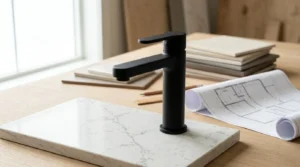
Tapware is a high-visibility, relatively low-cost item. Spending $300 to $600 on quality matte black or brushed nickel tapware creates a premium feel without a premium price tag. Cheap tapware looks and feels cheap; it is one of the first things buyers touch.
Shower screens range from $500 for a semi-frameless screen to $2,000 or more for a custom frameless panel. Frameless screens are the current market standard in Sydney and are worth the incremental spend for resale-focused renovations.
Toilets are functional items. A quality back-to-wall or wall-faced toilet in the $400 to $800 range is almost renovations need. Spending $2,000 on a smart toilet rarely improves ROI unless the property is positioned at the luxury end of the market.
Hidden Costs That Reduce Your Return
Hidden costs are the silent ROI killers. They do not appear in initial quotes, but they appear in final invoices. Accounting for them upfront is essential.
Asbestos removal is non-negotiable, and legally required bathrooms in Sydney homes built before 1990 frequently contain asbestos in wall sheeting, floor tiles, or adhesives, and licensed removal costs $1,500 to $5,000 depending on the extent. Structural repairs add $1,000 to $4,000 once walls and floors are stripped and damage from previous water leaks becomes visible. Plumbing relocation adds $1,000 to $3,000 per fixture; keeping fixtures in their current positions is one of the simplest ways to control costs. Electrical upgrades for older homes without adequate circuit capacity add $500 to $2,000, and council or strata approvals add cost and time through application fees and waiting periods.
A well-planned renovation budget includes a 10% to 15% contingency for unexpected issues. This is not a hidden cost; it is a planning requirement. Renovators who skip the contingency are the ones who blow their budget.
A Real-World Sydney Renovation ROI Example
A concrete example makes the numbers real. Consider a three-bedroom house in the Inner West with a single main bathroom last renovated in 2003. Current property value: $1.45 million. The bathroom is functional but has dated original tiles, a framed shower screen, and a vanity that has seen better days.
The renovation scope: full tile replacement (floor and walls), new frameless shower screen, wall-hung vanity, quality tapware, recessed downlights, and a new exhaust fan. Total cost: $28,500 including a $2,500 contingency draw for minor structural repairs behind the shower wall.
Post-renovation valuation increase: $21,000. ROI: 73.7%. The property also sold 11 days faster than comparable unrenovated properties in the same suburb over the same quarter a timeline benefit that carries its own financial value in a market where holding costs run at $3,000–$4,500 per month.
Renovations That Add the Most Value
Not all renovation dollars are equal. Some upgrades deliver outsized returns. Others cost more than they will ever return. Knowing the difference is the core skill of value-focused renovation.
The highest-ROI renovations share common traits. They address functional deficiencies, align with current buyer preferences, and deliver visual impact at a controlled cost. They do not chase trends that will date within five years.
High-ROI Bathroom Upgrades
Waterproofing and structural integrity. This is not glamorous, but it is the foundation of every other dollar you spend. A bathroom with certified waterproofing and sound structure is worth more than a beautiful bathroom with a leaking shower base.
Modern tiling in neutral tones. Replacing dated tiles with a clean, contemporary tile in white, grey, or warm neutral tones is consistently the highest-impact visual upgrade. It transforms the room and appeals to the widest buyer pool.
Quality tapware and fixtures. Upgrading from builder-grade tapware to a quality mid-range brand Caroma, Phoenix, Methven creates a noticeable quality lift at a modest cost. Matte black and brushed nickel remain the dominant finishes in Sydney.
Frameless shower screen. Replacing a framed or semi-frameless screen with a frameless panel makes the bathroom feel larger and more modern. The cost difference is typically $500 to $800, but the perceived value increase is significant.
Improved lighting. Replacing a single ceiling light with recessed downlights and a backlit mirror dramatically improves the feel of the space. Electrical costs for this upgrade are typically $500 to $1,000.
Ventilation. A properly ducted exhaust fan prevents moisture damage and mould. It protects your renovation investment and is a requirement under the Building Code of Australia for bathrooms without an openable window.
Cosmetic Refresh vs. Full Gut Renovation: Which Returns More?
The answer depends on the starting condition of the bathroom and the suburb tier. A cosmetic refresh new vanity, tapware, mirror, paint, and reseal at $8,000 to $12,000 typically delivers a 65% to 80% ROI because the cost base is low and the visual lift is immediate. A full gut renovation at $35,000 to $50,000 typically delivers a 55% to 72% ROI because the higher spend requires a proportionally larger value increase to match.
The cosmetic refresh wins on percentage return. The full renovation wins when the existing bathroom has structural issues, failed waterproofing, rotted framing, or non-compliant plumbing that a cosmetic fix cannot address. Spending $10,000 on a cosmetic refresh over a failing substrate is money lost. The right scope depends on what is actually behind the walls, not just what is visible at the surface.
Low-ROI Mistakes to Avoid
Over-customisation. Highly personalised design choices bold feature tiles, unusual colour schemes, bespoke fixtures reflect your taste, not the market’s. They narrow the buyer pool and rarely return their cost.
Relocating plumbing unnecessarily. Moving the toilet or shower to a new position adds thousands in plumbing costs without a proportional increase in property value. Unless the existing layout is genuinely dysfunctional, keep fixtures where they are.
Premium brands for the sake of branding. A $3,000 designer basin does not add $3,000 in property value. Most buyers cannot distinguish between a $600 quality basin and a $2,000 designer piece. Spend the difference elsewhere.
Underfloor heating in mild climates. Sydney’s climate does not demand heated bathroom floors. The $1,500 to $3,000 installation cost rarely returns at sale; it is a lifestyle upgrade, not a value upgrade.
Bathtub-to-shower conversions in family homes. Removing the only bathtub in a family home to create a larger shower can reduce property value. Families with young children expect at least one bath. In a second bathroom, the conversion makes more sense.
Budgeting Strategies to Maximise Renovation ROI
A renovation budget is not a wish list. It is a financial plan that determines whether your project builds wealth or destroys it. The most successful renovators in Sydney treat their budget as a constraint that forces better decisions, not a limit to be stretched.
Setting a Realistic Renovation Budget
Start with the end in mind. What is the property worth now? What will it be worth after renovation? What is the maximum you can spend and still achieve a positive return?
A useful rule of thumb for bathroom renovations is to spend no more than 1.5% to 3% of the property’s current value. On a $1.2 million Sydney home, that translates to a bathroom budget of $18,000 to $36,000, a range that covers a full renovation with quality mid-range finishes.
Break your budget into three tiers. Fixed costs: demolition, waterproofing, plumbing, electrical, and tiling labour represent the structural and compliance requirements of the renovation and are not optional. Fittings and fixtures: vanity, toilet, tapware, shower screen, mirror, accessories are where you have the most flexibility; allocate a specific dollar amount to each item and stick to it. Contingency of 10% to 15% of total budget covers asbestos, structural repairs, plumbing surprises, and anything else hidden behind the walls.
How to Prioritise Spending for Maximum Return
When the budget is tight, prioritise in this order. First, waterproofing and structural work; skipping or cheapening this step is the fastest way to negative ROI. Second, tiling: tiles cover the largest visible surface area and have the highest visual impact per dollar. Third, tapware and fixtures: these are the items buyers touch and interact with, and quality here signals quality throughout. Fourth, vanity and storage: a functional, well-sized vanity with adequate storage solves a daily problem for every user. Fifth, lighting and ventilation: relatively low-cost upgrades that improve both the experience and the longevity of the renovation. Last, accessories and styling: towel rails, toilet roll holders, robe hooks the finishing touches that are the easiest items to upgrade later.
How to Finance a Bathroom Renovation Without Killing Your ROI
Financing a renovation adds a cost that most ROI calculations ignore: interest. A $30,000 renovation funded by a personal loan at 9% p.a. over three years costs approximately $4,300 in interest, reducing your effective ROI from 73% to closer to 59%. Understanding your financing options before you commit to a scope is as important as understanding your trade costs.
The most cost-effective option for owner-occupiers with an offset account is drawing down from savings or offset funds. Every dollar drawn from an offset account saves mortgage interest at your home loan rate, typically 6% to 7% p.a. in 2025, which is cheaper than any personal loan or credit facility.
Home equity access through a redraw facility or line of credit is the next most cost-effective option. Rates are lower than personal loans, and the interest may be tax-deductible for investment properties. Personal renovation loans are the most accessible, but the most expensive; use them only when equity access is not available, and the renovation ROI clearly justifies the financing cost. For investment properties, speak with your accountant before choosing a financing structure, as the deductibility of interest and the depreciation schedule on new fixtures can materially improve your effective after-tax return.

Owner-Occupier vs. Investment Property Renovation ROI
The ROI calculation changes depending on who the renovation is for. An owner-occupier renovation serves the people living in the home. An investment property renovation serves the market. The budget, scope, and finish level should reflect this difference.
Renovating for Personal Use and Resale
Renovating your own home and planning to live in it for five or more years means your ROI calculation includes personal enjoyment. A $5,000 upgrade that makes your daily routine better has value even when it only returns $3,000 at sale; the key is making these decisions consciously, knowing the financial trade-off.
Renovating with resale in mind means shifting your thinking from “what do I want” to “what does the market want.” Research recent sales in your suburb, visit open homes, and look at what sold quickly and for strong prices. The finishes and layouts in those properties are your benchmark.
A common mistake is renovating to personal taste and assuming buyers will share it. Neutral finishes, functional layouts, and quality execution appeal to the broadest buyer pool and deliver the strongest resale ROI.
Renovating for Rental Yield and Capital Growth
Investment property renovations have a different objective: maximise rental income and long-term capital growth at the lowest possible cost. Tenants value function over form; a clean, well-maintained bathroom with reliable plumbing, good water pressure, adequate storage, and a functioning exhaust fan attracts quality tenants without requiring premium finishes.
For investment bathrooms, focus on durability: porcelain tiles over natural stone, solid surface vanity tops over engineered stone, chrome tapware over matte black (chrome shows wear less). Prioritise low-maintenance frameless shower screens are easier to clean; wall-hung vanities allow floor cleaning underneath, and large-format tiles mean fewer grout lines. Ensure neutral presentation: white, grey, and light timber tones photograph well for listings and appeal to the widest tenant pool. Confirm compliance: NSW Fair Trading requires certificates of compliance for plumbing and waterproofing, and missing certificates create problems at insurance claim time and at sale.
A well-executed investment bathroom renovation at $15,000 to $25,000 can increase weekly rent by $30 to $50 and add $15,000 to $20,000 in capital value. That is a strong combined return.
Tax Depreciation and Investment Property Renovation
Renovation costs on an investment property are not just a capital expense; they are a depreciable asset. Under the ATO’s Division 43 and Division 40 schedules, new fixtures and fittings, vanities, tapware, shower screens, exhaust fans, and lighting are depreciable at rates of 13.33% to 20% per year under the diminishing value method.
On a $25,000 investment bathroom renovation, a quantity surveyor’s depreciation schedule can generate $3,500 to $5,000 in deductions in year one alone. Over five years, cumulative deductions of $12,000 to $16,000 materially improve the effective after-tax ROI of the renovation. This is a planning step most investors skip, and it is one of the clearest ways to improve your real return without spending an extra dollar on the renovation itself.
How to Protect Your ROI During a Renovation
Planning a high-ROI renovation is one thing. Executing it without cost blowouts, delays, and quality failures is another. The construction phase is where ROI is either protected or lost.
Choosing the Right Contractor
Your contractor is the single biggest variable in your renovation outcome. A skilled, transparent contractor protects your budget, your timeline, and your return. A poor one destroys all three.
Get detailed, itemised quotes; a lump-sum quote with no breakdown is a red flag. You need to see labour, materials, and allowances separated so you can compare like-for-like and identify where your money is going. Check licences and insurance: in NSW, any building work over $5,000 requires a licensed contractor; verify the licence on the NSW Fair Trading website and confirm they hold current public liability and workers’ compensation insurance.
Ask for references and inspect previous work in person. Look at tile cuts, grout lines, silicone joints, and fixture alignment; these details reveal workmanship quality. A written contract is legally required for work over $5,000 in NSW and should include the full scope of work, a fixed price or clear allowance structure, a timeline, payment schedule, and dispute resolution process.
How Delays and Scope Creep Erode Your Return
Delays are not just an inconvenience; they are a direct ROI cost. In Sydney’s rental market, every week a renovation runs over schedule is a week of lost rental income. On a property renting at $650 per week, a two-week overrun costs $1,300 in lost yield before accounting for any additional tradie costs from scheduling gaps.
Scope creep is the other silent ROI killer. Every variation order an upgraded tile, a relocated fixture, an added accessory carries a margin on top of the material cost. We track every variation in writing before approving it, because a renovation that starts at $28,000 and finishes at $36,000 through unmanaged scope changes has a very different ROI profile than the one you planned. Locking scope before demolition begins and resisting mid-project changes is one of the most effective cost-control disciplines available.
Project Management and Cost Control
Once the renovation is underway, protecting your ROI requires active management. Stick to the plan; scope changes during construction are the number one cause of budget blowouts, and every change has a cost. Monitor the payment schedule: never pay the full amount upfront. A standard payment structure is a deposit of 10% to 15%, progress payments tied to milestones (demolition complete, waterproofing complete, tiling complete), and a final payment on completion and defect inspection.
Inspect at key stages: waterproofing must be inspected and certified before tiling begins, which is a legal requirement and a critical quality checkpoint. Document everything: keep a record of all communications, variations, payments, and approvals. Track spending against budget weekly, and reassess remaining scope early rather than waiting until the contingency is exhausted.
Conclusion
Renovation ROI is not about spending the most or choosing the flashiest finishes. It is about making informed decisions that align your renovation budget with what the Sydney property market actually rewards. From understanding cost structures and prioritising high-return upgrades to avoiding hidden expenses and overcapitalisation, every choice either builds or erodes your return.
Whether you are renovating a family bathroom for daily comfort, preparing a property for sale, or upgrading an investment unit to boost rental yield, the principles are the same. Plan thoroughly, budget realistically, choose quality over luxury, and work with a contractor who values transparency as much as you do.
At Sydney Home Renovation, we help homeowners and investors renovate with confidence, providing honest pricing, detailed budgeting, and skilled workmanship that protects your investment. Get in touch with our team for a clear, itemised quote with no hidden costs, and start your project on the right foundation.
Frequently Asked Questions
What is a good ROI for a bathroom renovation in Sydney?
A good ROI for a bathroom renovation in Sydney is between 60% and 80%. A $30,000 renovation should add approximately $18,000 to $24,000 in property value. Mid-range renovations with neutral finishes in well-located suburbs deliver the strongest returns.
How much does a bathroom renovation cost in Sydney in 2025?
A standard bathroom renovation in Sydney costs between $20,000 and $40,000 for a mid-range finish. Budget renovations start around $10,000 to $15,000, while high-end renovations exceed $50,000. Final cost depends on bathroom size, scope, material selections, and whether plumbing or structural changes are required.
Which bathroom upgrades add the most value to a property?
Waterproofing, modern tiling in neutral tones, quality tapware, frameless shower screens, and improved lighting consistently deliver the highest returns. These upgrades address both visual appeal and functional quality, the two factors buyers weigh most heavily when assessing a bathroom.
What are the most common hidden costs in a bathroom renovation?
Asbestos removal, structural repairs behind walls, plumbing relocation, electrical upgrades, and council or strata approvals are the most common hidden costs. Including a 10% to 15% contingency in your budget accounts for these surprises and prevents cost blowouts.
Should I renovate my bathroom before selling my house?
In most cases, yes. A dated or damaged bathroom is one of the biggest deterrents for buyers and can reduce sale price by more than the renovation would cost. A mid-range renovation aligned with suburb expectations typically returns 60% to 80% of its cost and helps the property sell faster.
Is it worth renovating a bathroom in an investment property?
Yes, when the renovation is scoped for durability, low maintenance, and broad tenant appeal rather than luxury finishes. A well-planned investment bathroom renovation at $15,000 to $25,000 can increase weekly rent by $30 to $50 and add meaningful capital value over time.
How do I avoid overcapitalising on a bathroom renovation?
Limit your bathroom renovation spend to 1.5% to 3% of the property’s current value. Research comparable sales in your suburb to understand what finish level the market expects. Choose mid-range materials, keep fixtures in their existing positions where possible, and avoid highly personalised design choices that narrow buyer appeal.


