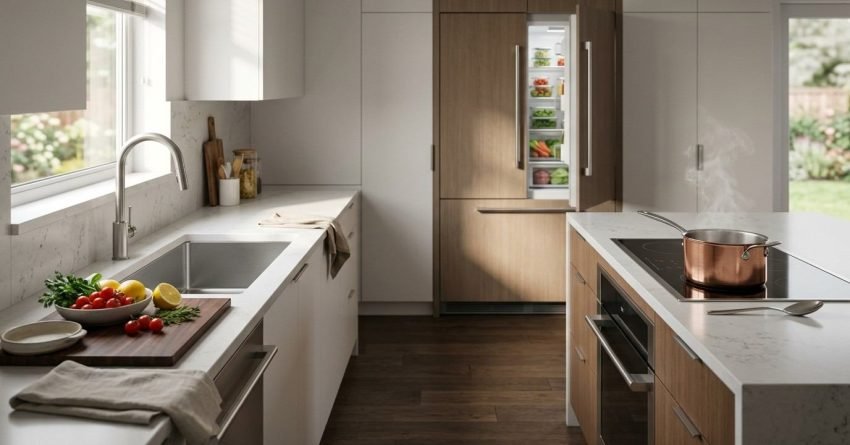
The kitchen triangle rule is a foundational design principle that connects your three primary kitchen work areas the sink, the stove, and the refrigerator into an efficient, unobstructed triangle that minimises unnecessary movement during cooking and food preparation.
Understanding this rule before you renovate can save you from a poorly functioning kitchen that looks great but frustrates you every single day. Layout decisions made early in a renovation are expensive to reverse once cabinetry, plumbing, and appliances are locked in.
This guide covers what the kitchen triangle rule is, the correct measurements, how it applies to every major kitchen layout, whether it still holds up in modern kitchen design, and what it means for your kitchen renovation in Sydney.
What Is the Kitchen Triangle Rule?
The kitchen triangle rule is a kitchen design guideline that positions the three primary work centres the sink, the cooktop or stove, and the refrigerator at the three points of an imaginary triangle. The principle holds that when these three zones are arranged efficiently, the cook can move between them with minimal steps, reducing fatigue and improving the overall function of the kitchen.
The rule is not about aesthetics. It is entirely about workflow. A kitchen can have beautiful cabinetry, premium stone benchtops, and high-end appliances, but if the layout forces you to walk across the room every time you move between the fridge and the stove, the kitchen will feel inefficient and tiring to use.
The kitchen triangle is sometimes called the “work triangle” because it maps the three tasks that happen most frequently during meal preparation: retrieving food from the refrigerator, washing and preparing food at the sink, and cooking at the stove. When these three points are positioned correctly, the kitchen functions as a cohesive workspace rather than a series of disconnected stations.
The Three Points of the Kitchen Triangle
The three fixed points of the kitchen triangle are:
The Refrigerator: This is where food storage begins. It is typically the first point of contact in the cooking process, where ingredients are retrieved before preparation begins.
The Sink: This is the preparation and cleaning hub. Food is washed here, vegetables are prepped, and dishes are rinsed. The sink is often the most frequently used point in the triangle because it serves both the beginning and end of the cooking process.
The Cooktop or Stove: This is where cooking happens. Whether it is a freestanding oven, a built-in cooktop, or a range, this point represents the final stage of active food preparation before serving.
Each leg of the triangle connects two of these three points. The efficiency of the kitchen depends on how well these legs are balanced not too short that the workspace feels cramped, and not too long that movement between stations becomes exhausting.
Where Did the Kitchen Triangle Rule Come From?
The kitchen triangle rule was developed in the 1940s and 1950s by researchers at the University of Illinois School of Architecture as part of the Small Homes Council research program. The research was driven by post-war housing development, where architects and designers were looking for ways to make smaller homes more functional and liveable.
The original research studied how people actually moved through kitchens during cooking and identified that the majority of kitchen activity was concentrated around three appliances: the refrigerator, the sink, and the stove. By optimising the spatial relationship between these three points, researchers found they could significantly reduce the distance a cook travelled during meal preparation.
The principle was widely adopted by kitchen designers and architects throughout the second half of the twentieth century and became one of the most referenced guidelines in residential kitchen design. It remains a standard reference point in kitchen planning today, even as kitchen design has evolved considerably since the 1950s.

What Are the Standard Measurements for the Kitchen Triangle?
The kitchen triangle rule is not just a conceptual idea; it comes with specific measurement guidelines that define what makes a triangle functional versus inefficient. These measurements were established through the original University of Illinois research and have been refined by kitchen designers and architects over decades of practical application.
Getting the measurements right is critical. A triangle that is too small creates a cramped, congested workspace. A triangle that is too large means you are covering unnecessary ground every time you move between stations, which defeats the purpose of the rule entirely.
Minimum and Maximum Leg Lengths
Each leg of the kitchen triangle, the imaginary line connecting two of the three work centres, should fall within a specific range:
Minimum leg length: 1.2 metres (approximately 4 feet). Any shorter than this and the workspace becomes too tight, making it difficult to open appliance doors, move freely, or have more than one person working in the kitchen at the same time.
Maximum leg length: 2.7 metres (approximately 9 feet). Any longer than this and the distance between work centres becomes inefficient, requiring too many steps between tasks and undermining the core purpose of the triangle.
These measurements apply to each individual leg of the triangle, not the total perimeter. A kitchen where one leg measures 3 metres, even if the other two are within range, will still produce an inefficient workflow because that single long leg creates a bottleneck in the cooking process.
Total Perimeter Guidelines
Beyond individual leg lengths, the kitchen triangle rule also specifies a recommended total perimeter: the combined length of all three legs added together.
Recommended total perimeter: Between 4 metres and 8 metres (approximately 13 to 26 feet).
A total perimeter under 4 metres typically indicates a kitchen that is too small to function comfortably, where appliances and work surfaces are too close together. A total perimeter over 8 metres suggests a kitchen where the work centres are spread too far apart, making cooking physically demanding and inefficient.
For most Sydney homes, particularly terrace houses, semi-detached homes, and apartment kitchens that are common across inner and middle-ring suburbs, a total perimeter in the 5 to 7 metre range tends to produce the most practical and comfortable kitchen workflow.
Why Does the Kitchen Triangle Rule Matter for Kitchen Design?
The kitchen triangle rule matters because kitchen layout is one of the most consequential decisions in any renovation, and it is one of the hardest to fix after the fact. Once your cabinetry is installed, your plumbing is set, and your appliances are positioned, changing the layout requires significant demolition and cost.
A well-planned kitchen triangle reduces the physical effort of cooking, improves safety by keeping high-traffic paths clear of the cooking zone, and makes the kitchen more enjoyable to use on a daily basis. These are not abstract benefits; they are practical outcomes that affect how you experience your home every single day.
How the Triangle Affects Kitchen Workflow
Kitchen workflow refers to the sequence of movements a cook makes during meal preparation. In a well-designed kitchen, this sequence flows naturally from the refrigerator to the sink to the stove and back again, with minimal backtracking, crossing, or unnecessary steps.
When the kitchen triangle is correctly proportioned, the cook can retrieve ingredients, wash and prepare them, and transfer them to the cooktop in a logical, linear sequence. The return journey from the stove back to the sink for cleaning is equally efficient.
When the triangle is poorly proportioned, workflow breaks down. A refrigerator positioned on the opposite side of the kitchen from the stove forces the cook to carry raw ingredients across the full width of the room. A sink placed too far from the cooktop means constant back-and-forth during cooking. These inefficiencies compound over time and make the kitchen genuinely frustrating to use, regardless of how well it is finished.
Common Kitchen Layout Problems the Triangle Solves
Several recurring kitchen layout problems are directly addressed by applying the triangle rule during the design phase:
Crossing traffic paths: When the path between two triangle points crosses a high-traffic area, such as a doorway or a main thoroughfare through the kitchen, the cooking process is constantly interrupted. The triangle rule encourages designers to position work centres so that their connecting paths remain within the kitchen’s primary work zone.
Appliance door conflicts: When the refrigerator, dishwasher, and oven doors open into each other’s paths, the kitchen becomes congested and difficult to navigate. Correct triangle spacing naturally reduces these conflicts by ensuring adequate clearance between appliances.
Inefficient sink placement: The sink is the most frequently used point in the triangle. Placing it too close to a corner, too far from the stove, or without adequate bench space on either side creates preparation bottlenecks that slow down every cooking session.
Isolated cooking zones: In some poorly planned kitchens, the stove is positioned in a way that isolates the cook from the rest of the kitchen, making it difficult to monitor other tasks or interact with people in the space. The triangle rule encourages a layout where the cook remains connected to the broader workflow.
How Does the Kitchen Triangle Apply to Different Kitchen Layouts?
The kitchen triangle rule was originally developed for enclosed, single-cook kitchens. Modern homes feature a much wider variety of kitchen configurations, and the triangle principle applies differently depending on the layout. Understanding how the triangle works in your specific kitchen type is essential for making good design decisions during a renovation.
Kitchen Triangle in a Galley Kitchen
A galley kitchen is a narrow, corridor-style layout with two parallel runs of cabinetry and appliances facing each other. It is one of the most common kitchen configurations in Sydney apartments, terrace houses, and older semi-detached homes.
In a galley kitchen, the triangle is typically formed across the two parallel runs, with the sink and cooktop on one side and the refrigerator on the opposite side, or with all three points distributed across both runs. The key challenge in a galley kitchen is ensuring that the triangle legs do not create a layout where the cook must constantly cross from one side to the other, particularly if the kitchen is used by more than one person at a time.
The galley kitchen is actually one of the most efficient layouts for the kitchen triangle when designed correctly, because the short distances between parallel runs naturally keep leg lengths within the recommended range.
Kitchen Triangle in an L-Shaped Kitchen
An L-shaped kitchen uses two adjacent walls at a right angle to each other. This is one of the most versatile kitchen layouts and one of the most common configurations in Australian homes, particularly in open-plan living areas.
In an L-shaped kitchen, the three triangle points are distributed across the two arms of the L. The most efficient arrangement typically places the sink at or near the corner where the two arms meet, with the refrigerator at one end and the cooktop at the other. This creates a natural triangle that keeps all three points within comfortable reach.
The L-shaped layout also allows for an island bench to be added without disrupting the triangle, provided the island is positioned outside the triangle’s perimeter rather than cutting through it.
Kitchen Triangle in a U-Shaped Kitchen
A U-shaped kitchen wraps around three walls, creating a highly enclosed workspace with maximum bench and storage space. This layout is common in larger Sydney homes and in kitchen renovations where storage and preparation space are priorities.
The U-shaped kitchen is well-suited to the triangle rule because the three walls naturally accommodate all three work centres without requiring any of them to be placed at an inconvenient distance from the others. The main risk in a U-shaped kitchen is placing the triangle points too close together, creating a cramped workspace, or positioning them so that the cook must turn 180 degrees to move between stations.
The U-shaped layout also benefits from careful consideration of where the kitchen opens to the rest of the home, as traffic entering and exiting the U can disrupt the cooking zone if the opening is positioned poorly.
Kitchen Triangle in an Open-Plan Kitchen
Open-plan kitchens where the kitchen flows directly into a living or dining area are now the dominant kitchen configuration in new builds and renovations across Sydney. The open-plan layout presents unique challenges for the kitchen triangle because the kitchen no longer has defined walls to anchor the three work centres.
In an open-plan kitchen, the triangle is typically anchored by an island bench, which often houses the sink or the cooktop. The refrigerator is usually positioned against a wall at one end of the kitchen, and the remaining work centre is placed either on the island or along the back wall.
The open-plan kitchen also introduces the challenge of multiple cooks and social interaction. When guests or family members are present in the kitchen space, the triangle’s traffic paths can become congested. This has led many designers to adapt the triangle rule into a broader work zone concept for open-plan kitchens, which is discussed in the following section.
What Are the Rules for a Good Kitchen Triangle?
Beyond the basic measurement guidelines, the kitchen triangle rule includes several additional principles that determine whether a triangle is genuinely functional or simply geometrically correct. A triangle that meets the measurement criteria but violates these additional rules will still produce a poorly functioning kitchen.
Traffic Flow and the Kitchen Triangle
One of the most important rules of the kitchen triangle is that no major traffic path should pass through the triangle. If the main route through the kitchen from the back door to the living area, for example, goes through the triangle, the cooking zone will be constantly disrupted by people moving through the space.
This rule is particularly relevant in open-plan kitchens, where the kitchen is a thoroughfare as much as it is a workspace. In these situations, the triangle should be positioned so that its interior remains a dedicated cooking zone, with traffic flowing around the outside of the triangle rather than through it.
The general guideline is that no single leg of the triangle should be crossed by a primary traffic path. If this cannot be avoided due to the kitchen’s configuration, the affected leg should be kept as short as possible to minimise the disruption.
Clearance Zones and Workspace Requirements
The kitchen triangle rule also requires adequate clearance around each of the three work centres. These clearance zones ensure that appliance doors can open fully, that there is sufficient bench space for food preparation adjacent to each station, and that two people can work in the kitchen simultaneously without obstructing each other.
Standard clearance guidelines include:
Minimum 400mm of bench space on at least one side of the cooktop, to allow for safe placement of hot pots and pans.
Minimum 400mm of bench space on the latch side of the refrigerator, to allow for easy unloading of groceries and retrieval of items.
Minimum 600mm of bench space on at least one side of the sink, to allow for food preparation and dish stacking.
Minimum 900mm of clearance between facing benchtops or between a benchtop and an island, to allow two people to pass each other comfortably and for appliance doors to open without obstruction.
These clearance requirements work in conjunction with the triangle measurements to define a kitchen that is not just geometrically efficient but genuinely comfortable and safe to use.
Is the Kitchen Triangle Rule Still Relevant Today?
The kitchen triangle rule has been a standard reference in kitchen design for over seventy years, but modern kitchens look very different from the enclosed, single-cook kitchens the rule was originally designed for. Open-plan living, larger kitchen footprints, multiple cooks, and the integration of additional appliances such as steam ovens, coffee machines, and wine fridges have all changed the way kitchens are used.
The honest answer is that the kitchen triangle rule remains a useful starting point, but it is no longer sufficient on its own for planning a modern kitchen. It works best as a foundational principle that is then adapted and supplemented based on the specific needs of the household and the configuration of the space.
Modern Kitchen Design and the Kitchen Work Zone Concept
The kitchen work zone concept is the most widely adopted evolution of the kitchen triangle rule. Rather than focusing on three fixed points, the work zone approach divides the kitchen into functional areas based on the tasks performed in each zone.
Common kitchen work zones include:
The consumables zone where food is stored, typically centred around the refrigerator and pantry.
The non-consumables zone where crockery, cookware, and utensils are stored, typically near the dishwasher and adjacent to the cooking zone.
The cleaning zone is centred around the sink and dishwasher, where food preparation waste is managed, nd dishes are cleaned.
The preparation zone is the primary bench space where food is cut, mixed, and assembled before cooking.
The cooking zone is centred around the cooktop and oven, where heat is applied to food.
The work zone concept is particularly well-suited to larger kitchens, open-plan layouts, and households where multiple people cook simultaneously. It allows for more nuanced planning than the triangle rule alone, because it accounts for the full range of kitchen activities rather than just the three primary appliances.
That said, the kitchen triangle remains embedded within the work zone concept. The cleaning zone, the consumables zone, and the cooking zone correspond directly to the sink, the refrigerator, and the stove, the three points of the original triangle. The work zone approach simply adds more detail and flexibility around those three anchors.
When to Follow the Triangle Rule and When to Adapt It
The kitchen triangle rule is most useful in the following situations:
Small to medium kitchens here the three primary work centres are the dominant features of the space and the layout options are limited. In these kitchens, getting the triangle right is the single most important layout decision.
Single-cook households where the kitchen is primarily used by one person at a time, and the workflow is linear and predictable.
Enclosed or semi-enclosed kitchens here the kitchen has defined walls, and the triangle can be anchored without interference from open-plan traffic.
The triangle rule should be adapted or supplemented in the following situations:
Large open-plan kitchens where the work zone concept provides more comprehensive guidance for managing multiple cooks, social interaction, and complex appliance configurations.
Kitchens with multiple cooking appliances where a second oven, a separate cooktop, or a dedicated baking station creates additional work centres that the triangle cannot accommodate.
Kitchens designed for entertaining where the social function of the kitchen is as important as its cooking function, and the layout needs to balance workflow efficiency with guest interaction.

How the Kitchen Triangle Rule Affects Your Kitchen Renovation in Sydney
Understanding the kitchen triangle rule is one thing. Applying it correctly within the constraints of a real Sydney home with its specific floor plan, existing plumbing locations, structural walls, and budget is a different challenge entirely. This is where the difference between a well-planned renovation and a costly layout mistake becomes most apparent.
Layout Planning and Its Impact on Renovation Costs
Kitchen layout decisions have a direct and significant impact on renovation costs. Moving plumbing, particularly the sink, is one of the most expensive changes in a kitchen renovation because it requires a licensed plumber to relocate drainage and water supply lines, which may involve cutting into floors or walls.
If your existing kitchen layout places the sink in a position that creates a poor triangle, you face a choice: accept the layout limitation and work around it, or invest in relocating the plumbing to achieve a better triangle. In many Sydney homes, particularly older terrace houses and apartments where plumbing runs are complex, relocating the sink can add several thousand dollars to the renovation budget.
The same principle applies to the cooktop. Moving a gas cooktop requires a licensed gasfitter to extend or reroute the gas line, which adds cost and complexity. An electric or induction cooktop is more flexible, but the electrical supply still needs to be positioned correctly.
This is why layout planning, including the kitchen triangle, should happen at the very beginning of the renovation process, before any other decisions are made. Changing the layout after cabinetry has been ordered or plumbing has been roughed in is expensive and disruptive. Getting it right at the planning stage costs nothing extra and can save significant money downstream.
Working with a Renovation Contractor to Apply the Triangle Rule
A skilled renovation contractor will assess your existing kitchen layout against the triangle rule as part of the initial design and planning process. This assessment identifies whether your current layout is working efficiently, where the key inefficiencies are, and what changes, if any, are worth making within your budget.
Not every kitchen renovation requires a full layout change. In many cases, the existing triangle is fundamentally sound but is being undermined by poor cabinetry placement, inadequate bench space, or appliances that are the wrong size for the space. These issues can often be resolved without moving plumbing or gas lines, which keeps costs manageable.
Where a layout change is genuinely warranted because the existing triangle is significantly outside the recommended measurements or because the traffic flow through the kitchen is creating serious functional problems, a good contractor will present the options clearly, with honest cost estimates for each, so you can make an informed decision about where to invest your renovation budget.
At Sydney Home Renovation, we include layout assessment and triangle analysis as part of our kitchen renovation planning process. We help you understand exactly what your current kitchen is doing well, what it is not, and what changes will deliver the most meaningful improvement in function and liveability within your budget.
Conclusion
The kitchen triangle rule is a proven, practical design principle that connects the three primary work centres of any kitchen the sink, the stove, and the refrigerator into an efficient workflow that reduces unnecessary movement and makes cooking more comfortable. Understanding the standard measurements, how the rule applies to your specific kitchen layout, and when to adapt it for modern open-plan living gives you a solid foundation for making smart layout decisions before your renovation begins.
At Sydney Home Renovation, we apply this kind of practical, evidence-based thinking to every kitchen renovation we plan and build. Getting the layout right from the start is one of the most valuable things you can do for your renovation budget, because layout mistakes are expensive to fix and live with every day.
If you are planning a kitchen renovation in Sydney and want honest, experienced guidance on layout, costs, and design decisions, contact Sydney Home Renovation today. We will help you plan a kitchen that works as well as it looks, on budget, on schedule, and built to last.
Frequently Asked Questions
What is the kitchen triangle rule in simple terms?
The kitchen triangle rule is a kitchen design guideline that positions the three main work areas the sink, the stove, and the refrigerator at the three points of a triangle. The idea is that when these three points are correctly spaced, the cook can move between them efficiently with minimal steps and effort.
What are the correct measurements for the kitchen triangle?
Each leg of the kitchen triangle should measure between 1.2 metres and 2.7 metres. The total perimeter of the triangle, he combined length of all three legs, should fall between 4 metres and 8 metres. Staying within these ranges ensures the kitchen is neither too cramped nor too spread out to function efficiently.
Does the kitchen triangle rule apply to small kitchens?
Yes, the kitchen triangle rule is particularly important in small kitchens because the consequences of a poor layout are more pronounced in a confined space. In small kitchens, the triangle legs will naturally be shorter, so the priority is ensuring the minimum clearance zones around each work centre are maintained and that traffic paths do not cut through the cooking zone.
Can you have a kitchen without a triangle layout?
Yes. Many modern kitchens, particularly large open-plan kitchens with island benches and multiple cooking appliances, are designed using the kitchen work zone concept rather than the traditional triangle. The work zone approach divides the kitchen into functional areas: consumables, preparation, cooking, and cleaning, and is better suited to complex, multi-cook kitchen environments.
What is the difference between the kitchen triangle and kitchen work zones?
The kitchen triangle focuses on the spatial relationship between three specific appliances: the sink, the stove, and the refrigerator. Kitchen work zones expand on this concept by mapping all kitchen activities, including storage, preparation, cooking, and cleaning, into dedicated areas. The work zone approach is more comprehensive and better suited to larger or more complex kitchens, but the triangle remains embedded within it.
How does the kitchen triangle affect kitchen renovation costs in Sydney?
The kitchen triangle affects renovation costs primarily through plumbing and appliance placement decisions. Moving the sink or cooktop to improve the triangle requires licensed tradespeople and can add high cost to a renovation. This is why layout planning, including triangle assessment, should happen at the very beginning of the renovation process, before cabinetry is ordered or any work begins on site.
Should I follow the kitchen triangle rule when renovating my kitchen?
The kitchen triangle rule is a reliable starting point for any kitchen renovation, particularly for small to medium kitchens and single-cook households. For larger open-plan kitchens or households where multiple people cook simultaneously, the work zone concept provides more comprehensive guidance. A good renovation contractor will assess your specific layout and advise whether the triangle rule, the work zone approach, or a combination of both is the right framework for your renovation.