
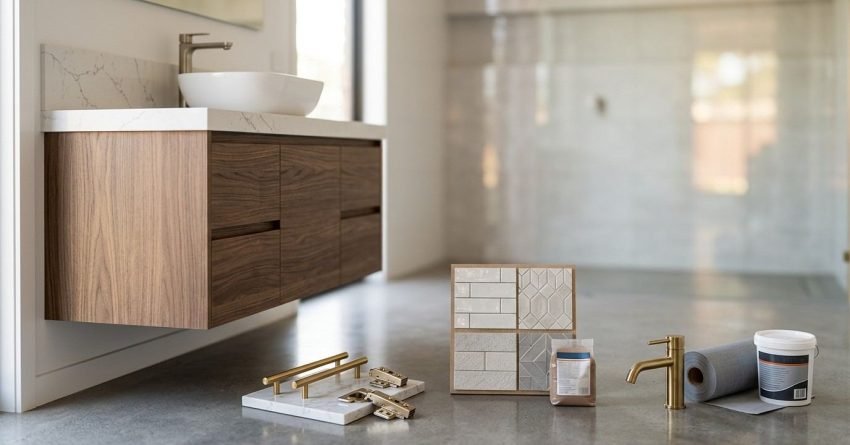
The one third rule for cabinets is a practical budgeting guideline that allocates roughly one third of a total bathroom renovation budget to cabinetry, including vanity units, storage, hardware, and installation labour. On a $20,000 Sydney bathroom renovation, we direct approximately $6,000 to $7,000 toward cabinet-related costs.
Getting this allocation wrong is one of the most common reasons bathroom renovations run over budget. Overspending on cabinetry compromises fittings, tiling, or waterproofing, while underspending risks poor-quality finishes that undermine the entire renovation.
We explain what the one third rule means, how we apply it across different budget tiers in Sydney, what a cabinet allowance should cover, and how to avoid the pricing mistakes that catch most homeowners off guard.
What Is the One Third Rule for Cabinets?
The one third rule for cabinets is a renovation budgeting framework that divides a bathroom renovation into three roughly equal cost categories: cabinetry, labour, and fittings or fixtures. Each category receives approximately one third of the total project budget, creating a balanced allocation that prevents any single cost area from consuming a disproportionate share of available funds.
In the context of bathroom renovations, the cabinet third covers everything related to storage and vanity cabinetry: the physical units, their hardware, and the cost of having them professionally installed. The remaining two-thirds address trade labour (tiling, plumbing, waterproofing, electrical) and fixtures (tapware, shower screens, toilets, mirrors, and lighting).
The rule originated in kitchen renovation planning, where cabinetry costs are typically the single largest line item. It was adopted into bathroom budgeting because the same cost imbalance risk exists: homeowners frequently overspend on a statement vanity and then find insufficient funds remain for quality tapware or proper waterproofing.
How the One Third Rule Works in Practice
To apply the one third rule, we start with the confirmed total renovation budget and divide it into three equal portions. Each portion becomes the maximum ceiling for its respective cost category before contingency is factored in.
A $15,000 bathroom renovation budget produces three allocations of approximately $5,000 each. The cabinet allowance sits at $5,000, the labour allowance at $5,000, and the fittings and fixtures allowance at $5,000, and from there we work within each allocation to select products and services that fit the ceiling without exceeding it.
The rule is a guide, not a rigid formula. Some renovations shift the balance slightly: a high-end custom vanity can push the cabinet third to 35% while the fittings third drops to 28%. What the rule prevents is the common scenario where cabinetry consumes 50% or more of the budget, leaving inadequate funds for everything else.

Why the One Third Rule Matters for Bathroom Renovation Budgeting
Bathroom renovation budgets fail most often not because of a single large overspend, but because of cumulative imbalance across cost categories. A homeowner who falls in love with a $4,500 freestanding vanity on a $12,000 budget and commits to it early typically spends the rest of the project compromising on tapware, tiling, and labour quality.
The one-third rule creates a structural guardrail against this pattern. Establishing a ceiling for cabinetry before product selection begins forces a discipline that keeps the overall renovation balanced and financially viable.
For first-time renovators, the rule provides a concrete starting point when budgeting feels overwhelming. Rather than approaching a renovation with a vague sense of what things cost, the one-third framework gives us a working allocation we can test against real quotes and product prices before committing to anything.
How Cabinet Costs Affect the Overall Renovation Budget
Cabinetry is the most visible and tactile element of a bathroom renovation, and also one of the most variable in price. A wall-hung vanity unit ranges from under $800 for a basic flat-pack option to over $5,000 for a custom-built, soft-close, stone-topped unit, and that range exists within the same bathroom size and layout.
This price variability makes cabinetry the category most likely to blow a renovation budget. Without a pre-set allocation, most homeowners anchor cabinet selection to aesthetics first and price second, which consistently produces overspend.
When cabinet costs exceed their allocated third, the financial pressure transfers directly to the other two thirds. Labour quality is the first casualty, as homeowners begin seeking cheaper trades, increasing the risk of defective waterproofing, poor tiling, and non-compliant plumbing work. Fittings quality drops next, producing a bathroom where the cabinetry looks premium but the tapware, shower screen, and toilet feel mismatched and cheap.
Applying the One Third Rule to a Bathroom Cabinet Budget in Sydney
Sydney’s renovation market carries a cost premium relative to most other Australian cities. Higher land values, stronger trade demand, and elevated material costs mean the same bathroom renovation that costs $18,000 in Brisbane can cost $22,000 to $26,000 in Sydney, consistent with renovation cost benchmarking published by the Housing Industry Association. The one-third rule applies equally in both markets, since the allocation percentages remain constant even as the absolute dollar figures shift upward.
For Sydney projects, this means the cabinet third of a renovation budget is typically larger in dollar terms than interstate equivalents, and it also needs to stretch further given Sydney’s higher supplier and installation costs.
What Does One Third of a Bathroom Renovation Budget Look Like?
The dollar value of the cabinet third depends entirely on the total renovation budget. The table below shows how the one-third allocation translates across common Sydney bathroom renovation budget ranges.
| Total Renovation Budget | Cabinet Third (Approx.) | Realistic Cabinet Scope |
| $10,000 | $3,000–$3,500 | Flat-pack vanity, basic hardware, standard installation |
| $15,000 | $4,500–$5,500 | Mid-range vanity unit, upgraded hardware, professional fit-out |
| $20,000 | $6,000–$7,000 | Quality freestanding or wall-hung vanity, soft-close hardware, custom storage |
| $30,000 | $9,000–$11,000 | Premium custom cabinetry, stone tops, integrated storage solutions |
| $40,000+ | $12,000–$15,000 | Full custom joinery, designer vanity, bespoke storage, premium hardware |
These figures include the vanity unit, any additional storage cabinetry, hardware, and installation labour. They do not include mirrors, shaving cabinets, or freestanding furniture pieces, which are typically allocated to the fittings third.
Budget Tiers and Cabinet Allowances for Sydney Homeowners
Sydney bathroom renovations broadly fall into three budget tiers, each with different expectations for cabinet quality, customisation, and finish.
At the entry level ($10,000 to $15,000 total), the cabinet tier supports flat-pack or semi-custom vanity units from suppliers such as Bunnings, Beaumont Tiles, or Reece. These units are functional and presentable but offer limited customisation in size, colour, and internal configuration, and installation is typically completed within a day.
At the mid-range level ($15,000 to $25,000 total), the cabinet third supports quality pre-made vanity units from bathroom specialists, with options for stone or engineered stone tops, soft-close hinges and drawers, and wall-hung configurations that simplify floor cleaning. This tier offers the best balance of quality, durability, and cost for most Sydney homeowners.
At the premium level ($25,000 and above total), the cabinet third supports custom-built joinery from a cabinet maker, allowing full control over dimensions, materials, internal organisation, and finish. Custom cabinetry at this tier is designed to fit the specific bathroom layout precisely, maximising storage in awkward spaces and delivering a bespoke result that pre-made units cannot replicate.

What the Cabinet Third Should Cover
Understanding what belongs inside the cabinet third, and what does not, is essential for accurate budgeting. Many homeowners underestimate the cabinet third because they price only the vanity unit itself, forgetting that hardware and installation add meaningful cost.
Vanity Units and Storage Cabinetry
The vanity unit is the primary cabinet cost in most bathrooms. It includes the cabinet carcass, doors, drawers, and benchtop or basin surround, and in Sydney, a quality mid-range wall-hung vanity with a stone top typically costs between $1,200 and $3,500 supply-only, depending on size, brand, and material specification.
Additional storage cabinetry, such as tall boy units, under-sink storage towers, or wall-mounted side cabinets, adds to the cabinet third when included in the renovation scope. These are often overlooked in initial budgeting but are frequently added during the design phase, which can push the cabinet allocation beyond its ceiling without advance planning.
Cabinet Hardware, Handles, and Soft-Close Mechanisms
Hardware is a small but meaningful cost within the cabinet budget. Handles, knobs, and pulls range from under $10 per unit for basic options to over $80 per unit for designer or brushed metal finishes, and a vanity with six drawer pulls and two door handles can add $100 to $500 in hardware costs depending on specification.
Soft-close hinges and drawer runners are a functional upgrade that most Sydney homeowners now consider standard rather than premium. They add durability, reduce noise, and extend the life of cabinet doors and drawers, typically adding $150 to $400 to the cabinet cost depending on the number of doors and drawers involved.
Installation Labour for Bathroom Cabinetry
Cabinet installation labour is a component of the cabinet third that is frequently misallocated to the general labour budget. For clarity and accuracy, installation of cabinetry, including wall-hanging, levelling, securing, and fitting hardware, should be costed within the cabinet third.
In Sydney, cabinet installation labour for a standard bathroom vanity and associated storage typically costs between $300 and $800, depending on complexity, wall substrate, and whether the installation requires modification to existing plumbing rough-in positions. Custom joinery installation is more complex and can cost $800 to $1,500 or more depending on scope.
Cabinet Material Choices and How They Shift the One-Third Allocation
Material selection is one of the biggest swing factors inside the cabinet third, and Sydney homeowners often underestimate how much it moves the final number. Moisture-resistant MDF is the most common base material for mid-range vanities, offering a reasonable balance of cost and durability in humid bathroom conditions.
Laminate and PVC-wrapped finishes sit at the entry to mid-range price point and hold up well against daily moisture exposure when properly sealed at the edges. Solid timber and engineered stone tops sit at the premium end, adding visual weight and longevity but consuming a larger share of the cabinet budget, sometimes pushing a project from the mid-range tier into the premium tier on material cost alone.
Choosing a durable, moisture-resistant material over a marginally cheaper option is one of the highest-value decisions inside the cabinet third, since replacing swollen or delaminated cabinetry within a few years erases any short-term savings.
Common Mistakes Homeowners Make When Budgeting for Cabinets
The one-third rule is straightforward in principle but frequently misapplied in practice. Several consistent mistakes cause homeowners to either overspend their cabinet allocation or underestimate it to the point where the budget becomes unworkable.
The most common mistake is pricing the vanity unit in isolation. A homeowner who finds a vanity for $1,800 on a $9,000 budget often assumes the cabinet budget is manageable, then discovers that hardware, installation, and an additional storage unit bring the true cabinet cost to $3,200, well above the one-third ceiling.
The second most common mistake is treating the one-third rule as a target rather than a ceiling. The rule does not suggest spending one third on cabinets; it suggests not exceeding one third. Spending 22% of a budget on cabinetry and redirecting the remaining 11% to higher-quality tapware or better tiling is a sound financial decision.
A third mistake is failing to account for delivery costs, which in Sydney can add $150 to $400 for large vanity units, particularly for upper-floor apartments or properties with restricted access.
How to Avoid Overspending on Cabinetry Without Sacrificing Quality
The most effective way to stay within the cabinet third is to set the allocation ceiling before product selection begins, not after. Once the total renovation budget is confirmed and the cabinet third calculated, that figure becomes the non-negotiable upper limit for all cabinet-related costs combined: unit, hardware, delivery, and installation.
We work backwards from the ceiling. A cabinet third of $5,500 with installation costing $600 leaves a supply budget of $4,900 for the vanity unit, hardware, and any additional storage, and that is the number we take to the showroom or supplier website, not the total $5,500.
Choosing a pre-made vanity over a custom-built unit is the single most effective way to reduce cabinet costs without compromising on finish quality. Many mid-range pre-made vanities from reputable Australian suppliers offer stone tops, soft-close hardware, and quality finishes at a fraction of the cost of equivalent custom joinery.
How to Prioritise Cabinet Spend for Maximum Value
Not all cabinet spend delivers equal value. Within the cabinet third, some choices produce lasting functional and aesthetic returns while others represent diminishing value beyond a certain price point, and understanding where to concentrate spend is the difference between a renovation that feels premium and one that simply costs a lot.
Value-Adding Cabinet Choices for Owner-Occupiers
For owner-occupiers, the cabinet choices that deliver the greatest long-term value combine durability, functionality, and visual impact. A wall-hung vanity with a stone or engineered stone top, soft-close drawers, and a quality finish delivers on all three dimensions and holds its appearance well over years of daily use.
Investing in a larger vanity with generous internal storage is consistently rated by homeowners as one of the most satisfying renovation decisions. Bathroom storage is chronically underestimated in renovation planning, and a vanity that looks beautiful but provides inadequate storage creates daily frustration that no aesthetic quality can offset.
Moisture-resistant cabinet materials are a non-negotiable for Sydney’s humid bathroom environments. Moisture-resistant MDF, PVC-wrapped doors, or solid timber with appropriate sealing outperform standard MDF in longevity and appearance retention, and the cost difference is modest relative to the lifespan benefit.
Cabinet Selections That Maximise ROI for Property Investors
For property investors renovating a rental property or preparing a property for sale, the cabinet calculus is different. The goal is not personal satisfaction but measurable return, either through rental yield improvement or sale price uplift.
At the rental property level, durability and ease of maintenance matter more than premium aesthetics. A mid-range wall-hung vanity in a neutral finish with soft-close hardware and a stone top presents well in listing photography, appeals to quality tenants, and withstands the wear of tenancy cycles without requiring frequent replacement.
For properties being prepared for sale, the vanity is one of the first elements prospective buyers notice in bathroom photography and during inspections. A dated or damaged vanity signals a neglected bathroom even when surrounding finishes are in good condition, and replacing it with a quality mid-range unit within the one-third allocation is one of the highest-return individual renovation decisions available to vendors.
How the One Third Rule Fits Into a Full Bathroom Renovation Budget
The one-third rule for cabinets only functions correctly when understood as part of a three-part budget structure. Viewing the cabinet allocation in isolation, without understanding what the other two thirds must cover, leads to misallocation and budget failure.
The Other Two Thirds: Labour and Fittings Breakdown
The labour third covers all trade work required to complete the renovation. In a Sydney bathroom renovation, this includes waterproofing, tiling (floor and wall), plumbing (rough-in adjustments, fixture installation, waste connections), electrical (lighting, exhaust fan, heated towel rail wiring), and plastering or wall preparation, and trade labour in Sydney is priced at a premium relative to most other Australian markets according to Master Builders Association wage benchmarking.
The fittings third covers all fixtures and fittings that are not cabinetry. This includes tapware (basin mixer, shower mixer, bath filler if applicable), the shower screen or bath, toilet suite, basin, mirror or shaving cabinet, lighting fixtures, exhaust fan, heated towel rail, and accessories such as toilet roll holders, towel bars, and hooks.
Both the labour third and the fittings third carry their own internal allocation challenges. Quality tapware from reputable brands such as Caroma, Methven, or Brodware can consume a significant portion of the fittings third on its own, which is why understanding the full three-part structure prevents the cabinet third from being treated as a flexible pool that absorbs overruns from other categories.
Hidden Costs That Can Disrupt the Cabinet Budget
Several costs sit at the boundary between the cabinet third and other budget categories, creating confusion and unexpected overruns when not identified and allocated in advance.
Plumbing adjustments required to accommodate a new vanity position or a different basin configuration are a labour cost, not a cabinet cost, but they are triggered by cabinet selection decisions. Choosing a vanity that requires relocating the waste outlet or adjusting the water supply rough-in means the associated plumbing cost needs to be anticipated during cabinet selection, even though it is paid from the labour third.
Wall preparation costs, such as patching, priming, or repairing the wall surface behind and around the vanity, are similarly a labour cost directly influenced by cabinet selection. A wall-hung vanity requires a structurally sound wall substrate capable of supporting the unit’s weight, and reinforcement or substrate replacement belongs in the labour third but must be identified during the cabinet planning phase.
Disposal of the existing vanity and cabinetry is a cost frequently omitted from initial budgets. In Sydney, skip bin hire or trade waste removal for a bathroom renovation typically adds $300 to $600 to the project cost.

Working With a Renovation Contractor to Apply the One Third Rule
The one-third rule is most effectively applied when a renovation contractor is involved in the budgeting process from the outset, rather than being engaged after product selections have already been made. A contractor with genuine bathroom renovation experience validates the cabinet allocation against real Sydney market pricing, identifies hidden costs before they become surprises, and advises on product selections that deliver quality within the allocated ceiling.
Contractors who provide transparent, itemised quotes make it straightforward to verify that the cabinet third is being applied correctly. An itemised quote separates cabinet supply, hardware, and installation costs from trade labour and fittings, giving a clear view of how each third is being allocated and where adjustments may be needed.
What to Ask a Renovation Contractor About Cabinet Budgeting
When engaging a renovation contractor, several specific questions help apply the one-third rule accurately and avoid budget surprises.
We recommend asking for a line-item breakdown that separates cabinet supply, hardware, delivery, and installation from all other renovation costs. This separation makes it immediately visible whether the cabinet allocation is being respected or whether costs are being blended in ways that obscure the true cabinet spend.
Asking whether the quoted vanity installation includes any plumbing adjustments, or whether those are priced separately, resolves one of the most common sources of budget confusion. A contractor may quote cabinet installation at a fixed price but exclude the plumbing work required to connect the new vanity to existing services.
We also ask contractors what they recommend within the cabinet third ceiling. An experienced contractor has direct knowledge of which suppliers and products deliver the best quality-to-cost ratio in the Sydney market, and their recommendations are grounded in real installation experience rather than showroom aesthetics.
Finally, we ask about lead times. Sydney’s renovation market experiences periodic supply delays on imported vanity units and custom cabinetry, and a contractor who factors lead times into the project schedule prevents a delayed cabinet delivery from stalling the entire renovation and increasing labour costs through idle time.
Conclusion
The one-third rule for cabinets gives Sydney homeowners, first-time renovators, and property investors a clear, structured framework for allocating bathroom renovation budgets without overspending on cabinetry at the expense of labour quality or fittings. Applied correctly, it produces balanced renovations that look premium, function well, and hold their value over time.
Understanding what belongs inside the cabinet third, including vanity units, hardware, and installation labour, and what sits in the other two thirds prevents the misallocation that causes most renovation budget failures. The rule works best when set before product selection begins, not after a vanity has already been chosen.
At Sydney Home Renovation, we apply transparent, itemised budgeting to every bathroom project, helping homeowners allocate their cabinet third with confidence and keep the full renovation on budget, on schedule, and built to last. Contact us today to discuss your bathroom renovation and get an honest, detailed cost plan tailored to your property and budget.
Frequently Asked Questions
What is the one third rule for bathroom cabinets?
The one third rule for bathroom cabinets is a budgeting guideline allocating approximately one third of a total bathroom renovation budget to cabinetry costs. This includes the vanity unit, storage cabinetry, hardware, and installation labour.
How much should I spend on cabinets in a bathroom renovation?
Cabinet spend should sit at approximately one third of the total renovation budget. On a $20,000 Sydney bathroom renovation, we allocate roughly $6,000 to $7,000 for all cabinet-related costs, set before product selection begins.
Does the one-third rule apply to all bathroom renovation budgets?
The one-third rule applies across all budget levels, from entry-level $10,000 renovations to premium $40,000-plus projects. The percentage allocation stays consistent even as the dollar figures change with budget size.
What is included in the cabinet third of a renovation budget?
The cabinet third covers the vanity unit, additional storage cabinetry, hardware including handles and soft-close mechanisms, delivery costs, and installation labour. Mirrors and shaving cabinets belong to the fittings third instead.
How do Sydney cabinet costs compare to the one-third rule?
Sydney’s higher renovation costs make the cabinet third larger in dollar terms than most other Australian cities, though the one-third principle stays the same. A $20,000 to $25,000 Sydney renovation produces a cabinet third of $6,500 to $8,000.
Can I spend less than one third on cabinets and still get quality?
Yes, spending less than one third on cabinetry is often a sound financial decision. The one-third rule sets a ceiling, not a target, so we redirect any savings toward better tapware, tiling, or fittings.
How does the one-third rule help avoid renovation budget blowouts?
The one-third rule prevents budget blowouts by setting a fixed ceiling for cabinetry costs before product selection begins. This structural discipline keeps all three cost categories balanced throughout the renovation planning process.


