
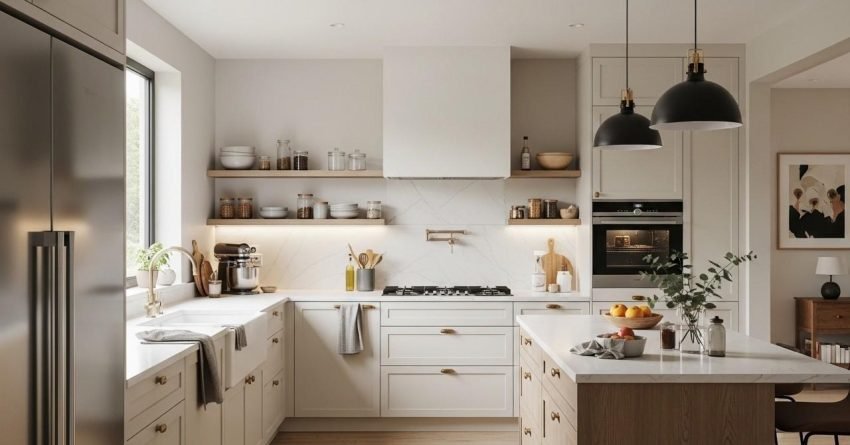
We follow a set of proven principles on every kitchen project because they balance function, flow, and livability better than trend-driven decisions ever will. Whether you’re planning a full kitchen renovation or reconfiguring an existing layout, we’ve found these golden rules help you avoid costly mistakes and build a kitchen that genuinely works for how you live.
Kitchen design decisions made without these principles often result in poor traffic flow, inadequate storage, and spaces that look impressive but frustrate daily use. Getting the fundamentals right from the start protects your renovation budget and your long-term satisfaction.
We cover every core rule here, from the work triangle and layout selection to lighting layers, ventilation standards, clearance requirements, and budget allocation, giving Sydney homeowners a complete framework for confident kitchen planning.
What Are the Golden Rules of Kitchen Design?
The golden rules of kitchen design are a set of evidence-based principles that govern how a kitchen gets planned, proportioned, and equipped to function efficiently. These rules address spatial relationships, ergonomics, workflow, storage capacity, and material performance. Together they form the foundation of every successful kitchen renovation.
These principles emerged from decades of residential design research and were refined through practical application across thousands of kitchen projects. They aren’t aesthetic preferences. They’re functional requirements that determine whether a kitchen supports daily life or creates daily friction.
At their core, the golden rules prioritise three outcomes: efficient movement between key work zones, adequate storage for the household’s actual needs, and safe, comfortable use of every surface and appliance. Every other design decision- cabinetry style, benchtop material, splashback choice- sits on top of this functional foundation.
For Sydney homeowners, applying these rules matters given the diversity of home types across the city. Terrace houses in Newtown, apartments in Pyrmont, and family homes in the Hills District all present different spatial constraints. We use these golden rules as a consistent framework that adapts to any footprint.
Why These Rules Matter for Sydney Homeowners
Sydney’s property market places significant value on kitchen quality. A kitchen that functions poorly, regardless of how it looks, reduces liveability and can negatively affect resale value. A kitchen designed around proven principles consistently delivers strong returns, both in daily use and at the point of sale.
Beyond resale, Sydney homeowners increasingly use their kitchens as multi-functional spaces. Open-plan living arrangements, home entertaining, and the rise of working from home have all elevated the kitchen’s role in the household. A kitchen designed without clear rules struggles to accommodate this expanded function.
We believe working with a renovation contractor who applies these principles from the planning stage, rather than retrofitting them after layout decisions get made, is the single most effective way to protect your renovation investment.
The Work Triangle Rule: Efficiency at the Core of Kitchen Design
The kitchen work triangle is one of the most enduring principles in residential design. It defines the relationship between the three primary work zones in any kitchen: the refrigerator, the sink, and the cooktop. The rule states that the total distance of the triangle formed by connecting these three points falls between 4 metres and 8 metres, with no single leg shorter than 1.2 metres or longer than 2.7 metres.
This measurement range isn’t arbitrary. Research into kitchen ergonomics established that distances within this range minimise unnecessary movement during food preparation while maintaining enough separation between zones for safe, comfortable use. A triangle that’s too tight creates congestion. One that’s too large creates fatigue.
The work triangle principle also requires that no major traffic pathway crosses through the triangle. When household members or guests pass through the primary work zone during meal preparation, efficiency drops and safety risks increase, particularly around the cooktop.
How to Apply the Kitchen Work Triangle in Modern Layouts
We apply the work triangle at the layout planning stage, before cabinetry or appliances get specified. We start by identifying the fixed constraints in your kitchen: the location of existing plumbing, gas connections, and electrical supply. These determine where your sink and cooktop can realistically sit without incurring significant relocation costs.
Once fixed points are established, we position the refrigerator to complete the triangle. In most Sydney kitchens, the refrigerator is the most flexible of the three elements because it only needs a power connection. Placing it at the entry point of the kitchen, where it can be accessed without entering the primary work zone, satisfies both the triangle principle and practical household use.
We measure the three legs of the proposed triangle before finalising the layout. When any leg falls outside the recommended range, we adjust appliance or fixture positions before committing to cabinetry placement. Correcting a poorly positioned work triangle after installation is expensive and often requires structural changes.
When the Work Triangle Doesn’t Work (and What to Use Instead)
The traditional work triangle was developed for single-cook kitchens. In households where two or more people regularly cook simultaneously, the triangle can create conflict rather than efficiency. Modern kitchen design has responded with the concept of work zones, dedicated areas for preparation, cooking, cleaning, and storage that function independently of one another.
The work zone approach divides the kitchen into distinct activity areas, each with its own surface space, storage, and access to utilities. A preparation zone sits adjacent to the refrigerator with a dedicated section of benchtop. A cooking zone centres on the cooktop and oven with immediate access to cookware storage. A cleaning zone surrounds the sink and dishwasher with nearby storage for cleaning products and dishes.
For open-plan kitchens with islands, increasingly common in Sydney renovations, the zone approach often delivers better outcomes than the triangle. The island typically functions as the preparation zone, while the perimeter cabinetry houses the cooking and cleaning zones. This separation allows multiple users to work simultaneously without crossing paths.

The Golden Rule of Kitchen Layout: Choosing the Right Floor Plan
Kitchen layout is the structural decision that all other design choices depend on. The layout determines traffic flow, storage capacity, appliance placement, and the relationship between the kitchen and adjacent living spaces. Choosing the wrong layout for your space and lifestyle is the most common, and most costly, kitchen design mistake we see.
There are five primary kitchen layouts used in residential design: single-wall, galley, L-shaped, U-shaped, and island or peninsula configurations. Each suits different room dimensions, household sizes, and living arrangements. Our golden rule of layout selection is simple: match the layout to the space and the household, not to a trend or a showroom display.
Single-Wall and Galley Kitchen Layouts
A single-wall kitchen places all cabinetry, appliances, and the sink along one wall. This layout suits small apartments, studio configurations, and spaces where the kitchen occupies one end of a combined living and dining area. The work triangle collapses into a work line here, with the refrigerator, sink, and cooktop arranged in sequence along the single run.
The primary limitation of a single-wall layout is benchtop length. With all elements on one wall, available preparation space is often insufficient for households that cook regularly. Adding a small island or breakfast bar perpendicular to the main run addresses this limitation without significantly increasing the kitchen’s footprint.
A galley kitchen uses two parallel runs of cabinetry facing each other, creating a corridor between them. This layout works efficiently for single-cook households and suits narrow, elongated spaces common in Sydney terrace houses and older apartment buildings. We recommend a minimum aisle width of 1,000mm between opposing runs for a single-cook galley and 1,200mm where two cooks regularly use the space simultaneously.
L-Shaped and U-Shaped Kitchen Configurations
An L-shaped kitchen distributes cabinetry and appliances across two adjacent walls, forming a right angle. This layout suits medium-sized kitchens and integrates naturally into open-plan living because the open corner allows easy connection to dining and living areas. The L-shape accommodates the work triangle effectively, with the sink typically positioned at the corner or along one leg and the cooktop and refrigerator on the other.
Corner storage in L-shaped kitchens needs careful planning. Standard corner base cabinets waste significant space unless fitted with a carousel, pull-out system, or Le Mans mechanism. Specifying the corner storage solution at the design stage, rather than treating it as an afterthought, recovers usable storage that would otherwise be lost.
A U-shaped kitchen wraps cabinetry around three walls, creating the most storage-dense and work-efficient layout available. This configuration suits larger kitchens and households that cook frequently. We recommend a minimum width of 1,200mm between opposing runs in a U-shaped kitchen, with 1,500mm preferred where space allows.
Island and Peninsula Layouts for Open-Plan Living
Kitchen islands have become the defining feature of contemporary Sydney kitchen renovations. An island is a freestanding cabinetry unit positioned in the centre of the kitchen, providing additional benchtop space, storage, and often seating. A peninsula is a connected version, attached to the main cabinetry run at one end, suited to spaces where a fully freestanding island would restrict circulation.
Our golden rule for island sizing requires a minimum of 900mm of clear circulation space on all sides of the island. In practice, a kitchen needs a minimum overall width of approximately 3,600mm to accommodate a standard 900mm-wide island with adequate clearance on both sides. Islands installed in kitchens that are too narrow create the exact circulation problems they’re meant to solve.
Islands that incorporate a sink or cooktop require plumbing or gas connections through the floor, adding cost and complexity to the renovation. We factor these decisions into the project budget at the design stage, before construction begins.
Storage First: The Rule That Separates Functional Kitchens from Beautiful Ones
Inadequate storage is the most frequently cited complaint among homeowners after a kitchen renovation. It’s also the most preventable. Our storage-first rule requires that storage capacity be calculated and specified before any aesthetic decisions get made. Cabinetry style, door profiles, and hardware are secondary to whether the kitchen can actually hold everything the household needs.
A practical starting point is inventorying your current kitchen: every item that needs storing, from cookware and appliances to pantry goods, cleaning products, and tableware. This inventory becomes the brief for your storage design. A kitchen that can’t accommodate your actual possessions will frustrate you regardless of how well it photographs.
Upper Cabinets, Base Cabinets, and the 600mm Rule
The standard depth for base cabinets in Australian kitchens is 600mm. This dimension comes from ergonomic research establishing the maximum comfortable reach depth for an average adult standing at a benchtop. Cabinets deeper than 600mm force users to lean forward to access the rear, reducing usability.
Upper cabinets typically run 300mm to 350mm deep, shallow enough to maintain clear sightlines and avoid head-height obstructions. Standard upper cabinet installation positions the base at 450mm above the benchtop surface. This gap accommodates standard kitchen appliances, toasters, kettles, and coffee machines, while keeping contents within comfortable reach.
Floor-to-ceiling cabinetry, increasingly popular in Sydney kitchen renovations, maximises storage volume by eliminating the dead space above standard upper cabinets. We use upper sections above 1,800mm for infrequently accessed items, seasonal cookware, bulk pantry goods, and appliances used occasionally, rather than everyday essentials.
Pantry Design, Pull-Out Drawers, and Hidden Storage Solutions
A dedicated pantry, whether a full walk-in configuration or a tall pantry cabinet, is one of the highest-value storage investments in a kitchen renovation. Pantry storage removes bulk food items from benchtop and base cabinet space, freeing those areas for cookware and preparation equipment. In Sydney kitchens where space is at a premium, a 600mm-wide tall pantry cabinet with internal pull-out shelving delivers substantial capacity within a compact footprint.
Pull-out drawers in base cabinets consistently outperform hinged doors with fixed shelving for accessibility. Items stored in pull-out drawers stay visible and reachable without crouching. We specify three-drawer configurations in base cabinets, rather than a single drawer above a hinged door, as a straightforward upgrade that improves daily kitchen function.
Concealed storage for small appliances, integrated appliance garages, lift-up door mechanisms, and dedicated appliance cabinets keep benchtops clear without relocating appliances to remote storage. Clear benchtops function better and look better, and kitchen designers consistently cite them as one of the most impactful improvements in a renovation.
The Clearance and Circulation Rules Every Kitchen Designer Follows
Clearance and circulation rules govern the physical space required for safe, comfortable movement within the kitchen. These rules derive from ergonomic standards and, in some cases, from the National Construction Code and Australian Standards that apply to residential construction. Ignoring them creates kitchens that are uncomfortable to use and, in some configurations, non-compliant with building regulations.
The fundamental principle is that every person using the kitchen simultaneously needs adequate space to move, open doors and drawers, and operate appliances without obstruction. Clearance requirements aren’t generous allowances. They’re minimum thresholds below which kitchen function is genuinely compromised.
Minimum Aisle Widths and Traffic Flow Standards
We recommend a minimum aisle width of 900mm for a single-cook kitchen, measured between the face of opposing cabinetry or between cabinetry and an island. For kitchens regularly used by two cooks simultaneously, 1,200mm is our recommended minimum. These dimensions allow one person to work at a benchtop while another passes behind without physical contact.
In kitchens that also serve as thoroughfares, connecting living areas to outdoor spaces, for example, traffic flow requirements increase. A kitchen that functions as a circulation path needs a minimum clear width of 1,000mm to accommodate passing traffic without disrupting the cook. We redirect traffic around, rather than through, the primary work zone whenever the layout allows it.
Appliance placement also affects aisle clearance. A dishwasher door, fully open, extends approximately 500mm into the aisle. A standard oven door extends a similar distance. We plan layouts so open appliance doors don’t block the primary circulation path, positioning appliances so their doors open away from high-traffic areas.
Door Swing Clearances and Appliance Placement Rules
Every hinged door in the kitchen- cabinet doors, appliance doors, room entry doors- needs a clear swing arc. Overlapping swing arcs create conflict: two doors that can’t open simultaneously, or a door that blocks access to an adjacent appliance. We map door swings at the design stage to eliminate these conflicts before construction begins.
The refrigerator door swing is a particularly common source of clearance problems. A standard refrigerator door needs approximately 600mm of clear space to open fully. Positioned at the end of a cabinetry run adjacent to a wall, the door swing often gets obstructed. Specifying a refrigerator with a reversible door hinge, or a French door or side-by-side configuration, resolves this in constrained spaces.
Oven placement should position the oven door so it opens away from the primary traffic path. An oven at the end of a run, with its door opening toward an open area rather than across an aisle, allows safe removal of hot dishes without collision risk.
The Electrical Rule: Power Point Placement That Actually Works
Electrical planning is one of the most overlooked golden rules in kitchen design, largely because it happens invisibly behind cabinetry. We treat power point placement as a functional requirement, not an afterthought bolted on after cabinetry gets installed.
Benchtop power points should sit above the splashback line, typically 150mm to 200mm above the benchtop surface, spaced no more than 1,200mm apart along any continuous run. This spacing ensures small appliances, kettles, mixers, and blenders always have a nearby outlet without relying on extension cords across wet zones.
Dedicated circuits matter for high-draw appliances. Ovens, induction cooktops, and dishwashers each need their own dedicated circuit rather than sharing a general power circuit with lighting or benchtop outlets. We plan circuit allocation early, because retrofitting dedicated circuits after cabinetry installation means cutting into finished walls.
Island benches need power just as much as perimeter runs. We route power to islands through the floor at the design stage, before slab work or flooring gets finalised, since running power to an island after the fact is one of the most expensive electrical corrections in a kitchen renovation.
Small Kitchen Rules Making Compact Spaces Work Harder
Sydney’s mix of terrace houses, inner-city apartments, and older federation homes means many of our clients work with genuinely compact kitchens. The golden rules still apply, but they get applied with tighter tolerances and smarter substitutions.
In a small kitchen, we prioritise vertical storage over horizontal footprint. Floor-to-ceiling cabinetry, tall pantry units, and wall-mounted rail systems recover storage that a small floor plan can’t otherwise provide. A single-wall or galley layout, rather than an L-shape or island configuration, usually makes better use of a compact footprint.
Reflective and light-enhancing materials matter more in small kitchens than large ones. Glass splashbacks, light-coloured benchtops, and under-cabinet lighting all help a compact kitchen read as larger than its actual dimensions. We also favour handleless or slimline hardware in tight galley kitchens, since protruding handles reduce the effective aisle width in already-narrow spaces.
Where an island genuinely won’t fit within our 900mm clearance rule, a fold-down or pull-out benchtop extension often delivers similar functional benefit without permanently occupying floor space.
Lighting Rules for a Kitchen That Works Day and Night
Kitchen lighting is one of the most underspecified elements in residential renovations. Many kitchens get designed with a single overhead light source, a ceiling-mounted fitting or a row of downlights, that provides general illumination but fails to adequately light the surfaces where work actually happens. Our golden rule of kitchen lighting requires three distinct layers: task lighting, ambient lighting, and accent lighting.
Each layer serves a different purpose and operates at a different height and intensity. Designing all three layers into the kitchen from the outset, rather than adding them as afterthoughts, produces a kitchen that’s safe, functional, and visually comfortable across all times of day.
Task Lighting, Ambient Lighting, and Accent Lighting Layers
Task lighting illuminates specific work surfaces directly. Its purpose is to eliminate shadows on benchtops, the cooktop, and the sink, the areas where precision and visibility matter most. Under-cabinet lighting is the primary task lighting solution for benchtop surfaces, while recessed downlights positioned directly above the cooktop and sink provide task illumination for those specific zones.
The critical rule for task lighting placement is that the light source must sit between the user and the work surface, not behind the user. A ceiling-mounted downlight positioned behind a person standing at the benchtop casts their shadow directly onto the work surface, defeating the light’s purpose entirely. Under-cabinet lighting eliminates this problem by positioning the source at the front edge of the upper cabinet.
Ambient lighting provides the general illumination level for the kitchen as a whole. Recessed downlights on a dimmer circuit are the most flexible ambient solution, letting the kitchen transition from bright task-oriented illumination during cooking to softer lighting during dining. We target 300 to 500 lux for ambient lighting, with task zones requiring 500 to 750 lux.
Accent lighting serves an aesthetic function, highlighting architectural features, open shelving, or glass-fronted cabinetry. It’s the least functionally critical of the three layers, but it contributes significantly to perceived quality and atmosphere. LED strip lighting inside glass-fronted cabinets, toe-kick lighting, and feature pendants over an island all fall into this category.
Under-Cabinet Lighting and Pendant Placement Guidelines
Under-cabinet lighting should be installed at the front edge of the upper cabinet, not the rear, to project light forward onto the benchtop. LED strip lighting is our preferred solution due to its low heat output, long service life, and even distribution. Warm white LEDs (2,700K to 3,000K) complement most kitchen finishes better than cool white alternatives.
Pendant lights over a kitchen island are one of the most visually impactful elements in a contemporary kitchen. Our golden rule for pendant placement positions the base of the pendant at 700mm to 800mm above the benchtop surface, providing adequate illumination while keeping the pendant within the visual field.
Pendant spacing follows a simple rule: for a standard 900mm-wide island, two pendants spaced evenly provide balanced illumination. For islands 1,500mm or longer, we recommend three pendants, centred over the island width and positioned so they don’t align with seating positions.

The Ventilation Rule: Why Rangehood Placement Is Non-Negotiable
Kitchen ventilation is a non-negotiable functional requirement, not an optional upgrade. Cooking generates steam, grease particles, combustion byproducts, and odours that, without adequate extraction, accumulate in the kitchen and adjacent living spaces. Inadequate ventilation causes grease buildup on surfaces, moisture damage to cabinetry, and persistent odours over time.
In Sydney, kitchen ventilation requirements are governed by the National Construction Code and Australian Standard AS 1668.2, which specifies minimum ventilation rates for habitable spaces. For residential kitchens, the standard requires mechanical ventilation capable of providing a minimum of 40 litres per second of extraction when cooking. Most quality rangehoods significantly exceed this minimum.
Rangehood Sizing, Ducting, and Australian Standards for Kitchen Ventilation
Our golden rule for rangehood sizing is that the rangehood should be at least as wide as the cooktop it serves, ideally 150mm wider on each side. A 600mm cooktop needs a minimum 600mm rangehood, with a 900mm rangehood preferred. This sizing ensures rising steam and grease particles get captured within the extraction zone.
Rangehood mounting height above the cooktop affects both extraction efficiency and safety. We recommend a mounting height of 650mm to 750mm above a gas cooktop and 600mm to 700mm above an electric or induction cooktop. Mounting too high reduces extraction efficiency. Mounting too low creates a fire risk and obstructs the cook’s view.
Ducted rangehoods, which exhaust air to the exterior of the building, are significantly more effective than recirculating models that filter air and return it to the kitchen. We always prefer a ducted installation where ducting to an external wall or roof is feasible. Recirculating rangehoods remain an acceptable alternative only where ducting genuinely isn’t possible, such as apartments where building rules prohibit external penetrations.
Duct diameter affects extraction performance. A 150mm diameter duct is the minimum we recommend for residential rangehood installations. Reducing duct diameter with adapters increases airflow resistance and reduces extraction efficiency, often to the point where the rangehood fails to meet the minimum ventilation standard despite being a quality unit.
Splashback, Benchtop, and Material Selection Rules
Material selection in kitchen design involves both aesthetic and functional decisions. Our golden rule is that functional performance takes precedence over visual appeal. A benchtop that looks exceptional but stains, chips, or requires intensive maintenance will frustrate its owners within months. A splashback that’s difficult to clean creates a hygiene problem in the most hygiene-sensitive room in the home.
We evaluate material selection against four criteria: durability under your kitchen’s specific conditions, maintenance requirements relative to your household’s habits, compatibility with adjacent materials, and cost relative to your overall budget.
Benchtop Height Standards and Ergonomic Design Principles
Standard benchtop height in Australian kitchens is 900mm from finished floor level. This dimension suits users of average height, approximately 165cm to 180cm, for standing food preparation tasks. The ergonomic principle behind this standard is that the benchtop surface should sit approximately 100mm to 150mm below the user’s elbow, allowing comfortable downward pressure without shoulder strain.
For households where primary users are significantly taller or shorter than average, adjusting benchtop height is worth considering. A 40mm increase in benchtop height, to 940mm, makes a meaningful ergonomic difference for users over 185cm. Custom height benchtops add minimal cost when specified at the design stage but are expensive to modify after installation.
Benchtop thickness affects both the visual weight of the kitchen and the structural requirements of the supporting cabinetry. Standard laminate and engineered stone benchtops run 20mm to 40mm thick. Thicker benchtops, 60mm to 80mm, create a more substantial visual presence and often get used as a design feature on island benchtops.
The Colour and Finish Balance Rule
Beyond function, a simple proportion guideline helps balance a kitchen’s visual composition. We generally apply a 60/30/10 split: one dominant material or colour for cabinetry, a secondary material for benchtops, and an accent material for the splashback or hardware.
This ratio prevents kitchens from looking either flat and monotone or visually chaotic. Getting this balance right doesn’t override the functional rules above. It simply ensures the finished kitchen looks cohesive once every functional decision has already been made.
Choosing Splashback and Surface Materials That Last
The splashback zone, the wall area between the benchtop and upper cabinets, gets exposed to heat, moisture, grease, and cleaning products daily. Material selection here must prioritise cleanability and heat resistance above all other considerations.
Ceramic and porcelain tiles remain the most widely used splashback material in Sydney kitchens due to their durability and ease of cleaning. Large-format tiles (600mm x 300mm or larger) reduce grout lines, the primary maintenance challenge in tiled splashbacks. Rectified tiles with minimal grout joints are our preferred specification for contemporary kitchens.
Glass splashbacks offer a seamless, grout-free surface that’s exceptionally easy to clean and reflects light effectively in smaller kitchens. Toughened glass panels resist heat well, though they’re susceptible to visible scratching over time. Engineered stone splashbacks create a cohesive visual effect but require sealing and aren’t recommended directly behind gas cooktops due to heat sensitivity.
For benchtop materials, engineered stone dominates the Sydney market due to its combination of durability, low maintenance, and design versatility. Porcelain slabs offer superior heat and scratch resistance as an emerging alternative. Natural stone, granite and marble, remains popular for premium renovations but requires regular sealing and stains more easily than engineered alternatives.
The Budget Allocation Rule: How to Spend Wisely on a Kitchen Renovation
Kitchen renovation budgets in Sydney vary enormously, from entry-level refreshes under $15,000 to full custom renovations exceeding $80,000. Our budget allocation rule provides a framework for distributing available funds across key cost categories to maximise functional and financial return.
We allocate the largest share of budget to the elements with the greatest impact on daily function and long-term durability: cabinetry, benchtops, and appliances. Aesthetic elements, splashbacks, hardware, and lighting fixtures get specified after functional priorities are funded, not before.
Where to Invest and Where to Save in a Kitchen Renovation
Cabinetry is the single largest cost component in most kitchen renovations, typically representing 35% to 45% of the total budget. It’s also where quality investment delivers the most durable return. Cabinet boxes built from moisture-resistant board, soft-close hinges and drawer runners, and quality internal fittings outlast cheaper alternatives by a decade or more.
Appliances represent another area where quality investment delivers measurable long-term value. A quality induction cooktop, oven, and rangehood from a reputable manufacturer will outperform budget alternatives in performance and longevity. Appliance replacement mid-renovation, or within a few years of completion, is a high unplanned cost that quality specification avoids.
Areas where cost savings are more achievable without compromising outcomes include splashback materials (standard tiles perform as well as premium alternatives in most applications), lighting fixtures (LED downlights are highly cost-effective), and hardware (handles and knobs are inexpensive to upgrade later). Flooring, where the kitchen connects to adjacent living areas, is often better addressed as part of a broader flooring project.
Typical Kitchen Renovation Costs in Sydney, NSW
Kitchen renovation costs in Sydney reflect the city’s high labour rates, material costs, and the complexity of working within existing residential structures. The following ranges represent typical project costs for Sydney homeowners based on standard renovation scope.
An entry-level kitchen renovation, replacing cabinetry, benchtops, and appliances within an existing layout without structural changes, typically costs between $15,000 and $25,000. This range assumes standard cabinetry, laminate or entry-level engineered stone benchtops, and mid-range appliances.
A mid-range kitchen renovation, including layout reconfiguration, quality cabinetry, engineered stone benchtops, quality appliances, and updated electrical and plumbing, typically costs between $25,000 and $50,000. This is the most common renovation tier for Sydney owner-occupiers.
A premium kitchen renovation, featuring custom cabinetry, premium stone benchtops, high-end European appliances, structural modifications, and bespoke design elements, typically costs between $50,000 and $100,000 or more.
Labour costs in Sydney typically represent 30% to 40% of the total kitchen renovation budget. This includes cabinetry installation, benchtop fabrication and installation, tiling, electrical work, plumbing, and project management. Engaging unqualified tradespeople to cut labour costs is a common source of budget overruns and quality failures.

Working With a Kitchen Designer vs. DIY Planning: What Sydney Renovators Need to Know
The decision to engage a professional kitchen designer or manage the planning process independently significantly affects both the outcome and the cost of a kitchen renovation. For straightforward projects within an existing layout, experienced homeowners with a clear brief can achieve good results through careful self-directed planning. For projects involving layout changes or structural modifications, professional design input consistently delivers better outcomes.
A professional kitchen designer brings technical knowledge of spatial planning, product specifications, and construction requirements that most homeowners don’t possess. They identify clearance conflicts, storage deficiencies, and ventilation problems at the planning stage, before they become expensive construction problems.
In Sydney, kitchen designers typically charge between $1,500 and $5,000 for a full design service, depending on project complexity. Many kitchen renovation contractors include design coordination as part of their end-to-end service, integrating design and construction under a single point of accountability. This reduces the risk of miscommunication between designer and builder, a common source of delays and cost overruns.
For homeowners who plan independently, the golden rules outlined here provide a reliable framework. The critical discipline is completing the functional planning, layout, work triangle or zones, storage inventory, clearance mapping, and ventilation specification before making any aesthetic decisions.
Conclusion
The golden rules of kitchen design, from the work triangle and layout selection to storage planning, clearance standards, ventilation, lighting, and material performance, form a complete framework for any kitchen renovation. Applied consistently from the planning stage, these principles produce kitchens that function efficiently, age well, and deliver lasting value.
Getting these fundamentals right before making aesthetic decisions is what separates renovations that satisfy for decades from those that disappoint within years. Every rule in this guide exists because its absence creates a measurable problem in daily kitchen use.
At Sydney Home Renovation, we apply these principles to every kitchen project we deliver, combining technical design knowledge with honest cost guidance and skilled construction to ensure your kitchen renovation is built right from the start. We’d love to discuss your project, so get in touch with our team today.
Frequently Asked Questions
What is the golden rule of kitchen design?
The golden rule of kitchen design is that function precedes form. We evaluate every layout, storage, and material decision first on functional merit- how it supports efficient, safe, comfortable use- before applying aesthetic considerations.
What is the 1/3 rule in kitchen design?
The 1/3 rule is a visual proportion guideline dividing kitchen elements into thirds for balanced composition. We most commonly apply it to material selection, using one dominant material for cabinetry, a secondary material for benchtops, and an accent for the splashback.
How much space do you need between kitchen benches?
We recommend a minimum of 900mm between opposing kitchen benches for a single-cook kitchen and 1,200mm where two people regularly cook simultaneously. These dimensions allow comfortable movement and safe appliance operation.
What is the most important element of kitchen design?
Layout is the most important element because it determines every other functional outcome, traffic flow, work efficiency, storage capacity, and appliance accessibility. A well-laid-out kitchen with modest finishes outperforms a beautifully finished kitchen with a poor layout.
How do I plan a kitchen layout from scratch?
We start by measuring the room accurately and identifying fixed constraints, plumbing, gas, electrical, windows, and doors. Then we apply the work triangle or zone principle, map clearances and door swings, and calculate storage needs before finalising cabinetry.
What are the most common kitchen design mistakes to avoid?
The most common mistakes include insufficient storage planning, inadequate aisle clearance, poor ventilation specification, task lighting that casts shadows on work surfaces, and prioritising aesthetics over function in material selection.
How much does a kitchen renovation cost in Sydney?
Kitchen renovation costs in Sydney range from approximately $15,000 to $25,000 for an entry-level project, $25,000 to $50,000 for a mid-range renovation, and $50,000 to $100,000 or more for a premium custom kitchen.
How do the golden rules change for a small kitchen?
In a small kitchen, we prioritise vertical storage, simpler layouts like single-wall or galley configurations, and light-reflective materials. The same functional rules apply, just with tighter tolerances and smarter substitutions for limited floor space.