
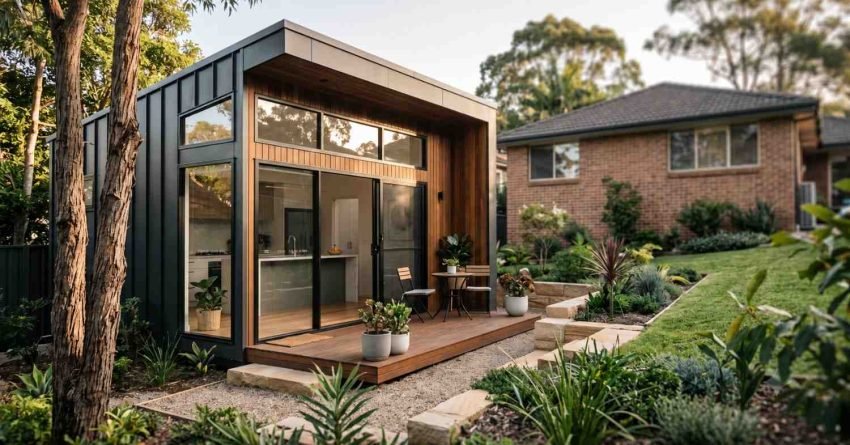
A granny flat is a self-contained secondary dwelling built on the same lot as a primary residence, providing a fully independent living space with its own kitchen, bathroom, and sleeping area. In Sydney and across NSW, granny flats have become one of the most financially compelling property decisions available to homeowners and investors, delivering rental income, housing flexibility, and measurable property value uplift from a single construction project.
Sydney’s housing affordability pressures and NSW’s streamlined Complying Development pathway have made granny flats more accessible than at any point in the past two decades. Demand from both builders and renters continues to grow.
This guide covers every dimension of the granny flat decision: what they are, the types available, regulations and approvals, costs, designs, rental returns, choosing a builder, the construction process, and how granny flats compare to other property additions.
What Is a Granny Flat?
A granny flat, formally known as a secondary dwelling under NSW planning legislation, is a self-contained residential unit located on the same lot as a principal dwelling. It must include its own kitchen, bathroom, laundry facilities, and sleeping area, and it must function as a fully independent living space.
The term “granny flat” is colloquial. The legal definition under the NSW State Environmental Planning Policy (Housing) 2021 is “secondary dwelling,” and this distinction matters when it comes to approvals, zoning eligibility, and what you can and cannot do with the property.
Definition and Legal Status in NSW
Under NSW planning law, a secondary dwelling is permitted on most residential lots across the state, subject to minimum lot size requirements, setback rules, and site coverage limits. The key threshold is a minimum lot size of 450 square metres for Complying Development approval, the faster, more streamlined pathway that bypasses the full Council Development Application process.
Granny flats are not the same as dual occupancies, duplexes, or boarding houses. They are a distinct dwelling category with their own planning controls, and understanding that distinction is the starting point for any granny flat project.
How Granny Flats Differ from Other Dwellings
Unlike a house extension, a granny flat creates a genuinely separate living environment. Unlike a duplex, it cannot be separately titled or sold as an independent property under standard NSW planning rules. Unlike a boarding house, it is designed for a single household rather than multiple unrelated occupants.
This combination of independence and shared lot status is what makes granny flats uniquely flexible. They can house family members, generate rental income, or serve as a home office or studio, all within the same property boundary.
The maximum internal floor area under the Complying Development pathway is 60 square metres, and setback requirements, site coverage limits, and height controls all apply on top of that. Confirming these dimensions against your specific block is one of the first steps in any granny flat project.
Types of Granny Flats in Sydney
Sydney homeowners have several structural options when it comes to granny flat design, and the right choice depends on block size, budget, existing structures, and how the dwelling will be used. The three primary types are detached granny flats, attached granny flats, and conversion-based solutions such as garage or studio conversions.
Detached Granny Flats
A detached granny flat is a fully standalone structure built separately from the main house, typically positioned at the rear of the block. It shares no walls with the principal dwelling and offers the greatest level of privacy and independence for both occupants.
Detached builds are the most popular granny flat type in Sydney because they maximise separation, allow for flexible positioning on the block, and tend to achieve the highest rental returns due to their privacy appeal. They are also the most straightforward to design as a purpose-built dwelling rather than an adaptation of existing space.
Attached Granny Flats
An attached granny flat shares at least one wall with the main house. This configuration is typically chosen when block size limits the available footprint for a standalone structure, or when the homeowner wants to minimise construction costs by sharing a structural wall.
Attached builds are generally less expensive than detached options because they require less external cladding, roofing, and foundation work. The trade-off is reduced acoustic and visual privacy for both households, which affects both liveability and rental appeal.
Garage Conversions and Studio Flats
Converting an existing garage, studio, or outbuilding into a secondary dwelling is a cost-effective option for homeowners who already have a suitable structure on their block. The existing slab, walls, and roof reduce the scope of new construction work.
Compliance upgrades are typically required to meet habitable space standards: insulation, waterproofing, electrical rewiring, and plumbing connections are the most common items. The savings on structure are real, but the compliance scope should be assessed by a builder before assuming a conversion will be significantly cheaper than a new build.
Prefab and Kit Granny Flats in Sydney
Prefabricated and kit granny flats have grown in popularity as a faster, more cost-predictable alternative to traditional site-built construction. A prefab granny flat is manufactured off-site in panels or modules and assembled on your block, while a kit home supplies pre-cut materials for on-site construction by a licensed builder.
The primary appeal is speed. A prefab build can reach lock-up stage in days rather than weeks, which reduces holding costs and shortens the overall project timeline. Kit homes offer a similar advantage in terms of material cost certainty, since the package price is fixed at the point of order.
Cost and Approval Considerations for Prefab Builds
Prefab and kit granny flats in Sydney typically cost between $90,000 and $180,000 fully installed, depending on the manufacturer, size, and site conditions. That range overlaps with traditional builds at the lower end, but the real advantage is timeline: a prefab project can reach practical completion in eight to twelve weeks from approval, compared to twelve to twenty weeks for a conventional build.
Approval requirements are identical to those for site-built secondary dwellings. A prefab granny flat still requires either Complying Development approval or a Council DA, and it must meet the same NSW Housing SEPP standards for floor area, setbacks, and site coverage. The manufacturer’s documentation package typically includes the engineering certificates and energy efficiency reports required for the approval application.
The trade-off is design flexibility. Prefab and kit options come in standard configurations, and customisation beyond the manufacturer’s range adds cost and time. For homeowners with straightforward blocks and standard layout requirements, a prefab build is worth serious consideration. For those with complex sites or specific design briefs, a custom site-built approach gives more control over the outcome.
Granny Flat Regulations and Approval in Sydney
Approval is the step that stops more granny flat projects than any other. Understanding the two available pathways, Complying Development and Council Development Application, and knowing which one applies to your property is essential before any design work begins.
NSW Complying Development vs. Council DA
Complying Development (CDC) is the faster approval pathway. If your property meets the eligibility criteria set out in the NSW Housing SEPP, a private certifier can approve your granny flat without any involvement from your local council. Approvals under this pathway typically take two to four weeks.
A Council Development Application (DA) is required when a property does not meet the CDC criteria, for example if the lot is smaller than 450 square metres, if the property is in a heritage conservation area, or if the proposed design exceeds the standard development controls. DA approvals typically take three to six months and involve a more detailed assessment process.
Key Eligibility Requirements
The core eligibility criteria for Complying Development approval in NSW include:
- Minimum lot size of 450 square metres
- The lot must be zoned for residential use
- The granny flat must not exceed 60 square metres of internal floor area
- Minimum setbacks from boundaries must be maintained (typically 900mm to 3 metres depending on wall height and boundary type)
- Total site coverage must not exceed the permitted maximum for the zone
One of the most common questions Sydney homeowners ask before starting is whether council approval is required on their specific property. The answer depends on lot size, zoning, and which approval pathway your project qualifies for. Navigating this correctly from the start saves months of delays and thousands in unexpected costs.
How Much Does a Granny Flat Cost in Sydney?
Cost is the central question in every granny flat conversation, and the honest answer is that it varies significantly depending on type, size, site conditions, finishes, and the builder you choose. In Sydney, a realistic budget range for a complete granny flat build, from design and approvals through to handover, sits between $120,000 and $250,000 for most standard projects, with premium builds or complex sites pushing higher.
Cost Ranges by Type and Size
| Granny Flat Type | Typical Sydney Cost Range |
| Studio / 1-bedroom detached (up to 40sqm) | $120,000 – $160,000 |
| 1-bedroom detached (40–50sqm) | $140,000 – $180,000 |
| 2-bedroom detached (50–60sqm) | $170,000 – $250,000 |
| Attached granny flat | $100,000 – $180,000 |
| Garage conversion | $60,000 – $120,000 |
| Prefab/kit granny flat (installed) | $90,000 – $180,000 |
These ranges reflect total project costs including design, approvals, construction, and standard inclusions. They do not account for site-specific variables that can add materially to the final figure.
What Drives Granny Flat Costs Up or Down
The most significant cost variables in a Sydney granny flat project are:
Site conditions: Sloping blocks, poor soil bearing capacity, high water tables, and difficult access all increase excavation, foundation, and site preparation costs. A flat, accessible block with good soil conditions is the most cost-efficient scenario.
Finishes and inclusions: Standard inclusions, laminate benchtops, basic appliances, entry-level tapware, keep costs at the lower end of the range. Upgrading to stone benchtops, quality fixtures, and premium flooring can add $15,000 to $30,000 to the total.
Approval pathway: CDC approval is faster and cheaper than a Council DA. Projects requiring a DA incur additional consultant fees, longer holding costs, and the risk of conditions that require design changes.
Builder selection: Fixed-price contracts from experienced builders provide cost certainty. Cost-plus arrangements or inexperienced operators are the most common source of budget blowouts.
Building on a Sloping Block
A sloping block is one of the most significant cost variables in Sydney granny flat construction, and it is frequently underestimated at the quoting stage. Where a flat block might require a standard slab at a cost of $15,000 to $25,000, a sloping block can require a suspended slab, pier-and-beam subfloor, or significant cut-and-fill earthworks, pushing the foundation cost to $30,000 to $60,000 or more depending on the degree of slope and soil conditions.
The additional cost is not just structural. Sloping sites often require retaining walls, additional drainage, and more complex access for construction vehicles, all of which add to the final figure. If your block has a significant slope, get a site-specific geotechnical assessment and a detailed foundation quote before committing to a total project budget.
Hidden Costs to Budget For
Several costs are frequently underestimated or omitted from initial quotes:
Utility connections: Connecting water, sewer, stormwater, gas, and electricity to a new secondary dwelling can cost $10,000 to $30,000 depending on the distance from existing and the complexity of the connection.
Landscaping and site restoration: Excavation and construction disturb the surrounding yard. Restoring paths, fencing, and garden areas adds to the final cost.
Certifier and consultant fees: Private certifier fees, structural engineer reports, and energy efficiency assessments are typically not included in builder quotes.
Demolition of existing structures: If a garage, shed, or other structure needs to be removed to make way for the granny flat, demolition costs apply.
How to Finance a Granny Flat in Sydney
Most Sydney homeowners fund a granny flat through one of three financing structures. A home equity loan or redraw facility draws on existing equity in the principal dwelling and is the most common approach for owner-occupiers who have built up equity over time. Interest rates are typically lower than construction loan rates, and the approval process is straightforward for borrowers with sufficient equity.
A construction loan is structured to release funds in stages as the build progresses, which reduces the interest burden during construction. Lenders assess construction loans against the completed value of the property, including the granny flat, which means the loan-to-value ratio calculation is more favourable than it might appear at the outset.
Some homeowners use a combination: a redraw facility for the approval and design phase, then a construction loan for the build itself. Speaking with a mortgage broker who has experience with secondary dwelling projects is the most efficient way to identify the right structure for your situation.
Granny Flat Designs and Floor Plans
The design of a granny flat has a direct impact on its liveability, rental appeal, and construction cost. A well-designed granny flat maximises usable space within the 60-square-metre limit, creates a comfortable and functional living environment, and integrates appropriately with the main house and the surrounding block.
1-Bedroom vs. 2-Bedroom Layouts
A 1-bedroom granny flat in the 40 to 50 square metre range is the most common configuration in Sydney. It suits a single occupant or couple, delivers strong rental returns relative to build cost, and fits comfortably on most standard residential blocks.
A 2-bedroom design in the 50 to 60 square metre range suits small families or two-person households and typically commands higher weekly rent. The trade-off is a higher build cost and a larger footprint that requires more available space on the block.
Design Considerations for Sydney Blocks
Sydney’s residential blocks vary significantly in size, shape, and orientation. Effective granny flat design accounts for:
Natural light and ventilation: North-facing living areas and cross-ventilation are important for comfort and energy efficiency, particularly in Sydney’s warm climate.
Privacy from the main house: Positioning windows, entries, and outdoor areas to minimise overlooking between the two dwellings improves the living experience for both households.
Outdoor space: Even a small private courtyard or covered outdoor area significantly improves the liveability and rental appeal of a granny flat.
Parking: Some council areas require an additional off-street parking space for a secondary dwelling. Confirming this requirement early avoids late-stage design changes.
Getting the layout right at the design stage is far less expensive than redesigning mid-build. The most successful granny flat designs in Sydney treat the 60-square-metre limit not as a constraint but as a discipline, forcing every square metre to earn its place.
Granny Flat Rental Income and Investment Returns
For property investors and homeowners looking to offset their mortgage, the rental income potential of a granny flat is one of its most compelling attributes. Sydney’s tight rental market and persistent housing undersupply have made secondary dwellings an increasingly attractive income-generating asset.
Typical Rental Yields in Sydney
Weekly rental income for a granny flat in Sydney varies by suburb, size, and quality of finish. As a general guide:
| Location | 1-Bedroom Weekly Rent | 2-Bedroom Weekly Rent |
| Inner Sydney (within 10km of CBD) | $550 – $750 | $700 – $950 |
| Middle Ring (10–20km from CBD) | $450 – $600 | $550 – $750 |
| Outer Western Sydney | $350 – $500 | $450 – $600 |
These figures reflect market conditions in 2024–2025 and will vary based on property presentation, proximity to transport, and local vacancy rates.
Return on Investment Considerations
A granny flat costing $180,000 to build in a middle-ring Sydney suburb generating $500 per week in rent produces a gross annual income of approximately $26,000, a gross yield of around 14.4% on the construction cost alone. Even accounting for vacancy, management fees, and maintenance, the net return is substantially higher than most alternative investments at a comparable capital outlay.
Beyond rental income, granny flats typically add between $100,000 and $200,000 to the market value of a Sydney property, according to industry data from property valuers and real estate agents active in the secondary dwelling market. The value uplift depends on the quality of the build, the suburb, and buyer demand for income-producing properties.
Short-Term Rental and Airbnb Considerations
Short-term rental through platforms such as Airbnb is legal for granny flats in NSW, subject to the state’s short-term rental accommodation (STRA) framework. Properties in Greater Sydney are subject to an 180-night cap per year for non-hosted short-term rentals, meaning the owner is not present on the property during the guest stay.
Weekly income from short-term rental can exceed long-term rental rates by 30 to 60 percent in well-located suburbs, particularly those near beaches, transport hubs, or tourist attractions. The trade-off is higher management effort, greater wear and tear, and income variability across seasons. Many granny flat owners in Sydney start with long-term tenants to stabilise cash flow, then reassess the short-term rental option once the property is established and the mortgage is partially offset.
Tax and Depreciation Considerations
Renting a granny flat to an unrelated tenant creates a taxable income stream, and the associated construction costs are depreciable under the Australian Tax Office’s capital works provisions. Division 43 capital works deductions apply to the structural components of the build at 2.5 percent per year over 40 years, while Division 40 plant and equipment deductions apply to removable assets such as appliances, carpet, and blinds at higher rates over shorter effective lives.
A quantity surveyor’s depreciation schedule is the most accurate way to calculate your annual deduction entitlement. For a granny flat costing $180,000 to build, the annual capital works deduction alone is approximately $4,500, which meaningfully reduces the taxable income generated by the rental. Capital gains tax implications apply when the property is sold, and the proportion of the lot used for income-producing purposes affects the CGT calculation. A tax adviser familiar with secondary dwelling investments is the right person to model this for your specific situation.
How to Choose a Granny Flat Builder in Sydney
The builder you choose will determine the quality, cost, and timeline of your project more than any other single decision. Sydney’s granny flat market includes a wide range of operators, from large volume builders offering standardised packages to smaller custom builders who work on individual projects, and the differences in quality, transparency, and accountability are significant.
What to Look for in a Builder
The most important attributes to assess when selecting a granny flat builder in Sydney are:
Licensing and insurance: Your builder must hold a current NSW contractor licence issued by NSW Fair Trading and carry both public liability and home building compensation (HBC) insurance. Verify both before signing any contract.
Experience with secondary dwellings: Granny flat construction involves specific knowledge of the NSW Housing SEPP, CDC approval processes, and the site constraints common to residential infill projects. A builder with a strong track record in secondary dwellings will navigate these requirements more efficiently than a general builder taking on their first granny flat project.
Fixed-price contracts: A fixed-price contract protects you from cost escalation during construction. Be cautious of builders who quote on a cost-plus basis or who provide estimates rather than firm prices.
References and completed projects: Ask for references from recent granny flat clients and, where possible, inspect completed projects. A reputable builder will have no hesitation providing this.
Questions to Ask Before Signing a Contract
Before committing to any builder, ask:
- Is the quoted price fixed, and what are the exclusions?
- Who manages the approval process, the builder or the client?
- What is the realistic construction timeline from approval to handover?
- How are variations handled, and what triggers a variation cost?
- What warranty applies to the completed work?
Selecting the right builder is the single decision that most determines whether your project finishes on time, on budget, and to the standard you expect.
Owner-Builder Granny Flats: What You Need to Know
An owner-builder licence from NSW Fair Trading allows homeowners to manage their own construction project, coordinating trades directly rather than engaging a licensed builder as the principal contractor. The appeal is cost savings on the builder’s margin, which typically runs at 15 to 20 percent of the total project cost.
The reality is more complex. Owner-builders are personally responsible for site safety, trade coordination, compliance with the Construction Certificate conditions, and the quality of all work. Home building compensation insurance is not available for owner-builder projects, which affects the property’s saleability for six years after completion. For most homeowners, the savings are outweighed by the risk, time commitment, and the complexity of managing a multi-trade construction project without professional experience.
The Granny Flat Building Process: What to Expect
Understanding the construction process from start to finish helps homeowners set realistic expectations, plan around disruption, and hold their builder accountable at each stage. A granny flat project in Sydney typically moves through three distinct phases: design and approval, construction, and fit-out and handover.
Stage 1: Design, Approval, and Planning
The project begins with a site assessment and design brief. Your builder or designer will assess the block, confirm eligibility for Complying Development or identify the need for a Council DA, and develop a set of architectural drawings and specifications.
Once the design is finalised, the approval application is lodged, either with a private certifier for CDC or with the local council for a DA. During this period, structural engineering, energy efficiency assessments, and any required specialist reports are completed.
CDC approvals typically take two to four weeks. Council DA approvals typically take three to six months. This stage is the most variable in terms of timeline and is the most common source of project delays.
Stage 2: Construction and Site Works
Once approval is granted and a Construction Certificate is issued, physical construction begins. The typical construction sequence for a detached granny flat is:
- Site preparation and excavation
- Slab or subfloor construction
- Frame erection (timber or steel)
- Roof structure and weatherproofing
- External cladding and windows
- Rough-in of plumbing, electrical, and mechanical
- Insulation and internal lining
- Internal fit-out (joinery, tiling, fixtures)
- External works (paths, fencing, landscaping)
Mandatory inspections occur at key stages during construction. The certifier typically inspects at slab/footings, frame, waterproofing, and final completion. Each inspection must be passed before the next stage proceeds, so trade scheduling and inspection booking need to be coordinated carefully to avoid delays.
Construction of a standard granny flat in Sydney typically takes eight to sixteen weeks from slab pour to practical completion, depending on the size of the build, weather conditions, and trade availability.
Stage 3: Fit-Out, Inspections, and Handover
The final stage covers the installation of kitchen and bathroom fixtures, appliances, flooring, painting, and all finishing works. A series of mandatory inspections are conducted by the certifier at key stages, typically at frame, waterproofing, and final completion.
At practical completion, the certifier issues an Occupation Certificate, which is the legal document confirming the dwelling is fit for habitation. The builder then hands over the keys, warranties, and all relevant documentation.
From initial design to Occupation Certificate, a typical Sydney granny flat project takes four to eight months in total. CDC projects at the faster end of that range; DA projects at the longer end.
Granny Flat vs. Other Property Additions: Which Is Right for You?
A granny flat is not the only way to add value, space, or income to a Sydney property. Homeowners weighing their options should understand how a secondary dwelling compares to the two most common alternatives: a house extension and a duplex.
Granny Flat vs. House Extension
A house extension increases the floor area of the main dwelling. It is the right choice when the goal is to add living space for the existing household, an extra bedroom, a larger kitchen, or an additional living area. Extensions do not generate rental income and do not create an independent living space.
A granny flat, by contrast, creates a separate dwelling that can be rented, used for family members, or left vacant as a future income asset. For homeowners whose primary goal is income generation or housing flexibility rather than expanding their own living space, a granny flat typically delivers a stronger financial return.
House extensions in Sydney are the better choice when the block is too small for a secondary dwelling, when the homeowner’s primary need is additional space for the existing household, or when zoning prevents secondary dwelling construction. The two options serve different goals, and the right answer depends on what the homeowner actually needs from the property.
Granny Flat vs. Duplex
A duplex involves constructing two separate dwellings on a single lot, each with its own title. Duplexes require larger blocks, higher construction budgets, and more complex approval processes than granny flats. However, they offer a significant advantage: each dwelling can be sold independently, allowing the owner to realise capital gains on both properties.
Duplex construction in Sydney typically requires a minimum lot size of 600 square metres or more depending on the local planning controls, and total project costs commonly run from $600,000 to $1,200,000 for a dual-occupancy development. Investors with larger blocks and stronger development budgets may find that a duplex delivers a higher total return than a single granny flat, particularly in suburbs where dual-occupancy zoning allows both dwellings to be sold or rented independently.
For most Sydney homeowners on standard residential lots, a granny flat is the more accessible and financially efficient option. The duplex pathway suits a narrower set of properties and budgets.
Is a Granny Flat Worth It in Sydney?
For most Sydney homeowners and property investors, the answer is yes, provided the project is planned carefully, approved correctly, and built by a qualified and experienced contractor. The combination of rental income, property value uplift, and housing flexibility makes a well-executed granny flat one of the most financially efficient property improvements available in the current market.
Financial Case for Building a Granny Flat
The financial case rests on three pillars: construction cost, rental income, and capital value uplift. A granny flat costing $180,000 to build that generates $500 per week in rent and adds $150,000 to the property’s market value has effectively paid for itself in rental income within seven years, while simultaneously increasing the owner’s equity position.
Sydney’s rental vacancy rate has remained below 2% across most metropolitan areas throughout 2024 and into 2025, according to Domain’s rental market data, meaning well-presented granny flats in accessible locations are consistently tenanted with minimal vacancy periods. The NSW Government’s ongoing commitment to housing supply, including the retention of the streamlined CDC pathway for secondary dwellings, means the regulatory environment remains favourable for granny flat construction in the near term.
Council Rates and Land Tax Considerations
Building a granny flat increases the improved value of your property, which typically results in a modest increase in council rates. The exact increase depends on your local council’s rating methodology, but most Sydney homeowners report a rates increase of $200 to $600 per year after a granny flat is added, which is easily absorbed by the rental income generated.
Land tax is a more significant consideration for investors. In NSW, land tax applies to investment properties where the total taxable land value exceeds the threshold (currently $1,075,000 for 2025). Adding a granny flat does not change the land value itself, since land tax is assessed on the unimproved land value, not the improved value. However, if you own multiple investment properties, the combined land value calculation may be affected. A tax adviser can confirm the land tax position for your specific portfolio.
Lifestyle and Family Benefits
Beyond the financial case, granny flats serve a range of lifestyle purposes that are increasingly relevant to Sydney households.
Multigenerational living is one of the most common motivations for building a granny flat in Sydney. Housing an ageing parent in a separate but proximate dwelling provides independence for both generations while keeping family close. The arrangement avoids the cost and disruption of aged care facilities for as long as the parent can live independently, and it gives adult children peace of mind without the loss of privacy that comes from sharing the main house. For families navigating this transition, a granny flat is often the most practical and emotionally sustainable solution available.
A detached granny flat also provides a genuinely separate workspace that eliminates the distractions of working from within the main house. And a granny flat built today can serve as a rental property, a family accommodation, or a home office at different stages of the owner’s life, making it a genuinely versatile long-term asset.
Conclusion
Granny flats represent one of Sydney’s most practical and financially rewarding property decisions, combining rental income, capital value growth, and genuine housing flexibility within a single, well-regulated construction project.
The sections throughout this guide cover every dimension of the decision: from cost breakdowns and design options to approval pathways, rental income modelling, and the building process, giving you the detailed information needed to move forward with confidence.
At Sydney Home Renovation, we specialise in granny flat design, approvals, and construction across Sydney. We offer obligation-free consultations to assess your block, discuss your goals, and provide a clear, honest scope, timeline, and budget for your project. Contact our team today to take the next step.
Frequently Asked Questions
How much does it cost to build a granny flat in Sydney?
A granny flat in Sydney typically costs between $120,000 and $250,000 for a complete build, depending on size, type, site conditions, and finish level. Garage conversions can start from $60,000 for simpler projects.
Do I need council approval to build a granny flat in NSW?
Most granny flats in NSW can be approved through the Complying Development pathway without council involvement, provided the lot meets the minimum 450 square metre size requirement and other eligibility criteria. Properties that do not qualify require a Council Development Application.
How long does it take to build a granny flat in Sydney?
From initial design to handover, a granny flat project in Sydney typically takes four to eight months in total. CDC approval takes two to four weeks, while construction of a standard build takes eight to sixteen weeks depending on size and site conditions.
Can I rent out my granny flat in Sydney?
Yes. Granny flats in NSW can be rented to unrelated tenants under a standard residential tenancy agreement. Weekly rents in Sydney range from approximately $350 to $750 for a one-bedroom granny flat depending on location and quality of finish.
What is the maximum size of a granny flat in NSW?
Under the NSW Housing SEPP, a secondary dwelling approved through the Complying Development pathway cannot exceed 60 square metres of internal floor area. Additional size limits may apply under Council DA pathways depending on the local planning controls.
Does a granny flat add value to my property?
Yes. A well-built granny flat typically adds between $100,000 and $200,000 to the market value of a Sydney property, in addition to generating ongoing rental income. The value uplift depends on the quality of the build, the suburb, and buyer demand for income-producing properties.
Can a granny flat be sold separately from the main house in NSW?
No. Under standard NSW planning rules, a granny flat cannot be separately titled or sold independently from the principal dwelling. Both dwellings remain on a single lot under a single title. Separate titling requires a strata or Torrens title subdivision, which is subject to different planning controls.
Do granny flats affect council rates?
Yes, modestly. Adding a granny flat increases the improved value of your property, which typically results in a council rates increase of $200 to $600 per year depending on your local council’s rating methodology.
Can I build a granny flat on a property I rent out?
Yes, provided you own the property. The granny flat is built on the land you own, and you can rent both the principal dwelling and the granny flat to separate tenants. The existing tenancy agreement for the main house may need to be reviewed to confirm the arrangement is consistent with the lease terms.


