
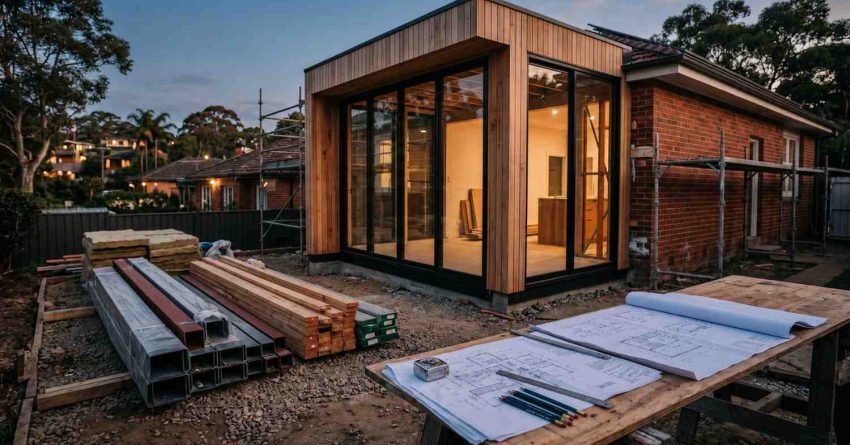
A home extension adds new living space to an existing property by building outward, upward, or both, giving homeowners the room they need without leaving the neighbourhood they love. For Sydney households facing growing families, changing work arrangements, or simply wanting more functional space, extending often makes more financial sense than selling and buying larger.
We put this guide together to cover everything needed to plan a successful extension project. The sections ahead walk through extension types, realistic costs for the Sydney market, council approval requirements, design considerations, builder selection, and what to expect during construction. Each section gives the foundation needed to make informed decisions at every stage.
What Is a Home Extension?
A home extension is a construction project that increases a property’s floor area by adding new rooms or expanding existing spaces. Unlike renovations that update or reconfigure what already exists, extensions create entirely new square metres that become part of the home’s permanent structure.
Extensions take several forms depending on the property’s constraints and the space requirements involved.
Single-Storey Extensions
Single-storey extensions build outward from the existing ground floor, typically extending into rear or side yard space. These projects suit properties with adequate land but limited vertical expansion options, such as homes in heritage areas or those with height restrictions.
Single-storey work generally costs less per square metre than going up because it avoids the structural complexity of supporting additional floors.
Double-Storey Extensions
Double-storey extensions add a complete new level above an existing home or build a two-storey addition alongside it. This approach maximises floor area on smaller blocks where ground-level expansion is limited.
Second-storey additions require more substantial structural work, including reinforcing existing foundations and walls to carry the additional load.
Rear, Side, and Front Extensions
The direction of an extension depends on the block’s shape, setback requirements, and where usable space exists. Rear extensions are most common in Sydney, pushing living areas toward the backyard and often incorporating indoor-outdoor connections.
Side extensions work well on wider blocks, while front extensions are less common due to streetscape regulations and council scrutiny.
Granny Flats and Secondary Dwellings
A granny flat, formally called a secondary dwelling under NSW planning law, is a self-contained living space built on the same lot as the primary home. Under the State Environmental Planning Policy (Housing), secondary dwellings up to 60 square metres are permitted on most residential lots in NSW without a full DA, provided the lot is at least 450 square metres.
This makes a granny flat one of the most cost-effective extension types available, with the added benefit of rental income potential. We regularly see homeowners use this pathway to fund the broader renovation program.
Extension or Renovation: How to Decide
The core question is whether the problem is about space or quality. If rooms feel cramped, circulation is awkward, or the household has simply outgrown the footprint, an extension is the right answer. If the spaces are adequate but dated, poorly finished, or functionally inefficient, a renovation delivers better value.
A useful test: if adding a room would solve the problem, extend. If reorganising or upgrading existing rooms would solve it, renovate. Many projects combine both extending the footprint while renovating the existing areas that connect to the new space.

Why Homeowners Choose to Extend
Sydney homeowners extend their properties for three primary reasons: they need more space, they want to increase their property’s value, or they have calculated that extending costs less than moving to a larger home.
Growing Family Space Requirements
Families outgrow their homes. Children need separate bedrooms, home offices have become essential for many households, and living areas that felt adequate a decade ago now feel cramped.
An extension allows homeowners to add the specific spaces they need, whether that is an extra bedroom, a larger kitchen, a dedicated study, or a combination of all three without disrupting children’s schooling or established routines.
Adding Property Value
A well-designed extension typically adds more value to a property than it costs to build. According to the Housing Industry Association, quality renovations and extensions in established Sydney suburbs regularly deliver returns of 1.5 to 2 times the construction cost when the property is sold.
The key is ensuring the extension suits the neighbourhood. In suburbs where median house prices sit between $1.5 million and $2.5 million, a $300,000 to $400,000 extension that adds a bedroom, bathroom, and open-plan living area typically adds $500,000 to $700,000 in market value, provided the result does not overcapitalise for the street. Overcapitalisation happens when the improved property’s value exceeds what buyers in that suburb are willing to pay, regardless of construction quality.
Avoiding the Cost of Moving
Selling a current home and buying a larger one involves substantial transaction costs. Stamp duty alone on a Sydney property purchase can exceed $50,000, and when real estate agent commissions, legal fees, and moving costs are added, the total transaction expense often reaches $80,000 to $120,000.
For many homeowners, that money is better invested in extending the current property. The lifestyle disruption of moving to new schools, longer commutes, and unfamiliar neighbourhoods adds a cost that does not appear on any invoice but is very real.
Planning Your Home Extension Project
The planning phase determines whether an extension project runs smoothly or becomes a source of stress and budget overruns. Investing time in thorough planning before engaging builders pays dividends throughout the construction process.
Assessing Your Current Property
Start by understanding what the property can realistically accommodate. Walk the block and note the available space in each direction. Check the property’s zoning through the local council’s online planning portal, which reveals setback requirements, height limits, floor space ratios, and any heritage or conservation overlays that affect what can be built.
Examine the existing home’s structure. Older homes may have foundations, framing, or roofing that complicates certain extension approaches. A building inspection or structural engineer’s assessment can identify potential issues before they become expensive surprises during construction.
Setting Realistic Goals and Priorities
Define what is actually needed versus what is wanted. List every space requirement, then rank them by importance. This prioritisation becomes essential when quotes come in higher than expected, and scope decisions need to be made without compromising core objectives.
Consider how needs might change over the next decade. An extension designed only for today’s requirements may not serve the household well as children grow, parents age, or work arrangements evolve. Building in some flexibility even without fitting out every space immediately often proves worthwhile.
Many extension projects incorporate a new or relocated kitchen as part of the redesigned floor plan. Kitchen works deserve their own budget allocation, as kitchen renovation costs in Sydney range from $30,000 to $80,000 depending on size, appliances, and cabinetry quality.
Creating a Project Timeline
Map out the major phases: design, approvals, builder selection, and construction. Each phase has its own timeframe, and they must happen in sequence.
Design typically takes two to four months for a substantial extension. Council approvals range from six weeks for a Complying Development Certificate to six months or more for a complex Development Application. Builder selection and contract negotiation add another one to two months. Construction itself varies from four to eight months depending on scope.
Work backward from any fixed deadlines. If the extension needs to be complete before a baby arrives or a new school year begins, the planning process needs to start much earlier than most people expect.
When You Need a Structural Engineer
A structural engineer is mandatory on any extension that involves removing load-bearing walls, adding a second storey, underpinning existing foundations, or connecting a new structure to an existing one at roof or floor level. In practice, that covers the majority of substantial extension projects.
The structural engineer assesses the existing building’s capacity, designs the new structural elements, and produces engineering drawings that form part of the approval documentation. Fees typically range from $3,000 to $8,000 for a residential extension, depending on complexity. This is not an area to economise on; the engineer’s drawings are what the certifier relies on to confirm the structure is safe.
Knockdown Rebuild vs Extension: Which Makes Sense
A knockdown rebuild, demolishing the existing home and building a new one on the same lot, is worth considering when the existing structure has significant defects, the floor plan is fundamentally unsuitable, or the cost of working around existing constraints exceeds the cost of starting fresh.
Extensions make more sense when the existing structure is sound, the location within the block is good, and the required additional space is achievable within the existing footprint’s constraints. As a rough guide, if the extension cost exceeds 70 percent of a comparable new build on the same lot, a knockdown rebuild deserves serious consideration. We work through this comparison with clients early in the feasibility stage, before any design fees are committed.
How to Finance a Home Extension in Sydney
Financing is the aspect of extension planning that most guides skip over, yet it is often the factor that determines whether a project proceeds and on what timeline. There are four main pathways Sydney homeowners use.
Home Equity Loans and Lines of Credit
The most common financing approach is drawing on existing home equity. If a property is worth $1.5 million and the outstanding mortgage is $600,000, there is $900,000 in equity, and most lenders will allow borrowing against 80 percent of the property’s value, meaning up to $600,000 may be accessible without lenders’ mortgage insurance.
A home equity loan provides a lump sum at a fixed rate. A line of credit (sometimes called a home equity line) allows drawing funds as needed during construction, which suits the staged payment structure most building contracts use.
Construction Loans
A construction loan is specifically designed for building projects. Rather than releasing the full loan amount upfront, the lender releases funds in stages called progress payments that align with construction milestones: slab, frame, lock-up, fit-out, and completion.
Interest is charged only on the drawn amount during construction, which reduces holding costs. Once construction is complete, the loan typically converts to a standard variable or fixed mortgage. Construction loans require a fixed-price building contract and council-approved plans before the lender will approve the facility.
Refinancing the Existing Mortgage
Refinancing to a new lender or renegotiating with the existing lender can unlock better rates and release equity simultaneously. This approach suits homeowners whose current mortgage rate is above market, as the refinance can reduce the ongoing repayment cost while funding the extension.
The key consideration is break costs on fixed-rate loans. If the existing mortgage is fixed, breaking it early to refinance may cost $5,000 to $20,000 in break fees, which needs to be weighed against the benefit of accessing equity at a lower rate.
Personal Loans and Renovation Finance Products
For smaller extensions typically under $100,000, personal loans or specialist renovation finance products offer a faster approval pathway than mortgage-based options. Interest rates are higher, typically 7 to 12 percent compared to 5 to 7 percent for mortgage products, but the speed and simplicity suit projects where the equity pathway is not available, or the timeline is tight.
We recommend speaking with a mortgage broker who specialises in construction finance before committing to any pathway. The right structure depends on the existing loan, the property’s current value, and the total project cost.
Home Extension Costs in Sydney
Understanding realistic costs is essential for planning an extension that delivers value without financial stress. Sydney’s construction market has specific cost drivers that differ from other Australian cities.
Cost Per Square Metre Breakdown
Home extensions in Sydney typically cost between $2,500 and $5,000 per square metre for the construction itself, with most projects falling in the $3,000 to $4,000 range for standard specifications. This wide range reflects differences in extension type, site conditions, and finish quality.
Single-storey rear extensions at the lower end of the market, with standard finishes and straightforward site access, might achieve $2,500 to $3,000 per square metre. Double-storey additions with quality finishes, structural steel, and complex connections to existing buildings typically sit at $4,000 to $5,000 per square metre or higher.
These figures cover construction only. Add 15 to 20 percent for professional fees including architect, engineer, and certifier costs. Add another 10 to 15 percent for council fees, utility connections, and landscaping to restore outdoor areas affected by construction.
Factors That Influence Extension Costs
Several variables push costs above or below average.
Site access significantly affects pricing. Properties with rear lane access allow materials and equipment to reach the work area easily. Properties requiring manual handling through the house or over fences add labour costs that compound throughout the project.
Structural complexity matters. Extensions that require underpinning existing foundations, removing load-bearing walls, or supporting new floors above existing spaces cost more than straightforward additions on new footings.
Finish quality creates the widest cost variation. Standard fixtures, laminate benchtops, and builder-grade finishes sit at one end. Custom joinery, stone surfaces, and premium appliances sit at the other. The difference can be $500 to $1,500 per square metre.
Hidden Costs and Budget Contingencies
Every extension budget should include a contingency of 10 to 15 percent for unexpected costs.
Common surprises include discovering asbestos in existing walls or ceilings that must be professionally removed before work can proceed. Finding that existing electrical or plumbing systems need upgrading to support the additional load is another frequent issue. Uncovering structural problems in existing foundations or framing that were not visible during initial inspection rounds out the most common budget shocks.
If the extension includes a new bathroom or ensuite renovation in Sydney, factor in wet area fit-out as a separate line item. Current bathroom renovation costs in Sydney range from $25,000 for a basic fit-out to $60,000 or more for a high-specification space, depending on fixtures, tiling, and waterproofing requirements.
Material prices, labour rates, and site conditions vary significantly across the Sydney metropolitan area, making accurate budgeting essential before committing to a builder.
Council Approvals and Building Regulations
Every home extension in NSW requires some form of approval before construction can begin. Understanding the approval landscape helps in choosing the right pathway and avoiding costly delays.
Development Applications in NSW
A Development Application, or DA, is the traditional approval pathway through the local council. Architectural plans, engineering details, and supporting documentation are submitted. Council planners assess the proposal against local planning controls, and neighbours may be notified and given the opportunity to comment.
DAs suit complex projects, properties with heritage overlays, or extensions that do not meet the standard requirements for faster approval pathways. The process typically takes three to six months, though contested applications can take longer. Council DA fees in Sydney range from $1,000 to $5,000 depending on the project’s value.
Complying Development Certificates
A Complying Development Certificate, or CDC, offers a faster alternative for extensions that meet specific criteria. Private certifiers can assess and approve CDC applications, often within two to four weeks. The trade-off is that the project must comply with predetermined standards for setbacks, height, floor area, and other parameters.
CDCs work well for straightforward extensions on standard residential blocks without heritage constraints. They do not suit properties in heritage conservation areas, flood-prone land, or bushfire zones, where DA assessment is typically required.
Heritage Overlays and What They Mean for Your Extension
Properties within a Heritage Conservation Area (HCA) or listed on the State Heritage Register face additional planning controls that affect what can be built, how it must look, and which approval pathway applies. In Sydney, suburbs including Paddington, Balmain, Glebe, Newtown, and parts of the Inner West contain significant heritage-listed precincts.
Within an HCA, extensions are generally required to be sympathetic to the existing character, meaning materials, rooflines, and setbacks must respond to the streetscape. Rear extensions are typically viewed more favourably than front or side additions that alter the street presentation. A Statement of Heritage Impact, prepared by a heritage consultant, is usually required as part of the DA documentation.
Heritage listing does not prevent extensions; it shapes them. We have completed extensions on heritage-listed properties across Sydney, and the design process simply requires more upfront consultation with council heritage officers to understand what is achievable before committing to a design direction.
Building Codes and Compliance Requirements
Regardless of which approval pathway is used, the extension must comply with the National Construction Code, which sets minimum standards for structural adequacy, fire safety, accessibility, and energy efficiency. A registered certifier inspects the work at key stages and issues an Occupation Certificate when construction is complete.
Sydney councils apply different assessment criteria depending on the property’s zoning, heritage overlays, and the scale of proposed works.
Insurance Requirements During Construction
Two insurance products are essential on any extension project. Contract works insurance, sometimes called construction insurance, covers the partially built structure against damage from fire, storm, theft, and accidental damage during the construction period. This is typically held by the builder and should be confirmed before work begins.
Home warranty insurance (formerly called builder’s warranty) is mandatory in NSW for residential building work over $20,000. The builder must provide a certificate of home warranty insurance before accepting any deposit. This insurance protects the homeowner if the builder dies, disappears, or becomes insolvent before completing the work. Always verify both policies are in place before signing a contract.

Designing Your Home Extension
Good design transforms an extension from a simple addition of space into an improvement that enhances how the entire home functions. The design phase deserves careful attention and appropriate professional input.
Working with Architects and Designers
For substantial extensions, engaging a registered architect or experienced building designer is a worthwhile investment. These professionals understand how to maximise a site’s potential, navigate planning requirements, and create spaces that work both practically and aesthetically.
Architects typically charge 8 to 12 percent of construction cost for full design or a fixed fee for smaller projects. Building designers often charge less but may have more limited experience with complex structural or planning challenges. Either can produce the documentation needed for approval and construction.
Matching the Extension to Your Existing Home
The most successful extensions feel like they have always been part of the house. This does not mean copying existing details slavishly, but rather understanding the proportions, materials, and character of the home and responding thoughtfully.
Consider rooflines, window proportions, and material palettes. A jarring contrast between old and new sections reduces both aesthetic appeal and resale value. A well-integrated extension, by contrast, can make the entire property feel more cohesive and considered.
Maximising Natural Light and Flow
Extensions often provide an opportunity to address shortcomings in the existing home’s natural light and circulation. North-facing windows, skylights, and clerestory glazing can transform dark interiors. Repositioning doorways and removing walls can improve flow between spaces.
Think about how movement happens through the home and where natural light falls at different times of day. The best extensions do not just add rooms; they improve the experience of living in every part of the house.
Designing for Energy Efficiency
Since 2023, all new residential construction in NSW, including extensions, must meet the NCC 2022 energy efficiency requirements, which require a minimum 7-star NatHERS rating for the new work. In practice, this means the extension’s insulation, glazing, and air sealing must be designed to a higher standard than older parts of the home.
The good news is that meeting these requirements does not add significantly to cost when designed correctly from the start. North-facing glazing, adequate eave depth to control summer sun, and quality bulk insulation in walls and ceiling are the core tools. Thermal mass concrete slabs and brick walls store heat in winter and moderate temperature in summer, reducing ongoing energy costs.
We design all extensions to exceed the minimum NatHERS requirement where the budget allows, because the long-term energy savings compound significantly over the life of the building.

Choosing the Right Builder for Your Extension
Builder selection has more impact on a project’s outcome than almost any other decision. A skilled, communicative builder makes the construction process manageable. A poor choice creates stress, delays, and budget problems that can take years to resolve.
What to Look for in an Extension Builder
Start with licensing and insurance. In NSW, builders must hold a licence from NSW Fair Trading appropriate to the value of work they undertake. Verify the licence is current and check for any disciplinary actions or complaints.
Look for demonstrated experience with projects similar to the one being planned. A builder who specialises in new homes may not have the skills needed for complex connections to existing structures. Ask to see completed extension projects and speak with those clients about their experience.
Questions to Ask Before Signing a Contract
Before committing to any builder, ask: How do you handle variations and unexpected costs? What is your communication process during construction? Who will be the main point of contact on site? What is your current workload and when can you realistically start? Can you provide references from extension projects completed in the last two years?
The answers reveal how the builder operates and whether their approach suits the project’s expectations. Vague or evasive responses are warning signs worth taking seriously.
Understanding Builder Quotes and Contracts
Obtain detailed quotes from at least three builders. Compare them line by line, not just on total price. A lower quote that excludes items included in higher quotes is not actually cheaper.
Understand the contract type. Fixed-price contracts provide cost certainty but may include higher margins to cover the builder’s risk. Cost-plus contracts expose the homeowner to cost increases if problems arise, but can deliver savings on straightforward projects where the builder’s risk is low. The right contract type depends on the project’s complexity and how well the scope is defined at the time of signing.
Failing to Document Variations
One of the most common sources of builder-client disputes is undocumented variation changes to the original scope that are agreed verbally but never confirmed in writing. Every change to the contract scope, no matter how minor, should be documented as a formal variation with a price and timeline impact before the work proceeds.
A builder who resists putting variations in writing is a builder to be cautious about. Good builders welcome written variations because they protect both parties.
The Home Extension Construction Process
Understanding what happens during construction helps in preparing for the disruption and making informed decisions when issues arise. Most extensions follow a predictable sequence of phases.
Site Preparation and Demolition
Construction begins with site establishment: temporary fencing, site sheds, and protection for areas not being worked on. If the extension requires demolishing existing structures or removing parts of the home, this happens first.
Excavation follows for new footings and slabs. The depth and complexity depend on soil conditions and structural requirements. This phase is often when unexpected issues emerge, such as rock, contaminated soil, or underground not shown on plans.
Structural Work and Framing
Once footings are poured and cured, structural work begins. For single-storey extensions, this typically means slab-on-ground construction followed by wall framing. Double-storey work involves more complex structural steel and load-bearing connections.
The framing phase moves quickly once it starts. Within a few weeks, the shape of the new spaces becomes visible. Roof framing and covering follow, bringing the extension to the lock-up stage where it is weatherproof.
Fit-Out, Finishes, and Handover
The fit-out phase takes longer than most homeowners expect. Electrical and plumbing rough-in comes first, followed by insulation, plasterboard, and internal linings. Then come the visible finishes: painting, flooring, cabinetry, fixtures, and fittings.
Each trade must complete their work before the next can begin, and delays in one area cascade through the schedule. Quality builders manage this sequencing carefully, but some delays are unavoidable. Most Sydney home extensions take between four and eight months from site establishment to handover, though complex projects or approval delays can extend this significantly.
Living Through a Home Extension
Many homeowners choose to remain in their home during construction. This decision involves real trade-offs between cost savings and quality of life.
Staying On-Site vs. Moving Out
Staying on-site saves the cost of temporary accommodation, which can add $15,000 to $30,000 or more to the project budget for a six-month build. It also allows progress to be monitored and questions to be addressed quickly.
Living through construction means dealing with noise, dust, restricted access, and the general disruption of having tradespeople in and around the home daily. For families with young children, people working from home, or those with health sensitivities, the stress may outweigh the savings.
Managing Disruption and Dust
Establish clear boundaries between living areas and construction zones. Plastic sheeting and temporary walls help contain dust, though some will inevitably migrate. Plan for periods when essential be interrupted, particularly when plumbing or electrical work connects new and existing systems.
If the kitchen is affected by the works, set up a temporary kitchen: a bench, microwave, kettle, and bar fridge in a spare room before construction starts. This small investment in preparation makes a significant difference to daily life over a four-to-eight-month build. School-age children adapt more easily when their routines are protected; keeping bedrooms and study areas as dust-free as possible is worth the extra effort in sealing.
Establish routines that work around construction hours. Most builders work from 7 am to 4 pm on weekdays, with some Saturday work. Knowing when noise will be loudest helps in planning activities accordingly.
Communication with Your Builder
Regular communication prevents small issues from becoming major problems. Establish a weekly site meeting or phone call to review progress, discuss upcoming work, and address any concerns. Good builders welcome this engagement; those who avoid it may be hiding problems.
Document everything. Take photos regularly, keep copies of all correspondence, and note any verbal agreements in writing. This documentation protects both parties if disputes arise later.

Common Home Extension Mistakes to Avoid
Learning from others’ mistakes helps in navigating a project more successfully. These are the issues that most commonly derail extension projects.
Underestimating Costs and Timeframes
The most frequent mistake is budgeting too tightly. Homeowners who allocate every dollar to construction costs with no contingency find themselves making compromises or taking on debt when unexpected issues arise. Build a 15 percent contingency into the budget from the start.
Timeline optimism causes similar problems. When builders quote timeframes, they assume everything goes smoothly. Add buffer time for approvals, weather delays, and the inevitable minor setbacks that occur on every project.
Skipping Professional Design Input
Attempting to design an extension without professional input, or relying solely on a builder’s basic plans, often results in spaces that do not function well or integrate poorly with the existing home. The cost of professional design input is typically 8 to 12 percent of construction cost a worthwhile investment that often pays for itself through better outcomes and fewer changes during construction.
Ignoring Structural and Compliance Issues
Cutting corners on structural engineering or trying to avoid approval requirements creates serious problems. Unpermitted work can be ordered demolished, and structural failures can cause injury or death. Always engage qualified professionals and obtain proper approvals, even when it seems like unnecessary bureaucracy.
Choosing the Wrong Contract Type
Signing a cost-plus contract on a project with a poorly defined scope is one of the most reliable ways to end up with a budget blowout. Cost-plus works well when the scope is genuinely uncertain, for example, when demolition will reveal unknown structural conditions. For extensions with a well-defined design and engineering documentation, a fixed-price contract provides the cost certainty that most homeowners need.
Conclusion
A home extension represents one of the most significant investments a homeowner will make in their property. The decisions made during planning, design, and builder selection determine whether that investment delivers the space, value, and lifestyle improvement being sought.
Understanding costs, approvals, and construction processes gives the foundation to navigate a project confidently. The sections in this guide connect to the deeper decisions that arise at each stage, from financing and heritage constraints to structural engineering and contract selection.
At Sydney Home Renovation, we help homeowners plan and execute extension projects that stay on budget, meet timelines, and deliver lasting value. We bring transparent cost planning, skilled project coordination, and honest communication to every project, so reach out to discuss your extension goals and let us show you what is achievable on your block.
Frequently Asked Questions
How much does a home extension cost in Sydney?
Home extensions in Sydney typically cost between $2,500 and $5,000 per square metre for construction, with most projects in the $3,000 to $4,000 range. Total project costs depend on extension type, site conditions, and finish quality.
Do I need council approval for a home extension?
Yes, most home extensions require either a Development Application through the local council or a Complying Development Certificate through a private certifier. The appropriate pathway depends on the property’s zoning and the scope of proposed works.
How long does a home extension take to build?
Most Sydney home extensions take between four and eight months from site establishment to handover. This timeframe varies based on extension size, structural complexity, and any delays in approvals or material supply.
Can I live in my home during an extension?
Many homeowners stay on-site during construction, though this depends on the scope of works and tolerance for disruption. Consider the impact on daily routines, especially for households with young children or people working from home.
What is the difference between a renovation and an extension?
A renovation updates or reconfigures existing spaces within the home’s current footprint. An extension adds new floor area by building outward, upward, or both, creating additional rooms that did not previously exist.
How do I find a reliable extension builder?
Look for licensed builders with demonstrated extension experience, check references from similar completed projects, compare detailed quotes from multiple builders, and ensure contracts clearly define scope, timeline, and payment terms.
Will a home extension add value to my property?
A well-designed extension typically adds more value than it costs to build, particularly in established Sydney suburbs where land values are high. The key is ensuring the extension suits the neighbourhood and does not overcapitalise for the street.
Do I need a structural engineer for a home extension?
Yes, for any extension involving load-bearing wall removal, a second storey, or new structural connections to the existing building. Structural engineer fees typically range from $3,000 to $8,000 for a residential extension.
How do I finance a home extension?
The main options are drawing on home equity via a loan or line of credit, a construction loan with staged progress payments, refinancing the existing mortgage, or a personal renovation loan for smaller projects. A mortgage broker who specialises in construction finance is the best starting point.


