
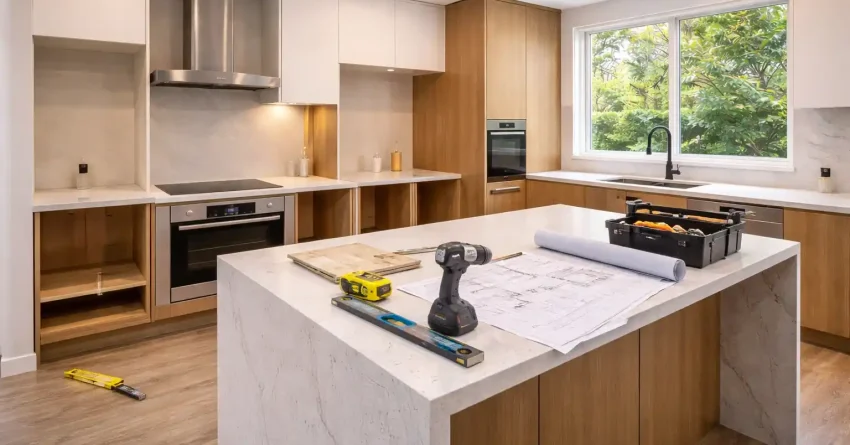
A kitchen renovation in Sydney typically costs between $15,000 and $100,000 or more, depending on the size of your kitchen, the materials you choose, and the scope of work involved. That range is wide for a reason. Every kitchen project carries its own combination of layout decisions, trade requirements, and finish selections that shift the final number.
This guide breaks down exactly where your money goes. You will find detailed cost ranges for cabinetry, benchtops, appliances, labour, and the hidden expenses that catch most renovators off guard.
Whether you are an owner-occupier upgrading a tired kitchen, a first-time renovator setting a realistic budget, or a property investor weighing return on investment, this cost guide gives you the pricing clarity you need to plan with confidence and avoid budget blowouts.
How Much Does a Kitchen Renovation Cost in Sydney?
Kitchen renovation costs in Sydney vary significantly based on the level of finish, the complexity of the layout, and whether structural changes are involved. The table below gives you a realistic starting point based on three common renovation tiers.
| Renovation Tier | Typical Cost Range | What’s Included |
| Budget | $15,000–$25,000 | Cosmetic updates, flat-pack or prefab cabinetry, laminate benchtops, basic appliances, minimal plumbing changes |
| Mid-Range | $25,000–$55,000 | Custom cabinetry, stone or engineered benchtops, quality appliances, new tiling, updated plumbing and electrical |
| High-End | $55,000–$100,000+ | Fully custom design, premium stone benchtops, high-end appliances, structural changes, premium fixtures and finishes |
These figures reflect Sydney market pricing in 2025 and include both materials and labour. Your actual cost depends on the specific decisions you make at every stage of the project.
Budget Kitchen Renovation ($15,000–$25,000)
A budget kitchen renovation focuses on cosmetic improvements that refresh the look and function of your kitchen without major structural work. At this price point, you are typically working with the existing layout and plumbing positions.
Common inclusions at this level are flat-pack or prefabricated cabinetry, laminate benchtops, a standard tile splashback, and entry-level appliances. Painting existing walls, replacing handles and tapware, and installing new flooring over existing substrate are all realistic within this range.
Budget renovations suit homeowners who want a noticeable improvement without a large financial commitment. They also work well for investment properties where the goal is to lift rental appeal or sale presentation without overcapitalising.
The trade-off is limited customisation. You are choosing from standard sizes, finishes, and configurations. Kitchens with unusual layouts or plumbing and electrical points that need relocating will push costs beyond this tier quickly.

Mid-Range Kitchen Renovation ($25,000–$55,000)
The mid-range tier is where most Sydney homeowners land. This budget allows for custom or semi-custom cabinetry, engineered stone or natural stone benchtops, quality brand appliances, and a full retile of floors and splashbacks.
At this level, moderate layout adjustments are achievable. Moving a sink along the same wall, adding an island bench, or reconfiguring cabinet runs to improve workflow are all within scope. Electrical upgrades such as additional power points, under-cabinet lighting, and rangehood ducting are standard inclusions.
Mid-range renovations deliver a significant transformation. Material quality is noticeably higher, cabinetry is built to measure, and appliance packages include reliable brands with solid warranty coverage.
This tier strikes the best balance between cost and long-term value for most owner-occupiers. You get durable materials, a functional layout, and finishes that hold up well over ten to fifteen years of daily use.
High-End Kitchen Renovation ($55,000–$100,000+)
A high-end kitchen renovation in Sydney involves fully custom design, premium materials, and often significant structural modifications. This tier includes architect or kitchen designer involvement, bespoke cabinetry with specialty finishes, natural stone or porcelain slab benchtops, and top-tier appliance suites.
Structural changes such as removing walls to create open-plan living, relocating plumbing stacks, upgrading electrical switchboards, and installing butler’s pantries or sculleries are common at this price point. Integrated appliances, soft-close hardware throughout, stone or large-format tile flooring, and designer tapware are standard expectations.
High-end renovations are typically driven by lifestyle priorities or significant property value goals. Homeowners at this level want a kitchen that reflects a specific design vision and delivers a premium daily experience.
The cost escalation at this tier comes from three main areas: the complexity of structural and services work, the price premium on materials and appliances, and the extended project timeline that increases labour hours. Projects at this scale often involve whole home renovation planning where multiple rooms are budgeted and sequenced together.

Kitchen Renovation Cost Breakdown by Category
Understanding where your renovation dollars go helps you make informed trade-offs. The following breakdown covers every major cost category in a typical Sydney kitchen renovation.
Cabinetry and Storage Costs
Cabinetry is consistently the largest single expense in a kitchen renovation. In Sydney, kitchen cabinetry costs range from $5,000 for flat-pack options to $30,000 or more for fully custom builds.
Flat-pack cabinetry from retailers like IKEA or Bunnings offers the lowest entry point. These units come in standard sizes and require assembly and installation. They suit budget renovations and simple layouts.
Semi-custom cabinetry is manufactured to your measurements but uses standard construction methods and a set range of door profiles and finishes. Expect to pay between $8,000 and $18,000 for a standard-sized kitchen.
Fully custom cabinetry is built from scratch by a cabinet maker to your exact specifications. You choose the material, construction method, door style, finish, and internal fittings. Custom cabinetry for a mid-to-large Sydney kitchen typically costs $15,000 to $30,000 or more.
Internal storage accessories such as pull-out drawers, corner carousels, spice racks, and bin systems add $1,000 to $4,000 depending on the number and type of fittings.
Cabinet Refacing vs. Full Replacement
Refacing existing cabinets costs roughly 30% to 50% less than full replacement, typically $3,000 to $8,000 versus $8,000 to $30,000 for new cabinetry. Refacing works well when the existing cabinet boxes are structurally sound, and the layout does not need changing.
Full replacement is the right call when the carcasses are damaged, the layout is inefficient, or you want to change the kitchen’s configuration entirely. The upfront cost is higher, but the long-term functional gain is significantly greater.
Benchtop Materials and Pricing
Benchtops are the second most visible element in your kitchen and one of the most variable cost items. Pricing depends on the material, edge profile, cutouts for sinks and cooktops, and total linear meterage.
| Benchtop Material | Cost per Linear Metre (Installed) | Best For |
| Laminate | $200–$600 | Budget renovations, rental properties |
| Engineered Stone (e.g., Caesarstone) | $600–$1,200 | Mid-range renovations, durability |
| Natural Stone (Marble, Granite) | $800–$2,000 | High-end kitchens, premium aesthetics |
| Porcelain Slab | $900–$1,800 | Modern design, heat resistance |
| Timber | $500–$1,200 | Feature sections, island benches |
| Stainless Steel | $800–$1,500 | Commercial-style kitchens |
Engineered stone remains the most popular choice in Sydney mid-range renovations. It offers consistent colour, low maintenance, and strong durability at a reasonable price point. Natural stone costs more and requires periodic sealing but delivers a unique visual character that engineered products cannot replicate.
For a standard kitchen with 4 to 6 linear metres of benchtop, expect to pay between $2,400 and $12,000 installed, depending on material selection.
Appliance Costs and Allowances
Appliance quality and brand positioning vary enormously, which is why the cost range for this category is so wide. A basic appliance package covering an oven, cooktop, rangehood, and dishwasher starts at around $3,000 to $5,000 for entry-level brands.
Mid-range packages from brands like Bosch, Fisher & Paykel, or Westinghouse sit between $6,000 and $12,000. Premium packages featuring brands like Miele, SMEG, or Wolf can exceed $20,000 to $40,000.
Refrigeration is often budgeted separately. A standard freestanding fridge costs $1,000 to $3,000. Integrated or built-in refrigeration starts at $4,000 and can exceed $15,000 for large-capacity or French-door models.
When budgeting for appliances, consider the total package rather than individual items. Many suppliers offer bundle pricing that reduces the per-unit cost. Also factor in installation costs, which are separate from the purchase price and typically range from $150 to $500 per appliance depending on complexity.
Energy-Efficient Upgrades and Their Cost Impact
Choosing energy-efficient appliances adds a modest premium upfront but reduces ongoing running costs. Induction cooktops, for example, cost $800 to $3,000 more than equivalent gas models but eliminate gas connection costs and reduce energy consumption.
LED under-cabinet lighting, efficient rangehoods with heat-exchange technology, and WELS-rated tapware are all low-cost upgrades that improve the kitchen’s environmental performance. These additions typically add $500 to $2,000 to the overall budget and are increasingly expected by buyers and tenants in Sydney’s current market.
Plumbing and Electrical Work
Plumbing and electrical work are essential trade costs in every kitchen renovation. Even a cosmetic refresh usually requires some electrical work for compliance, and any change to sink or dishwasher positioning triggers plumbing costs.
Plumbing costs for a kitchen renovation in Sydney typically range from $2,000 to $8,000. A straightforward sink replacement in the same position costs less. Relocating the sink, adding a second sink in an island, or moving gas lines for a cooktop increases costs significantly.
Electrical work ranges from $1,500 to $6,000 depending on scope. Common electrical tasks include adding power points, installing under-cabinet LED lighting, wiring for rangehood ducting, and upgrading circuits to handle modern appliance loads. Switchboard upgrades to meet current standards add $1,000 to $2,500.
Gas fitting is an additional cost for installing or relocating a gas cooktop. Expect $500 to $1,500 for gas connection work, depending on the distance from the existing gas point.
Flooring and Tiling
Kitchen flooring costs depend on the material, the area to be covered, and whether the existing floor needs removal or levelling before new flooring goes down.
Popular kitchen flooring options in Sydney include porcelain tiles ($50 to $120 per square metre installed), vinyl plank ($40 to $90 per square metre installed), engineered timber ($80 to $160 per square metre installed), and polished concrete ($100 to $150 per square metre for grinding and sealing existing slabs).
For a standard kitchen of 10 to 15 square metres, flooring costs typically range from $1,000 to $2,500 for mid-range materials including installation. Floor preparation, including removal of old tiles, levelling compound, and waterproofing where required, can add $500 to $1,500.
Tile selection affects labour cost as well as material cost. Large-format tiles require fewer grout lines but need a flatter substrate and more careful handling. Small mosaic or patterned tiles increase labour time and cost.
Splashback Options and Costs
The splashback protects your wall behind the cooktop and sink while contributing significantly to the kitchen’s visual style. Common splashback options and their installed costs include:
| Splashback Type | Cost per Square Metre (Installed) | Notes |
| Ceramic/Porcelain Tiles | $80–$200 | Widest range of styles, easy to replace |
| Subway Tiles | $100–$250 | Classic look, labour-intensive for smaller tiles |
| Glass Panel | $350–$700 | Seamless finish, custom colour matching |
| Engineered Stone | $400–$800 | Matches benchtop, premium look |
| Pressed Metal | $150–$300 | Heritage style, easy installation |
| Paint (with sealer) | $30–$80 | Budget option, limited durability |
Most Sydney kitchens require 2 to 4 square metres of splashback. A tiled splashback in a mid-range renovation typically costs $400 to $1,000 installed. Glass panel splashbacks cost $1,000 to $2,800 for the same area.
Painting, Lighting, and Finishing Touches
These final elements are often underestimated in renovation budgets but collectively add $1,500 to $5,000 to the project cost.
Painting the kitchen walls and ceiling costs $800 to $2,000 depending on the room size and surface preparation required. Painting over previously tiled areas or patching plasterwork after cabinet removal increases preparation costs.
Lighting is a functional and aesthetic priority. A basic lighting plan with ceiling downlights costs $500 to $1,500 installed. Adding pendant lights over an island, under-cabinet task lighting, and dimmer switches pushes the lighting budget to $1,500 to $4,000.
Finishing touches include new tapware ($200 to $1,200 per set), cabinet handles ($100 to $800 for a full kitchen), window treatments ($200 to $600), and any decorative elements. These items seem minor individually but add up quickly across a full kitchen.

Labour Costs for Kitchen Renovations in Sydney
Labour represents a substantial portion of any kitchen renovation budget in Sydney. Understanding trade costs helps you evaluate quotes accurately and identify where pricing differences come from.
What Tradespeople Do You Need?
A standard kitchen renovation requires coordination between multiple licensed trades:
- Kitchen installer/carpenter: Installs cabinetry, benchtops, and handles all joinery work
- Plumber: Connects sinks, dishwashers, gas lines, and any water supply or drainage modifications
- Electrician: Installs power points, lighting, rangehood wiring, and ensures switchboard compliance
- Tiler: Lays floor tiles and splashback tiles
- Painter: Prepares and paints walls, ceilings, and any exposed surfaces
- Gas fitter: Connects gas cooktops and ovens (often the same licensed plumber)
- Demolition/labourer: Strips the old kitchen, removes waste, and prepares the site
For larger projects involving structural changes, you may also need a builder or project manager, a structural engineer, and potentially a waterproofer where the renovation affects wet areas adjacent to the kitchen.
Average Hourly and Project-Based Labour Rates
| Trade | Hourly Rate (Sydney) | Typical Project Cost |
| Kitchen Installer/Carpenter | $60–$90/hr | $3,000–$8,000 |
| Licensed Plumber | $80–$120/hr | $2,000–$8,000 |
| Licensed Electrician | $80–$110/hr | $1,500–$6,000 |
| Tiler | $50–$80/hr | $1,000–$4,000 |
| Painter | $40–$70/hr | $800–$2,000 |
| Demolition/Labourer | $40–$60/hr | $500–$1,500 |
| Project Manager/Builder | $60–$100/hr | $3,000–$10,000 (percentage of total) |
These rates reflect Sydney pricing in 2025. Rates vary by experience, licensing, insurance coverage, and demand. Always confirm that tradespeople hold current licences and appropriate insurance before engaging them.
How Labour Costs Vary by Project Scope
A cosmetic kitchen refresh with no layout changes requires fewer trade hours and less coordination. Labour for this type of project typically falls between $3,000 and $8,000.
A mid-range renovation with moderate layout changes, new plumbing positions, and full electrical upgrades requires more trade hours and tighter scheduling. Labour costs for this scope typically range from $8,000 to $20,000.
A high-end renovation with structural modifications, custom installations, and premium finishes demands the most labour. Multiple trades work across an extended timeline, and project management becomes essential. Labour costs at this level range from $20,000 to $40,000 or more.
The number of trades involved, the complexity of coordination between them, and the total project duration are the three biggest drivers of labour cost variation.
Hidden Costs and Unexpected Expenses
Hidden costs are the most common reason kitchen renovations exceed their original budget. Knowing what to expect helps you plan a realistic contingency and avoid financial stress mid-project.
Structural and Compliance Surprises
Older Sydney homes frequently reveal issues once demolition begins. Common structural surprises include asbestos in wall linings or flooring (removal costs $1,500 to $5,000 or more depending on extent), termite damage to framing ($2,000 to $10,000 for remediation and repair), water damage or rot in subfloor or wall framing ($1,000 to $5,000), and non-compliant plumbing or electrical that must be brought up to current code ($1,000 to $4,000).
These issues are impossible to fully assess before demolition. A pre-renovation inspection can identify some risks, but hidden conditions behind walls and under floors only become visible once the old kitchen is stripped out.
Temporary Kitchen and Living Arrangements
A full kitchen renovation takes your cooking space offline for three to eight weeks. Setting up a temporary kitchen with a portable cooktop, bar fridge, and basic washing station costs $200 to $500 in equipment. Eating out more frequently during the renovation can add $500 to $2,000 to your overall spend.
For extensive renovations affecting multiple rooms, some homeowners choose temporary accommodation. This is less common for kitchen-only projects but worth considering when the disruption extends beyond six weeks.
Waste Removal and Site Preparation
Demolishing an existing kitchen generates a significant volume of waste. Skip bin hire in Sydney costs $300 to $800 depending on the bin size and rental duration. Most kitchen demolitions require a 4 to 6 cubic metre skip.
Kitchens with asbestos-containing materials require licensed removal and disposal at approved facilities, which increases waste costs substantially. Site preparation costs include protecting floors and surfaces in adjacent rooms ($200 to $500), dust barriers and containment ($100 to $300), and temporary services relocation where needed.
Council Approvals and Permits in Sydney
Most cosmetic and like-for-like kitchen renovations in Sydney do not require council approval. Approval is needed for structural changes such as removing or modifying load-bearing walls, changing the external footprint of the building, or altering plumbing stacks that affect other units in a strata building.
Development application (DA) fees with Sydney councils typically range from $500 to $2,500 depending on the scope of work. Complying development certificates (CDC) through a private certifier offer a faster alternative for straightforward structural changes and cost $1,000 to $3,000.
Strata property owners also need strata committee approval before starting work. This process can take four to eight weeks and may require submission of detailed plans and a building report. Always confirm approval requirements with your local council or a qualified builder before committing to a renovation scope that involves structural work.
What Factors Affect Kitchen Renovation Pricing?
No two kitchen renovations cost the same. Understanding the key pricing variables helps you control costs and make deliberate choices about where to allocate your budget.
How Kitchen Layout Style Affects Renovation Cost
The layout configuration of your kitchen has a direct bearing on renovation cost, independent of size. A galley kitchen, two parallel runs of cabinetry, is the most cost-efficient layout to renovate because it involves minimal plumbing complexity and straightforward cabinet installation.
An L-shaped or U-shaped kitchen adds corner cabinet solutions and more linear metres of benchtop, pushing costs up by $2,000 to $6,000 compared to a galley of equivalent size. Island bench additions are the most significant layout cost driver, typically adding $5,000 to $15,000 depending on whether plumbing, electrical, or structural work is required to support the island.
Open-plan kitchens that require wall removal to connect to living or dining areas carry the highest layout-related costs. Engineering, structural work, and making-good can add $8,000 to $20,000 before a single cabinet is installed.
Kitchen Size and Layout Changes
Kitchen size directly affects material quantities and labour hours. A small galley kitchen of 6 to 8 square metres costs less to renovate than a large open-plan kitchen of 20 square metres or more, simply because there is less cabinetry, fewer tiles, and less benchtop to install.
Layout changes have an even bigger impact on cost than size alone. Keeping the existing layout and replacing materials in the same positions is the most cost-effective approach. Moving the sink to a different wall, adding an island bench, or reconfiguring the entire kitchen footprint requires plumbing relocation, electrical rerouting, and potentially structural work. Each of these changes adds $2,000 to $10,000 or more to the project.
Material Quality and Brand Selection
The gap between entry-level and premium materials is substantial. Laminate benchtops cost a fraction of natural stone. Flat-pack cabinetry costs a fraction of custom joinery. Entry-level appliances cost a fraction of integrated premium brands.
Material selection is the single biggest lever you have for controlling your renovation budget. A beautiful, functional kitchen is achievable at every price point by making informed choices about where material quality matters most and where a mid-range option delivers sufficient performance.
For most homeowners, investing in durable benchtops and quality cabinetry while choosing mid-range appliances and standard tiling delivers the best long-term value.
Age and Condition of Your Existing Kitchen
Renovating a kitchen last updated 10 years ago is a different proposition from gutting one untouched for 40 years. Older kitchens are more likely to have outdated plumbing and electrical systems that need upgrading, asbestos-containing materials that require licensed removal, non-standard measurements that complicate new installations, and structural issues hidden behind dated finishes.
Each of these conditions adds cost and complexity. Homes built before 1990 warrant an additional 10% to 20% contingency for remediation work that only becomes apparent during demolition.
Structural Work and Plumbing Relocation
Structural modifications are the highest-cost variable in kitchen renovations. Removing a load-bearing wall to create an open-plan kitchen requires engineering assessment ($500 to $1,500), a steel beam and installation ($3,000 to $8,000), and associated making-good work.
Plumbing relocation is the second most significant cost escalator. Moving a sink from one wall to another requires new water supply lines, new drainage connections, and potentially modifications to the main drainage stack. Costs range from $1,500 to $6,000 depending on the distance and complexity of the relocation.
Both structural changes and plumbing relocation together can add $5,000 to $15,000 to your budget before any finishes are selected. These are the same trade disciplines involved in home extension projects, where load-bearing modifications and services relocation are standard scope items.

How to Budget for a Kitchen Renovation
A well-structured budget is the foundation of a successful kitchen renovation. The following steps help you build a realistic financial plan that accounts for all costs and minimises the risk of overruns.
Setting a Realistic Budget Range
Start by defining your renovation tier. A cosmetic refresh, a mid-range upgrade, and a full high-end transformation each carry a distinct budget range, and your answer to that question determines everything that follows.
Your actual budget should reflect your specific goals, the condition of your existing kitchen, and how long you plan to stay in the home. Be honest about your financial limits before selecting materials and finishes. A well-executed mid-range renovation delivers far better outcomes than a high-end project that runs out of funds halfway through.
Where to Spend and Where to Save
Not all renovation dollars deliver equal value. Prioritise spending on items that affect daily function, durability, and long-term maintenance.
Spend more on:
- Cabinetry construction quality (soft-close hinges, solid drawer runners, moisture-resistant materials)
- Benchtop durability (engineered or natural stone over laminate where budget allows)
- Plumbing and electrical compliance (never cut corners on licensed trade work)
- Rangehood performance (proper extraction protects cabinetry and air quality)
Save on:
- Cabinet door finishes (a mid-range door on quality carcasses looks and performs well)
- Splashback materials (subway tiles deliver excellent value)
- Appliance brands (mid-range brands offer strong reliability without premium pricing)
- Handles and hardware (these are easy and inexpensive to upgrade later)
Building a Contingency Fund
Every kitchen renovation budget should include a contingency of 10% to 20% of the total project cost. This fund covers unexpected discoveries during demolition, minor scope changes, price variations in materials, and any other costs that were not foreseeable at the quoting stage.
For a $40,000 renovation, a 15% contingency means setting aside $6,000. Unused contingency stays in your pocket. Used contingency prevents the stress and compromise of rushed decisions under financial pressure.
Contingency is not optional. It is a core part of responsible renovation budgeting.
Getting Accurate Quotes from Sydney Contractors
Accurate quotes require accurate information. Before approaching contractors, prepare the following:
- A clear scope of work describing what you want done
- Your preferred materials and finishes (or at least the quality level)
- Photos of your existing kitchen with measurements
- Any design plans or inspiration images
- Your budget range (sharing this helps contractors tailor realistic proposals)
Obtain at least three detailed quotes from licensed contractors. Compare quotes on a like-for-like basis, checking that each quote covers the same scope, materials, and inclusions. The cheapest quote is not always the best value. Look for clarity, detail, and transparency in how costs are presented.
Ask each contractor what is included and what is excluded. Common exclusions that catch homeowners off guard include appliance supply, council fees, asbestos removal, and floor preparation.
Kitchen Renovation Cost by Sydney Region
Renovation costs in Sydney vary by region due to differences in property values, contractor demand, access logistics, and local council requirements.
Inner City and Eastern Suburbs
Inner city and eastern suburbs locations such as Surry Hills, Paddington, Bondi, and Randwick attract higher renovation costs. Contractor rates are elevated due to high demand, parking and access restrictions increase logistics costs, and many properties are older terraces or apartments with complex structural constraints.
Expect to pay a 10% to 20% premium over Sydney averages in these areas. Strata properties add further complexity and cost due to approval processes and building access restrictions.
Northern Beaches and North Shore
The Northern Beaches and North Shore, including Mosman, Manly, Chatswood, and Dee Why, also sit at the higher end of Sydney renovation pricing. Property values support larger renovation budgets, and homeowner expectations for finish quality tend to be high.
Contractor availability in these areas is generally good, but premium tradespeople are in consistent demand. Lead times for starting projects can be longer, particularly during peak renovation seasons from September to March.
Western Sydney and South-West
Western Sydney and south-western suburbs including Parramatta, Penrith, Liverpool, and Campbelltown generally offer more competitive renovation pricing. Contractor rates are moderately lower, access and parking are typically easier, and material delivery logistics are less constrained.
Kitchen renovations in these areas often cost 5% to 15% less than inner-city equivalents for the same scope and material quality. This makes western Sydney an attractive market for property investors seeking strong renovation returns.
Sutherland Shire and Southern Sydney
The Sutherland Shire and southern Sydney areas, including Cronulla, Miranda, and Hurstville, sit in the mid-range for renovation pricing. Costs are generally comparable to Sydney averages, with some variation based on property type and access conditions.
Coastal properties in the Shire may require additional consideration for salt air exposure when selecting materials, particularly for hardware, tapware, and external ventilation components.

Does a Kitchen Renovation Add Value to Your Property?
A well-executed kitchen renovation is consistently ranked as one of the highest-value home improvements. The return depends on how much you spend, what you improve, and the local property market.
Return on Investment for Owner-Occupiers
For owner-occupiers, a kitchen renovation delivers value in two ways: improved daily living experience and increased property value at sale. Research consistently identifies kitchens as one of the top features buyers assess when evaluating a property.
A mid-range kitchen renovation can add meaningful perceived value in Sydney’s current market, depending on the suburb and the condition of the rest of the home. Buyers respond to overall presentation, not an itemised cost list. The strongest returns come from renovations that bring a dated kitchen up to current market expectations without exceeding the standard for the street or suburb.
Rental Yield Improvements for Investors
For property investors, a kitchen renovation can increase weekly rental income and reduce vacancy periods. A modernised kitchen with functional cabinetry, clean benchtops, and reliable appliances is a strong drawcard for tenants.
A budget-to-mid-range kitchen renovation on an investment property can meaningfully increase weekly rent in many Sydney suburbs. Over a five-year period, that additional rental income recovers a significant portion of the renovation cost while also increasing the property’s capital value.
Investors should focus on durable, low-maintenance materials that minimise ongoing repair and replacement costs. Laminate benchtops, vinyl plank flooring, and mid-range appliances deliver the best return for rental properties.
Value-Adding Upgrades vs. Overcapitalisation
Overcapitalisation occurs when you spend more on a renovation than the value it adds to the property. This risk is highest when renovation quality significantly exceeds the standard of the surrounding neighbourhood or when premium materials are installed in a property that does not support premium pricing.
Value-adding upgrades:
- Replacing dated cabinetry with modern, functional storage
- Installing durable benchtops that appeal to broad buyer or tenant demographics
- Upgrading to energy-efficient appliances
- Improving kitchen lighting and ventilation
- Creating better workflow and storage efficiency
Overcapitalisation risks:
- Installing $20,000 appliance packages in a $600,000 property
- Choosing imported natural stone in a suburb where engineered stone is the norm
- Adding structural changes that do not meaningfully improve function
- Selecting ultra-trendy finishes that may date quickly
The safest approach is to renovate to the upper end of your suburb’s expectations without exceeding them. Research recent sales in your area to understand what buyers expect and what they are willing to pay for. Broader value-add strategies such as adding a secondary dwelling or extending the home carry their own ROI considerations that interact with kitchen renovation decisions.
How to Avoid Cost Overruns on Your Kitchen Renovation
Cost overruns are the most common source of stress in kitchen renovations. Most blowouts are preventable with proper planning, clear communication, and disciplined decision-making.
Locking In Scope Before Work Begins
The single most effective way to control costs is to finalise every detail of your renovation scope before demolition starts. This means confirming your kitchen layout, selecting all materials and finishes, choosing appliances, and agreeing on a detailed specification with your contractor.
Changes made after work begins are called variations. Every variation triggers additional costs for materials, labour, and potentially project delays. A $200 tapware upgrade decision made during the planning phase costs $200. The same decision made mid-project can cost $500 or more once you factor in plumber callbacks, schedule disruption, and restocking fees.
Invest time in planning. Visit showrooms. Request samples. Make decisions before the first tile is removed.
Managing Variations and Change Orders
Even with thorough planning, some variations are unavoidable. Hidden structural issues, product discontinuations, and unforeseen site conditions can all require scope changes.
Establish a clear variation process with your contractor before work begins. Every variation should be documented in writing with a description of the change, the cost impact, and the timeline impact. Both parties should sign off before the variation work proceeds.
Never approve verbal variations. Undocumented changes are the leading cause of disputes between homeowners and contractors. A professional contractor will welcome a structured variation process because it protects both parties.
Choosing a Fixed-Price vs. Cost-Plus Contract
Your contract type significantly affects your cost certainty.
Fixed-price contracts set a total project cost upfront. The contractor bears the risk of cost increases within the agreed scope. You know exactly what you will pay, provided you do not request variations. This is the preferred option for most homeowners because it provides budget certainty.
Cost-plus contracts charge you for actual costs of materials and labour plus a margin or management fee (typically 10% to 20%). This structure offers flexibility but transfers cost risk to you. Final costs are uncertain until the project is complete.
For most kitchen renovations, a fixed-price contract with a clearly defined scope and a structured variation process delivers the best combination of cost certainty and project quality. The NSW Fair Trading home building contracts guide outlines your legal rights and obligations under both contract types.
Kitchen Renovation Timeline and How It Affects Cost
Time is money in renovation. A longer project means more labour hours, extended disruption, and greater risk of cost escalation. Understanding typical timelines helps you plan realistically and identify potential delays before they happen.
Typical Renovation Timeline in Sydney
| Renovation Phase | Duration | Notes |
| Design and planning | 2–6 weeks | Includes measurements, design, material selection |
| Council approval (if required) | 4–12 weeks | Only for structural changes or strata properties |
| Material ordering and lead times | 2–8 weeks | Custom cabinetry and imported items take the longest |
| Demolition | 1–3 days | Includes waste removal |
| Plumbing and electrical rough-in | 3–5 days | First fix before cabinetry installation |
| Cabinetry installation | 3–7 days | Depends on kitchen size and complexity |
| Benchtop templating and installation | 1–2 weeks | Template after cabinets, fabrication, then install |
| Tiling (floor and splashback) | 2–5 days | Depends on area and tile type |
| Plumbing and electrical fit-off | 1–2 days | Final connections after cabinetry and benchtops |
| Painting and finishing | 2–3 days | Final touch-ups and detailing |
| Total (mid-range renovation) | 6–12 weeks | From demolition to completion |
Design, planning, and material ordering happen before construction begins. The construction phase for a mid-range kitchen renovation typically runs four to eight weeks on site.
Delays That Increase Your Budget
Common causes of renovation delays in Sydney include late material deliveries (particularly for custom or imported items), trade scheduling conflicts, unexpected structural or compliance issues discovered during demolition, weather impacts on deliveries and site access, and homeowner decision delays on materials or finishes.
Each week of delay adds labour holding costs, potential price increases on materials, and extended disruption to your household. A two-week delay on a mid-range renovation can add $2,000 to $5,000 in additional costs.
How to Keep Your Project on Schedule
Proactive schedule management starts before construction begins:
- Finalise all material selections and place orders before demolition starts
- Confirm trade availability and book specific dates in advance
- Establish a clear communication schedule with your contractor (weekly updates at minimum)
- Make decisions promptly when questions arise during construction
- Build buffer time into your timeline for deliveries and inspections
- Avoid making changes to the scope once work is underway
A well-organised contractor will provide a project schedule at the start of the job and update it as work progresses. A contractor who cannot provide a timeline is a red flag worth addressing before signing a contract.
Conclusion
Kitchen renovation costs in Sydney range from $15,000 for a budget refresh to over $100,000 for a high-end transformation. Your final cost depends on layout complexity, material choices, labour requirements, and the hidden expenses that surface during demolition.
Understanding where every dollar goes puts you in control of your renovation budget. From cabinetry and benchtops to plumbing, electrical, and council approvals, each cost category offers opportunities to make smart trade-offs that align with your priorities and financial limits.
At Sydney Home Renovation, we help homeowners and investors plan and deliver kitchen renovations with transparent pricing, honest advice, and quality workmanship. Contact us today for a detailed, obligation-free quote tailored to your kitchen, your goals, and your budget.
Frequently Asked Questions
How much does an average kitchen renovation cost in Sydney?
An average mid-range kitchen renovation in Sydney costs between $25,000 and $55,000 including materials and labour. Budget renovations start around $15,000, while high-end projects exceed $55,000 to $100,000 or more depending on scope and finishes.
What is the most expensive part of a kitchen renovation?
Cabinetry is typically the most expensive single item in a kitchen renovation. Custom cabinetry for a standard Sydney kitchen ranges from $15,000 to $30,000. Labour costs collectively represent the second largest expense category.
Can I renovate my kitchen for under $20,000?
Yes, a budget kitchen renovation under $20,000 is achievable by keeping the existing layout, choosing flat-pack or prefab cabinetry, using laminate benchtops, and selecting entry-level appliances. Cosmetic updates like painting, new handles, and a fresh splashback deliver noticeable results at this price point.
How long does a full kitchen renovation take?
A full mid-range kitchen renovation in Sydney takes six to twelve weeks from demolition to completion. The construction phase typically runs four to eight weeks on site. Design, planning, and material ordering add two to eight weeks before construction begins.
Do I need council approval for a kitchen renovation in Sydney?
Most cosmetic and like-for-like kitchen renovations do not require council approval. Approval is needed for structural changes such as removing load-bearing walls, altering the building footprint, or modifying plumbing stacks in strata properties.
Should I renovate my kitchen before selling my house?
A kitchen renovation before selling can increase your sale price and reduce time on market, provided you do not overcapitalise. Focus on mid-range finishes that appeal to broad buyer demographics. Renovating to the upper end of your suburb’s expectations delivers the strongest return.
How much should I set aside for unexpected costs?
Set aside a contingency of 10% to 20% of your total renovation budget for unexpected costs. For a $40,000 project, that means reserving $4,000 to $8,000. Older homes and projects involving structural changes should budget toward the higher end of this range.
Is it cheaper to reface cabinets or replace them?
Refacing existing cabinets costs roughly 30% to 50% less than full replacement, typically $3,000 to $8,000 versus $8,000 to $30,000 for new cabinetry. Refacing works well when the existing cabinet boxes are structurally sound, and the layout does not need changing.
What is the best benchtop material for the price?
Engineered stone offers the best balance of durability, appearance, and cost for most Sydney kitchens. At $600 to $1,200 per linear metre installed, it provides consistent colour, low maintenance, and strong resistance to scratches and stains. It suits both mid-range and high-end renovations.
How do I choose the right kitchen renovation contractor?
Choose a contractor who holds a current NSW builder’s licence, carries appropriate insurance, provides detailed written quotes, and can supply references from recent kitchen projects. Compare at least three quotes on a like-for-like basis and prioritise transparency, communication quality, and relevant experience over the lowest price.


