A standard bathroom renovation in Sydney costs between $15,000 and $35,000 in 2025, depending on the size of the space, your choice of materials, and the complexity of the work involved. Without structured renovation project management, that number climbs fast.
Bathroom renovations are one of the highest-value improvements you can make to a Sydney property. They also carry some of the highest risk for budget blowouts.
Every cost, hidden expense, and planning decision you need is covered here so you can manage your bathroom renovation from start to finish with confidence.
What Is Renovation Project Management
Renovation project management is the process of planning, coordinating, and controlling every phase of a home renovation from initial budgeting through to final completion. For bathroom renovations specifically, it covers scope definition, cost estimation, trade scheduling, material procurement, quality control, and timeline management.
It is not just about hiring a builder and hoping for the best. Effective project management means every dollar has a purpose, every trade arrives on schedule, and every decision is made before the demolition hammer swings.
Why Bathroom Renovations Need a Structured Approach
Bathrooms are the most trade-intensive rooms in any home. A single bathroom renovation in Sydney typically involves a demolition crew, plumber, electrician, waterproofer, tiler, carpenter, and painter, and each trade depends on the one before it.
If your plumber runs late, your waterproofer cannot start. If your waterproofer cannot start, your tiler sits idle. Every idle day costs money.
The confined space also means there is zero room for error on measurements, drainage falls, and waterproofing membranes. Waterproofing defects are consistently among the most common sources of building disputes in residential renovations across New South Wales. A structured approach prevents these cascading failures before they start.
Key Stages of a Renovation Project
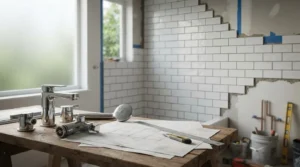
Every well-managed bathroom renovation follows a predictable sequence. Skipping or rushing any stage is where budgets break.
Design and scope definition. Finalise the layout, fixtures, and finishes before any work begins. Changes after demolition are expensive; every decision made here saves money later.
Budget development. Build a detailed cost plan covering labour, materials, fixtures, permits, and a contingency buffer. A budget without a contingency is not a budget.
Contractor selection and quoting. Obtain at least three itemised quotes. Compare scope, not just price; a low quote with a vague scope is a risk, not a saving.
Permit and compliance checks. Confirm whether your renovation requires council approval or a complying development certificate before a single tool is picked up.
Demolition and strip-out. Remove existing fixtures, tiles, and fittings. This is where hidden issues surface and where your contingency earns its place.
Rough-in trades. Plumbing, electrical, and structural work happen first while walls are open. Sequencing these correctly is the core of trade coordination.
Waterproofing and inspection. Waterproofing membranes are applied and must pass inspection before tiling begins. This step cannot be rushed or skipped.
Tiling, fit-out, and finishing. Tiles go down, fixtures are installed, and painting completes the space. Quality at this stage is what the homeowner sees every day.
Final inspection and handover. A walkthrough confirms everything meets the agreed scope and quality standards. Get it in writing.
How to Plan a Bathroom Renovation Budget in Sydney
Budgeting is the foundation of renovation project management. Get this wrong and every decision that follows is compromised. Get it right, and you will make confident choices throughout the entire build.
Setting a Realistic Budget Range
Sydney bathroom renovation costs vary significantly based on the scope of work. Here is what to expect in 2025:
| Renovation Type | Typical Cost Range (Sydney) | Scope |
| Basic refresh | $10,000 to $18,000 | New fixtures, paint, minor tiling |
| Standard renovation | $18,000 to $30,000 | Full strip-out, new layout, mid-range finishes |
| High-end renovation | $30,000 to $55,000+ | Premium fittings, custom joinery, structural changes |
These ranges assume a standard-sized bathroom of approximately 4 to 8 square metres. Ensuites and powder rooms sit at the lower end. Large master bathrooms with freestanding baths, double vanities, or heated flooring push toward the upper range.
The most common mistake first-time renovators make is budgeting based on the lowest number they find online. Those figures rarely include demolition, waste removal, waterproofing certification, or the cost of temporary plumbing arrangements while the bathroom is out of service.
Ensuite vs. Main Bathroom: How Scope Affects Cost
The type of bathroom you are renovating has a direct impact on your budget. An ensuite renovation in Sydney typically costs $12,000 to $22,000; the smaller footprint reduces tiling area, fixture count, and trade time.
A main bathroom with a separate bath, shower, and double vanity sits firmly in the $20,000 to $35,000 range for a standard renovation. A powder room toilet and basin only can be completed for $8,000 to $14,000 depending on finishes.
Understanding which category your bathroom falls into before you start budgeting prevents the most common planning error: applying a main bathroom budget to an ensuite, or vice versa.
FURTHER READING
► How Much Does an Ensuite Renovation Cost in Australia?
Understanding Cost Variables That Affect Your Bottom Line
Several factors determine where your renovation lands within those ranges.
Bathroom size and layout complexity. A simple like-for-like replacement costs far less than reconfiguring the entire layout. Moving a toilet or shower drain involves cutting into the concrete slab, which adds thousands to the plumbing bill.
Material and fixture quality. The price gap between builder-grade and premium fixtures is substantial. A basic wall-hung vanity costs around $400. A custom timber vanity with stone top exceeds $3,000.
Age and condition of the existing bathroom. Older homes in Sydney’s Inner West, Eastern Suburbs, and North Shore often reveal asbestos sheeting, deteriorated framing, or non-compliant plumbing once walls are opened. Remediation adds cost and time.
Access and site conditions. A ground-floor bathroom with easy truck access is simpler to service than a third-floor apartment renovation requiring lift bookings and strata coordination.
Trade availability and market conditions. Sydney’s construction market fluctuates. During peak demand periods, trade rates increase and lead times extend.
Contingency Planning and Budget Buffers
Every renovation budget needs a contingency allowance. For bathroom renovations, a buffer of 10% to 15% of the total project cost is the industry standard.
This is not a slush fund for upgrades. It exists to cover genuine unknowns: concealed water damage, outdated wiring that does not meet current Australian Standards, or a subfloor that needs levelling before tiles can be laid.
If you are renovating a bathroom built before 1990, increase your contingency to 15% to 20%. The probability of encountering asbestos-containing materials, lead paint, or non-compliant plumbing rises significantly in older Sydney properties.
Financing Your Bathroom Renovation in Sydney
Most homeowners fund a bathroom renovation through one of three routes: savings, a personal loan, or equity drawn from their home loan via a redraw facility or line of credit.
Personal loans for renovation work in Australia typically carry interest rates between 7% and 14% depending on the lender and your credit profile. For a $25,000 renovation, that adds $2,000 to $4,500 in interest over a three-year term a real cost that belongs in your budget planning.
Homeowners with sufficient equity often find a redraw or construction loan the most cost-effective option, as home loan rates are substantially lower. Speak with your lender before committing to a renovation scope, so your financing structure is confirmed before demolition begins.
Bathroom Renovation Cost Breakdown
Understanding where your money goes is the single most important step in renovation project management. Here is a detailed breakdown of typical costs for a standard Sydney bathroom renovation.
Labour Costs and Trade Coordination
Labour typically accounts for 40% to 50% of a bathroom renovation budget in Sydney. This reflects the number of specialist trades required and the sequential nature of the work.
| Trade | Typical Cost Range | Duration |
| Demolition and waste removal | $1,000 to $2,500 | 1 to 2 days |
| Plumber | $3,000 to $6,000 | 2 to 4 days (across stages) |
| Electrician | $1,500 to $3,500 | 1 to 2 days |
| Waterproofer | $800 to $1,500 | 1 day + curing time |
| Tiler | $2,500 to $5,500 | 3 to 5 days |
| Carpenter/joiner | $500 to $2,000 | 1 to 2 days |
| Painter | $500 to $1,200 | 1 day |
Coordination between these trades is where project management earns its value. A single scheduling conflict can idle an entire team and push your completion date back by a week or more.
Material and Fixture Allowances
Materials and fixtures make up roughly 30% to 40% of the total budget. This is also where you have the most control over final cost.
| Item | Budget Range | Mid-Range | Premium |
| Floor and wall tiles | $30 to $50/m² | $60 to $100/m² | $120 to $250+/m² |
| Vanity (incl. basin) | $400 to $800 | $1,000 to $2,000 | $2,500 to $5,000+ |
| Toilet suite | $250 to $500 | $600 to $1,200 | $1,500 to $3,000 |
| Shower screen | $400 to $800 | $900 to $1,500 | $1,800 to $3,500 |
| Tapware set | $200 to $500 | $600 to $1,200 | $1,500 to $3,000+ |
| Mirror/shaving cabinet | $150 to $400 | $500 to $1,000 | $1,200 to $2,500 |
Select your fixtures and fittings before demolition begins. Back-ordered items are one of the most common causes of renovation delays in Sydney. If your chosen vanity has a six-week lead time, order it the day you sign the contract.
Plumbing, Waterproofing, and Electrical Work
These are the non-negotiable costs. You cannot cut corners on plumbing, waterproofing, or electrical work without creating serious long-term problems.
Plumbing is typically the largest single trade cost. A like-for-like replacement where fixtures stay in the same position costs less than a layout change. Moving a shower from one wall to another or relocating a toilet requires new drainage lines, which involves cutting into a concrete slab; slab work alone adds $2,000 to $4,000.
Waterproofing is a legal requirement in NSW for all wet areas. The National Construction Code mandates that shower recesses, floors, and adjacent walls be waterproofed to specific standards. A waterproofing certificate must be issued before tiling can commence. Cutting this cost is not an option.
Electrical work covers lighting, exhaust fans, heated towel rails, and power points. All electrical work must be performed by a licensed electrician and certified upon completion. If your existing wiring is aluminium or does not meet current standards, a switchboard upgrade is required.
Tiling, Finishes, and Fittings
Tiling is often the most visible element of a bathroom renovation and one of the most variable costs. The tile itself is only part of the equation; preparation, adhesive, grout, waterproofing overlap, and labour all contribute.
Large-format tiles (600mm x 600mm and above) create a clean, modern look but require a perfectly level substrate. If your walls or floor are not flat, the tiler needs to apply levelling compound first. Feature walls with mosaic or herringbone patterns increase labour time significantly.
Fittings like towel rails, toilet roll holders, robe hooks, and shower shelves add up quickly. Budget $300 to $800 for a complete set of bathroom accessories in a mid-range finish.
Hidden Costs and Common Budget Pitfalls
This is where most renovation budgets fail. Not because homeowners overspend on tiles or tapware, but because they did not account for what they could not see.
Structural Surprises Behind Walls
Once demolition begins, the true condition of your bathroom is revealed. Common discoveries in Sydney homes include:
Termite damage to timber framing. Particularly prevalent in older homes across Sydney’s Northern Beaches, Inner West, and Hills District. Replacing damaged studs and bearers costs $1,500 to $5,000 depending on the extent.
Asbestos-containing materials. Homes built before 1987 in NSW contain asbestos in wall sheeting, floor tiles, or adhesives. Licensed asbestos removal is required under Safe Work NSW regulations and typically costs $1,500 to $4,000 for a bathroom-sized area.
Failed or non-existent waterproofing. Many older bathrooms were never waterproofed to current standards. Water damage to the subfloor or adjacent rooms becomes visible only once tiles are removed.
Corroded or non-compliant plumbing. Galvanised steel pipes, common in pre-1970s Sydney homes, corrode internally over decades. Replacing them with copper or PEX is not optional when they are found during demolition.
Council Approvals and Compliance Costs
Not every bathroom renovation requires council approval, but some do. If your renovation involves structural changes, altering external walls, or modifying plumbing stacks in a strata building, you need a complying development certificate or a full development application.
Costs for approvals vary:
- Complying development certificate: $1,500 to $3,000
- Development application (if required): $2,000 to $5,000+
- Strata approval and building management coordination: $500 to $2,000
Check with your local council or a private certifier before work begins. Retrospective approvals are more expensive and more stressful than getting it right upfront.
Scope Creep and Mid-Project Changes
Scope creep is the silent budget killer.
It starts with “while we’re at it, let’s also replace the laundry taps” and ends with a project that costs 30% more than planned. Every change made after demolition carries a premium; your trades have already scheduled their time and materials have been ordered to specification.
The best defence against scope creep is a detailed, fixed scope of works agreed before any demolition begins. If you want to make changes, make them during the design phase when they cost nothing.
Renovating a Bathroom in a Sydney Strata Building
Strata renovations carry an additional layer of complexity that freestanding home renovations do not. Before any work begins in a strata property, you need written approval from the Owners Corporation and, in many cases, from the building manager as well.
Most strata schemes in NSW operate under by-laws that restrict the type of work permitted, the hours trades can access the building, and the materials that can be used. Wet area renovations almost always require a waterproofing inspection report to be submitted to the Owners Corporation as part of the approval process.
The practical costs of strata bathroom renovation compliance add up. Owners Corporation consent applications typically cost $500 to $1,500 in administrative fees. If your renovation involves changes to common property shared drainage stacks, external walls, or structural elements, a special resolution from the Owners Corporation is required, which adds time and legal cost. Budget an additional $1,000 to $3,000 for strata-specific compliance in a standard bathroom renovation, and allow four to eight weeks for approval before scheduling trades.
FURTHER READING
► Bathroom Renovations in Strata: A Complete Guide
► Strata Approval Process for Home Renovations NSW
► How Long Does Strata Renovation Approval Take in NSW?
How to Prioritise Spending for Maximum Value
Not every dollar in a bathroom renovation delivers equal return. Smart renovation project management means directing your budget toward the elements that matter most.
Where to Invest for Long-Term Return
Waterproofing quality. This is the single most important investment in any bathroom renovation. A failed waterproofing membrane causes tens of thousands of dollars in damage to surrounding structures. Pay for a reputable waterproofer and insist on a compliance certificate.
Plumbing and drainage. New pipes, proper drainage falls, and quality fittings last decades. Cheap plumbing fails early and costs more to repair than it saved.
Tiling and floor preparation. Well-laid tiles on a properly prepared substrate look better, last longer, and resist cracking. This is not the place to choose the cheapest quote.
Ventilation. A quality exhaust fan prevents mould, protects paint and grout, and extends the life of every surface in the bathroom. Budget $300 to $800 for a properly ducted exhaust system.
Bathroom Renovation ROI for Sydney Property Investors
Bathroom renovations consistently rank among the highest-return improvements for Sydney residential properties. For investment properties in the $800,000 to $1.5 million price bracket, a well-executed bathroom renovation typically adds more value than its cost, particularly when the existing bathroom is dated or in poor condition.
The strongest returns come from renovations that bring the bathroom to a contemporary standard without over-capitalising on the suburb. A $22,000 renovation in a suburb where comparable properties have modern bathrooms protects your rental yield and sale price. A $55,000 renovation in the same suburb rarely recovers its full cost at sale.
The rule for investors is straightforward: renovate to the suburb’s standard, not above it. Clean, functional, and compliant outperform luxurious every time in the investment property context.
Where to Save Without Sacrificing Quality
Tapware. Mid-range Australian-standard tapware from brands like Caroma, Methven, or Phoenix performs identically to premium European brands at a fraction of the cost. The savings reach $1,000 or more across a full bathroom set.
Tiles. Locally stocked, standard-format tiles are significantly cheaper than imported or custom-order options. A well-chosen $60/m² tile looks just as good as a $180/m² alternative when laid properly.
Vanity selection. Off-the-shelf vanities from reputable suppliers offer strong value. Custom joinery adds $1,500 to $3,000 to the budget. Unless your space demands a non-standard size, a quality pre-made unit delivers excellent results.
Accessories and hardware. Towel rails, hooks, and shelves in brushed nickel or matte black are widely available at competitive prices. A $60 towel rail from a reputable brand does the same job as a $200 designer equivalent.

Choosing the Right Renovation Contractor in Sydney
Your choice of contractor determines whether your renovation project management plan succeeds or fails. The right contractor turns a good plan into a great result. The wrong one turns a reasonable budget into a financial headache.
What to Look for in Quotes and Contracts
A professional renovation quote is fully itemised, with separate line items for demolition, plumbing, electrical, waterproofing, tiling, fixtures, and any allowances. A single lump sum with no breakdown gives you no way to compare quotes meaningfully or identify where costs are hidden.
When comparing quotes, look at three things in parallel: what is explicitly included, what is explicitly excluded, and what is simply not mentioned. The gaps in a quote are where variations appear later. A quote that lists “tiling” without specifying supply or tile format is an open-ended cost.
Key elements every contract must include:
- Fixed price or cost-plus structure clearly stated
- Detailed scope of works describing exactly what is included and excluded
- Payment schedule tied to project milestones, not calendar dates
- Start and completion dates with provisions for delays
- Variation process explaining how changes are quoted and approved
- Warranty terms for workmanship and materials
- Licence and insurance details including NSW contractor licence number
Verify your contractor’s licence through the NSW Fair Trading licence check before signing anything.
Red Flags That Signal Budget Blowouts
Watch for these warning signs during the quoting process.
Vague or incomplete quotes. If a contractor cannot tell you exactly what is included, they will find ways to charge extra later.
No written contract. Verbal agreements offer zero protection. Every element of the renovation must be documented.
Unusually low pricing. If one quote is 30% below the others, something is missing. Either the scope is incomplete, the materials are inferior, or the contractor is underquoting to win the job and will recover the margin through variations.
Requesting large upfront deposits. A deposit of 10% to 15% is standard in Sydney. Anything above 20% before work begins is a risk indicator.
No fixed timeline. A contractor who cannot commit to a completion date likely has scheduling issues or is juggling too many projects.
Managing Your Renovation Timeline and Schedule
Time is money in renovation project management. Every extra day your bathroom is out of service costs you in inconvenience, temporary arrangements, and potentially in holding costs if the property is an investment.
Typical Bathroom Renovation Timelines in Sydney
| Renovation Scope | Typical Duration | Key Variables |
| Basic refresh (no layout changes) | 1 to 2 weeks | Fixture availability, tiling area |
| Standard full renovation | 2 to 4 weeks | Trade scheduling, material lead times |
| High-end or structural renovation | 4 to 8 weeks | Council approvals, custom orders, complexity |
These timelines assume all materials are on-site before demolition begins and all trades are pre-booked. Add one to two weeks if fixtures or tiles need to be ordered after the project starts.
Sydney’s construction industry experiences peak demand from September through March. Scheduling your renovation during the quieter winter months (May through August) reduces wait times for trades and can improve pricing.
How Delays Impact Your Budget
Every week of delay adds cost. Your trades need to reschedule, which pushes them into other commitments. Materials stored on-site risk damage. If you are renting alternative accommodation or losing rental income on an investment property, the financial impact compounds quickly.
The most common causes of bathroom renovation delays in Sydney are:
- Back-ordered fixtures or tiles. Order everything before demolition.
- Failed waterproofing inspections. Use a certified, experienced waterproofer.
- Discovery of hidden defects. Budget contingency covers the cost; good project management minimises the time impact.
- Trade no-shows. Work with a contractor who manages all trades under one contract rather than coordinating individual subcontractors yourself.
- Weather delays. Less common for interior bathroom work but relevant if external walls or roofing are involved.
Proactive communication between you and your contractor is the best tool for managing delays. Weekly progress updates, a shared schedule, and clear escalation processes keep everyone aligned. If your project is part of a broader whole home renovation, coordinating bathroom works within the wider programme is especially critical to avoid cascading delays across trades.
Conclusion
Renovation project management transforms a bathroom renovation from a stressful, unpredictable expense into a controlled, well-planned investment. Understanding your costs, planning for hidden expenses, and choosing the right contractor are the foundations of a successful project.
Every decision you make during the planning phase protects your budget during the build phase. From setting realistic cost expectations to prioritising high-value upgrades, informed renovators consistently achieve better outcomes.
At Sydney Home Renovation, we manage every stage of your bathroom renovation from detailed cost planning and trade coordination through to quality finishes and compliance sign-off. Contact us today to start your renovation with a clear plan, honest pricing, and a team that delivers on budget and on time.
Frequently Asked Questions
How much does a bathroom renovation cost in Sydney in 2025?
A standard bathroom renovation in Sydney costs between $18,000 and $30,000. Basic refreshes start around $10,000, while high-end renovations with premium finishes exceed $50,000 depending on scope and materials.
What is the highest hidden cost in a bathroom renovation?
Structural remediation behind walls is the most common hidden cost. Termite damage, asbestos removal, and failed waterproofing discovered during demolition add $2,000 to $5,000 or more to your budget unexpectedly.
How long does a full bathroom renovation take?
A standard full bathroom renovation in Sydney takes two to four weeks from demolition to completion. Complex renovations involving structural changes or custom fixtures extend to six to eight weeks.
Should I renovate my bathroom before selling my property?
Yes, in most cases. A well-executed bathroom renovation is one of the highest-return improvements for Sydney properties. Focus on clean, modern finishes rather than ultra-premium fittings to maximise your return on investment.
How do I avoid going over budget on a renovation?
Lock in a detailed scope of works before demolition, include a 10% to 15% contingency buffer, order all materials upfront, and avoid making changes mid-project. A fixed-price contract with an experienced contractor provides the strongest budget protection.
What does a renovation project manager actually do?
A renovation project manager coordinates all trades, manages the schedule, tracks the budget, handles material procurement, ensures compliance with building codes, and communicates progress to the homeowner throughout the build. For larger projects such as home extensions or multi-room works, the coordination role expands significantly.
Is it cheaper to renovate a bathroom yourself or hire a contractor?
DIY saves on labour but introduces significant risk. Plumbing, electrical, and waterproofing work must be completed by licensed professionals in NSW. Mistakes in these areas cost more to fix than the original professional installation.
Do I need Owners Corporation approval to renovate a bathroom in a strata building?
Yes. In NSW strata properties, wet area renovations require written Owners Corporation consent before work begins. Most schemes also require a waterproofing inspection report as part of the approval submission. Allow four to eight weeks for the approval process before scheduling trades.