
Renovating a bathroom in a strata property is a fundamentally different process from renovating a freehold home, and getting it wrong costs far more than the renovation itself. In Sydney, strata owners face a layered set of obligations: owners corporation approvals, by-law compliance, waterproofing standards, licensed trades, and neighbour obligations that simply do not exist in a standalone house. The stakes are real. Unapproved work can trigger rectification orders, fines, and disputes that drag on for months.
This guide exists because most renovation advice ignores the strata context entirely. We cover every stage of the process.
We walk through approvals, waterproofing, costs, trades compliance, contractor selection, and the mistakes that derail strata renovations, so you can plan with confidence and renovate without surprises.
What Is a Strata Scheme and Why It Changes Everything
A strata scheme is a form of property ownership where individuals own a defined lot, typically an apartment or townhouse, while sharing ownership of common areas with all other lot owners through a legal entity called the owners corporation. That shared ownership structure is what makes bathroom renovations in strata fundamentally more complex than in a freehold property.
In a freehold home, you own the land and the building outright. You make decisions about your property without needing anyone else’s permission. In strata, the moment your renovation touches common property, or creates a risk of damage to a neighbouring lot, the owners corporation has both the right and the obligation to get involved.
That is not bureaucracy for its own sake. It is a legal framework designed to protect every owner in the building.
How Strata Title Differs from Freehold Ownership
Strata title divides a building into individual lots and common property. Your lot is the airspace within your apartment’s walls, floor, and ceiling, roughly speaking. The common property includes the structure of the building itself: external walls, roofing, load-bearing elements, shared pipes, and shared electrical infrastructure.
Freehold ownership gives you complete autonomy. Strata title gives you autonomy within your lot, subject to the by-laws of your scheme and the decisions of your owners corporation. The practical difference for a bathroom renovation is significant. Work that affects the structure, the waterproofing membrane, or shared services requires approval. Work that is purely cosmetic and contained within your lot may not.
The line between the two is not always obvious, and that ambiguity is where most strata renovation problems begin.
What Parts of Your Bathroom Are Strata Property
The short answer: more than most owners expect. The waterproofing membrane beneath your tiles is typically considered part of the building structure and therefore common property in many strata schemes. The pipes within your walls that serve only your lot are generally your responsibility, but the pipes that serve multiple lots or run through common property belong to the owners corporation.
Your tiles, fixtures, vanity, toilet, shower screen, and tapware are lot property, they are yours to replace. But the substrate beneath the tiles, the drainage system, and the structural elements behind the walls sit in a grey zone that your specific by-laws and strata plan will define.
Always check your strata plan and by-laws before assuming anything is yours to modify freely.
Understanding Your Strata By-Laws Before You Renovate
By-laws are the rulebook for your strata scheme. Every scheme has them, and no two schemes are identical. Before you engage a contractor, request a copy of your current by-laws from your strata manager and read them in full. This is not optional, it is the foundation of every decision you make from here.
By-laws govern what you can and cannot do within your lot, what approvals you need, what materials are permitted, and what obligations you carry toward your neighbours. Renovating without understanding your by-laws is the single fastest way to end up in a dispute with your owners corporation.
How to Read and Interpret Your By-Laws
Your by-laws will typically include a section on renovations or alterations. Look for clauses that reference “cosmetic work,” “minor renovations,” and “major renovations, these categories carry different approval requirements under the Strata Schemes Management Act 2015 (NSW), which is the governing legislation for strata in New South Wales.
Pay close attention to any clauses about waterproofing, flooring, noise, and trades. Some schemes require that all contractors working in the building hold specific insurance minimums. Others specify approved materials or restrict the hours during which trades can work. If a clause is ambiguous, ask your strata manager for clarification in writing before proceeding.
Written confirmation protects you. A verbal assurance from a strata manager carries no legal weight if a dispute arises later.
Common By-Law Restrictions That Affect Bathrooms
The most common restrictions I see affecting bathroom renovations in Sydney strata buildings include flooring type, many schemes prohibit hard flooring without acoustic underlay to protect the lot below. Waterproofing is almost universally addressed, with most by-laws requiring compliance with AS 3740 as a minimum standard.
Some schemes restrict the removal or relocation of plumbing fixtures because repositioning a toilet or shower drain affects the drainage system that may serve other lots. Others require that all electrical work be certified and that compliance certificates be submitted to the owners corporation within a set timeframe after completion.
Noise restrictions during construction are almost universal. Working hours are typically limited to Monday through Friday, 7am to 5pm, with no work permitted on weekends or public holidays, though your specific scheme may vary.

Do You Need Strata Approval for a Bathroom Renovation?
Yes — in most cases. The level of approval required depends on the nature and scope of the work. The Strata Schemes Management Act 2015 (NSW) establishes three categories of work: cosmetic work, minor renovations, and major renovations. Each carries a different approval pathway.
Understanding which category your renovation falls into is the first practical step after reading your by-laws.
Minor Works vs. Major Works, What Requires Approval
Cosmetic work, painting, replacing tapware, installing shelving, replacing a toilet suite like-for-like, generally does not require owners corporation approval. You notify your strata manager as a courtesy, but no formal vote is needed.
Minor renovations include work like installing new flooring, replacing a bath with a shower, or reconfiguring internal layout without structural changes. These require approval by ordinary resolution at a general meeting, or in some schemes, approval by the strata committee if the by-laws permit it.
Major renovations involve structural changes, changes to waterproofing, changes to common property, or work that affects shared services. These require a special resolution, a 75% vote in favour at a general meeting. This is the category that catches most bathroom renovators off guard, because waterproofing work almost always falls here.
| Work Type | Examples | Approval Required |
| Cosmetic | Painting, tapware replacement, shelving | None — notify only |
| Minor Renovation | New flooring, shower-to-bath conversion, internal layout change | Ordinary resolution or committee approval |
| Major Renovation | Waterproofing, structural changes, common property impact | Special resolution (75% vote) |
How to Submit a Renovation Application to Your Owners Corporation
Start by contacting your strata manager and requesting the scheme’s renovation application form. If no standard form exists, submit a written application that includes a description of the proposed works, the names and licence numbers of all contractors, evidence of contractor insurance, a proposed timeline, and confirmation of how you will manage noise, dust, and waste.
For major renovations, your application goes to a general meeting. Allow at least four to six weeks for the meeting to be scheduled and the vote to occur. For minor renovations, the strata committee may be able to approve the work between meetings, which is faster, but confirm this pathway with your strata manager before assuming it applies.
Once approval is granted, get it in writing. Keep a copy of the approval, the minutes of the meeting, and all correspondence throughout the project.
Waterproofing in Strata, The Non-Negotiable Standard
Waterproofing is the single most consequential element of any bathroom renovation in a strata building. A failed waterproofing membrane does not just damage your bathroom, it damages the lot below, potentially the lot below that, and triggers liability claims that can run into tens of thousands of dollars. The owners corporation takes waterproofing seriously, and so do we.
This is not an area where cutting costs makes sense. It is an area where doing it properly the first time saves enormous expense and conflict later.
Why Waterproofing Is Treated Differently in Strata
In a freehold home, a waterproofing failure is your problem and your cost. In strata, it becomes everyone’s problem. Water ingress from a bathroom on level three can damage the ceiling of level two, the walls of level two, and potentially the floor of level two, creating a chain of damage and a chain of liability that the owners corporation must manage.
This is why most strata by-laws treat waterproofing as a major renovation regardless of the scope of other work. Even if you are simply retiling your bathroom floor, if the existing waterproofing membrane is disturbed, you are legally required to replace it to the current standard. There is no partial waterproofing in a strata context.
Australian Standards That Apply (AS 3740)
AS 3740:2010 — Waterproofing of Domestic Wet Areas is the Australian Standard that governs waterproofing in bathrooms, laundries, and other wet areas. It specifies membrane types, application methods, minimum upstand heights, and testing requirements. In NSW, compliance with AS 3740 is a building code requirement, not a recommendation.
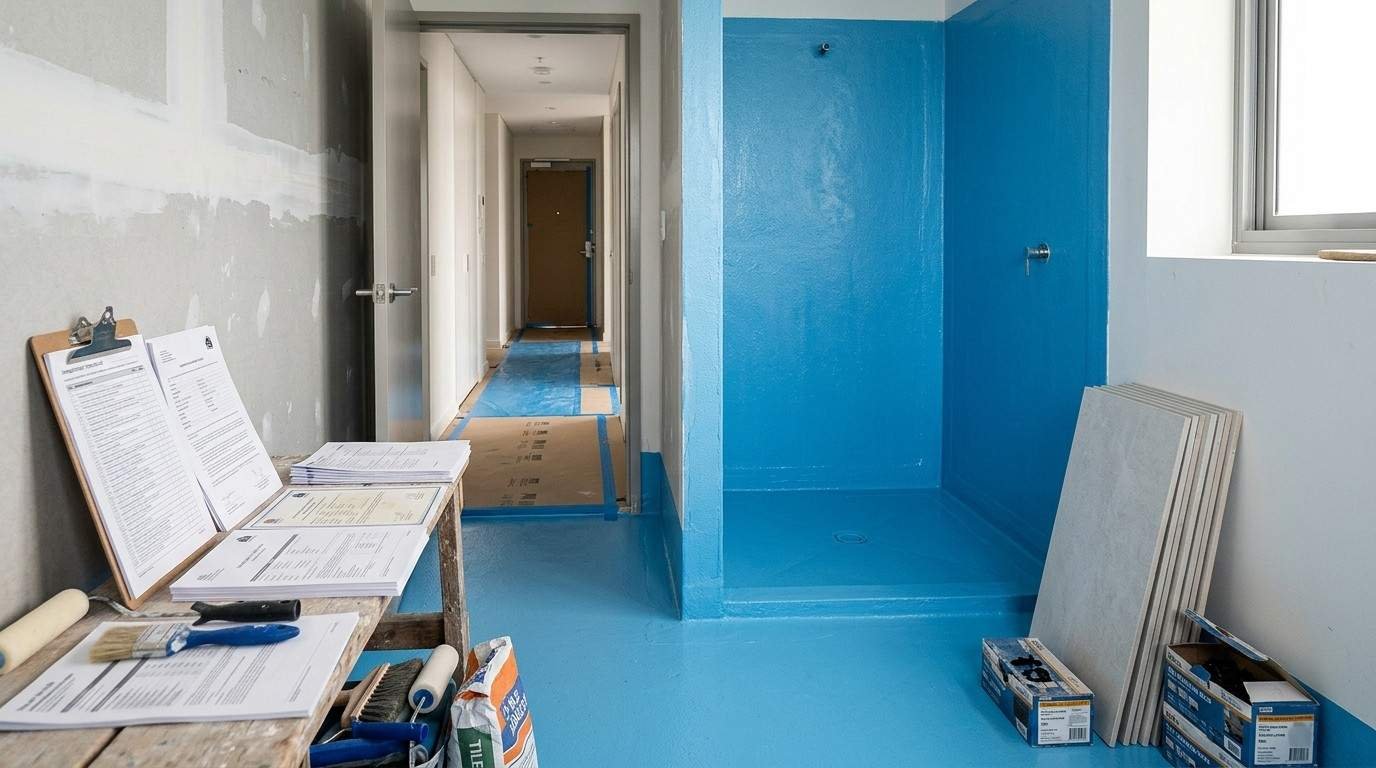
Your waterproofing contractor must be licensed. In NSW, waterproofing is a specialist trade that requires a contractor licence issued by NSW Fair Trading. After the waterproofing is applied and before tiling begins, the membrane must be inspected and a compliance certificate issued. That certificate is submitted to your owners corporation as part of your renovation documentation.
Do not tile over uninspected waterproofing. The inspection exists to protect you, your neighbours, and the building.
Noise and Neighbour Obligations During a Strata Reno
Bathroom renovations are noisy. Tile removal, drilling, grinding, and the movement of materials through common areas all create disruption for neighbours. In a strata building, that disruption is not just an inconvenience, it is a legal obligation you are required to manage.
Failing to manage noise and neighbour obligations is one of the most common triggers for strata disputes during renovations. And disputes slow projects down, sometimes significantly.
Acoustic Requirements and Floating Floor Rules
Many Sydney strata schemes now require that hard floor coverings, tiles, timber, vinyl planks, be installed over an acoustic underlay that meets a minimum impact sound rating. This requirement exists to protect the lot below from the transmission of footfall noise, which is amplified by hard surfaces compared to carpet.
The specific rating required varies by scheme. Some by-laws reference NCC (National Construction Code) acoustic standards directly. Others specify a minimum underlay thickness or product type. Check your by-laws before selecting your flooring system, because installing non-compliant flooring means pulling it up and starting again.
For bathroom floors specifically, the acoustic underlay must also be compatible with the waterproofing system beneath it. Not all underlays are. Your contractor needs to specify a system where both elements work together, waterproofing integrity and acoustic compliance are not separate problems.
Working Hours, Dust, and Debris Obligations
Standard working hours for construction in residential strata buildings in NSW are Monday to Friday, 7am to 5pm, and Saturday, 8am to 1pm, under NSW Environment Protection Authority guidelines. Many strata schemes are more restrictive than this, no Saturday work, no work before 8am, no work after 4pm. Your by-laws govern, not the EPA minimums.
Dust and debris management is your responsibility. Trades must use drop sheets in common areas, clean up at the end of each day, and use the building’s designated waste disposal areas. If your building has a goods lift, book it in advance and protect the interior. Damage to common property during a renovation is charged back to the lot owner, not the contractor.
Notify your immediate neighbours in writing before work begins. It is not legally required in most schemes, but it prevents complaints and builds goodwill that makes the whole project run more smoothly.
Plumbing and Electrical Work in Strata Buildings
Plumbing and electrical work in strata buildings carries compliance obligations that go beyond a standard residential renovation. The trades must be licensed, the work must be inspected, and compliance certificates must be issued and submitted. There are no shortcuts here, and any contractor who suggests otherwise is not someone you want working in your strata building.
Who Owns the Pipes, Lot vs. Common Property
The ownership of pipes in a strata building follows a straightforward principle in most schemes: pipes that serve only your lot are your responsibility; pipes that serve more than one lot or run through common property belong to the owners corporation. In practice, the boundary is not always easy to identify without a licensed plumber reviewing your strata plan.
The pipes inside your walls that connect your fixtures to the main stack are typically lot property. The main stack itself, the vertical drainage pipe that runs through the building, is common property. If your renovation requires connecting to or modifying the main stack, that work requires owners corporation approval and must be carried out by a licensed plumber with a compliance certificate.
Blocked or damaged common property pipes discovered during your renovation are not your financial responsibility to repair, but you are responsible for notifying the owners corporation immediately and not proceeding with work that could worsen the damage.
Licensed Trades, Permits, and Compliance Certificates
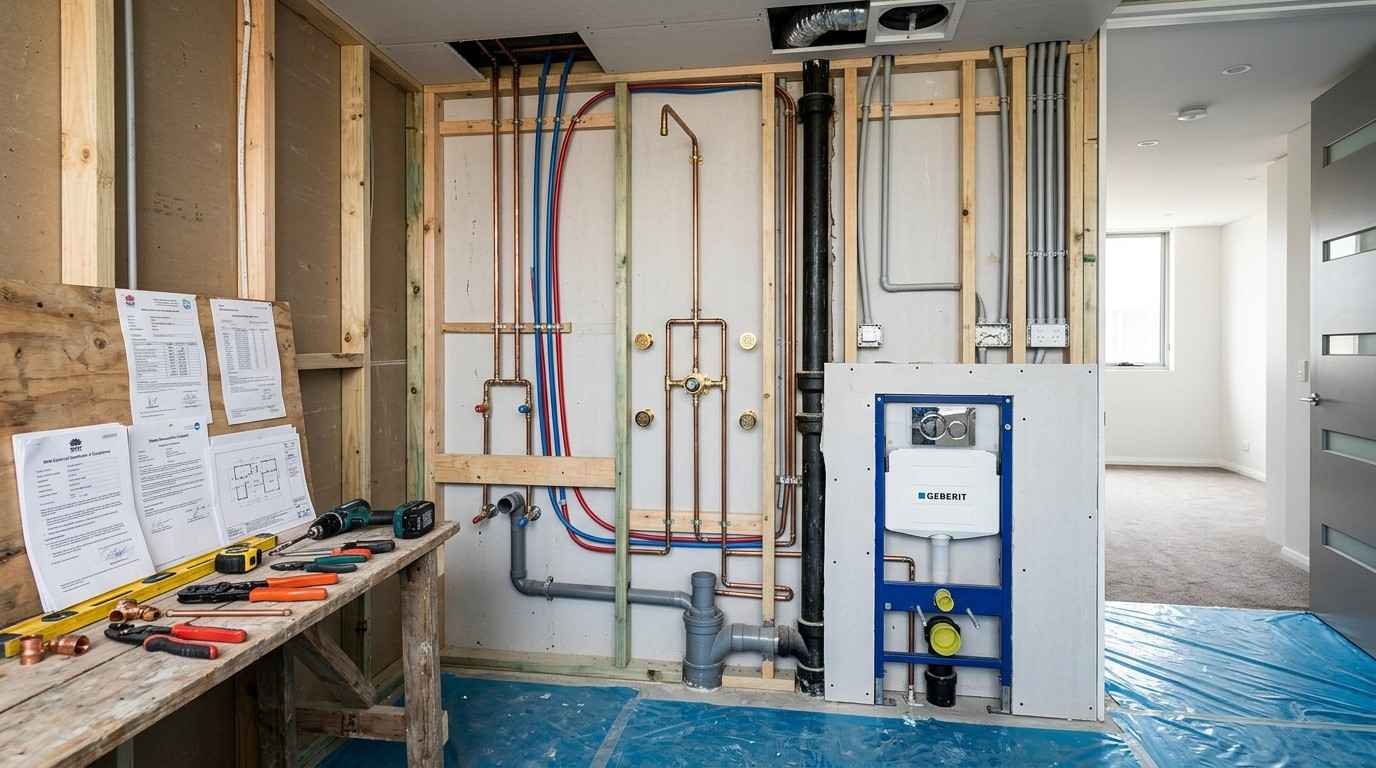
In NSW, all plumbing and drainage work must be carried out by a licensed plumber and drainer. All electrical work must be carried out by a licensed electrician. Both trades are required to issue a compliance certificate, a Certificate of Compliance (Plumbing and Drainage) for plumbing work, and a Certificate of Compliance (Electrical Work) for electrical work — upon completion.
These certificates are not optional paperwork. They are legal documents that confirm the work was carried out to the required standard. Your owners corporation will require them as part of your post-renovation documentation. Your building insurer may require them in the event of a claim. Keep originals and provide copies to your strata manager.
Any renovation that involves moving a power point, installing a new exhaust fan, adding a heated towel rail, or changing the lighting circuit requires a licensed electrician and a compliance certificate. The same applies to any change to your plumbing layout, including relocating a shower drain or adding a new fixture.
How Much Does a Strata Bathroom Renovation Cost in Sydney?
A strata bathroom renovation in Sydney costs more than an equivalent renovation in a freehold home. The additional cost comes from compliance requirements, approval processes, trade coordination complexity, and the constraints that a multi-dwelling environment places on how and when work can be done. Understanding the cost structure before you budget prevents the most common financial mistake: underestimating the strata premium.
Budget, Mid-Range, and Premium Cost Tiers
For a standard Sydney strata bathroom, the cost tiers break down roughly as follows. These figures reflect 2025 market rates for Sydney and include labour, materials, waterproofing, tiling, fixtures, and compliance certificates, but exclude owners corporation application fees and any structural work.
| Tier | Scope | Estimated Cost Range |
| Budget | Like-for-like replacement, builder-grade fixtures, standard tiles | $12,000 – $18,000 |
| Mid-Range | Full renovation, quality fixtures, feature tiles, semi-frameless shower | $18,000 – $30,000 |
| Premium | Full renovation, designer fixtures, large-format tiles, custom joinery | $30,000 – $55,000+ |
These are starting points, not fixed prices. Bathroom size, existing condition, access constraints, and the specific requirements of your strata scheme all affect the final figure. A bathroom on level twelve with no goods lift access costs more to renovate than an identical bathroom on level one.
Labour Costs Specific to Strata Projects
Labour in a strata renovation carries a premium over freehold work for several reasons. Trades must work within restricted hours, which reduces daily productivity. Materials must be transported through common areas carefully, which takes time. Waste removal is more complex. And the compliance documentation, waterproofing inspections, compliance certificates, photographic records, adds administrative time that is billed to the project.
A licensed tiler in Sydney charges between $60 and $120 per square metre for supply and lay, depending on tile size and complexity. A licensed plumber charges $120 to $180 per hour. A licensed electrician charges $110 to $160 per hour. Waterproofing by a licensed applicator typically costs $1,500 to $3,500 for a standard bathroom, depending on size and membrane system.
In a strata context, expect each trade to spend additional time on compliance documentation and coordination. Budget an additional 10 to 15 percent on labour compared to a freehold renovation of equivalent scope.
Hidden Costs That Catch Strata Owners Off Guard
The costs that most strata owners do not anticipate fall into four categories. First, owners corporation application fees, most schemes charge an administrative fee to process a renovation application, ranging from $200 to $1,500 depending on the scheme and the complexity of the work.
Second, compliance certificate fees, waterproofing inspections, plumbing compliance certificates, and electrical compliance certificates each carry a cost. Budget $300 to $800 per certificate depending on the trade and the certifier.
Third, rectification of pre-existing defects, when tiles come off and walls open up, pre-existing waterproofing failures, mould, or structural damage are sometimes discovered. In a strata building, the responsibility for rectifying these defects depends on whether they affect lot or common property, which can trigger a dispute with the owners corporation about who pays. Budget a contingency of 10 to 20 percent for this scenario.
Fourth, extended timelines, approval delays, trade scheduling constraints, and inspection hold points all extend the project duration. If you are renting alternative accommodation during the renovation, every additional week has a direct cost.
Choosing the Right Contractor for a Strata Renovation
Not every renovation contractor has experience working in strata buildings. The compliance requirements, the approval processes, the neighbour obligations, and the documentation demands of a strata project require a contractor who understands the environment, not just the construction.
Choosing the wrong contractor in a strata context does not just produce a poor renovation. It produces a renovation that may be rejected by the owners corporation, trigger a dispute, or require rectification at your expense.
What to Look for in a Strata-Experienced Renovator
Ask directly whether the contractor has completed bathroom renovations in strata buildings in Sydney. Ask for examples. Ask how they manage the owners corporation approval process, do they assist with documentation, or do they leave that entirely to you? Ask how they handle compliance certificates and inspection hold points.
A strata-experienced contractor understands that the project does not start on day one of construction. It starts with the approval application. They factor approval timelines into their scheduling, they know which trades need to be licensed and certified, and they manage the documentation trail that protects you throughout the project and after it is complete.
We work with strata owners across Sydney every day. The difference between a smooth strata renovation and a costly dispute almost always comes down to preparation and documentation — and that starts with the contractor you choose.
Insurance, Licensing, and Strata-Specific Requirements
Every contractor working in your strata building must hold current public liability insurance with a minimum coverage of $20 million. Many owners corporations specify this minimum in their by-laws. Your strata manager will confirm the requirement for your scheme.
In addition to public liability insurance, contractors should hold workers compensation insurance for all employees and subcontractors. Ask for certificates of currency for both policies before any work begins. An expired or insufficient insurance policy is grounds for the owners corporation to stop the work immediately.
All trades must hold current NSW Fair Trading contractor licences appropriate to their work. You can verify any licence at NSW Fair Trading’s licence check portal. Do this before signing any contract. A contractor who cannot provide a valid licence number is not legally permitted to carry out the work.
Managing the Renovation Timeline in a Strata Building
A strata bathroom renovation takes longer than an equivalent freehold renovation. The approval process adds weeks before construction begins. Working hour restrictions reduce daily output. Inspection hold points, particularly for waterproofing, create mandatory pauses in the construction sequence. And coordinating multiple licensed trades in a building where access and noise are restricted requires more scheduling precision than a standalone house.
Realistic timeline expectations prevent frustration and allow you to plan your living arrangements, your budget, and your contractor’s schedule properly.
How Approval Delays Affect Your Schedule
The owners corporation approval process is the most variable element of the strata renovation timeline. For minor renovations requiring committee approval, the process can take two to four weeks if the committee meets regularly and the application is complete. For major renovations requiring a special resolution at a general meeting, the process takes four to twelve weeks depending on when the next general meeting is scheduled.
Incomplete applications are the most common cause of delay. An application that is missing contractor licence numbers, insurance certificates, or a clear scope of works description will be returned for resubmission, adding weeks to the process. Submit a complete, well-documented application the first time.
Once approval is granted, allow a further two to four weeks for contractor scheduling, material procurement, and trade coordination before construction begins. A realistic total timeline from decision to construction start is six to sixteen weeks for a major bathroom renovation in strata.
Coordinating Trades in a Multi-Dwelling Environment
A bathroom renovation involves a sequence of trades: demolition, waterproofing, plumbing rough-in, electrical rough-in, waterproofing inspection, tiling, plumbing fit-off, electrical fit-off, and finishing. In a freehold home, this sequence can be compressed. In a strata building, each stage must respect working hour restrictions, building access rules, and the inspection hold points that cannot be skipped.
The waterproofing inspection is the most critical hold point. Tiling cannot begin until the waterproofing membrane has been inspected and certified. If the inspector is unavailable for several days, the project pauses. A contractor who understands strata schedules this inspection in advance, not after the membrane is applied.
Goods lift bookings, waste removal scheduling, and common area protection all require coordination with the building manager. A contractor who treats these as afterthoughts creates problems that slow the project and damage your relationship with the owners corporation.
Common Mistakes Strata Owners Make When Renovating
The mistakes that derail strata bathroom renovations are almost always avoidable. They share a common cause: underestimating the complexity of the strata environment and treating a strata renovation like a freehold renovation with extra paperwork.
How to Avoid Disputes, Fines, and Rectification Orders
The most expensive mistake is starting work without approval. Unapproved work in a strata building can result in a stop-work order from the owners corporation, a requirement to restore the bathroom to its original condition at your expense, a fine under the Strata Schemes Management Act, and a notation on the strata records that affects the property’s sale value.
The second most common mistake is using unlicensed trades. An unlicensed waterproofer, plumber, or electrician cannot issue a compliance certificate. Without compliance certificates, your renovation documentation is incomplete, your owners corporation approval conditions are not met, and your building insurance may be voided for claims arising from that work.
The third mistake is failing to notify neighbours. A neighbour who is surprised by construction noise at 7am on a Monday is a neighbour who files a noise complaint. A neighbour who received a written notice two weeks earlier is a neighbour who planned around it. The difference in outcome is significant.
The fourth mistake is ignoring the waterproofing inspection hold point. Tiling over uninspected waterproofing is a compliance failure. If the waterproofing is later found to be defective, the tiles must be removed, the membrane replaced, and the tiles relaid, at your cost, with no recourse against the contractor if you instructed them to proceed without inspection.
Tips for Maximising Value in a Strata Bathroom Renovation
A well-executed strata bathroom renovation adds genuine value to your property, both in resale price and rental yield. But not all upgrades deliver equal returns. Understanding where to spend and where to hold back is the difference between a renovation that pays for itself and one that simply costs money.
Upgrades That Add the Most Resale and Rental Value
In Sydney’s strata market, the upgrades that consistently deliver the strongest return are those that improve the perceived quality and functionality of the bathroom without adding unnecessary complexity. A frameless or semi-frameless shower screen transforms the feel of a bathroom for a relatively modest cost. Large-format tiles, 600x600mm or larger, make a small bathroom feel significantly bigger and photograph well for listings.
A wall-hung vanity with concealed plumbing creates a sense of space and is easier to clean, which appeals to both buyers and tenants. Heated towel rails are a low-cost addition that tenants consistently value. Matte black or brushed nickel tapware and accessories photograph well and signal quality without requiring a full premium fitout.
Avoid over-capitalising for your building’s price bracket. A $55,000 bathroom renovation in a building where comparable apartments sell for $650,000 will not return its full cost at sale. Match the renovation standard to the building’s market position.
What to Prioritise When Budget Is Tight
When the budget is constrained, prioritise waterproofing and tiling above everything else. These are the elements that protect the building, satisfy the owners corporation, and determine the longevity of the renovation. A bathroom with compliant waterproofing, clean tiles, and basic fixtures is a sound renovation. A bathroom with premium fixtures over failing waterproofing is a liability.
Second priority is plumbing functionality. Replace any fixtures that are worn, leaking, or non-compliant. A new toilet suite, a functional shower, and a working vanity basin are the minimum standard for a rentable or saleable bathroom.
Cosmetic upgrades, paint, accessories, mirrors, lighting, come last. They are the least expensive changes and the easiest to do later. Get the structural and compliance elements right first, then finish the aesthetics within whatever budget remains.
Frequently Asked Questions
Do I need to tell my strata manager before I start a bathroom renovation?
Yes, always. Even for cosmetic work that does not require formal approval, notifying your strata manager in writing before work begins creates a record and prevents disputes. For any work beyond cosmetic changes, formal approval is required before construction starts.
Can I renovate my strata bathroom without touching the waterproofing?
Only if the existing waterproofing membrane is completely undisturbed. The moment any tile is removed from a wet area floor or shower, the membrane beneath it is considered disturbed and must be replaced to current AS 3740 standard before retiling. There is no partial exception to this requirement.
What happens if I renovate without owners corporation approval?
The owners corporation can issue a stop-work order, require you to restore the bathroom to its original condition at your expense, and pursue a fine under the Strata Schemes Management Act 2015 (NSW). Unapproved work also creates a disclosure obligation at sale and can complicate building insurance claims.
How long does strata approval take for a bathroom renovation?
For minor renovations requiring committee approval, expect two to four weeks. For major renovations requiring a special resolution at a general meeting, expect four to twelve weeks. A complete, well-documented application submitted promptly is the most effective way to minimise approval time.
Who is responsible if a plumber damages a common property pipe during my renovation?
Your contractor’s public liability insurance covers damage they cause to common property during the renovation. This is why verifying that your contractor holds current, adequate public liability insurance before work begins is essential, not optional.
Can I relocate my toilet or shower drain in a strata bathroom?
Relocating a toilet or shower drain is possible but requires owners corporation approval in most schemes because it affects the drainage system. The work must be carried out by a licensed plumber, and a compliance certificate must be issued and submitted to the owners corporation on completion.
What is the minimum insurance a contractor must hold to work in my strata building?
Most Sydney strata schemes require a minimum of $20 million public liability insurance. Confirm the specific requirement with your strata manager before engaging any contractor. Also verify that the contractor holds current workers compensation insurance for all employees and subcontractors on site.
Are there restrictions on what tiles I can use in a strata bathroom?
Your by-laws may specify acoustic underlay requirements for hard floor coverings, but tile selection itself is generally unrestricted. The key compliance requirement is that the tile installation system, including adhesive, grout, and underlay, is compatible with the waterproofing membrane beneath it.
Can the owners corporation reject my renovation application?
Yes. The owners corporation can reject an application that is incomplete, that proposes work affecting common property without adequate justification, or that does not meet the scheme’s by-law requirements. A well-prepared application with full contractor documentation and a clear scope of works significantly reduces the risk of rejection.
Conclusion
Strata bathroom renovations in Sydney are manageable when you understand the framework. Approvals, waterproofing compliance, licensed trades, and neighbour obligations are not obstacles, they are the process, and working through them properly protects your investment and your relationship with the building.
The owners who navigate strata renovations successfully are the ones who prepare thoroughly, document everything, and choose contractors who understand the environment they are working in.
At Sydney Home Renovation, we manage strata bathroom renovations from approval application to final compliance certificate. Contact us to start planning your renovation with a team that knows exactly what strata requires.


