
Getting strata approval for a home renovation in NSW means understanding three tiers of work, submitting the right documentation to your owners corporation, and following the Strata Schemes Management Act 2015, before a single tradie sets foot on site.
Most homeowners in strata underestimate how structured this process is. Miss a step and your renovation stops, or gets ordered undone at your expense.
This guide walks through every stage of the strata approval process, from identifying which tier your renovation falls under to submitting your proposal and getting the vote across the line.
What Is the Strata Approval Process in NSW?
The strata approval process is the formal pathway owners must follow before carrying out renovation work that affects common property or the structural fabric of a strata building. It exists to protect every lot owner in the scheme, not just the one renovating.
In NSW, this process is governed by the Strata Schemes Management Act 2015 and enforced through the owners corporation. The owners corporation is the legal body made up of all lot owners in the scheme, and it holds decision-making authority over anything that touches shared infrastructure or common property.
Not every renovation triggers the same level of scrutiny. The Act divides renovation work into three distinct tiers, each with its own approval threshold.
Who Governs Strata Renovations in NSW?
The owners corporation governs all renovation decisions in a strata scheme. Day-to-day administration is typically handled by a strata manager, but the authority to approve or reject renovation work sits with the owners corporation as a whole, or with the strata committee for lower-tier decisions.
NSW Fair Trading provides the regulatory framework and dispute resolution pathways when owners and the corporation cannot agree. Their guidance on renovating in a strata scheme is the primary reference point for any NSW lot owner planning works.
What Counts as a Renovation Under Strata Law?
Under the Strata Schemes Management Act 2015, a renovation is any work that changes the structure, appearance, or infrastructure of a lot or common property. This includes work inside your lot that affects shared systems, plumbing stacks, waterproofing membranes, load-bearing elements, and electrical risers all count.
Purely cosmetic changes that leave the building fabric untouched sit outside the formal approval tiers. Everything else falls somewhere on the spectrum from minor to major.
Three Tiers of Strata Renovation Work
The Act creates three categories of renovation work. Your tier determines what approval you need — and how long the process takes.
Cosmetic Work, No Approval Needed
Cosmetic work requires no approval from the owners corporation. This covers changes entirely within your lot that do not affect structure, waterproofing, or shared systems.
Common examples include painting internal walls, installing picture hooks, laying carpet over existing flooring, and replacing internal blinds or curtains. These are changes a lot owner can make freely, without notifying anyone.
The boundary is clear: the moment work touches a wall cavity, a floor substrate, or any shared service, it moves out of cosmetic territory.
Minor Renovations, Ordinary Resolution Required
Minor renovations require approval by ordinary resolution at a general meeting. An ordinary resolution passes when more than 50% of votes cast are in favour.
Work in this tier includes installing timber or hard flooring , recessed lighting, built-in wardrobes, and kitchen benchtop replacements. These works change the character of the lot but do not structurally alter the building or affect common property in a lasting way.
The owners corporation can attach conditions to its approval, acoustic underlay requirements for hard floors are the most common example.
Major Renovations, Special Resolution Required
Major renovations require a special resolution, meaning at least 75% of eligible votes must be cast in favour. This is a significantly higher bar and reflects the serious impact these works can have on the building and other owners.
Structural changes, waterproofing replacement, reconfiguring internal walls that form part of the building structure, and any work affecting common property all fall into this tier. Bathroom renovations that involve retiling to the substrate, replacing the waterproofing membrane, or relocating plumbing typically sit here.
This is the tier where thorough documentation and professional plans make the biggest difference to your outcome.

How to Apply for Strata Approval Step by Step
The application process follows a logical sequence. Skipping any stage creates delays, or grounds for rejection.
Step 1 Review the By-Laws and Strata Plan
Start with your strata plan and the scheme’s registered by-laws. The strata plan defines the exact boundaries of your lot, where common property ends and your lot begins. This matters enormously for bathroom and kitchen renovations where walls, floors, and ceilings may be shared.
By-laws set the specific rules your scheme has adopted for renovation work. Some schemes have detailed renovation by-laws that specify approved materials, working hours, and contractor licensing requirements. Others rely entirely on the Act’s default provisions.
Get both documents from your strata manager before you plan anything. Designing a renovation around assumptions about your lot boundaries is a costly mistake.
Step 2 Prepare Your Renovation Proposal
Your proposal needs to give the owners corporation enough information to make an informed decision. For minor renovations, a written scope of works and a licensed contractor’s quote is usually sufficient.
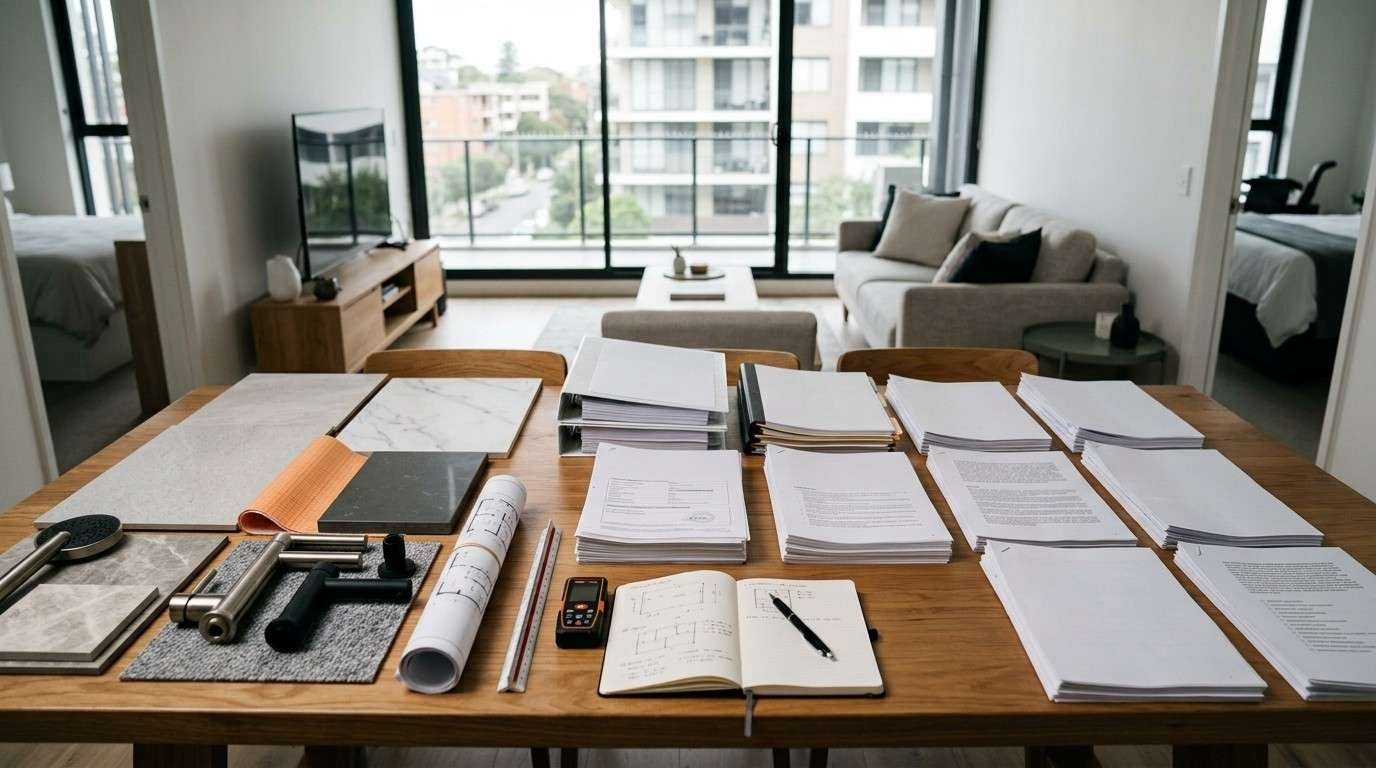
For major renovations, expect to provide architectural or building plans, a structural engineer’s report where walls or slabs are involved, a waterproofing specification from a licensed waterproofer, and a noise and vibration management plan. The more complete your documentation, the fewer questions the committee has, and the faster the vote moves.
Include your proposed start date, estimated duration, and the name and licence number of your principal contractor.
Step 3 Submit to the Owners Corporation
Submit your written application to the strata manager with all supporting documents attached. The strata manager places your item on the agenda for the next general meeting — or, for minor renovations, may refer it to the strata committee for a faster decision.
NSW strata law requires a minimum notice period before a general meeting. Under the Strata Schemes Management Act 2015, owners must receive at least 7 days’ notice for a general meeting, though most schemes give 14 days or more. Factor this into your renovation timeline from the start.
Step 4 Attend the General Meeting (If Required)
For major renovations requiring a special resolution, attending the general meeting is worth doing in person. You can answer questions directly, address concerns from neighbouring owners, and demonstrate that you have engaged a professional team.
Bring your full documentation set. Owners who can see a waterproofing specification, a structural engineer’s sign-off, and a licensed contractor’s details are far more likely to vote in favour than those asked to approve a vague scope of works.
What the Owners Corporation Looks At
The owners corporation is not looking for reasons to reject your application. It is looking for evidence that your renovation will not damage the building, affect other owners, or create ongoing liability for the scheme.
Structural Impact and Common Property
Any work that touches load-bearing walls, concrete slabs, or structural columns triggers immediate scrutiny. The owners corporation needs to know that a structural engineer has assessed the impact and that the work will be carried out by a licensed builder.
Common property boundaries are the other major concern. In most NSW strata schemes, the structural elements of floors, ceilings, and external walls are common property, even if they sit inside your lot. Work that penetrates or modifies these elements requires explicit approval and, in many cases, a by-law to authorise the change.
Waterproofing, Plumbing, and Noise Compliance
Bathroom renovations attract the most scrutiny of any residential strata renovation. Water damage from failed waterproofing is one of the most common and expensive claims in strata buildings, and the owners corporation knows it.
Expect the committee to ask for a waterproofing specification that meets AS 3740-2021 — the Australian Standard for waterproofing of domestic wet areas. They will also want confirmation that any plumbing work is carried out by a licensed plumber and that penetrations through the floor slab are properly sealed.
Noise compliance matters too. Hard flooring over a concrete slab transmits impact noise to the lot below. Most owners corporations require acoustic underlay with a minimum impact isolation rating before approving hard floor installations.
How Long Does Strata Approval Take in NSW?
The timeline depends entirely on which tier your renovation falls into.
Cosmetic work has no approval timeline, you can start immediately. Minor renovations referred to the strata committee can be approved within two to four weeks, depending on how quickly the committee meets and how complete your documentation is.
Major renovations requiring a special resolution at a general meeting take longer. Add the minimum notice period for the meeting, the meeting itself, and any conditions the owners corporation attaches to its approval. Realistically, budget six to twelve weeks from submission to approval for a major renovation in a well-run scheme. In schemes with infrequent general meetings or complex by-law requirements, it can take longer.
Submit early. The single biggest cause of renovation delays in strata is owners who start the approval process after they have already engaged a contractor and locked in a start date.
What Happens If You Renovate Without Approval?
Carrying out unapproved renovation work in a strata scheme is a serious mistake. The owners corporation has the power to issue a notice to comply, requiring you to stop work immediately and rectify any unauthorised changes, at your own cost.
If you ignore a notice to comply, the matter escalates to the NSW Civil and Administrative Tribunal (NCAT). NCAT can order you to reinstate the property to its original condition, pay the costs of rectification, and in some cases impose financial penalties. The NSW Civil and Administrative Tribunal handles strata disputes as part of its Consumer and Commercial Division, and orders are legally enforceable.
Beyond the legal exposure, unapproved works create problems when you sell. A solicitor’s strata report will flag unauthorised renovations, and buyers, and their banks, will want them resolved before settlement.
Tips to Get Your Strata Approval Approved Faster
Build a relationship with your strata manager before you submit. A strata manager who knows you are organised and professional will help move your application through the process more smoothly.
Submit a complete application the first time. Incomplete applications get tabled, not approved, and every tabling adds weeks to your timeline. Include every document the by-laws require, plus anything else that answers the obvious questions before they are asked.
Engage a licensed contractor with strata renovation experience. Contractors who understand strata documentation requirements, waterproofing specs, noise management plans, structural engineer sign-offs, make your application stronger and your renovation faster to approve.
Talk to your neighbours before the meeting. Owners who have already heard about your renovation and had their questions answered are far less likely to raise objections at the general meeting. A five-minute conversation with the owner below you about your waterproofing approach can be the difference between a smooth vote and a contested one.
Conclusion
The strata approval process in NSW is structured, but it is navigable. Understanding your tier, preparing complete documentation, and engaging the owners corporation early are the three things that determine whether your renovation moves forward on schedule or stalls.
Bathroom renovations in strata require the most careful preparation, waterproofing, plumbing, and structural elements all come under scrutiny, and the documentation bar is high.
At Sydney Home Renovation, we work with strata owners across Sydney every day. We know what owners corporations look for, and we prepare the documentation that gets approvals across the line. Contact us to start your strata renovation the right way.
Frequently Asked Questions
Do I need strata approval for a bathroom renovation in NSW?
Yes. Most bathroom renovations in NSW strata schemes require approval because they involve waterproofing, plumbing, or structural elements that affect common property. The level of approval — ordinary or special resolution — depends on the scope of work.
What is the difference between cosmetic and minor renovations in strata?
Cosmetic renovations require no approval and cover changes entirely within your lot that do not affect structure or shared systems. Minor renovations require an ordinary resolution and include works like hard flooring, recessed lighting, and built-in storage that change the lot but do not affect the building structure.
How do I find out what by-laws apply to my strata property?
Request a copy of the registered by-laws and the strata plan from your strata manager. These documents define your lot boundaries and the specific rules your scheme has adopted for renovation work, including any approved materials, working hours, and contractor requirements.
Can the owners corporation reject my renovation application?
Yes. The owners corporation can reject an application if the proposed work affects common property without adequate documentation, poses a structural or waterproofing risk, or does not comply with the scheme’s by-laws. A well-prepared application with complete documentation significantly reduces the risk of rejection.
Do I still need council approval if I have strata approval?
Yes, in many cases. Strata approval and council development approval are separate processes. Work that requires a Development Application or a Complying Development Certificate under the Environmental Planning and Assessment Act 1979 still needs council sign-off, regardless of strata approval status.
What is a special resolution in strata NSW?
A special resolution is a vote where at least 75% of eligible votes cast are in favour of the motion. It is required for major renovations that affect common property or the structural fabric of the building. A special resolution carries more weight than an ordinary resolution and reflects the significance of the proposed works.