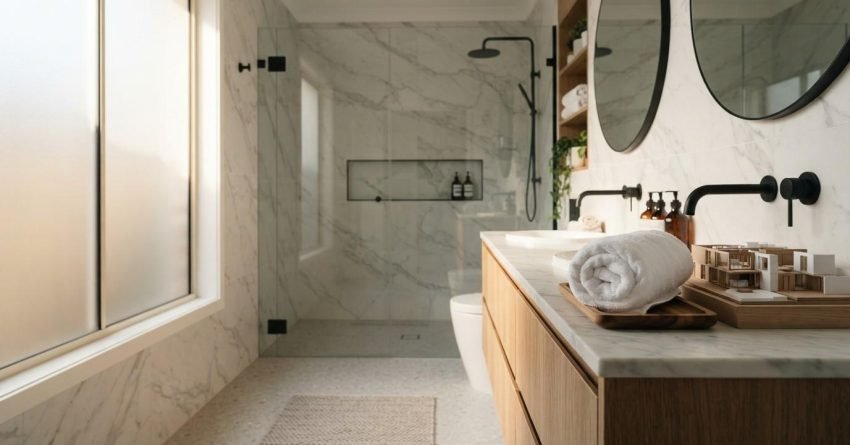
An ensuite renovation transforms the private bathroom attached to your master bedroom, upgrading fixtures, finishes, waterproofing, and layout to improve function, comfort, and long-term property value. For Australian homeowners and investors, it’s one of the highest-impact renovation projects you can undertake.
Get it wrong and you’re looking at cost blowouts, compliance failures, and finishes that date quickly. Get it right and you add genuine value to your home while creating a space that works harder every single day.
This guide covers everything: what ensuite renovations involve, realistic cost ranges, labour rates, materials, hidden expenses, budget planning, ROI, contractor selection, and project timelines, all built for Sydney conditions.
What Is an Ensuite Renovation?
An ensuite renovation is the process of upgrading, reconfiguring, or fully rebuilding the private bathroom directly connected to a bedroom, most commonly the master bedroom. It typically involves replacing or upgrading fixtures, retiling surfaces, updating waterproofing, and improving the overall layout and finish quality.
In Australia, ensuite renovations range from cosmetic refreshes, new tapware, a vanity swap, and fresh tiles, through to full structural rebuilds that relocate plumbing, expand the footprint, and install premium fittings. The scope you choose determines the cost, the timeline, and the trades involved.
We see this project undertaken for three main reasons: the existing ensuite is functionally outdated, the finishes are worn or water-damaged, or the homeowner wants to increase property value before a sale or rental. Each reason shapes the brief differently, and understanding your primary driver is the first step toward a well-planned renovation.
Ensuite vs. Bathroom, What’s the Difference?
An ensuite is a bathroom that opens directly from a bedroom, providing private access without entering a shared hallway or common area. A standard bathroom, by contrast, is accessed from a shared space and serves multiple household members or guests.
This distinction matters for renovation planning because ensuites are typically smaller, more design-focused, and used by fewer people, which shifts the balance toward premium finishes and personal preference over pure functionality. It also means the renovation brief is more personal and the ROI calculation is different from a family bathroom.
When Does an Ensuite Need Renovating?
The clearest signals are water damage, failing waterproofing, cracked or lifting tiles, outdated fixtures, and inadequate storage. Beyond the functional triggers, many homeowners renovate simply because the space no longer reflects the standard of the rest of the home.
In Sydney’s property market, an outdated ensuite in an otherwise well-presented home is a visible gap that buyers and tenants notice immediately. We find that ensuites renovated within the last five to seven years consistently outperform older ones in both sale price negotiations and rental appraisals.
How Much Does an Ensuite Renovation Cost in Australia?
Ensuite renovation costs in Australia typically range from $8,000 for a basic cosmetic refresh to well over $50,000 for a full premium rebuild. The wide range reflects differences in size, scope, material selections, and the complexity of the trades involved.
In Sydney specifically, labour costs sit higher than the national average — a factor that pushes mid-range projects toward the upper end of their tier. According to HIA’s 2024 Residential Renovation Report, bathroom and ensuite renovations remain among the most frequently undertaken residential projects in NSW, with average spend continuing to rise year on year as material and labour costs increase.
Understanding which cost tier your project falls into is the foundation of realistic budget planning. We break it down across three bands.
Budget Ensuite Renovations ($8,000–$15,000)
At this level, you’re working with a like-for-like replacement strategy, same layout, same footprint, entry-level to mid-range fixtures, and standard tiling. No walls are moved, plumbing stays in place, and the focus is on refreshing the space rather than transforming it.
This tier suits investment properties where durability and tenant appeal matter more than luxury finishes. It also works for homeowners who need a functional upgrade without the budget for a full rebuild. Expect standard ceramic tiles, a builder-grade vanity, a basic shower screen, and chrome tapware.
The risk at this tier is underestimating waterproofing and compliance costs, which are non-negotiable regardless of finish level. We always build these into the budget from day one.
Mid-Range Ensuite Renovations ($15,000–$30,000)
This is the most common tier for Sydney owner-occupiers. At this level, you gain access to better tile selections, semi-frameless shower screens, stone or stone-look benchtops, quality tapware, and improved storage solutions. Minor layout adjustments, like relocating a vanity or reconfiguring the shower, become viable.
Mid-range renovations deliver the strongest balance of quality, longevity, and return on investment. The finishes hold up well over time, the space feels genuinely upgraded, and the project scope is manageable for most renovation contractors.
We find that most homeowners who start with a budget brief end up in this tier once they see what the additional spend delivers in finish quality and durability.
Premium Ensuite Renovations ($30,000+)
Premium renovations involve full layout reconfiguration, high-end imported tiles, freestanding baths, custom joinery, heated floors, frameless shower enclosures, and designer tapware. At this level, the ensuite becomes a genuine feature of the home, a space that competes with boutique hotel bathrooms.
In Sydney’s upper-middle and prestige property segments, a premium ensuite is an expectation, not a luxury. Buyers in these markets factor the quality of the ensuite directly into their offer price. For investors in high-yield short-term rental markets, premium finishes can justify significantly higher nightly rates.
The key discipline at this tier is avoiding over-capitalisation, spending more than the property’s value can absorb. We always benchmark premium renovation budgets against comparable sales in the same suburb before finalising the scope.
What Drives Ensuite Renovation Costs?
No two ensuite renovations cost the same, and understanding the variables that drive pricing is essential before you commit to a budget. The three biggest cost levers are size and layout complexity, your choice of fixtures and finishes, and the structural and waterproofing requirements of the existing space.
Getting clarity on each of these before you engage a contractor means you walk into the quoting process informed, and far less likely to be surprised by variations once work begins.
Size and Layout Complexity
A standard ensuite in an Australian home runs between 3 and 6 square metres. Every additional square metre adds cost across tiling, waterproofing, and labour. But size alone doesn’t tell the full story, layout complexity is often the bigger cost driver.
Moving a toilet, relocating a shower, or shifting a vanity to a different wall requires a licensed plumber to reroute waste and water lines. In a single-storey home, this is manageable. In a multi-storey home where the ensuite sits above a finished ceiling, the cost and complexity increase significantly.
We always assess layout change requirements before quoting, because a seemingly simple relocation can add $2,000–$5,000 to the plumbing component alone.
Fixtures, Fittings, and Finishes
Fixtures and finishes are where renovation budgets vary most dramatically. A builder-grade vanity costs $400–$800. A custom-joinery vanity with stone top costs $3,000–$8,000. The same gap exists across every product category, tiles, tapware, shower screens, and baths.
The practical discipline is matching your finish level to your property tier and your renovation objective. A premium vanity in a mid-market investment property doesn’t return its cost. Equally, a builder-grade finish in a prestige home undermines the property’s positioning.
We help clients build a finishes schedule that aligns spend with return, identifying where quality investment pays off and where standard selections perform just as well.
Structural and Waterproofing Requirements
Waterproofing is the most critical, and most frequently underestimated, cost in any ensuite renovation. Under AS 3740 (Waterproofing of Domestic Wet Areas), all wet areas must be waterproofed to a compliant standard before tiling. This is not optional, and it cannot be skipped to save money.
In older Sydney homes, we regularly uncover failed waterproofing membranes, rotted substrate, and water damage that has spread beyond the ensuite into adjacent walls and floors. Rectifying this before the renovation proceeds adds cost, but it’s cost that protects the entire structure of the home.
Structural surprises are the primary driver of budget variations in ensuite renovations. A contingency allowance of 10–15% of your total budget is not excessive, it’s prudent planning.
Labour Costs for Ensuite Renovations in Sydney
Labour typically accounts for 40–55% of the total cost of an ensuite renovation in Sydney. Understanding what each trade charges, and why Sydney rates sit above the national average, helps you evaluate quotes accurately and avoid being undercut by contractors who cut corners on compliance.
Sydney’s tight construction labour market and high cost of living push trade rates above those in most other Australian cities. This is a structural reality of renovating in NSW, not a negotiating point.
Tiler and Waterproofer Rates
Tiling is one of the most labour-intensive components of an ensuite renovation. In Sydney, licensed tilers charge between $45 and $85 per square metre for supply and lay, depending on tile format, pattern complexity, and substrate condition. Large-format tiles (600x600mm and above) cost more to lay due to the precision and time required.
Waterproofing is typically quoted as a separate line item, expect $800–$2,000 for a standard ensuite, depending on the area being treated and the membrane system specified. We always use a licensed waterproofer and document the installation for compliance purposes.
Plumber and Electrician Costs
Licensed plumbers in Sydney charge $120–$180 per hour, with most ensuite renovations requiring 10–20 hours of plumbing work for a standard like-for-like replacement. Relocating fixtures adds significantly to this figure.
Electricians are required for exhaust fans, heated towel rails, lighting circuits, and any heated floor systems. Expect $100–$160 per hour, with a standard ensuite electrical scope running 6–12 hours. Both trades require licensed practitioners under NSW law, unlicensed work voids insurance and creates serious liability.
Project Management and Coordination
Coordinating multiple trades across a renovation, tilers, plumbers, electricians, plasterers, and painters, is a project management task that directly affects both cost and timeline. When trades are poorly sequenced, delays compound and costs escalate.
A renovation contractor who manages the full project, scheduling trades, managing variations, and maintaining quality control, adds a coordination margin of 10–20% of the project cost. This is money well spent. The alternative is managing it yourself, which most homeowners significantly underestimate in time and complexity.
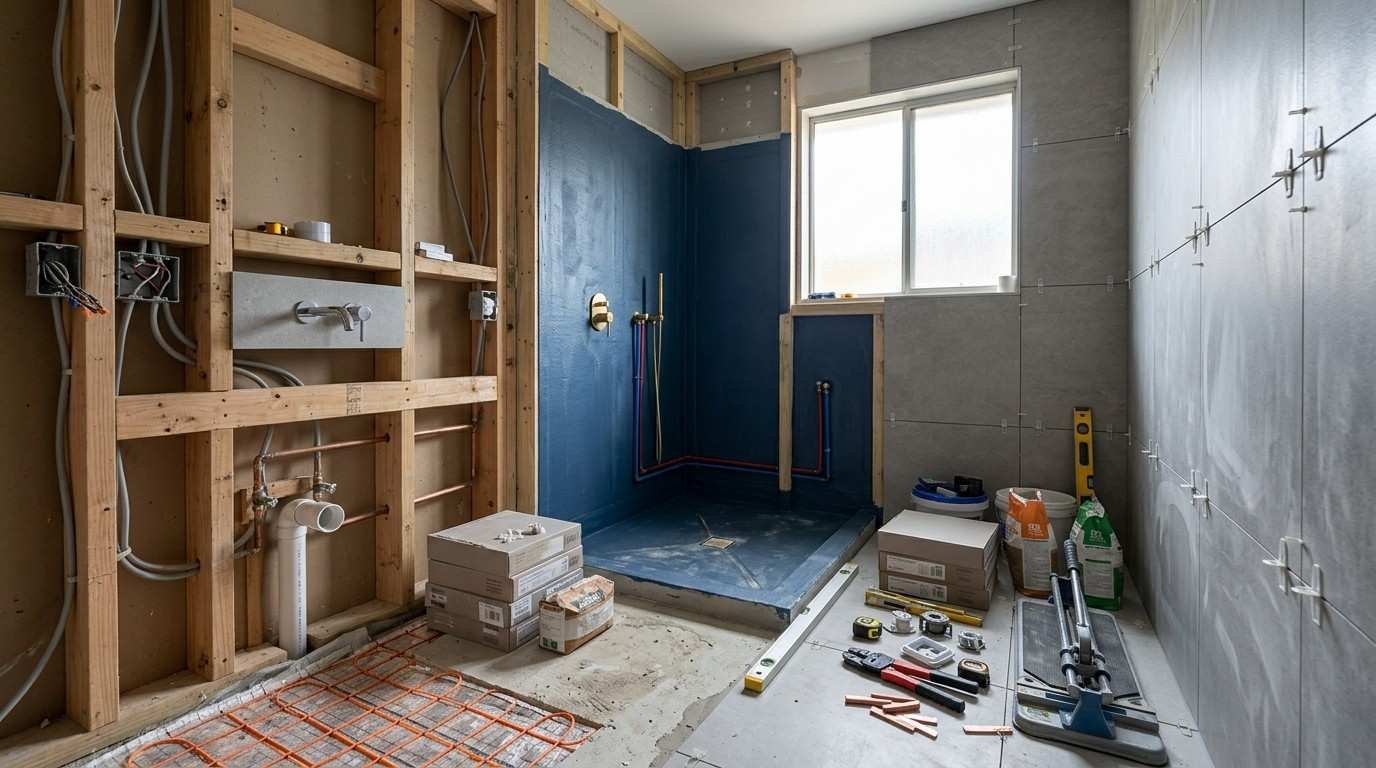
Ensuite Renovation Materials and Fittings Guide
Material and fitting selections define the look, feel, and longevity of your ensuite. They also represent the area of the budget where you have the most control, and where the most costly mistakes are made when selections are rushed or made without a clear brief.
We work with clients to build a finishes schedule before any work begins. This locks in selections, prevents mid-project changes, and gives every trade a clear scope to price against.
Tiles, Choosing for Style, Budget, and Durability
Tiles are the dominant visual element in any ensuite and one of the largest material cost lines. In Australia, tile prices range from $30 per square metre for standard ceramic through to $300+ per square metre for imported porcelain or natural stone.
Beyond price, the key selection criteria are slip resistance (particularly for floor tiles), grout joint sizing, and maintenance requirements. Rectified large-format porcelain tiles are currently the most popular choice in Sydney mid-range to premium renovations, they deliver a clean, contemporary look with good durability and relatively low maintenance.
For a deeper look at tile selection for Australian bathrooms, our ensuite tile selection guide covers formats, finishes, and slip ratings in full detail.
Vanities, Basins, and Storage
The vanity is the functional centrepiece of the ensuite and the piece that most directly communicates the quality tier of the renovation. Wall-hung vanities are the dominant choice in contemporary Sydney renovations, they create a sense of space, simplify floor cleaning, and allow height adjustment for different users.
Basin selection, whether integrated, above-counter, or undermount, affects both the aesthetic and the cleaning maintenance of the vanity. Above-counter basins read as premium but require more regular cleaning around the base. Undermount basins are practical and suit a cleaner, more streamlined look.
Storage is consistently underplanned in ensuite renovations. We recommend a minimum of 600mm of drawer storage per user, plus a mirrored cabinet for daily-use items. Getting this right at the design stage costs nothing, retrofitting storage after the renovation is expensive and disruptive.
Showers, Baths, and Tapware
The shower is the most-used fixture in the ensuite and deserves a proportionate share of the budget. Frameless shower screens, large-format shower bases or tiled floors, and a quality overhead or rail shower system are the baseline for a mid-range renovation. Niche shelving, built-in seating, and dual shower heads move the specification into premium territory.
Freestanding baths have become a signature feature in premium Sydney ensuites, but they require adequate floor space (minimum 1,800mm clearance), structural floor assessment, and a dedicated fill tap. They add significant cost and are best suited to ensuites of 8 square metres or more.
Tapware is a high-visibility, relatively low-cost opportunity to elevate the finish of the space. Brushed nickel, matte black, and brushed brass finishes are currently dominant in Sydney renovations. Consistency across all tapware, basin mixer, shower, bath filler, and towel rail, is the mark of a well-considered renovation.
Hidden Costs and Budget Blowouts to Watch For
Hidden costs are the single biggest source of renovation stress for Sydney homeowners. They’re not truly hidden, they’re predictable risks that experienced contractors plan for and inexperienced ones ignore until they become variations.
We’ve completed enough ensuite renovations in Sydney to know exactly where the surprises come from. Understanding these risks before you start is the most effective form of budget protection available.
Waterproofing Failures and Structural Issues
Failed waterproofing is the most common hidden cost in ensuite renovations. When tiles are removed, it’s routine to find that the existing membrane has failed, either through age, poor original installation, or movement in the substrate. Rectifying this is mandatory before retiling, and the cost depends on the extent of the damage.
In worst-case scenarios, water has tracked through the substrate into the wall framing or the floor structure below. We’ve opened ensuites in Sydney homes where the damage extended 600–900mm beyond the wet area into adjacent rooms. Structural rectification in these cases adds $3,000–$10,000 to the project cost before the renovation itself begins.
Asbestos, Mould, and Compliance Surprises
Sydney homes built before 1987 have a meaningful probability of containing asbestos-containing materials (ACM) in wall sheeting, floor adhesives, or ceiling materials. Under NSW SafeWork regulations, any ACM must be identified and managed by a licensed removalist before demolition proceeds.
Asbestos removal in an ensuite typically costs $1,500–$4,000 depending on the volume and type of material. It’s a cost that cannot be avoided once identified, and attempting to proceed without licensed removal creates serious legal and health liability.
Mould remediation is a separate but related issue. Chronic moisture in a poorly ventilated ensuite creates mould growth in wall cavities that isn’t visible until demolition. Remediation adds cost and time, and the underlying ventilation issue must be resolved as part of the renovation scope.
Scope Creep and Variation Costs
Scope creep, the gradual expansion of the renovation brief beyond the original quote, is the most controllable hidden cost, and the one most homeowners underestimate. It happens when selections change mid-project, when “while we’re at it” decisions are made on site, and when the original brief wasn’t detailed enough to prevent ambiguity.
Every variation on a live renovation site costs more than it would have in the planning stage. A tile change after waterproofing has been completed, for example, can trigger re-waterproofing costs, additional labour, and material wastage. We lock in all selections before work begins specifically to prevent this.
A detailed scope of works, a fixed finishes schedule, and a clear variation approval process are the three documents that protect your budget from scope creep.
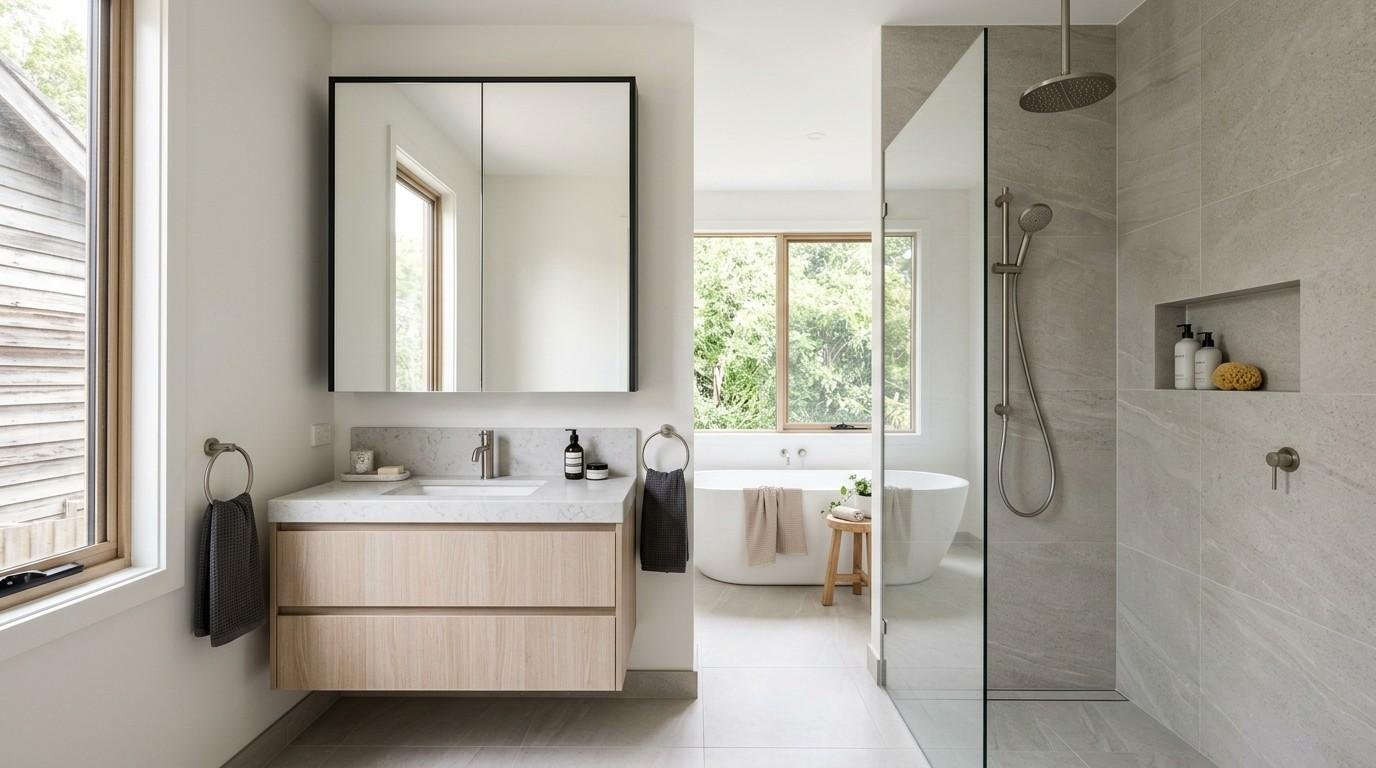
How to Plan Your Ensuite Renovation Budget
Budget planning is where most ensuite renovations succeed or fail, not on site, but in the weeks before a single tile is removed. A well-structured budget gives you control over the project; a poorly structured one leaves you reacting to costs as they emerge.
We use a consistent budgeting framework across every project we manage, and the principles apply whether you’re spending $12,000 or $45,000.
Setting a Realistic Budget Allowance
Start with your total available budget and work backwards, not forwards. Identify your non-negotiables (waterproofing compliance, licensed trades, quality fixtures in high-use areas) and your flexible items (decorative finishes, accessories, feature elements).
In Sydney, a realistic minimum for a compliant, quality ensuite renovation is $15,000–$18,000 for a standard 4–5 square metre space. Below this figure, compromises on compliance or finish quality become unavoidable. Any quote significantly below this range warrants careful scrutiny of what has been excluded.
Prioritising Where to Spend and Where to Save
The highest-return areas of spend in an ensuite renovation are waterproofing, tiling, and the vanity. These are the elements that define the quality and longevity of the space. Cutting costs here creates problems that are expensive to fix later.
The areas where savings are most achievable without compromising quality are accessories (towel rails, toilet roll holders, hooks), lighting fixtures, and mirror selections. These items are visible but replaceable, and the market offers excellent options at every price point.
We also recommend spending on quality tapware over quantity of features. One excellent shower system outperforms two mediocre ones every time.
Contingency Planning for Unexpected Costs
A contingency allowance of 10–15% of your total renovation budget is the standard we recommend for all ensuite projects in Sydney. For older homes (pre-1980), we recommend 15–20% given the higher probability of waterproofing failures, asbestos, and structural issues.
This contingency is not a slush fund for upgrades, it’s a financial buffer for genuine surprises. If it goes unspent, it’s a bonus. If it’s needed, it’s the difference between a project that stays on track and one that stalls mid-construction.
Ensuite Renovation ROI, Does It Add Value to Your Home?
An ensuite renovation is one of the most consistently cited value-adding projects in Australian residential property. But ROI is not automatic, it depends on the quality of the renovation, the property tier, and the market conditions at the time of sale or appraisal.
Understanding how ROI works differently for owner-occupiers versus investors helps you calibrate your spend to your objective.
Renovation ROI for Owner-Occupiers
For owner-occupiers, ROI has two components: the financial return at sale and the daily lifestyle value of the upgraded space. CoreLogic’s 2024 Renovation Value Report found that bathroom renovations in Sydney delivered an average return of $1.71 for every $1.00 spent when the renovation was aligned with the property’s price bracket.
The key qualifier is alignment. A $45,000 premium renovation in a $600,000 property is unlikely to return its full cost. The same renovation in a $1.5 million property is a baseline expectation for buyers in that segment.
Renovation ROI for Property Investors and Landlords
For investors, the ROI calculation is more direct: does the renovation increase rental yield, reduce vacancy, or support a higher sale price? In Sydney’s competitive rental market, a well-renovated ensuite consistently commands a $50–$150 per week rental premium over comparable unrenovated properties, depending on the suburb and property tier.
For landlords targeting the short-term rental market, a premium ensuite is a direct revenue driver, guests cite bathroom quality as one of the top three factors in property selection and review scores. The renovation pays for itself faster in this context than in long-term residential tenancies.
Choosing the Right Ensuite Renovation Contractor in Sydney
The contractor you choose determines the quality, compliance, and cost certainty of your renovation more than any other single decision. Sydney’s renovation market includes excellent operators and unreliable ones, and the difference isn’t always obvious from a quote alone.
We’ve seen the consequences of poor contractor selection too many times: failed waterproofing, unlicensed trade work, abandoned projects, and disputes that cost more to resolve than the original renovation.
What to Look for in a Renovation Contractor
A credible ensuite renovation contractor in Sydney should hold a current NSW Fair Trading Home Building licence, carry home building compensation (HBC) insurance for projects over $20,000, and be able to provide references from completed bathroom or ensuite projects.
Beyond credentials, look for a contractor who provides a detailed written scope of works, a fixed-price contract with a clear variation process, and a realistic timeline with defined milestones. Vague quotes and verbal agreements are the precursors to disputes.
We provide all of these as standard, because transparent documentation protects both the client and the contractor.
Questions to Ask Before Signing a Contract
Before committing to any contractor, ask: Who holds the relevant trade licences, the contractor or their subcontractors? Is waterproofing included and documented for compliance? What is the variation approval process? What happens if hidden structural issues are discovered?
The answers to these questions reveal how a contractor manages risk and communicates under pressure. A contractor who answers them clearly and confidently is one who has managed these situations before. One who deflects or gives vague answers is one who hasn’t, or one who has and handled it poorly.
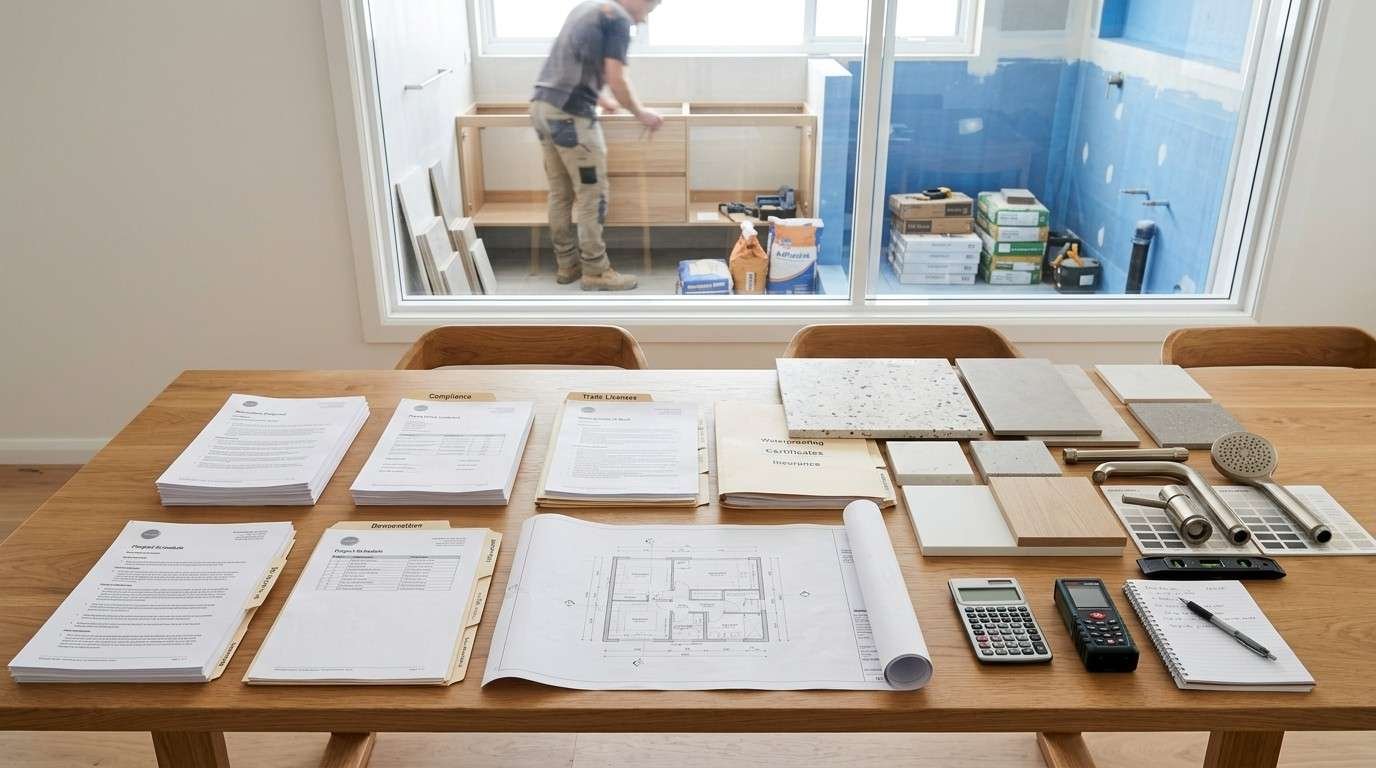
Ensuite Renovation Timeline, How Long Does It Take?
A standard ensuite renovation in Sydney takes 3 to 6 weeks from demolition to completion, depending on scope, trade availability, and whether any structural issues are encountered. Premium renovations with custom joinery, imported tiles, or significant layout changes can extend to 8–12 weeks.
Understanding the project phases and the factors that cause delays helps you plan your household disruption and set realistic expectations with your contractor.
Typical Project Phases and Durations
A standard ensuite renovation moves through five phases: demolition and strip-out (1–2 days), rough-in plumbing and electrical (2–4 days), waterproofing and substrate preparation (3–5 days including cure time), tiling (3–5 days), and fit-off — fixtures, screens, vanity, and accessories (2–3 days).
Between each phase, there are mandatory cure and inspection periods, waterproofing membranes require 24–48 hours of cure time before tiling, and some councils require inspection sign-off at specific stages. These periods are not delays; they’re compliance requirements built into every well-managed project timeline.
What Causes Delays and How to Avoid Them
The most common causes of timeline blowouts are: late material deliveries (particularly imported tiles and custom vanities), trade scheduling conflicts, and structural discoveries that require additional work before the renovation can proceed.
The most effective mitigation is lead time planning. We order all materials and confirm all trade bookings before demolition begins. A renovation that starts without confirmed material delivery dates is a renovation that will stall mid-project, and a stalled renovation costs money in idle trade time and extended household disruption.
Frequently Asked Questions
How much does a small ensuite renovation cost in Sydney?
A small ensuite renovation in Sydney, typically 3 to 4 square metres with a like-for-like layout, costs between $12,000 and $20,000. This covers compliant waterproofing, standard tiling, a quality vanity, and licensed trade work. Budget quotes below $10,000 almost always exclude critical compliance items.
Do I need council approval for an ensuite renovation in NSW?
Most ensuite renovations in NSW are classified as exempt development under the State Environmental Planning Policy (Exempt and Complying Development Codes) 2008, meaning council approval is not required. However, any structural changes, additions to the building footprint, or work on heritage-listed properties require a Development Application or Complying Development Certificate.
How long does an ensuite renovation take from start to finish?
A standard ensuite renovation takes 3 to 6 weeks from demolition to completion. Premium renovations with custom elements or significant layout changes take 8 to 12 weeks. The timeline depends on scope, trade availability, and whether structural issues are discovered during demolition.
What is the most expensive part of an ensuite renovation?
Labour is consistently the largest cost component, accounting for 40–55% of the total budget. Within materials, tiling and the vanity are the highest-cost items. Structural rectification, waterproofing failures, rotted substrate, or asbestos removal, can become the largest single cost line when discovered during demolition.
Can I renovate my ensuite without moving plumbing?
Yes, a like-for-like renovation that keeps all fixtures in their existing positions avoids plumbing relocation costs entirely. This is the most cost-effective approach and suits most cosmetic and mid-range renovations. Moving any fixture to a different wall requires a licensed plumber to reroute waste and water lines, adding $2,000–$5,000 or more to the plumbing scope.
What adds the most value in an ensuite renovation?
Quality waterproofing, large-format tiles, a well-designed vanity with adequate storage, and a frameless or semi-frameless shower screen deliver the strongest combination of visual impact and long-term value. In Sydney’s property market, a clean, contemporary ensuite with quality finishes consistently outperforms dated or poorly finished spaces in both sale price negotiations and rental appraisals.
How do I avoid budget blowouts on my ensuite renovation?
Lock in all material selections before work begins, build a 10–15% contingency into your budget, use a fixed-price contract with a clear variation approval process, and choose a contractor who provides a detailed written scope of works. The majority of budget blowouts trace back to late selections, vague contracts, or structural surprises that a proper pre-renovation inspection would have identified.
Conclusion
An ensuite renovation touches every dimension of your home’s liveability and value, from waterproofing compliance and labour costs through to material selections, hidden risks, and long-term ROI. The decisions you make in the planning stage determine whether the project delivers on its potential.
The cluster resources linked throughout this guide go deeper on each component, from tile selection and contractor vetting to budget planning and investment returns. Use them to build a renovation brief that’s specific, realistic, and built for your property.
We’re ready to help you plan and deliver your ensuite renovation with full cost transparency and quality workmanship. Contact Sydney Home Renovation today to start your project with confidence.