
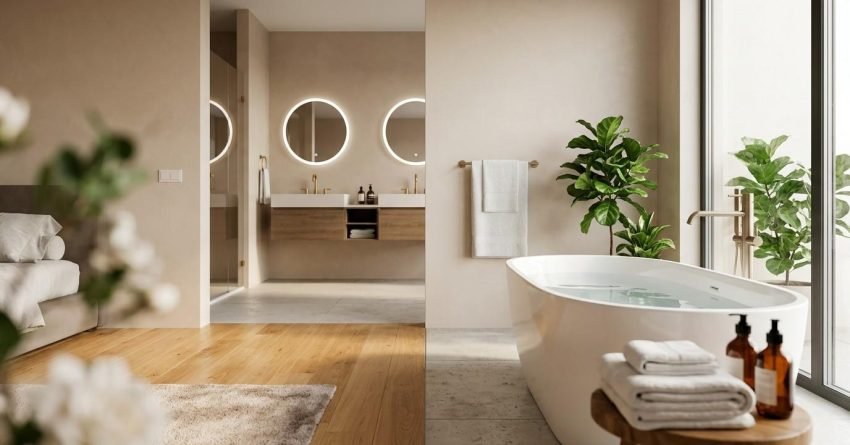
An open-plan bathroom removes the visual and physical barriers between the shower, vanity, and bathing zones, creating a seamless, spa-like space that feels larger and more connected. For Sydney homeowners weighing up a bathroom renovation, it is one of the most compelling layout directions available, and it comes with real trade-offs that deserve honest consideration before you commit.
Getting the layout decision right early protects your budget and prevents costly structural changes mid-project that derail timelines and inflate final costs.
What Is an Open-Plan Bathroom?
An open-plan bathroom is a layout that integrates two or more functional zones, typically the shower, vanity, and sometimes the bath, into a single, unpartitioned space. Rather than separating the wet area behind a full-height screen or wall, the design allows water, light, and sightlines to flow freely across the room.
The result is a bathroom that feels more like a private retreat than a functional utility space. It is a format that has become increasingly popular in Sydney renovations, particularly in larger master ensuites and new builds where spatial generosity allows the concept to work at its best.
Open-Plan Bathrooms vs. Wet Rooms: What’s the Difference?
These two terms are often used interchangeably, but they describe different things. A wet room is a fully waterproofed, fully tiled space where the entire floor functions as the shower zone, with no screen or enclosure at all. An open-plan bathroom integrates multiple zones, including a vanity and sometimes a freestanding bath, into one connected space, but the shower area is still defined, typically by a frameless screen or a change in floor level.
The distinction matters for waterproofing scope, drainage design, and compliance. Wet rooms require full-floor waterproofing and a continuous fall to a single drain. Open-plan bathrooms give you more layout flexibility while still demanding a higher waterproofing standard than a traditional partitioned bathroom.
How Open-Plan Bathrooms Differ from Traditional Layouts
Traditional bathroom layouts use walls, screens, and doors to separate wet and dry zones. Each area functions independently, with moisture contained within defined boundaries. Open-plan layouts dissolve those boundaries intentionally, which changes how waterproofing, ventilation, heating, and privacy must all be managed.
The design shift is not purely aesthetic. It has structural and compliance implications that affect both the renovation process and the ongoing performance of the space.
The Pros of Open-Plan Bathroom Design
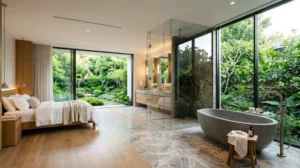
Open-plan bathrooms offer genuine advantages for the right home and the right homeowner. Understanding what those advantages actually deliver, and when they apply, helps you assess whether the format is worth pursuing.
A Sense of Space and Light
Removing partitions between zones makes a bathroom feel significantly larger than its footprint suggests. Natural light travels further across the room, reflective surfaces work harder, and the eye is not interrupted by walls or screens.
In Sydney homes where bathroom footprints are often modest, this visual expansion makes a meaningful difference to how the space feels and functions day to day. Large-format porcelain tiles laid continuously across the floor and up the walls amplify the effect further, and in terrace houses where the bathroom sits in the middle of the floor plan, a well-placed skylight can transform what was a dark utility room into the best space in the house. The effect is strongest in rooms with at least one external window or skylight, where light reaches the full depth of the space.
Flexible Layout and Design Freedom
Open-plan design gives you greater freedom to position fixtures where they work best for the space rather than where partition walls dictate. Freestanding baths, wall-hung vanities, and frameless shower zones can be arranged to create a layout that feels intentional and considered.
This flexibility is particularly valuable during a full bathroom renovation, where you have the opportunity to reconfigure the space from scratch rather than working around an existing layout that no longer serves the household. The wet zone can be positioned relative to the drainage point rather than relative to a wall, which opens up fixture arrangements that a traditional layout simply cannot achieve. A linear drain running along one wall, for example, allows the shower to occupy a full corner without any screen interrupting the sightline to the vanity.
Potential to Add Property Value
A well-executed open-plan bathroom strengthens the appeal of a property, particularly at the upper end of the Sydney market where buyers expect a higher standard of finish in master ensuites. The format signals quality, space, and considered design, attributes that resonate with both owner-occupiers and investors looking to maximise long-term return on renovation spend.
At the $1.5M-plus property tier in Sydney, a master ensuite that reads as a spa-quality space is increasingly a baseline expectation rather than a premium differentiator. The value uplift is most reliable when the design is executed to a high standard, and the layout genuinely suits the room’s proportions. Over-capitalising on an open-plan ensuite in a property where the rest of the home does not support that level of finish rarely delivers proportionate return.
Choosing Materials for an Open-Plan Bathroom
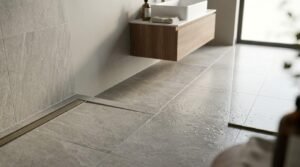
Material selection becomes more consequential in an open-plan layout because every surface in the room is exposed to moisture, not just the shower enclosure. Porcelain tiles are the most reliable choice for floors and walls: they are non-porous, dimensionally stable, and available in large formats that reduce grout lines and maintenance burden.
Natural stone performs well aesthetically but requires sealing and ongoing maintenance in a fully wet environment. Slip resistance is a non-negotiable consideration for the floor: the slip resistance rating for wet areas in residential bathrooms in Australia is P4 or higher under AS 4586, and in an open-plan layout where the entire floor is treated as a wet zone, that standard applies throughout.
Grout selection matters more than most homeowners expect. Epoxy grout outperforms cement-based grout in fully wet environments because it does not absorb moisture or harbour mould. Wall surfaces beyond the tiled zone, including any painted plasterboard, must be moisture-resistant grade to handle the elevated humidity that an open-plan layout generates.
The Cons of Open-Plan Bathroom Design
The same features that make open-plan bathrooms appealing also introduce challenges that are easy to underestimate during the planning phase. These are not reasons to avoid the format, but they are factors that must be addressed directly in the design and budget.
Privacy and Practicality Challenges
Open-plan layouts work best in single-occupancy ensuites or master bathrooms used by a couple with aligned routines. In shared bathrooms or family bathrooms, the absence of separation between zones creates practical friction: one person cannot use the vanity while another showers without the entire room becoming wet and occupied.
For households with children, guests, or multiple users with different schedules, a traditional partitioned layout often delivers better day-to-day functionality despite being less visually striking.
Waterproofing and Moisture Management
When wet and dry zones share the same open space, moisture management becomes significantly more demanding. The entire floor area must be waterproofed to a higher standard, and ventilation must be sufficient to clear steam and humidity from the full room volume.
In New South Wales, waterproofing work must comply with AS 3740 and be carried out by a licensed waterproofer. The membrane must be inspected and approved before tiling begins: skipping this inspection stage creates a compliance gap that affects both your home insurance and the property’s resale disclosure obligations. Cutting corners on waterproofing in an open-plan bathroom is one of the most common causes of long-term structural damage and costly remediation work.
Drainage Design in Open-Plan Bathrooms
Drainage is a design decision in an open-plan bathroom, not just a plumbing one. The entire floor must fall toward the drain at a consistent gradient, typically 1:80 for tiled floors, to prevent pooling in the dry zones of the room.
A linear drain running along one wall gives you the most layout flexibility because it allows a continuous floor fall in a single direction, which is easier to tile and easier to waterproof correctly. A centre drain requires a four-way fall, which is more complex to execute and harder to achieve with large-format tiles. The choice of drain type should be made at the design stage, before any structural or waterproofing work begins, because changing it mid-project is expensive.
Heating and Ventilation Requirements
An open-plan bathroom generates a larger volume of humid air than a partitioned layout, and the ventilation system must be sized to match. A standard 10-litre-per-second exhaust fan is typically undersized for an open-plan space: most building practitioners recommend a minimum of 25 litres per second for rooms over 6 square metres, with a humidity-sensing controller to run the fan automatically after the shower is used.
In-slab hydronic heating or an electric heated floor serves a dual purpose in an open-plan bathroom: it provides comfort underfoot and accelerates surface drying across the full floor area, which reduces the moisture load on the ventilation system. In NSW, any electrical work associated with heated floors must be carried out by a licensed electrician and comply with AS/NZS 3000.
Higher Renovation Costs and Complexity
Open-plan bathrooms typically cost more to build than equivalent traditional layouts. The extended waterproofing area, the need for precision drainage design, the higher specification of materials required to perform in a fully wet environment, and the additional labour involved in achieving seamless transitions between zones all contribute to a higher project cost.
The cost premium for an open-plan layout over a standard bathroom renovation in Sydney typically sits in the range of 20 to 35 percent, driven primarily by waterproofing membrane area, drainage complexity, and tile specification. Understanding the full bathroom renovation costs in Sydney before you start is essential, because the hidden expenses in an open-plan project, particularly remediation risk if waterproofing is not done correctly, can significantly exceed the upfront premium.
Is an Open-Plan Bathroom Right for Your Home?
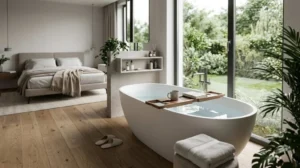
Open-plan design is not a universal upgrade. It is a format that performs exceptionally well in the right conditions and creates ongoing frustration in the wrong ones. The decision should be driven by your room’s proportions, your household’s usage patterns, your budget, and your renovation goals rather than by aesthetic preference alone.
A bathroom under 6 square metres will rarely benefit from an open-plan layout. The design relies on spatial generosity to deliver its visual impact, and in a compact room, removing partitions can make the space feel less functional without making it feel meaningfully larger. The format works best in rooms of 8 square metres or more, where a freestanding bath can be included without crowding the vanity zone, and where the floor fall to the drain can be achieved without creating an uncomfortable gradient across the full room. Larger ensuites and master bathrooms with good natural light and adequate floor area are where the format consistently delivers on its promise.
Budget is the other critical variable. If your renovation budget is tight, the additional cost of extended waterproofing, precision drainage, and higher-specification materials is better directed toward quality fixtures and finishes within a traditional layout that performs reliably for years without remediation risk.
Key Questions to Ask Before You Renovate
Before committing to an open-plan layout, work through these four questions directly.
Is the room large enough? The format needs at least 6 square metres to function, and 8 or more to deliver the visual impact that justifies the cost premium.
Who uses this bathroom and how? Single-occupancy ensuites suit open-plan design well. Shared or family bathrooms rarely do.
What is the realistic total cost? Get a detailed quote that itemises waterproofing, drainage, and materials separately, not just a single renovation figure.
Does the layout add genuine value to this property? A well-executed open-plan ensuite adds value in the right home. In the wrong property type or price bracket, it adds cost without proportionate return.
Conclusion
Open-plan bathroom design offers real advantages in the right space: greater visual openness, layout flexibility, and the potential to lift property appeal in Sydney’s competitive market. The format also introduces genuine complexity around waterproofing, moisture management, drainage design, and cost that must be planned for honestly.
The strongest open-plan bathrooms are the result of careful decisions made early: the right room size, the right household context, the right materials, and a budget that accounts for the full scope of what the format requires to perform well long-term.
At Sydney Home Renovation, we work through exactly these decisions with homeowners and investors before a single tile is laid. We combine transparent cost planning, licensed waterproofing coordination, and end-to-end project management so your bathroom renovation delivers the outcome you planned for, on budget and built to last.
Frequently Asked Questions
What size bathroom do you need for an open-plan design?
Most open-plan bathrooms work best in spaces of at least 6 square metres, with 8 or more ideal. Below 6 square metres, removing partitions rarely delivers the visual spaciousness the format promises.
Does an open-plan bathroom add value to a Sydney property?
Yes, in the right conditions. A well-executed open-plan ensuite adds value at the upper end of the Sydney market. The uplift depends on execution quality, room size, and whether the layout suits the property’s price bracket.
Is an open-plan bathroom harder to keep clean?
Yes, it requires more consistent maintenance. Moisture spreads across a larger area, so surfaces throughout the room need to be water-resistant, and ventilation must be adequate to prevent humidity buildup and mould.
What waterproofing is required for an open-plan bathroom in NSW?
In New South Wales, waterproofing must comply with AS 3740 and be completed by a licensed waterproofer. Open-plan layouts require full-floor waterproofing, wall coverage to the required height, and a pre-tile inspection before work proceeds.
Can you convert a traditional bathroom to open-plan?
Yes, but the conversion involves more than removing a screen or wall. It requires reassessing the waterproofing membrane, redesigning drainage to handle the expanded wet zone, and potentially upgrading ventilation. A structural assessment is needed if load-bearing elements are involved.
How much more does an open-plan bathroom cost than a standard renovation?
The cost premium in Sydney typically sits between 20 and 35 percent, driven by extended waterproofing, drainage complexity, and higher-specification materials. A detailed itemised quote is the most reliable way to understand the true cost difference for your specific project.
Is an open-plan bathroom suitable for a family bathroom?
Generally, no. Open-plan layouts work best in single-occupancy ensuites or master bathrooms. In shared or family bathrooms, the lack of zone separation creates practical friction for multiple users and is rarely the most functional choice for everyday household use.


