
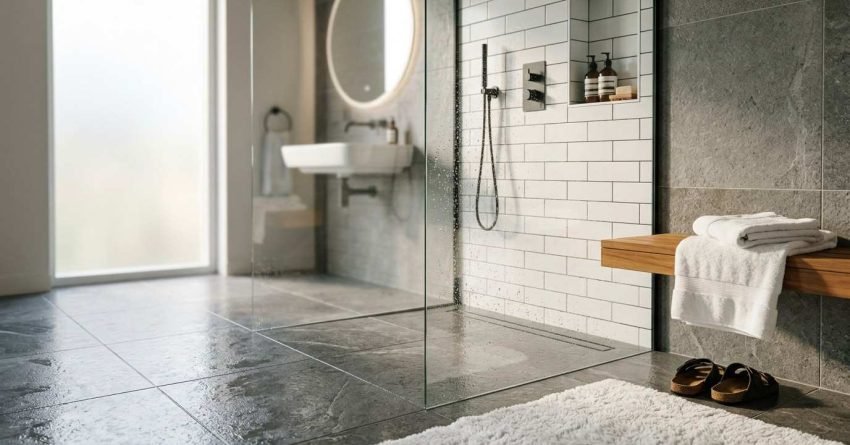
A wet room is a fully waterproofed, open-plan bathroom where the shower area flows seamlessly into the rest of the space: no tray, no screen barrier, no raised threshold. Done well, it is one of the most functional and visually striking bathroom formats available to Sydney homeowners. Done poorly, it becomes one of the most expensive renovation mistakes to fix.
This guide exists because wet room design involves more technical decisions than most homeowners expect. Getting the waterproofing, gradient, drainage, and fixture selection right from the start determines whether your wet room performs for decades or fails within years.
You will find everything here: design principles, flooring and drainage options, shower and wall finishes, lighting and ventilation compliance, accessibility planning, Sydney-specific costs, and how to choose the right contractor for the job.
What Is a Wet Room?
A wet room is a bathroom where the entire floor and lower wall area is waterproofed to a continuous membrane standard, allowing water to flow freely across the floor surface to a drain without being contained by a shower tray or enclosure. The shower zone is defined by gradient and drainage rather than physical barriers. The result is a fully integrated wet area where water management is engineered into the floor itself.
The format originated in Scandinavian and Japanese bathroom design traditions and has become increasingly common in Australian residential renovations over the past decade. Its appeal lies in the combination of clean aesthetics, ease of cleaning, and the ability to make small bathrooms feel significantly larger by removing visual obstructions.
In Sydney, wet rooms are particularly popular in apartment renovations, terrace house bathrooms, and high-end residential builds where open-plan design is a priority. They are also the preferred format for accessible bathroom design, where threshold-free entry is a functional requirement rather than a stylistic choice.
Understanding what a wet room is and what it demands structurally is the starting point for every design decision that follows.
How a Wet Room Differs from a Standard Bathroom
The fundamental difference between a wet room and a standard bathroom is the waterproofing specification and the floor gradient system. In a standard bathroom, waterproofing is applied only within the shower enclosure, and the shower tray or base contains water within a defined zone. In a wet room, the entire floor surface is waterproofed to a continuous standard, and the floor is graded to direct water toward a central or linear drain.
This distinction has significant implications for construction. A wet room requires a higher-specification waterproofing membrane, a precisely engineered floor gradient (typically between 1:60 and 1:80 fall toward the drain), and a drainage system capable of handling the full floor area’s water load. The subfloor must also be structurally sound enough to support the membrane system without flex, which can cause membrane failure over time.
From a design perspective, the absence of a shower tray or enclosure creates a visually open space that reads as larger than its actual dimensions. This is why wet rooms are frequently chosen for compact Sydney bathrooms where every visual centimetre matters.
Wet Room Design Principles for Sydney Homes
Effective wet room design is not primarily about aesthetics. It is about engineering a space that manages water correctly, complies with Australian standards, and functions reliably for the life of the building. The aesthetic outcomes follow from getting the technical foundations right.
In Sydney, wet room design must comply with AS 3740 (Waterproofing of Domestic Wet Areas), the National Construction Code (NCC), and any applicable local council requirements. These standards govern membrane type, application method, substrate preparation, and the minimum performance requirements for all wet area construction. Working within these standards is not optional; it is the baseline for any compliant renovation.
Layout Planning and Space Optimisation
The layout of a wet room determines how water moves through the space, where fixtures are positioned, and how the room functions day to day. Before any design decisions are made about tiles, fittings, or finishes, the floor plan must establish the drain location, the gradient direction, and the relationship between the shower zone and the rest of the bathroom.
In a rectangular wet room, a linear drain positioned along one wall is typically the most efficient layout choice. It allows the entire floor to slope in a single direction, simplifying the gradient engineering and reducing the risk of pooling. In a square or irregular space, a centre drain with a four-way gradient is more common, though it requires more precise tiling work to achieve a clean finish.
Fixture placement in a wet room follows the water flow logic. The shower head and controls are positioned so that water is directed toward the drain rather than toward the toilet, vanity, or door. In Sydney apartments and terrace houses where bathroom dimensions are often constrained, this planning step is critical to making the wet room format work within the available footprint.
Waterproofing as the Foundation of Wet Room Design
Waterproofing is not a finishing step in wet room construction; it is the structural foundation on which every other element depends. A wet room without correctly specified and applied waterproofing will fail. Water will penetrate the substrate, cause structural damage, and create conditions for mould growth that are expensive and disruptive to remediate.
Under AS 3740, wet rooms require a continuous waterproofing membrane applied to the full floor area and to wall surfaces to a minimum height of 1,800mm in the shower zone. The membrane must be applied to a prepared substrate, allowed to cure fully before tiling, and inspected before any covering work proceeds. In NSW, waterproofing in wet areas must be carried out by a licensed waterproofer.
The membrane system chosen, whether sheet membrane, liquid-applied membrane, or a hybrid system, must be compatible with the substrate, the adhesive system, and the tile format being used. Incompatible systems are one of the most common causes of wet room failure.
Substrate Preparation: Concrete vs. Timber Subfloors
The substrate beneath a wet room membrane is one of the most consequential variables in the entire build. Concrete subfloors are the preferred base for wet rooms: they are rigid, dimensionally stable, and provide a consistent surface for membrane adhesion. A concrete slab requires surface preparation, grinding, priming, and in some cases a levelling screed, but it does not flex under load, which is the critical requirement for long-term membrane integrity.
Timber subfloors present a greater challenge. Timber moves with changes in temperature and humidity, and that movement creates stress on a rigid waterproofing membrane. In Sydney homes with suspended timber floors common in Federation and inter-war terrace houses a wet room installation requires either a structural screed to create a stable base, a decoupling membrane system designed to absorb movement, or in some cases a structural assessment to confirm the floor can carry the additional load. A licensed waterproofer will assess the subfloor condition before specifying the membrane system. Skipping this assessment is one of the most common causes of premature membrane failure in Sydney wet room renovations.
Wet Room Flooring: Materials, Gradients, and Drainage
The floor of a wet room carries more technical requirements than any other surface in the space. It must be slip-resistant when wet, correctly graded to drain efficiently, compatible with the waterproofing membrane, and visually consistent with the overall design intent. These requirements narrow the material options considerably compared to a standard bathroom floor.
Slip resistance is the primary safety requirement. The Australian Building Codes Board specifies minimum slip resistance ratings for wet area floors under the NCC, with wet rooms requiring a higher rating than standard bathroom floors due to the larger wet surface area. This requirement must be verified for any tile or surface material before it is specified.
Choosing the Right Floor Tiles for a Wet Room
Porcelain tiles are the most widely used floor material in Sydney wet rooms. They offer high density, low water absorption, consistent slip resistance ratings, and a wide range of format sizes and surface finishes. Large-format porcelain tiles (600x600mm and above) are popular for their clean, minimal aesthetic, but they require a very precise floor gradient; to drain correctly, any deviation in the substrate will be visible in the finished surface.
Smaller mosaic tiles (50x50mm or 100x100mm) offer a practical advantage in wet rooms: the higher grout line frequency provides additional grip and makes it easier to achieve the required gradient across a complex floor shape. The trade-off is increased cleaning maintenance, as grout lines accumulate soap residue and require more frequent attention.
Natural stone marble, travertine, and slate are used in higher-specification wet rooms but require careful selection. Not all natural stone is suitable for wet environments. Porous stones require sealing and ongoing maintenance, and some finishes do not meet the minimum slip resistance requirements for wet area floors. Any natural stone specified for a wet room floor must be verified against the NCC slip resistance requirements before installation.
Drainage Systems: Linear, Centre, and Concealed Options
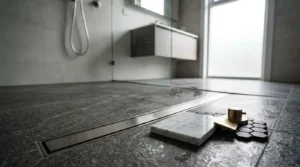
The drainage system is the functional core of a wet room floor. The three primary formats used in Sydney wet rooms are linear drains, centre drains, and concealed tile-insert drains, each with different implications for floor gradient, installation complexity, and visual outcome.
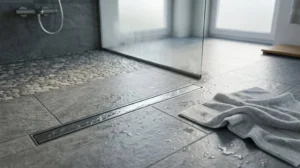
A linear drain runs along one wall or across the width of the floor, allowing the entire floor surface to slope in a single direction. This is the simplest gradient to engineer and tile, and it produces a clean, contemporary aesthetic. Linear drains are the preferred choice in most modern Sydney wet room renovations.
A centre drain requires the floor to slope from all four sides toward a central point. This is more complex to tile correctly and requires greater precision in the substrate preparation, but it works well in square rooms and is the traditional format for older wet room designs.
Concealed tile-insert drains are the premium option. The drain body is recessed into the floor and covered with a tile that matches the floor surface, making the drain virtually invisible. They require the highest level of installation precision and carry a higher cost, but they produce the cleanest visual result.
Wet Room Shower Design: Screens, Fixtures, and Fittings
The shower configuration in a wet room is one of the most consequential design decisions in the entire project. It determines how water is contained within the shower zone, how the space feels to use, and how the room reads visually. The options range from fully open wet room formats to partially screened configurations, each with different functional and aesthetic implications.
Frameless Glass Screens vs. Open Wet Room Configurations
A frameless glass screen is the most common shower configuration in Sydney wet rooms. A single fixed panel or a hinged panel positioned at the entry to the shower zone provides sufficient water containment to protect the vanity and toilet areas from direct spray, while maintaining the open visual quality that makes wet rooms appealing. The screen is typically 10mm toughened safety glass, fixed with minimal hardware to preserve the frameless aesthetic.
A fully open wet room no screen, no barrier is the purest expression of the format. It works well in larger bathrooms where the shower zone is positioned away from other fixtures, or in dedicated shower rooms where the entire space is the shower. In smaller Sydney bathrooms, a fully open configuration requires careful fixture placement and a high-performance drainage system to prevent water from reaching the vanity and toilet areas.
The choice between screened and open configurations is driven by the room’s dimensions, the fixture layout, and the practical needs of the household. A frameless screen adds minimal visual weight while providing meaningful functional protection for most Sydney wet rooms; it is the right balance.
Shower Fixtures, Heads, and Water Pressure Considerations
Shower fixture selection in a wet room follows the same principles as any high-specification bathroom, with one additional consideration: the fixtures must be compatible with the waterproofing membrane and the wall substrate. Recessed niches, concealed valve systems, and wall-mounted shower heads all require penetrations through the waterproofing membrane, and each penetration must be correctly sealed to maintain membrane integrity.
Rainfall shower heads are the most popular choice in Sydney wet rooms. Ceiling-mounted or extended arm formats deliver a high-volume, low-pressure water flow that suits the open wet room format. Thermostatic valve systems, which maintain a preset water temperature regardless of pressure fluctuations, are the preferred control option for households with children or elderly users, and they are increasingly standard in higher-specification Sydney renovations.
Water pressure is a practical consideration that is frequently overlooked at the design stage. Sydney’s mains water pressure varies by suburb and building type, and some shower head formats require a minimum dynamic pressure to perform correctly. A licensed plumber assesses the available pressure before shower fixtures are specified, particularly for high-flow rainfall heads and multi-function shower systems.
Wet Room Wall Design: Tiles, Panels, and Finishes
The walls of a wet room are subject to continuous water exposure in the shower zone and intermittent moisture exposure across the rest of the space. The surface material must be waterproof or water-resistant, easy to clean, and compatible with the waterproofing membrane beneath. Within these constraints, the design options are broad.
Wall Tile Selection for Wet Rooms
Large-format wall tiles 600x1200mm and above are the dominant choice in contemporary Sydney wet rooms. They minimise grout lines, create a clean and expansive visual effect, and are straightforward to clean. The practical challenge with large-format tiles is the substrate: the wall must be perfectly flat and structurally sound to support tiles of this size without lippage or adhesion failure. In older Sydney homes, this often requires substrate preparation work before tiling can begin.
Subway tiles and smaller format ceramics remain popular in heritage-style renovations and period terrace houses, where the scale of the tile suits the character of the building. They are more forgiving of minor substrate imperfections and offer a wider range of grout colour options that can be used as a design element.
Grout selection is a design and maintenance decision. Epoxy grout is the most durable and stain-resistant option for wet room walls, but it is more difficult to apply and more expensive than cement-based grout. For high-traffic wet rooms or households with hard water, the additional cost of epoxy grout is typically justified by the reduction in long-term maintenance.
Wet Room Wall Panels as a Tiling Alternative
Wet room wall panels, large-format acrylic, PVC, or composite panels applied directly to the wall substrate, are an increasingly common alternative to tiling in Sydney renovations. They offer a grout-free surface that is faster to install, easier to clean, and less susceptible to water ingress through grout failure.
The trade-off is longevity and perceived quality. High-quality acrylic and composite panels can perform well for 10 to 15 years, but they do not match the lifespan of correctly installed porcelain or ceramic tiles. They are also more susceptible to surface scratching and are difficult to repair if damaged.
For investment properties and rental renovations where speed and cost efficiency are priorities, wall panels are a practical choice. For owner-occupied homes where long-term quality is the priority, tiles remain the superior option.
Wet Room Lighting Design
Wet room lighting must comply with AS/NZS 3000 (the Australian Wiring Rules) and the zone classification system that defines which types of fittings can be installed at different distances from water sources. Getting this wrong is not a minor oversight; it is a safety and compliance failure that can affect insurance coverage and building certification.
IP Ratings and Safe Lighting Zones in Wet Rooms
The IP (Ingress Protection) rating system classifies the degree of protection a fitting provides against water and solid particle ingress. In wet rooms, the zone classification determines the minimum IP rating required for any fitting installed in that zone.
Zone 0 is inside the shower area itself; any fitting installed here must carry a minimum IP67 rating, meaning it is protected against temporary immersion. Zone 1 extends to 2.25 metres above the shower floor and 0.6 metres horizontally from the shower zone; fittings here require a minimum IP44 rating. Zone 2 extends a further 0.6 metres beyond Zone 1; IP44 is still required.
In practice, most Sydney wet room renovations use IP65-rated recessed downlights throughout the entire bathroom for consistency and compliance confidence. LED downlights in this rating are widely available, energy-efficient, and produce a clean, even light distribution that suits the open-plan wet room format. All electrical work in wet rooms must be carried out by a licensed electrician, and the installation must be inspected and certified before the renovation is signed off.
Ventilation and Exhaust Fan Requirements
Ventilation is a mandatory NCC requirement in any wet area, and wet rooms are no exception. The NCC requires mechanical exhaust ventilation in bathrooms without openable windows, and in practice most Sydney wet rooms, particularly in apartments and internal bathrooms, require a compliant exhaust fan regardless of window configuration.
The minimum exhaust rate for a bathroom under the NCC is 25 litres per second for continuous operation, or a higher intermittent rate if the fan is switch-activated. In wet rooms, where the entire floor area generates moisture, a higher-capacity fan is advisable to prevent condensation buildup on walls and ceilings. The exhaust fan must be installed by a licensed electrician and must carry an appropriate IP rating for its zone. A standard fan installed in Zone 1 or Zone 2 is a compliance failure.
In Sydney apartments, the exhaust duct must terminate to the exterior of the building in accordance with the building’s mechanical services design. Strata approval is sometimes required before duct routing is modified. Confirm the exhaust specification with your electrician and building manager before work begins.
Wet Room Accessibility and Universal Design
A wet room is inherently one of the most accessible bathroom formats available. The threshold-free entry, open floor plan, and continuous waterproofed surface make it the natural choice for households planning for ageing-in-place, accommodating a family member with a mobility impairment, or meeting the requirements of the Livable Housing Design Guidelines.
Designing Wet Rooms for Elderly and Mobility-Impaired Users
An accessible wet room design must meet the requirements of AS 1428.1 (Design for Access and Mobility) where applicable, and incorporate the Livable Housing Design Guidelines’ silver or gold standard specifications for households planning for long-term use.
The key design elements for an accessible wet room include a minimum 900mm clear floor space adjacent to the shower zone for wheelchair or mobility aid manoeuvring, a fold-down or fixed shower seat positioned at the correct height (typically 460–480mm from the floor), grab rails installed at the shower zone and adjacent to the toilet at the correct load-bearing specification, and a handheld shower head on a height-adjustable rail.
Floor gradient in an accessible wet room must balance drainage efficiency with safe mobility. A gradient steeper than 1:50 creates instability for users with mobility impairments, while a gradient shallower than 1:80 may not drain efficiently enough to prevent pooling. The target range of 1:60 to 1:80 satisfies both requirements when correctly engineered.
Tapware and controls in an accessible wet room are lever-operated rather than knob-operated, positioned at a height accessible from both standing and seated positions (typically 900–1,100mm from the floor), and located within reach of the shower seat. Thermostatic controls are strongly recommended to prevent scalding.
For eligible households, the Australian Government’s Home Modification Assistance Program provides funding support for accessibility modifications including wet room conversions. A certified aging-in-place specialist or occupational therapist can assess your home and identify which modifications qualify before you commit to a design.
Wet Room Cost Guide for Sydney Homeowners
Wet rooms cost more to build than standard bathrooms. The additional cost comes from the higher-specification waterproofing system, the precision required in the floor gradient and drainage installation, and the increased labour time associated with a more technically demanding construction process. Understanding where the cost goes and why is the foundation of realistic budget planning.
What Drives Wet Room Renovation Costs in Sydney
The primary cost drivers in a Sydney wet room renovation are waterproofing, tiling, drainage, and labour. Waterproofing a wet room to AS 3740 standard costs more than waterproofing a standard shower enclosure because the membrane must cover the entire floor area and a greater wall surface area. In Sydney, budget between $1,500 and $3,500 for waterproofing alone, depending on the room size and membrane system specified.
Tiling costs in a wet room are higher than in a standard bathroom for two reasons: the floor gradient requires more precise cutting and laying, and the larger waterproofed wall area increases the total tile quantity. Large-format tiles add further cost due to the substrate preparation required and the higher skill level needed for installation. Sydney tiling rates for wet rooms typically range from $80 to $150 per square metre for supply and installation, depending on tile format and complexity.
Drainage system costs vary significantly by type. A standard centre drain can be installed for $300 to $600 including labour. A linear drain system ranges from $800 to $2,000 depending on the drain length and brand. A concealed tile-insert drain system can cost $1,500 to $4,000 installed. These are not areas to cut costs; a drainage system failure in a wet room is expensive to remediate.
Labour costs for a wet room renovation in Sydney reflect the higher skill requirements of the format. A complete wet room renovation, including demolition, waterproofing, tiling, drainage, plumbing, electrical, and fitting installation, typically requires 10 to 20 trade days depending on the room size and specification level.
Wet Room Renovation Cost Breakdown (Sydney)
The table below sets out typical Sydney pricing ranges for each component of a wet room renovation. These figures reflect mid-range specification; premium finishes and complex layouts will sit at the upper end or above.
| Component | Budget Range | Notes |
| Demolition and removal | $800–$2,000 | Depends on existing fit-out and access |
| Waterproofing (AS 3740) | $1,500–$3,500 | Full floor + wall area; licensed waterproofer |
| Substrate preparation | $500–$2,000 | Levelling, priming, screed if required |
| Floor tiling (supply + install) | $80–$150/m² | Porcelain; natural stone higher |
| Wall tiling (supply + install) | $70–$130/m² | Large-format at upper end |
| Drainage system | $300–$4,000 | Centre drain to concealed tile-insert |
| Plumbing (fixtures + rough-in) | $1,500–$4,000 | Drain relocation adds cost |
| Electrical (lighting + exhaust) | $800–$2,500 | IP-rated fittings; licensed electrician |
| Shower screen (frameless) | $800–$2,500 | 10mm toughened glass; hardware finish |
| Tapware and fittings | $500–$3,000+ | Entry-level to premium thermostatic |
| Vanity, toilet, accessories | $1,000–$5,000+ | Specification-dependent |
| Total (mid-range) | $15,000–$35,000 | Full wet room renovation, Sydney |
| Total (high-specification) | $35,000–$55,000+ | Premium tiles, concealed drain, custom fittings |
Wet Room vs. Standard Bathroom Renovation: Cost Comparison
A wet room renovation in Sydney typically costs 20 to 35 percent more than a comparable standard bathroom renovation. The premium reflects the additional waterproofing specification, the drainage system upgrade, and the increased labour time. For a mid-range Sydney bathroom renovation, this translates to an additional $3,000 to $8,000 over a standard bathroom of equivalent size and finish level.
The investment is generally justified by the functional and aesthetic outcomes. A well-designed wet room adds measurable value to a Sydney property, particularly in the apartment and terrace house market where open-plan bathroom design is a strong selling point. The accessibility benefits also add long-term value for owner-occupiers planning to remain in the property as they age.
How to Plan a Wet Room Renovation in Sydney
A wet room renovation is a multi-trade project. It requires a licensed plumber, a licensed waterproofer, a licensed electrician, and a tiler at minimum. In many Sydney renovations, a builder or renovation contractor coordinates these trades under a single contract, which simplifies project management and provides a single point of accountability for the finished result.
Wet Room Renovation Stages: What Happens and When
Understanding the sequence of a wet room renovation prevents costly mistakes and sets realistic expectations for the timeline. The stages run in this order:
Stage 1: Design and approvals. The Floor plan is finalised, the drain location is confirmed, the membrane system is specified, and any required council approvals or strata permissions are obtained before work begins.
Stage 2: Demolition. The Existing bathroom is stripped to the substrate. The subfloor is assessed for structural integrity and suitability for the membrane system.
Stage 3: Rough-in plumbing. The Drain is positioned and set to the correct height for the finished floor gradient. Any pipe relocations are completed at this stage.
Stage 4: Substrate preparation. Levelling, priming, and any screed or decoupling layer is applied and allowed to cure.
Stage 5: Waterproofing. Membrane is applied to the full floor area and walls to the required height. Mandatory curing period follows, typically 24 to 72 hours depending on the membrane system. No tiling begins until the membrane is inspected and certified.
Stage 6: Tiling. Floor tiles are laid to the engineered gradient. Wall tiles follow. Grout is applied after adhesive cure.
Stage 7: Electrical and lighting. IP-rated fittings and an exhaust fan are installed by a licensed electrician.
Stage 8: Fixture installation. Shower screen, tapware, vanity, toilet, and accessories are fitted by the plumber.
Stage 9: Inspection and sign-off. Compliance certificates are issued by the plumber, waterproofer, and electrician. Final inspection confirms the renovation meets AS 3740 and NCC requirements.
A complete wet room renovation in Sydney typically takes two to four weeks from demolition to sign-off, with the waterproofing curing period representing a fixed timeline that cannot be shortened.
Permits, Compliance, and Licensed Trades in NSW
In NSW, bathroom renovations that involve plumbing, electrical, or structural work require licensed trades and, in many cases, council approval or a complying development certificate. The specific requirements depend on the scope of work, the property type, and the local council’s development controls.
Plumbing work in a wet room, including drain relocation, pipe replacement, and fixture installation, must be carried out by a licensed plumber and drainer holding a current NSW Fair Trading licence. Electrical work must be carried out by a licensed electrician. Waterproofing must be carried out by a licensed waterproofer. All three trades must provide a certificate of compliance for their work upon completion.
For renovations that involve structural changes, moving walls, altering the building envelope, or changing the floor structure, a development application or complying development certificate may be required from the local council. Your renovation contractor advises on the specific approval requirements for your project before work begins.
Choosing a Wet Room Renovation Contractor in Sydney
The quality of a wet room renovation is determined almost entirely by the quality of the contractor and trades who build it. A wet room built to a lower standard than the technical requirements demand will fail, and the cost of remediation typically exceeds the cost of doing it correctly the first time.
When selecting a contractor for a wet room renovation in Sydney, verify that they hold a current NSW Home Building licence, that they can provide references for completed wet room projects, and that they carry the required insurances including home building compensation cover for projects over $20,000. Ask specifically about their waterproofing specification and which membrane system they use. A contractor who cannot answer this question clearly is not the right choice for a wet room project.
Wet Room Maintenance and Cleaning
A correctly built wet room is one of the easiest bathroom formats to maintain, but it does require a consistent routine to preserve the grout, membrane, and surface finishes over time.
Grout and Tile Care
Cement-based grout in a wet room requires sealing at installation and resealing every 12 to 18 months, depending on water hardness and usage frequency. Unsealed grout absorbs soap residue, mineral deposits, and biological growth that is difficult to remove and accelerates grout deterioration. Epoxy grout does not require sealing but benefits from a weekly wipe-down with a pH-neutral cleaner to prevent soap film buildup.
Floor tiles in a wet room accumulate soap residue at the grout lines and around the drain. A weekly clean with a non-abrasive, pH-neutral tile cleaner prevents buildup without damaging the tile surface or grout. Avoid acidic cleaners on natural stone; they etch the surface and strip any sealer applied at installation.
Drain and Glass Screen Maintenance
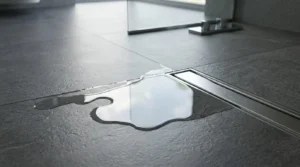
The drain is the most maintenance-critical component of a wet room floor. Hair and soap debris accumulate in the drain body and reduce flow rate over time. Clean the drain cover weekly and flush the drain body monthly with hot water to prevent blockage. A slow-draining wet room floor is a slip hazard; address it immediately rather than allowing the problem to develop.
Frameless glass screens attract soap scum and mineral deposits, particularly in Sydney’s harder water areas. A squeegee after each use is the single most effective maintenance habit for a glass screen. A monthly clean with a dedicated glass cleaner removes mineral buildup before it etches the glass surface. Avoid abrasive pads; they scratch the glass and create surfaces that attract more residue.
Common Wet Room Design Mistakes to Avoid
The most expensive wet room mistakes are the ones that are invisible until they cause damage. Understanding the common failure points before your renovation begins is the most effective form of budget protection available.
Inadequate waterproofing specification. The single most common cause of wet room failure is a waterproofing membrane that does not meet AS 3740 requirements, either because the wrong membrane was specified, it was applied incorrectly, or the substrate was not adequately prepared. This failure is invisible until water damage appears in the ceiling below or mould growth becomes visible behind tiles. Remediation requires full tile removal, membrane replacement, and retiling, a cost that typically exceeds the original waterproofing budget several times over.
Incorrect floor gradient. A floor gradient that is too shallow will not drain efficiently, leaving standing water that creates slip hazards and accelerates grout deterioration. A gradient that is too steep creates instability and makes the floor uncomfortable to stand on. The target range of 1:60 to 1:80 must be engineered into the substrate before tiling; it cannot be corrected after tiles are laid.
Undersized drainage. A drainage system specified for a standard shower enclosure will not handle the water load of a full wet room floor. Undersized drains cause pooling, slow drainage, and in severe cases, water overflow beyond the wet room zone. The drain must be specified for the full floor area, not just the shower zone.
Ignoring IP rating requirements. Installing standard fittings in wet room lighting zones is a safety and compliance failure. It can void building insurance, fail a building inspection, and create a genuine electrical hazard. Every fitting in a wet room must be specified and installed to the correct IP rating for its zone.
Skipping the substrate preparation. Large-format tiles on an inadequately prepared substrate will crack, lift, or show lippage within months of installation. Substrate preparation, including levelling, priming, and in some cases installing a decoupling membrane, is not optional for a wet room floor. It is the foundation of a durable tiled surface.
Conclusion
A well-designed wet room combines precise engineering with considered aesthetics, waterproofing, gradient, drainage, and fixture selection working together to create a space that performs reliably and looks exceptional.
For Sydney homeowners, the investment in a correctly built wet room delivers long-term functional value, accessibility benefits, and measurable property appeal that a standard bathroom renovation cannot match.
At Sydney Home Renovation, we build wet rooms across Sydney with transparent pricing, licensed trades, and a commitment to getting every technical detail right. Contact us to discuss your project and receive a clear, honest renovation plan.
Frequently Asked Questions
What is the minimum size for a wet room in Sydney?
There is no single minimum size prescribed specifically for wet rooms under Australian standards, but a functional wet room requires enough floor area to accommodate the shower zone, drainage gradient, and clear circulation space. In practice, most Sydney wet rooms are a minimum of 1,500mm x 1,500mm to function comfortably as an open-plan wet area.
Does a wet room add value to a Sydney property?
Yes. A well-designed and correctly built wet room adds measurable value to Sydney properties, particularly in the apartment and terrace house market. The combination of contemporary aesthetics, accessibility, and ease of maintenance makes wet rooms a strong selling point for buyers and renters in Sydney’s competitive property market.
How long does a wet room renovation take in Sydney?
A complete wet room renovation in Sydney typically takes between two and four weeks from demolition to completion, depending on the room size, the complexity of the design, and the availability of trades. The waterproofing membrane requires a mandatory curing period before tiling can begin, which is a fixed timeline that cannot be shortened without compromising the membrane’s performance.
Can a wet room be installed in an apartment?
Yes, but apartment wet room renovations require additional planning. The building’s strata by-laws must be reviewed for any restrictions on wet area modifications, the building manager or owners corporation may require approval before work begins, and the waterproofing specification must account for the risk of water damage to the apartment below. A licensed waterproofer experienced in apartment renovations is essential.
What waterproofing standard applies to wet rooms in Sydney?
Wet rooms in Sydney must comply with AS 3740 (Waterproofing of Domestic Wet Areas), which specifies the membrane types, application methods, and minimum performance requirements for all wet area construction. The National Construction Code references AS 3740 as the applicable standard. All waterproofing work must be carried out by a licensed waterproofer and certified upon completion.
How much does a wet room renovation cost in Sydney?
A mid-range wet room renovation in Sydney typically costs between $15,000 and $35,000, depending on the room size, the specification level, and the complexity of the drainage and waterproofing system. High-specification wet rooms with premium tiles, concealed drainage, and custom shower fittings can exceed $50,000. The wet room format typically costs 20 to 35 percent more than a comparable standard bathroom renovation.
Do I need council approval for a wet room renovation in Sydney?
Most wet room renovations in Sydney do not require council approval if they are carried out within the existing bathroom footprint without structural changes. However, if the renovation involves moving walls, altering the building structure, or changing the property’s footprint, a development application or complying development certificate may be required. Your renovation contractor advises on the specific approval requirements for your project before work begins.
What is the best tile size for a wet room floor?
The best tile size for a wet room floor depends on the room dimensions and the drainage configuration. Smaller format tiles (100x100mm to 300x300mm) are more forgiving of gradient variations and provide more grout lines for grip. Large-format tiles (600x600mm and above) create a cleaner aesthetic but require a very precise substrate and gradient to install correctly. Both options are widely used in Sydney wet rooms; the choice is guided by the room’s dimensions and the installer’s capability.
How is a wet room different from a walk-in shower?
A wet room waterproofs the entire bathroom floor and allows water to flow freely across the full floor area to a drain. A walk-in shower is a shower enclosure without a door but with a defined shower tray or base that contains water within the shower zone. The key difference is the extent of the waterproofing and the floor gradient. A wet room is a whole-room waterproofed system, while a walk-in shower is a contained shower format within a standard bathroom.
Can I convert my existing bathroom into a wet room?
Yes, but a wet room conversion requires full demolition of the existing bathroom to the substrate level. The existing waterproofing, tiles, and floor structure must be removed, the substrate must be assessed and prepared, and a new waterproofing membrane must be installed to AS 3740 standard before any new tiling or fitting work begins. A wet room conversion is not a surface-level renovation; it is a full bathroom rebuild to a higher technical specification.


