
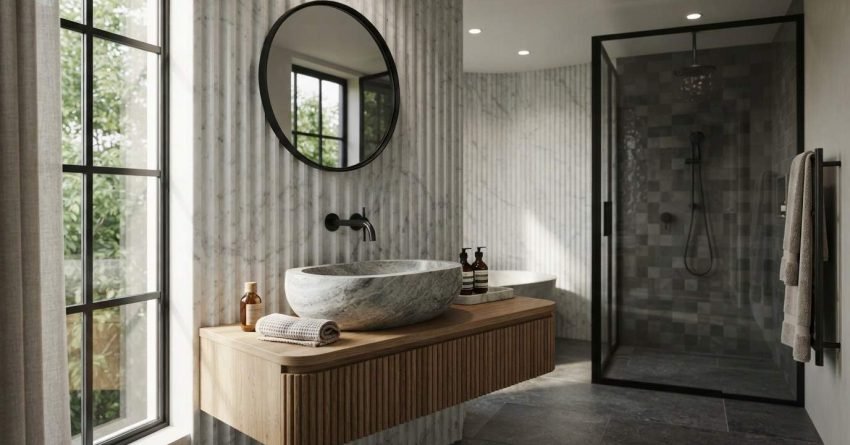
Bathroom design is shifting fast in 2026, and the gap between a renovation that feels current and one that already looks dated comes down to knowing which trends are actually worth building around. I’ve watched these shifts play out across dozens of Sydney bathrooms this year, and a handful of directions are clearly pulling ahead of the rest. Some are aesthetic. Some are functional. Most are both.
Homeowners and investors who understand these trends make sharper decisions, about where to spend, what to prioritise, and which upgrades hold their value.
This guide covers the ten bathroom design trends defining renovations right now, what each one costs to execute, and how to use them to build a bathroom that performs long after the trend cycle moves on.
1. Warm Minimalism Is Replacing Cold Modernism
The all-white, high-gloss, clinically clean bathroom had a long run. It’s over. What’s replacing it is warmer, softer, and far more liveable, and Sydney renovators are embracing it quickly.
Warm minimalism keeps the clean lines and uncluttered layouts that made modern bathrooms appealing. But it swaps the cold palette and hard surfaces for materials and tones that feel grounded and human.
Natural Materials Taking Centre Stage
Timber vanities, stone basins, honed travertine, and textured concrete are appearing in bathrooms that would have been all-white five years ago. These materials bring visual warmth without adding visual noise.
Honed finishes are particularly strong right now. They read as sophisticated without the maintenance anxiety that polished marble creates. Travertine, in particular, has moved from boutique renovations into mainstream Sydney bathrooms at a pace I haven’t seen before.
The practical upside is real. Natural materials age well. A honed stone surface that picks up minor wear over time often looks better at year five than a high-gloss acrylic that shows every scratch.
Warm Neutrals Over Stark White
Colour is shifting too. Warm whites, greige, sand, clay, and soft terracotta are replacing the cool, blue-toned whites that dominated the last decade. These tones work with natural light rather than fighting it.
For Sydney homes specifically, warm neutrals interact beautifully with the quality of light we get, particularly in north-facing bathrooms where morning light is golden rather than harsh. The result is a bathroom that feels calm at 6am and still looks considered at night under artificial light.
2. Japandi Bathrooms Are Dominating Renovation Wish Lists
Japandi is the design language that’s showing up on more renovation briefs than anything else I’ve seen this year. It’s not a passing trend. It’s a genuine shift in how people want their bathrooms to feel.
What Japandi Actually Looks Like
Japandi combines Japanese minimalism with Scandinavian warmth. In a bathroom, that means clean geometry, natural materials, a restrained palette, and an almost meditative sense of order. Nothing is decorative for its own sake. Every element earns its place.
Practically, a Japandi bathroom typically features a floating timber vanity, a wall-hung toilet, matte fixtures in a single metal finish, and a neutral tile in a large format or subtle texture. The overall effect is calm, considered, and quietly luxurious.
Why It Works for Australian Homes
Japandi translates well to Australian homes because it suits both compact inner-city bathrooms and larger suburban ensuite spaces. The design language doesn’t depend on scale, it depends on restraint.
It also ages exceptionally well. Because Japandi avoids trend-specific colours and decorative details, a bathroom built in this style in 2025 will still look current in 2032. For property investors especially, that longevity is a genuine financial argument for the style.
3. Statement Tiles Are Back, and Bolder Than Ever
After years of large-format neutral tiles dominating the market, statement tiles are back with real force. And they’re being used with more confidence than the last time they were popular.
Feature Walls vs. Full-Room Tile
The most common approach right now is a single feature wall, typically the shower wall or the wall behind a freestanding bath, tiled in something bold, textured, or patterned. The rest of the bathroom stays neutral. This gives the room a focal point without overwhelming the space.
Full-room statement tile is also appearing in smaller bathrooms, where the commitment to a single bold choice reads as intentional rather than chaotic. A small powder room tiled floor-to-ceiling in a geometric or handmade tile is one of the strongest design moves available at a relatively modest cost.
Tile Trends Worth Budgeting For
The specific tile directions worth knowing about right now: zellige and handmade-look tiles with natural variation, large-format stone-look porcelain, fluted and ribbed tiles used vertically, and terracotta-toned encaustic tiles for floors. Each of these has moved from design-magazine territory into mainstream Sydney tile suppliers this year.
Budget-wise, handmade and zellige tiles carry a significant premium over standard porcelain, often three to five times the cost per square metre. The ROI case is strong for feature walls where the tile quantity is limited. Full-room application in handmade tile is a luxury spend that suits high-end renovations specifically.
4. Freestanding Baths and Curved Fixtures Are Surging
The freestanding bath had a moment about eight years ago, then got overshadowed by the walk-in shower trend. It’s back, and this time it’s bringing curved, sculptural shapes with it across the entire bathroom.
The Return of Sculptural Shapes
Curved basins, oval baths, rounded vanity edges, and arched mirrors are appearing together in bathrooms that previously would have been entirely rectilinear. The shift is deliberate. Curves soften a space in a way that straight lines simply can’t, and they photograph exceptionally well, which matters for property presentation.
Freestanding baths in particular are being chosen for master ensuites where the bath functions as a design centrepiece rather than a primary bathing fixture. The visual weight of a well-chosen freestanding bath anchors a large ensuite in a way that a built-in bath never quite achieves.
Cost Considerations for Curved Fittings
Curved and sculptural fixtures carry a cost premium that’s worth understanding before you commit. A quality freestanding bath in Australia typically ranges from $1,500 for an entry-level acrylic model to $8,000 or more for a stone resin or cast iron option. Installation adds complexity, particularly around plumbing rough-in positioning, which needs to be planned before tiling begins.
Curved basins and rounded vanities are more accessible. The price difference over standard rectangular equivalents is often modest, and the visual impact is disproportionately large. This is one area where a relatively small budget shift delivers a significant design return.
5. Smarter Storage Without Sacrificing Style
Storage has always been a bathroom problem. What’s changed this year is the design sophistication of the solutions. The era of the bulky, door-heavy bathroom cabinet is giving way to integrated, considered storage that disappears into the design.
Integrated Vanity Solutions
Integrated vanities, where the basin, benchtop, and storage unit are designed as a single cohesive form, are the dominant direction in new bathroom builds and renovations right now. They read as custom even when they’re not, and they eliminate the visual clutter that comes from mismatched components.
Drawer-heavy configurations are outperforming door-heavy ones. Deep drawers with internal organisers give better access to everyday items than a cabinet where everything stacks behind a single door. This is a functional improvement that also looks cleaner.
Recessed Niches and Hidden Hardware
Recessed shower niches have become standard rather than premium. Homeowners expect them now, and bathrooms without them feel unfinished. The trend this year is toward larger niches, sometimes spanning the full width of a shower wall, and toward niches tiled in a contrasting material to create a subtle feature.
Tapware and hardware are also moving toward concealed and semi-concealed designs. In-wall cisterns, concealed shower mixers, and push-to-open vanity drawers all contribute to the clean, uninterrupted surfaces that define the best bathrooms being built in Sydney right now.
6. Sustainable and Water-Efficient Design Is No Longer Optional
Sustainability in bathroom design has shifted from a nice-to-have into a genuine renovation priority, driven by both environmental awareness and the very practical reality of rising water costs in Sydney.
WELS-Rated Fixtures and Real Savings
The Water Efficiency Labelling and Standards (WELS) scheme run by the Australian Government rates tapware, showerheads, and toilets on a six-star scale. A 3-star rated showerhead uses around 9 litres per minute. A 6-star model uses around 6 litres. Over a year of daily use, that difference adds up to thousands of litres per household.
The cost difference between a 3-star and a 6-star showerhead at the point of purchase is often negligible, sometimes under $50. Specifying high WELS-rated fixtures at the time of renovation costs almost nothing extra and delivers ongoing savings for the life of the bathroom. I always recommend going to at least 4-star across all tapware and showerheads.
Recycled and Low-Impact Materials
Recycled glass tiles, reclaimed timber vanity components, and low-VOC grouts and adhesives are appearing more frequently in renovation specifications. These choices are increasingly available through mainstream suppliers rather than specialist eco-retailers, which means the cost premium has dropped significantly.
For property investors, sustainable specifications are also becoming a genuine selling point. Buyers and tenants in Sydney are increasingly asking about water efficiency and material provenance, particularly in the inner suburbs and inner west where environmental values are strong among the buyer demographic.
7. Spa-Inspired Features Are Moving Into Everyday Bathrooms
The spa bathroom used to be a luxury category reserved for high-end builds. That boundary has dissolved. Features that were once exclusive to five-star hotels and prestige renovations are now appearing in standard Sydney bathroom renovations at accessible price points.
Heated Floors, Rain Showers, and Steam Features
Hydronic and electric underfloor heating, large-format rain showerheads, and steam shower enclosures are the three features I see most frequently requested in renovation briefs this year. Each has become significantly more accessible in the last two to three years.
Electric underfloor heating in a standard bathroom, say, four to six square metres, typically adds $800 to $1,500 to a renovation budget when installed during a full retile. That’s a modest premium for a feature that transforms the daily experience of the space, particularly through Sydney winters.
Rain showerheads have become almost standard in new bathroom builds. The cost difference over a standard showerhead is minimal. The experience difference is significant.
Balancing Luxury With Budget Reality
Steam enclosures are the one spa feature that still carries a meaningful cost premium, typically $3,000 to $8,000 installed, depending on enclosure size and steam generator specification. They make strong sense in a master ensuite renovation where the bathroom is a genuine lifestyle investment. In a secondary bathroom or investment property, the ROI case is weaker.
The principle I apply across all spa features is simple: prioritise the ones that improve daily use over the ones that impress on inspection. Heated floors and a quality rain shower improve every single morning. A steam generator gets used occasionally. Budget accordingly.
8. Mixed Metals and Layered Finishes
The rule that all metal finishes in a bathroom must match has been quietly retired. Mixed metals, done with intention, are now a recognised design approach rather than a mistake to avoid.
Which Metal Combinations Work
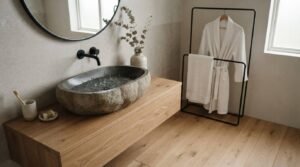
The combinations that work share a common logic: one dominant finish and one accent finish, with the accent used sparingly. Chrome and brushed brass work. Matte black and brushed nickel work. Gunmetal and warm brass work. What doesn’t work is three or more finishes competing for attention with no clear hierarchy.
The dominant finish typically appears on the largest fixtures, tapware, shower mixer, towel rails. The accent finish appears on smaller hardware, cabinet handles, toilet roll holder, mirror frame. This ratio keeps the combination feeling intentional rather than accidental.
Brushed Brass, Matte Black, and Gunmetal in Practice
Brushed brass is the finish with the most momentum right now. It reads as warm, considered, and slightly retro without being nostalgic. It pairs particularly well with the warm neutrals and natural materials that define the broader trend direction this year.
Matte black remains strong, particularly in contemporary and Japandi-influenced bathrooms. Gunmetal is emerging as a sophisticated alternative, darker than brushed nickel, warmer than matte black, and distinctive enough to read as a deliberate choice.
Budget note: premium tapware in brushed brass or gunmetal finishes carries a significant cost premium over chrome equivalents, often two to three times the price. This is one area where the finish genuinely affects the perceived quality of the entire bathroom, so it’s worth allocating budget here rather than cutting it.
9. Biophilic Design: Bringing the Outside In
Biophilic design, the practice of connecting interior spaces to natural elements, has moved from architectural theory into mainstream bathroom renovation. And it makes particular sense in a bathroom, where the goal is often restoration and calm.
Plants, Natural Light, and Organic Textures
Biophilic bathrooms incorporate living plants where ventilation allows, maximise natural light through skylights or larger windows, and use organic textures, stone, timber, woven elements, to create a sensory connection to the natural world. The effect is a bathroom that feels restorative rather than purely functional.
Skylights are the single highest-impact biophilic intervention available in a bathroom renovation. Natural light transforms the quality of a space in a way that no artificial lighting can replicate. Where the roof structure allows, a skylight addition is almost always worth the investment.
Practical Biophilic Choices for Sydney Bathrooms
Sydney’s climate makes biophilic bathrooms genuinely achievable. The combination of strong natural light, mild temperatures, and good ventilation options means that plants thrive in Sydney bathrooms more readily than in colder climates.
Practical plant choices for bathrooms with reasonable light: devil’s ivy, peace lilies, and certain ferns handle humidity well and don’t require direct sunlight. For bathrooms with skylights or large windows, the options expand considerably. The key is matching the plant to the actual light and humidity conditions of the specific room rather than choosing on aesthetics alone.
10. What These Trends Mean for Your Renovation Budget
Understanding trends is one thing. Knowing how to translate them into smart renovation decisions is another. Not every trend delivers equal value, and the right approach depends on your specific goals, whether that’s daily liveability, resale value, or rental yield.
Trend-Driven Upgrades With the Best ROI
The trends with the strongest return on investment for Sydney properties right now are the ones that combine aesthetic currency with functional improvement. Warm minimalism and Japandi styling, high WELS-rated fixtures, integrated storage, and quality tapware finishes all deliver both.
These upgrades improve the daily experience of the bathroom, photograph well for property listings, and appeal to a broad buyer and tenant demographic. They don’t depend on a single trend remaining fashionable, they’re grounded in timeless design principles that happen to be trending right now.
Where to Spend and Where to Save
Spend on: tapware and fixtures (they’re touched every day and define the perceived quality of the space), tiles for the feature wall or shower (high visual impact, moderate quantity), and storage integration (functional improvement that buyers notice immediately).
Save on: full-room handmade tile (reserve for powder rooms where quantity is small), steam generators in secondary bathrooms (low ROI outside master ensuites), and decorative accessories (these are easy to update later without a renovation).
The most expensive bathroom isn’t always the best one. The best bathroom is the one where the budget was allocated to the elements that matter most, and that’s a decision that requires knowing which trends are worth building around and which ones are worth admiring from a distance.
At Sydney Home Renovation, we help homeowners and investors make exactly these calls, translating current design trends into renovation plans that stay on budget, hold their value, and genuinely improve the way you live in your home. Get in touch and let’s talk through what’s right for your bathroom.
Frequently Asked Questions
What bathroom design style is most popular in Sydney right now?
Japandi and warm minimalism are the two dominant styles in Sydney bathroom renovations this year. Both prioritise natural materials, restrained palettes, and clean geometry, and both age well, which makes them strong choices for owner-occupiers and investors alike.
Are freestanding baths still a good investment in 2025?
Yes, particularly in master ensuites where the bath functions as a design centrepiece. A well-chosen freestanding bath adds visual impact and appeals strongly to buyers during property inspections. In smaller bathrooms or investment properties, a quality walk-in shower typically delivers better ROI.
What tile trends are worth spending money on this year?
Zellige and handmade-look tiles, fluted porcelain, and large-format stone-look tiles are the strongest directions right now. For budget-conscious renovations, I recommend concentrating the premium tile spend on a single feature wall rather than full-room application, the visual impact is nearly identical at a fraction of the cost.
How much does it cost to add spa features to a Sydney bathroom?
Electric underfloor heating typically adds $800 to $1,500 to a renovation budget when installed during a retile. A quality rain showerhead adds minimal cost over a standard fitting. Steam enclosures are the significant spend, typically $3,000 to $8,000 installed. Prioritise the features that improve daily use first.
Can I mix metal finishes in my bathroom renovation?
Yes, with one dominant finish and one accent finish used sparingly. Brushed brass with matte black, or chrome with brushed nickel, are combinations that work well. The key is maintaining a clear hierarchy so the mix reads as intentional. Avoid introducing a third finish, which typically tips the balance from considered to cluttered.


