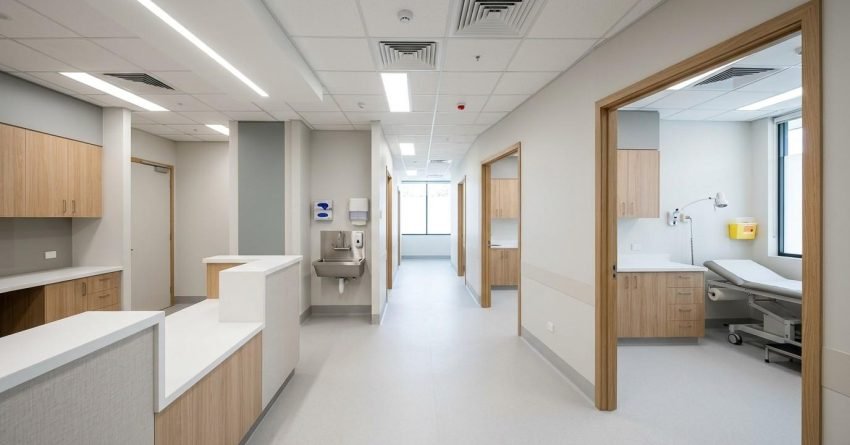
Medical office renovations carry a distinct set of technical, regulatory, and functional requirements that set them apart from every other category of commercial fitout. Whether we are fitting out a new GP clinic, specialist suite, or allied health practice in Sydney, the scope of work extends well beyond aesthetics; it encompasses infection control compliance, clinical zone planning, medical-grade materials, and specialist mechanical and electrical systems. Getting these requirements right from the start determines whether your renovation delivers a safe, functional, and compliant healthcare environment.
Failing to plan for these requirements early creates costly delays, compliance failures, and rework that disrupts patient care and blows out budgets.
This guide covers every core requirement for a medical office renovation from regulatory frameworks and functional zone specifications to materials, MEH systems, and contractor selection.
What Makes Medical Office Renovations Different from Standard Commercial Fitouts
Medical office renovations operate under a fundamentally different set of obligations than standard commercial construction. Where a typical office fitout prioritises aesthetics, workflow efficiency, and cost, a medical fitout simultaneously satisfies clinical safety standards, infection control requirements, patient privacy obligations, and building code compliance specific to healthcare occupancies.
The consequences of non-compliance in a healthcare environment are significant. Regulatory bodies including the Australian Health Practitioner Regulation Agency (AHPRA) and state health departments set minimum standards for clinical environments. The National Construction Code (NCC) and relevant Australian Standards, including AS 1668 for ventilation and AS 4187 for reprocessing of reusable medical devices impose specific technical requirements that we design and build into the fitout from the outset.
Compliance and Regulatory Frameworks for Healthcare Spaces
Medical fitouts in NSW comply with the National Construction Code, relevant Australian Standards, and any conditions attached to the practice’s healthcare facility registration. Depending on the practice type, additional requirements apply under the Health Practitioner Regulation National Law, the Aged Care Act, or the Private Health Facilities Act.
Most medical office renovations in NSW require either a Development Application (DA) or a Complying Development Certificate (CDC), depending on the scope of works and the property’s zoning. Practices operating under a licensed facility registration face additional approval requirements from the relevant health facility registration authority, and we factor these pathways into the project programme from day one.
Key compliance areas include:
- Building classification: Medical consulting rooms typically fall under Class 5 or Class 9b occupancy classifications, each carrying specific structural, fire, and egress requirements.
- Disability access: The Disability Discrimination Act 1992 and the NCC require accessible design across all patient-facing areas, including reception, waiting, and consultation spaces.
- Infection control: AS/NZS 4187 and the National Safety and Quality Health Service (NSQHS) Standards set requirements for surface finishes, hand hygiene facilities, and waste management infrastructure.
- Privacy and acoustic separation: Consultation rooms meet minimum acoustic performance standards to protect patient confidentiality.
Infection Control and Clinical Hygiene Standards
Infection control is not a finishing consideration in a medical fitout it is a design driver. Surface selections, joinery configurations, ventilation systems, and waste management infrastructure are all specified with infection control outcomes in mind from the earliest design stage.
Hand hygiene facilities are positioned at clinical entry and exit points, with fixture selection verified against the cleaning agents used in the practice. Surfaces in clinical zones are non-porous, seamless where possible, and tested for compatibility with TGA-listed disinfectants and healthcare-grade cleaning chemicals. Waste segregation infrastructure covering sharps disposal, clinical waste, and general waste streams is integrated into the fitout design with dedicated cabinetry and compliant bin stations, not retrofitted after construction.
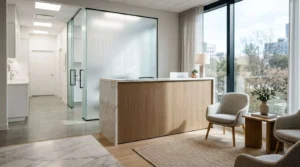
Core Functional Zones in a Medical Office Renovation
A well-planned medical office is organised around clearly defined functional zones, each with its own spatial, technical, and regulatory requirements. Zone planning determines clinical workflow efficiency, patient experience, staff safety, and compliance outcomes.
Reception and Patient Waiting Area Requirements
The reception and waiting area is the first clinical environment a patient encounters. It balances accessibility, privacy, and infection control with a welcoming, functional design.
Key requirements include:
- Reception desk height: Accommodates both standing and seated interactions, with a lowered section for wheelchair access compliant with AS 1428.
- Waiting area capacity: Calculated against expected patient throughput with adequate circulation space between seating.
- Privacy screening: Visual and acoustic separation between the reception desk and waiting area to protect patient information.
- Hand hygiene access: At least one hand hygiene station accessible to patients within or adjacent to the waiting area.
- Pram and mobility aid access: Clear pathways and turning circles compliant with accessibility standards.
Consultation Room and Treatment Bay Specifications
Consultation rooms and treatment bays are the core clinical spaces in any medical fitout. Their design supports safe clinical practice, patient dignity, and efficient workflow.
Minimum requirements include:
- Floor area: A standard consultation room requires a minimum of 9–12 square metres to accommodate a desk, examination couch, and clinical equipment with adequate circulation.
- Hand basin: A clinical hand basin with elbow- or sensor-operated tapware is installed within the consultation room.
- Examination couch clearance: A minimum 900mm clearance on three sides of the examination couch is required for clinical access.
- Storage: Lockable storage for medications, sharps, and clinical consumables is integrated into the joinery design.
- Acoustic performance: Wall and door assemblies achieve a minimum Sound Transmission Class (STC) rating of 45–50 for confidential consultations. This typically requires a combination of acoustic-rated wall framing, resilient mounts, and solid-core doors with perimeter seals; standard plasterboard construction alone does not meet this threshold.
Staff Areas, Sterilisation Rooms, and Back-of-House Zones
Back-of-house zones support clinical operations and are designed with the same rigour applied to patient-facing spaces. Sterilisation rooms, staff rooms, and utility areas each carry specific technical requirements.
Sterilisation rooms comply with AS 4187 and incorporate a clearly defined clean/dirty workflow separation dirty instruments enter from one side, are processed, and exit on the clean side without crossing paths. Bench heights, sink configurations, and autoclave clearances are specified to support this workflow. Ventilation in sterilisation rooms uses dedicated exhaust that is separated from general building air handling, and all surfaces withstand repeated exposure to sterilisation chemicals and steam. Staff rooms provide adequate amenities under the relevant workplace health and safety legislation, and utility rooms accommodate clinical waste storage, linen management, and equipment maintenance workflows.
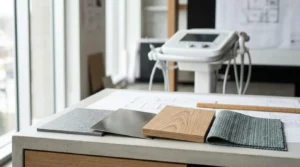
Materials, Finishes, and Equipment Specifications for Medical Fitouts
Material selection in a medical fitout is governed by clinical performance requirements, not aesthetics alone. Every surface specification is evaluated against infection control standards, durability under healthcare cleaning protocols, and compliance with relevant Australian Standards.
Flooring, Wall Finishes, and Ceiling Systems
Flooring in clinical zones is non-porous, slip-resistant, and seamless or coved at wall junctions to eliminate bacterial harborage points. Vinyl sheet flooring with heat-welded seams and integral coved skirting is the most widely specified solution in Australian medical fitouts. Carpet is not appropriate in clinical zones.
Wall finishes are washable, impact-resistant, and compatible with healthcare cleaning agents. Painted plasterboard is acceptable in low-risk areas with appropriate paint specification. Wet areas and clinical zones require impervious wall linings such as solid surface panels, ceramic tiles with epoxy grout, or proprietary healthcare wall systems.
Ceiling systems in clinical areas are accessible for maintenance while minimising dust accumulation. Lay-in grid systems are generally avoided in high-infection-risk areas in favour of flush, cleanable ceiling solutions.
Medical-Grade Joinery, Cabinetry, and Built-In Equipment
Medical joinery is specified to withstand the physical and chemical demands of a clinical environment. Moisture-resistant substrate, impervious surface finishes, and concealed fixings that eliminate harborage points are standard requirements.
Built-in equipment including examination couch power outlets, medical gas outlets, and clinical hand basins is integrated into the joinery and design at the documentation stage, not added as afterthoughts during construction.
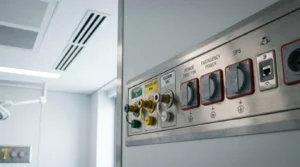
Mechanical, Electrical, and Hydraulic (MEH) Requirements
MEH systems in a medical fitout are significantly more complex than those in a standard commercial renovation. We engage qualified engineers to design these systems, document them in detail, and coordinate installation by licensed tradespeople with verified healthcare construction experience.
Ventilation, HVAC, and Air Quality Systems
Ventilation in medical fitouts complies with AS 1668.2 and, where applicable, the Infection Control Guidelines for the Prevention of Transmission of Infectious Diseases in Health Care Settings. Key requirements include:
- Air change rates: Clinical areas require higher air change rates than standard commercial spaces, with specific requirements for procedure rooms, sterilisation areas, and waiting rooms.
- Pressure differentials: Isolation rooms and procedure rooms require positive or negative pressure differentials to control airborne infection risk.
- Filtration: HEPA filtration is required in high-risk clinical areas.
- Exhaust separation: Clinical exhaust is separated from general building exhaust and discharged appropriately.
Electrical Load Planning and Medical Gas Installations
Electrical systems in medical fitouts accommodate higher load demands than standard commercial fitouts, driven by diagnostic equipment, sterilisation units, and clinical lighting requirements. Dedicated circuits, appropriate switchboard capacity, and emergency power provisions are designed into the electrical documentation from the outset.
Medical gas installations including oxygen, nitrous oxide, and medical air are designed and installed in accordance with AS 2896 and commissioned by a qualified medical gas installer. Outlet locations are coordinated with the clinical workflow design and integrated into the joinery and wall systems.
Clinical Lighting Requirements
Clinical lighting in a medical fitout goes well beyond standard commercial illumination. Consultation rooms and treatment bays require task lighting at examination areas that achieves a minimum of 1,000 lux at the working surface, with colour rendering index (CRI) values of 90 or above to support accurate clinical assessment. General ambient lighting in waiting areas and corridors is specified to a minimum of 300 lux, with glare control to reduce patient discomfort. Emergency lighting is installed in accordance with AS 2293 across all egress paths, and all lighting circuits are separated from general power to allow independent control and fault isolation.
Project Planning, Staging, and Minimising Operational Disruption
Medical office renovations in active practices require careful staging to maintain patient care continuity. Unlike a standard commercial fitout where the space can be vacated entirely, many medical practices cannot afford extended closures. A standard medical office fitout in Sydney typically runs 8 to 16 weeks from construction commencement, and we build the staging programme around the practice’s appointment schedule from the first planning meeting.
Working Around an Active Practice During Renovation
Effective staging of a medical fitout around an active practice requires a detailed construction programme that sequences work to minimise clinical disruption. Practical approaches include:
- Zone-by-zone sequencing: Completing one clinical zone before commencing the next, allowing the practice to continue operating in unaffected areas.
- After-hours and weekend construction: Scheduling high-disruption trades including demolition, concrete work, and noisy mechanical installations outside clinical hours.
- Temporary infection control barriers: Installing hoarding and dust suppression measures that meet healthcare infection control standards during construction.
- Utility isolation planning: Coordinating water, power, and gas isolations with the practice schedule to avoid disruption to clinical.

Cost Considerations and Budget Planning for Medical Office Renovations
Medical fitouts consistently cost more per square metre than standard commercial renovations. The premium reflects the complexity of compliance requirements, the specification of medical-grade materials and systems, and the coordination demands of working in a regulated healthcare environment.
In Sydney, medical office fitout costs typically range from $1,500 to $3,500 per square metre depending on practice type, fitout complexity, and the extent of MEH works required. The table below gives a practical breakdown by practice type:
| Practice Type | Typical Cost Range (per m²) | Key Cost Drivers |
| GP Clinic (standard) | $1,500–$2,200 | Compliance fitout, hand basins, basic MEH |
| Allied Health Practice | $1,600–$2,400 | Acoustic treatment, accessible design, joinery |
| Specialist Suite | $2,000–$2,800 | Procedure room fit, specialist equipment integration |
| Procedure / Day Surgery | $2,500–$3,500 | Medical gas, HEPA ventilation, sterilisation room |
Specialist procedure rooms, sterilisation facilities, and medical gas installations sit at the higher end of this range. Budget planning for a medical fitout involves a wider range of cost variables than most commercial renovations, and we provide detailed, itemised cost plans at the outset so there are no surprises during construction.
Choosing the Right Contractor for a Medical Office Renovation
Not every commercial renovation contractor has the experience, systems, or trade relationships required to deliver a compliant medical fitout. Selecting the wrong contractor is one of the most common causes of compliance failures, cost overruns, and project delays in healthcare construction.
Key criteria for evaluating a medical fitout contractor include:
- Demonstrated healthcare construction experience: Verified project history in medical fitouts, not just general commercial renovation.
- Familiarity with relevant Australian Standards: Working knowledge of AS 4187, AS 1668, AS 2896, and the NCC healthcare occupancy requirements.
- Qualified subcontractor network: Established relationships with licensed medical gas installers, healthcare electrical contractors, and infection control-compliant builders.
- Project management capability: Ability to coordinate complex, multi-trade programmes with staging requirements around active practices.
- Transparent cost documentation: Detailed, itemised quotations that separate trade costs, materials, compliance allowances, and contingency provisions.
Selecting a contractor with verified experience in healthcare construction is one of the most consequential decisions in a medical fitout.
Conclusion
Medical office renovations demand a level of technical precision, regulatory knowledge, and construction coordination that goes well beyond standard commercial fitouts. From infection control compliance and clinical zone planning to MEH system design and medical-grade material specifications, every decision carries clinical and regulatory consequences.
Getting these requirements right from the planning stage protects your investment, your patients, and your practice registration. A well-executed medical fitout delivers a clinical environment that supports safe, efficient healthcare delivery for years ahead.
At Sydney Home Renovation, we bring the healthcare construction expertise, trade relationships, and project management discipline your medical fitout requires. Contact us today to start planning a compliant, on-budget renovation built for long-term clinical performance.
Frequently Asked Questions
What approvals are required for a medical office renovation in NSW?
We typically need either a Development Application (DA) or a Complying Development Certificate (CDC), depending on the scope of works and zoning. Practices with a licensed facility registration face additional health authority approvals.
How long does a medical office renovation take to complete?
A standard medical office fitout in Sydney takes 8 to 16 weeks from construction commencement. Compliance documentation and approval processes add time before construction begins.
What is the difference between a Class 5 and Class 9b building classification for medical fitouts?
Class 5 covers standard office buildings, including medical consulting rooms where no overnight patient care is provided. Class 9b covers assembly buildings and some healthcare facilities, and the classification determines which NCC fire, egress, and accessibility provisions apply.
Do medical consultation rooms require a clinical hand basin?
Yes. We install a clinical hand basin with elbow- or sensor-operated tapware in every consultation room and treatment bay, positioned to support the clinical workflow and comply with infection control guidelines.
What flooring is recommended for medical office clinical zones?
Vinyl sheet flooring with heat-welded seams and integral coved skirting is the most widely specified solution in Australian medical fitouts. It provides a seamless, non-porous surface that eliminates bacterial harborage points and withstands healthcare cleaning agents.
Are medical gas installations required in a GP clinic fitout?
Not all GP clinics require medical gas installations. Practices providing procedural, anaesthesia, or oxygen therapy need medical gas outlets designed and installed in accordance with AS 2896 by a qualified medical gas installer.
How much does a medical office renovation cost per square metre in Sydney?
Medical office fitout costs in Sydney typically range from $1,500 to $3,500 per square metre, depending on practice type, fitout complexity, and the extent of MEH and compliance works required. Specialist procedure rooms and sterilisation facilities sit at the higher end.