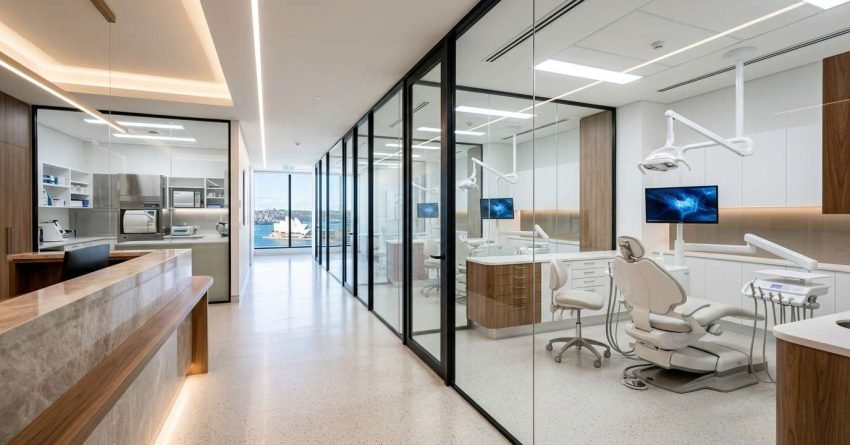
Renovating a dental office in Sydney involves far more than updating the aesthetics. It requires careful planning across clinical compliance, infection control zoning, equipment layout, ventilation standards, and patient flow design, all before a single wall is touched.
Whether we are fitting out a new practice or upgrading an existing one, understanding the full scope of requirements before construction begins is what separates a smooth project from a costly one. Dental fitouts carry unique obligations that standard commercial renovations do not. Getting these wrong creates delays, rework, and serious regulatory risk.
This guide covers the key requirements, design principles, material standards, cost considerations, timeline expectations, and contractor selection criteria for a dental office renovation in Sydney.
What Is a Dental Office Renovation?
A dental office renovation is the process of redesigning, refitting, or upgrading a clinical workspace to meet the functional, regulatory, and patient experience standards required of a modern dental practice. It encompasses structural changes, clinical zone planning, equipment installation, infection control compliance, and interior design all within a framework governed by Australian health facility guidelines and local council requirements.
Unlike a standard office fitout, a dental renovation must account for the specific demands of clinical environments: plumbing for dental chairs, medical-grade ventilation, infection control surfaces, and clearly defined zones separating clinical and non-clinical areas.
When Does a Dental Office Need Renovating?
A dental practice typically requires renovation when existing infrastructure no longer supports current equipment, when infection control standards have changed, or when the practice is expanding its treatment capacity. Lease renewals, practice acquisitions, and rebranding are also common triggers for a full fitout review.
The physical environment directly affects patient retention and staff efficiency. When the space is working against the practice, renovation is no longer optional it is a clinical and business necessity.
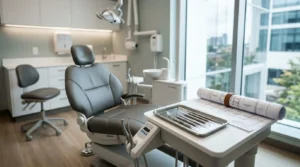
Key Requirements Before Starting a Dental Office Renovation
Before any construction work begins, a dental office renovation in Sydney must satisfy a defined set of regulatory, clinical, and planning requirements. Skipping or underestimating these steps is one of the most common causes of project delays and budget overruns.
We work through these requirements systematically with every practice we take on because the cost of getting them wrong at the construction stage is always higher than the cost of getting them right at the planning stage.
Regulatory Compliance and Council Approvals
Dental practices in New South Wales operate under a combination of local council planning controls, the National Construction Code (NCC), and Australian health facility design guidelines. Depending on the scope of work, a Development Application (DA) or Complying Development Certificate (CDC) may be required before construction can begin.
The NCC building classification for a dental practice is not always straightforward. A practice operating as a standalone health facility typically falls under Class 9a (health-care building), while a small practice within a mixed-use commercial building may be assessed as Class 5. The classification affects fire safety requirements, accessibility standards, and the level of documentation required for approval. Engaging a certifier or town planner early prevents costly redesigns after documentation has been submitted.
Fitouts that involve changes to plumbing, electrical systems, structural elements, or the building’s use classification will almost always require formal approval. Lease agreements also require review before work begins; most commercial leases require written landlord consent for fitout works, and make-good clauses at lease end can affect material and fixture choices made during the renovation.
Infection Control and Clinical Zone Planning
Infection control is a non-negotiable design requirement for any dental fitout. The Australian Dental Association (ADA) and the Dental Board of Australia set standards for sterilisation workflows, surface materials, ventilation, and the physical separation of clean and contaminated zones within the practice.
Clinical zone planning defines how patients, staff, instruments, and waste move through the practice without cross-contamination. This includes the placement of sterilisation rooms relative to treatment rooms, the design of instrument flow pathways, and the specification of surfaces that can withstand clinical-grade disinfection. Waste stream separation, including sharps disposal, clinical waste, and general waste, must be designed into the floor plan from the outset.
Sterilisation Room Design and Workflow
The sterilisation room is the operational heart of infection control in any dental practice. Its placement relative to treatment rooms is critical: the room must support a one-way instrument flow from contaminated (dirty) to clean, with no crossover between used and sterilised instruments.
We design sterilisation rooms with a minimum of two distinct zones: a contaminated receiving area and a clean dispatch area separated by physical barriers or clearly defined workflow boundaries. Bench space, autoclave positioning, ultrasonic cleaner placement, and storage for sterilised instruments all need to be resolved at the design stage, not retrofitted after construction. A sterilisation room that is too small or poorly positioned creates compliance risk and daily workflow friction that compounds over the life of the practice.
Ventilation and Air Quality Standards
Dental procedures generate aerosols, vapours, and airborne particulates that require active management through the building’s ventilation system. Australian Standard AS 1668.2 governs mechanical ventilation in health-care premises, and dental practices must meet specific air change rates and pressure differential requirements in clinical zones.
Treatment rooms typically require negative pressure relative to corridors to prevent aerosol migration. The sterilisation room requires dedicated exhaust ventilation to manage chemical vapours from cleaning agents and autoclave steam. Medical-grade HVAC design is not a standard commercial fitout specification; it requires a mechanical engineer with health-facility experience and must be coordinated with the building’s existing systems before construction begins.
Dental Office Design Principles That Drive Patient Experience
A well-designed dental office does more than meet compliance requirements. It actively reduces patient anxiety, improves staff efficiency, and supports the clinical outcomes of the practice. Design decisions made at the planning stage have a direct impact on how the practice functions day to day and how patients perceive the quality of care they receive.
Every dental practice has unique spatial demands. Traffic flow, acoustic separation, lighting quality, and zone adjacency all interact, and getting the balance right requires design thinking that goes beyond standard commercial fitout principles.
Reception and Waiting Area Design
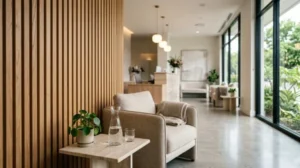
The reception and waiting area is the first physical touchpoint for every patient. Its design communicates the professionalism and care standard of the practice before any clinical interaction takes place.
Key design considerations include sightlines from the reception desk to the entry, acoustic separation from treatment areas, seating arrangements that reduce perceived wait times, and lighting that creates a calm, welcoming environment. Accessibility compliance under the Disability Discrimination Act (DDA) also applies, including path-of-travel requirements, counter heights, and accessible seating provisions.
Treatment Room Layout and Equipment Clearances
Treatment room design is the most technically demanding aspect of a dental fitout. Each room must accommodate the dental chair, delivery unit, overhead light, cabinetry, and assistant’s position within a space that allows the dentist to work efficiently and the patient to be positioned correctly.
Australian standards and equipment manufacturer specifications define minimum clearances around dental chairs, access requirements for emergency egress, and the placement of utilities including compressed air, suction, water, and electrical. Getting these dimensions wrong at the design stage means expensive remediation once equipment is installed.
Plumbing and Utility Rough-In Requirements
Each treatment room requires a coordinated set of utilities that must be roughed in before walls and floors are finished. These include compressed air lines (typically at 550–700 kPa), high-volume suction and saliva ejector connections, cold water supply for the dental unit, and electrical for the chair, overhead light, and equipment.
Electrical installations in clinical areas must comply with AS/NZS 3000 and the additional requirements for medical locations under AS/NZS 3003. The position of every service penetration must be confirmed against the equipment manufacturer’s installation drawings before rough-in begins. Moving a compressed air line after tiling is high-cost. We coordinate directly with dental equipment suppliers during the design phase to lock in service positions before construction commences.
Acoustic Design and Sound Separation
Dental anxiety is one of the most significant barriers to patient attendance and retention. Acoustic design directly addresses this; patients who can hear drilling, suction, or clinical conversation from adjacent treatment rooms experience measurably higher anxiety levels.
Treatment rooms should target a minimum Sound Transmission Class (STC) rating of 45–50 between rooms and between treatment areas and the waiting room. This is achieved through acoustic wall construction (staggered stud framing, acoustic insulation batts, double-layer plasterboard), acoustic door seals, and careful management of penetrations through walls. Acoustic design is most cost-effective when resolved at the structural design stage; retrofitting acoustic treatment after construction is significantly more expensive and rarely achieves the same result.

Materials and Finishes for Clinical and Non-Clinical Zones
Material selection in a dental fitout is driven by two competing priorities: clinical performance and patient experience. Clinical zones require surfaces that are non-porous, chemical-resistant, and easy to disinfect. Non-clinical zones, such as reception, waiting areas, and staff rooms, allow for a wider range of materials that prioritise aesthetics and comfort.
The specification decisions made here affect both the compliance of the fitout and its long-term maintenance cost. Choosing the wrong surface in a clinical zone is not just an aesthetic problem it is an infection control failure.
Flooring, Wall Surfaces, and Cabinetry Standards
In treatment rooms and sterilisation areas, flooring must be seamless or have minimal joins to prevent bacterial harbouring. Vinyl sheet flooring with heat-welded seams is the most common clinical choice in Australian dental practices. Wall surfaces in clinical zones should be smooth, non-absorbent, and compatible with disinfectant chemicals used in dental environments.
Cabinetry in treatment rooms must be purpose-built for clinical use; standard residential or commercial joinery is not appropriate. Clinical cabinetry requires specific handle types (touch-free or recessed), surface materials (high-pressure laminate or solid surface), and construction methods that support infection control protocols and withstand the demands of a high-use clinical environment.
Dental Office Renovation Costs in Sydney
Dental office renovation costs in Sydney vary significantly depending on the size of the practice, the scope of clinical upgrades, the condition of the existing fitout, and the level of finish required. A basic refurbishment of an existing practice will cost considerably less than a full fitout of a new tenancy or a multi-chair expansion.
As a general guide based on practitioner-reported project data, dental fitout costs in Sydney typically range from $1,500 to $3,500 per square metre for a full fitout. Specialist clinical components dental chair plumbing, medical-grade ventilation, and sterilisation room construction represent a significant portion of the total budget and are often underestimated in early planning.
What Drives Cost Variation in Dental Fitouts
The primary cost drivers in a dental fitout are the number of treatment rooms, the complexity of plumbing and electrical, the specification of clinical cabinetry, and the level of acoustic treatment required. Compliance costs, including certifier fees, council applications, and engineering reports, add to the total and are consistently underestimated.
A useful planning benchmark is cost per chair. A single fully equipped treatment room including dental chair plumbing, clinical cabinetry, flooring, wall finishes, electrical, and acoustic treatment typically costs between $45,000 and $85,000 to construct and fit out, excluding the dental chair and equipment itself. A rough trade-by-trade allocation for a full fitout looks like this:
| Trade / Cost Category | Approximate Share of Total Budget |
| Clinical cabinetry and joinery | 20–28% |
| Plumbing and dental | 15–22% |
| Electrical and data | 10–15% |
| HVAC and ventilation | 8–12% |
| Flooring and wall finishes | 8–12% |
| Acoustic treatment | 5–8% |
| Builder’s work and structure | 10–15% |
| Compliance, certification, and fees | 5–10% |
These ranges shift depending on the number of treatment rooms, the condition of the existing tenancy, and the specification level chosen for clinical and non-clinical zones.
How to Plan a Dental Office Renovation Without Disrupting Practice Operations
Most dental practices cannot afford to close for the duration of a renovation. Staging the work to maintain operational continuity requires detailed sequencing, clear communication between the contractor and practice management, and a realistic understanding of which areas can be worked on simultaneously.
Common staging approaches include completing non-clinical areas first, working on treatment rooms sequentially rather than simultaneously, and scheduling high-disruption work such as plumbing rough-ins and ceiling works outside of practice hours or over extended weekends.
Dental Fitout Timeline: Phase by Phase
Understanding the full project timeline helps practice owners plan around patient bookings, staff rosters, and equipment delivery schedules. A typical dental fitout in Sydney moves through four phases:
Design and documentation (4–8 weeks): Architectural drawings, engineering reports, infection control design, equipment coordination, and council submission preparation. This phase cannot be rushed; incomplete documentation is the most common cause of DA delays.
Approval (6–12 weeks for DA; 10–15 business days for CDC): Council assessment timelines vary by local government area and the complexity of the application. Complying Development is faster but only available where the scope and site meet the relevant SEPP criteria.
Construction (8–16 weeks): Demolition, structural works, rough-in of all, wall and ceiling construction, flooring, cabinetry installation, and fit-off. Practices remaining operational during this phase should expect construction to run 20–30% longer than a vacant-site fitout.
Commissioning and handover (1–2 weeks): Equipment installation, infection control validation, regulatory sign-off, and staff orientation. This phase is often compressed under schedule pressure; we protect it because a practice that opens before systems are validated creates compliance and clinical risk.
Choosing the Right Renovation Contractor for a Dental Fitout
Not every commercial fitout contractor in Sydney has the experience or capability to deliver a compliant dental fitout. Dental renovations require a contractor who understands clinical zone planning, infection control design requirements, the coordination of specialist trades including dental equipment installers, and the compliance documentation required for health facility fitouts.
When evaluating contractors, ask for evidence of completed dental or medical fitout projects, references from practice owners, and a clear explanation of how they manage compliance documentation and council approvals. A contractor who cannot demonstrate direct experience in clinical environments is a significant project risk.
The right contractor brings more than construction capability. They bring a working knowledge of dental equipment supplier requirements, infection control design standards, and the council approval process for health-facility fitouts, and they coordinate all of this without the practice owner having to manage it themselves.
Conclusion
A dental office renovation in Sydney demands a higher level of planning, compliance knowledge, and clinical design expertise than a standard commercial fitout. From infection control zoning and council approvals through to treatment room layout, ventilation standards, and material specifications, every decision affects both regulatory compliance and the long-term performance of the practice.
Getting the requirements right before construction begins is what protects the budget, the timeline, and the ability to deliver quality patient care from day one of operation. The practices that experience the smoothest fitouts are the ones that invest in thorough planning before a single wall is touched.
At Sydney Home Renovation, we bring end-to-end dental fitout capability from compliance planning and clinical design coordination through to construction, specialist trade management, and project handover. Contact our team today to start your dental office renovation with a clear plan, an accurate budget, and a contractor who understands clinical environments from the ground up.
Frequently Asked Questions
Do I need council approval for a dental office renovation in Sydney?
In most cases, yes. Dental fitouts involving changes to plumbing, electrical systems, structural elements, or building use classification require either a Development Application or a Complying Development Certificate before work begins.
What NCC classification applies to a dental practice?
A standalone dental practice typically falls under NCC Class 9a as a health-care building. A small practice within a mixed-use commercial building may be assessed as Class 5. The classification affects fire safety, accessibility, and documentation requirements; confirm this with a certifier early.
How long does a dental office renovation typically take?
A full dental fitout in Sydney generally takes between 8 and 16 weeks for construction, plus 4–8 weeks for design and documentation and 6–12 weeks for DA approval. We plan the full timeline from the first briefing so nothing catches the practice by surprise.
What infection control requirements apply to dental fitout design?
Dental fitouts must comply with Australian Dental Association guidelines and the Dental Board of Australia’s infection control standards, which govern surface materials, sterilisation room placement, instrument flow pathways, ventilation, and the physical separation of clean and contaminated zones.
What is the average cost per square metre for a dental fitout in Sydney?
Based on practitioner-reported project data, dental fitout costs in Sydney typically range from $1,500 to $3,500 per square metre for a full fitout. The wide range reflects variation in treatment room count, clinical service complexity, and finish level across clinical and non-clinical zones.
What acoustic standards apply to dental treatment rooms?
Treatment rooms should target a minimum STC rating of 45–50 between rooms and between clinical and waiting areas. We achieve this through acoustic wall construction, door seals, and careful management of service penetrations, all resolved at the design stage.
Can a dental practice stay open during a renovation?
Yes, with careful staging and sequencing. Most dental practices can remain partially operational by completing non-clinical areas first, working on treatment rooms sequentially, and scheduling high-disruption trades outside of practice hours.
What materials are required in dental treatment rooms?
Treatment room surfaces must be non-porous, chemical-resistant, and compatible with clinical-grade disinfectants. Vinyl sheet flooring with heat-welded seams, smooth non-absorbent wall finishes, and purpose-built clinical cabinetry are the standard specifications for compliant dental treatment rooms in Australia.
How do I choose a contractor for a dental office renovation?
Look for a contractor with documented experience in dental or medical fitouts, verifiable references from practice owners, and a clear process for managing compliance documentation and council approvals. Experience with specialist dental trades including equipment installation and clinical plumbing is essential.