Veterinary clinic renovation is the process of redesigning, upgrading, or rebuilding a clinical veterinary facility to meet modern operational standards, regulatory compliance requirements, and the evolving expectations of both animal patients and their owners.
Understanding what a veterinary clinic renovation involves, and what it truly costs, is the difference between a project that runs smoothly and one that stalls mid-construction, blows its budget, or fails a council inspection.
This guide covers every dimension of veterinary clinic renovation in Sydney: planning and compliance, cost structures, design considerations, fit-out requirements, contractor selection, financing, and the hidden expenses that catch most clinic owners off guard.
What Is a Veterinary Clinic Renovation and When Does One Become Necessary?
A veterinary clinic renovation encompasses any significant structural, functional, or aesthetic upgrade to an existing veterinary facility. This includes reconfiguring consultation rooms, upgrading surgical suites, improving infection control infrastructure, expanding waiting areas, or bringing an older facility into compliance with current Australian veterinary practice standards.
Renovation becomes necessary for several reasons. Regulatory changes from bodies such as the Australian Veterinary Association require facilities to meet updated standards for sterilisation, waste management, or animal housing. Practice growth demands more consultation rooms, separate waiting areas for cats and dogs, or expanded diagnostic imaging space.
Ageing infrastructure, including outdated plumbing, inadequate ventilation, or deteriorating flooring, creates hygiene risks and operational inefficiencies that directly affect patient outcomes and staff performance. In Sydney’s competitive veterinary market, clinic presentation plays a measurable role in client retention. A dated, poorly laid-out facility signals to pet owners that the practice is not keeping pace with modern veterinary care standards, regardless of the clinical quality being delivered inside.
The decision to renovate is rarely triggered by a single factor. Most clinic owners reach a tipping point where compliance pressure, operational inefficiency, and client experience concerns converge simultaneously. Recognising that tipping point early, before a compliance notice or a significant equipment failure forces the issue, is what separates a planned, well-budgeted renovation from an emergency reactive one.
Renovate or Relocate? How to Make the Right Decision for Your Practice
The renovate-versus-relocate question is one of the most consequential decisions a veterinary practice owner faces. Getting it wrong in either direction is expensive.
Renovation is the stronger choice when the existing premises are in a well-established location with strong client catchment, when the building structure is sound, and when the scope of works is achievable within the existing footprint. It preserves your client base, avoids the disruption of a full practice move, and typically costs significantly less than establishing a new fit-out in a new location.
Relocation makes more sense when the building has fundamental structural limitations that renovation cannot resolve, when the lease terms are unfavourable, or when the practice needs substantially more floor area than the current site provides. A thorough building condition assessment and a realistic scope-of-works estimate are the two inputs that make this decision clear. We recommend completing both before committing to either path.
Veterinary Clinic Renovation Costs in Sydney: What to Budget
Veterinary clinic renovation costs in Sydney vary significantly based on clinic size, scope of works, existing building condition, and the level of specialist fit-out required.
A basic cosmetic refresh, covering new flooring, paint, cabinetry, and lighting, typically ranges from $1,500 to $2,500 per square metre. A mid-range renovation involving structural changes, new plumbing, upgraded ventilation, and modern clinical fit-out generally falls between $2,500 and $4,500 per square metre. A full high-specification renovation or new-build fit-out for a specialist or emergency veterinary facility exceeds $5,000 to $8,000+ per square metre, depending on the complexity of surgical, imaging, and intensive care infrastructure.
For a typical suburban Sydney veterinary clinic of 150 to 250 square metres, total renovation budgets commonly range from $300,000 to $900,000, with specialist facilities and multi-vet practices at the higher end of that range.
Several cost variables have the greatest influence on final project spend.
Structural changes: Removing or adding walls, modifying load-bearing elements, or changing the building footprint adds high cost and requires structural engineering input.
Plumbing and drainage: Veterinary clinics require extensive clinical-grade plumbing, including multiple hand-wash basins, surgical scrub sinks, floor drains with appropriate trap systems, and waste management infrastructure. Relocating or upgrading these systems is one of the highest-cost line items in any veterinary renovation.
Ventilation and HVAC: Infection control requirements mandate separate air-handling zones for surgical, isolation, and general clinical areas. Upgrading or installing compliant HVAC systems is a major cost driver.
Flooring: Clinical-grade, seamless, non-porous flooring systems, such as epoxy or polyurethane coatings, are required in clinical areas and carry a significant premium over standard commercial flooring.
Cabinetry and joinery: Custom clinical cabinetry built to veterinary workflow requirements is substantially more expensive than standard commercial joinery.
Commercial construction labour rates in Sydney are among the highest in the country, reflecting both the cost of living and the concentration of specialist trade contractors required for clinical fit-outs.
Veterinary Clinic Renovation ROI: What the Investment Returns
A well-executed veterinary clinic renovation is not just a compliance or maintenance exercise. It is a measurable investment in practice value, client retention, and long-term revenue.
Practices that renovate consistently report improvements in client retention rates, new client acquisition, and average transaction value. A modern, well-designed facility communicates clinical quality before a single consultation takes place. In Sydney’s competitive veterinary market, that first impression carries real commercial weight.
From a practice valuation perspective, the physical condition and functional quality of the facility is a direct input into the goodwill and asset value of the business. Buyers and investors assess the remaining useful life of the fit-out, the compliance status of the facility, and the operational efficiency of the layout. A recently renovated, compliant, well-designed clinic commands a meaningfully higher valuation than an equivalent practice in an ageing, non-compliant facility.
The return is strongest when the renovation addresses both compliance and operational efficiency simultaneously. Fixing compliance issues alone recovers value; improving workflow and client experience on top of that creates it.

Regulatory Compliance and Council Approvals for Veterinary Clinic Renovations
Regulatory compliance is one of the most complex and frequently underestimated dimensions of a veterinary clinic renovation in New South Wales. Unlike a standard commercial fit-out, veterinary facilities are subject to overlapping regulatory frameworks that govern animal welfare, infection control, waste management, building standards, and local planning requirements simultaneously.
Development Approval requirements depend on the nature and scale of the works. Minor internal fit-outs that do not change the building’s use classification or external appearance qualify as Complying Development under the State Environmental Planning Policy, allowing faster approval through a private certifier. Works that change the building footprint, alter the facade, affect structural elements, or change the use classification require a full Development Application through the relevant Sydney council.
Building Code of Australia compliance applies to all renovation works. For veterinary clinics, this includes requirements for accessible design under the Disability Discrimination Act, fire safety systems, emergency egress, and structural integrity. A certifier must be engaged to confirm compliance before works commence and to issue an Occupation Certificate upon completion.
Veterinary practice standards set by the Veterinary Practitioners Board of NSW establish minimum facility requirements for registered veterinary practices. These include standards for surgical suite design, sterilisation equipment and processes, isolation facilities for infectious patients, waste disposal, and the physical separation of clinical and non-clinical areas.
NSW infection control requirements for veterinary facilities align with the principles of AS/NZS 4187 (reprocessing of reusable medical devices) and the NSW Health waste management guidelines for clinical and related waste. Floor-to-wall junctions must be coved to prevent bacterial accumulation. Surfaces in clinical areas must be non-porous and cleanable. Ventilation systems must prevent cross-contamination between surgical, isolation, and general clinical zones.
Navigating these overlapping requirements without specialist guidance is one of the most common causes of project delays and cost overruns in veterinary clinic renovations. Engaging a contractor with direct experience in veterinary fit-outs, rather than a general commercial builder, significantly reduces the risk of compliance failures that require expensive rectification works after construction.
Veterinary Clinic Design: Layout, Workflow, and Clinical Functionality
Effective veterinary clinic design is not primarily an aesthetic exercise. It is a functional and clinical one. The layout of a veterinary facility directly affects infection control outcomes, staff workflow efficiency, patient stress levels, and the capacity of the practice to deliver safe, high-quality care.
The foundational principle of veterinary clinic design is zoning: the physical separation of the facility into distinct functional areas that prevent cross-contamination, manage patient flow, and support clinical workflows. A well-designed veterinary clinic separates the following zones.
Public reception and waiting: Separate waiting areas for cats and dogs reduce patient stress. Species-separated waiting is now standard in modern veterinary facility design and is supported by a substantial body of feline behaviour research.
Consultation rooms: Sized and equipped for efficient examination, with direct access to clinical support areas without passing through public zones.
Surgical suite: A dedicated, positively pressured surgical environment with restricted access, appropriate lighting, anaesthetic gas scavenging, and a separate scrub area.
Preparation and recovery: Adjacent to but physically separated from the surgical suite, with appropriate monitoring infrastructure.
Diagnostic imaging: Radiation-shielded X-ray rooms require specific structural requirements and must comply with the Australian Radiation Protection and Nuclear Safety Agency (ARPANSA) standards.
Isolation ward: A negatively pressured, separately ventilated area for infectious patients, with dedicated entry and waste management protocols.
Inpatient wards: Separated by species where possible, with appropriate housing standards for the range of animals treated.
Staff areas: Adequate staff amenities, storage, and administrative space to support practice operations.
Workflow efficiency is the second major design driver. The physical distance between frequently used areas, such as consultation rooms, the preparation area, and the dispensary, directly affects how many steps staff take per patient interaction. In a busy multi-vet practice, poor workflow design translates into measurable reductions in patient throughput and staff fatigue.
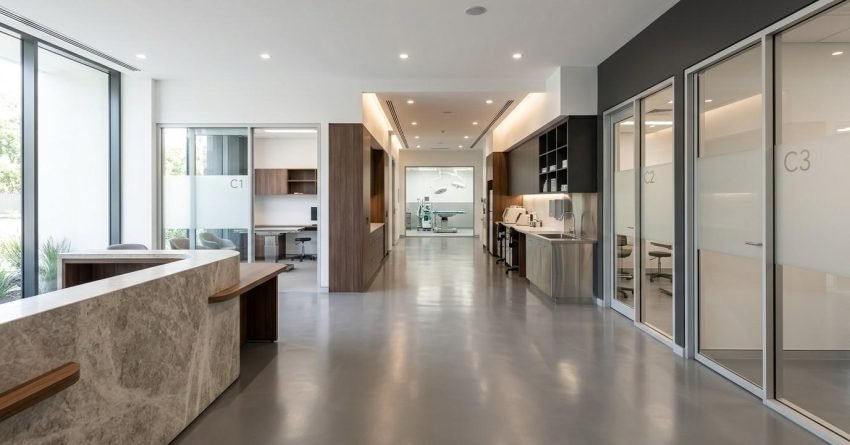
Client experience design has also become an increasingly important consideration. Natural light, acoustic management, clear wayfinding, and a calm, professional aesthetic all contribute to client confidence and practice reputation.
Veterinary Clinic Fit-Out: Equipment, Cabinetry, and Clinical Infrastructure
The fit-out phase of a veterinary clinic renovation is where the majority of the project budget is committed and where the quality of clinical outcomes is most directly determined. Veterinary fit-out encompasses everything installed within the building shell: clinical cabinetry, examination tables, surgical lighting, anaesthetic equipment, sterilisation infrastructure, diagnostic imaging systems, flooring systems, and all associated plumbing, electrical, and data cabling.
Clinical cabinetry and joinery in a veterinary context must meet standards that standard commercial cabinetry cannot satisfy. Surfaces must be non-porous, resistant to clinical disinfectants, and free of joints or gaps that harbour bacteria. Custom-fabricated stainless steel or high-pressure laminate cabinetry with coved bases is standard in clinical areas. The cost premium over standard commercial joinery is significant, typically 40 to 60% higher per linear metre, but the infection control and durability benefits justify the investment over the life of the fit-out.
Examination and treatment tables range from basic fixed-height stainless steel units to hydraulic or electric height-adjustable tables with integrated scales and restraint systems. For a multi-vet practice, investing in height-adjustable tables reduces staff musculoskeletal injury risk and improves patient handling safety.
Surgical lighting must provide shadow-free, colour-accurate illumination across the surgical field. LED surgical lights have become the standard, offering superior colour rendering, lower heat output, and longer service life than older halogen systems.
Sterilisation infrastructure, including autoclaves, ultrasonic cleaners, and instrument storage, must be positioned to support a logical clean-to-dirty workflow that prevents cross-contamination between used and sterilised instruments.
Flooring systems in clinical areas require seamless, non-porous, chemical-resistant surfaces. Epoxy and polyurethane resin flooring systems are the most common specification, with slip-resistance ratings appropriate for wet clinical environments. Coved skirting, where the floor surface curves up the wall to eliminate the floor-wall junction, is a mandatory infection control requirement in surgical and preparation areas.
Technology and digital infrastructure planning is increasingly critical in modern veterinary fit-outs. Digital radiography systems, practice management software, and telemedicine capabilities all require structured cabling, dedicated server room space, and integration planning from the earliest design stage. Retrofitting data infrastructure after construction is consistently more expensive than building it in from the start.
Hidden Costs in Veterinary Clinic Renovations
Hidden costs are the single most common cause of budget overruns in veterinary clinic renovations. These are expenses that are either not visible during initial scoping, not included in early contractor quotes, or not anticipated by clinic owners who have not previously managed a commercial renovation project.
Asbestos and hazardous materials removal is a significant risk in any Sydney building constructed before 1990. Asbestos-containing materials were used extensively in wall sheeting, ceiling tiles, floor adhesives, and pipe insulation. Identification, removal, and disposal by a licensed asbestos removalist is mandatory under NSW Work Health and Safety legislation and adds $10,000 to $50,000+ to a project budget depending on the extent of contamination.
Structural defects discovered during demolition are common in older commercial buildings. Once walls are opened, contractors frequently encounter deteriorated framing, inadequate structural support, or non-compliant previous works that must be rectified before new construction proceeds. A contingency allowance of 10 to 15% of the total project budget is the standard industry recommendation for commercial renovations.
Hydraulic and electrical upgrades are frequently underestimated. Older buildings often have inadequate water pressure, undersized drainage systems, or electrical switchboards that cannot support the load of modern clinical equipment. Upgrading these adds $20,000 to $80,000 depending on the extent of works required.
Certification and inspection fees, including building certifier fees, council DA fees, structural engineering reports, and ARPANSA radiation compliance assessments for X-ray rooms, are often omitted from early budget estimates. These fees collectively reach $15,000 to $30,000 on a mid-scale renovation.
Temporary relocation costs are a significant operational expense that many clinic owners fail to budget for. If the practice must cease trading or operate from a temporary facility during construction, the combined cost of temporary premises, equipment relocation, and lost revenue represents a substantial financial impact over a renovation period of three to six months.
Delays and variations are the most unpredictable hidden costs. Supply chain disruptions affecting specialist clinical equipment, trade contractor availability in Sydney’s tight construction market, and scope changes driven by compliance discoveries all extend project timelines and increase costs beyond the original contract sum.

Choosing the Right Contractor for Your Veterinary Clinic Renovation
Selecting the right contractor is the single most consequential decision in a veterinary clinic renovation. The complexity of clinical fit-out requirements, the overlap of regulatory frameworks, and the operational sensitivity of a working veterinary practice mean that a general commercial builder without specific veterinary experience is a significant project risk.
Veterinary-specific experience is the primary selection criterion. A contractor who has completed multiple veterinary clinic renovations in Sydney understands the infection control requirements, the clinical workflow implications of design decisions, the regulatory approval pathways, and the specialist subcontractors, including plumbers, electricians, HVAC engineers, and flooring contractors, who have experience in clinical environments. This knowledge cannot be substituted by general commercial construction experience.
Licensing and insurance are non-negotiable. In NSW, all building contractors must hold a current contractor licence issued by NSW Fair Trading. For commercial projects above $20,000, a contractor licence in the appropriate category is required. Verify that the contractor holds current public liability insurance (minimum $20 million for commercial projects) and workers’ compensation insurance for all employees and subcontractors.
Project management capability is critical for a veterinary renovation, where multiple specialist trades must be coordinated in a precise sequence and where delays in one trade cascade through the entire project programme. Ask prospective contractors how they manage trade sequencing, how they handle variations, and what their communication protocols are for keeping the client informed throughout the project.
References from comparable projects are the most reliable indicator of a contractor’s capability. Request references from at least two completed veterinary clinic renovations of similar scale and complexity. Speak directly with those clients about budget performance, programme adherence, communication quality, and how the contractor managed unexpected issues during construction.
Tender documentation and contract structure should be reviewed carefully before signing. A detailed scope of works, a fixed-price or clearly structured cost-plus contract, a payment schedule tied to construction milestones, and clear provisions for variations and dispute resolution are all essential elements of a well-structured renovation contract.
Staging a Veterinary Clinic Renovation Around an Operating Practice
One of the most operationally complex challenges in veterinary clinic renovation is managing construction works while the practice continues to trade. Full closure for the duration of a renovation is rarely financially viable for an established practice with ongoing client commitments, staff employment obligations, and fixed operating costs.
Staged renovation, dividing the project into sequential phases that allow portions of the clinic to remain operational while others are under construction, is the most common approach. A well-structured staging plan identifies which areas can be temporarily vacated, which clinical functions can be consolidated into reduced space, and how patient flow can be maintained safely throughout the construction period.
The key constraints that govern staging decisions include the following.
Infection control during construction: Dust, debris, and construction traffic create significant infection control risks in a clinical environment. Physical separation between construction zones and operational clinical areas, using temporary hoarding, negative pressure containment, and dedicated construction access routes, is essential.
Noise and patient stress: Construction noise is highly stressful for hospitalised animals. Scheduling high-noise activities outside of clinical hours, or during periods when the inpatient ward is at minimum capacity, reduces patient welfare impacts.
Utility interruptions: Planned interruptions to water, power, or gas supply must be scheduled to minimise impact on clinical operations. Surgical procedures, anaesthetic recovery, and critical care patients cannot tolerate unplanned utility outages.
Staff safety and workflow: Construction zones must be clearly demarcated and inaccessible to clinical staff and clients. Temporary workflow changes must be communicated clearly to all staff before each construction phase commences.
Temporary relocation of specific clinical functions, such as moving surgical procedures to a nearby specialist facility during the surgical suite renovation, is sometimes the most practical solution for high-risk areas where construction and clinical activity cannot safely coexist.
A realistic staging plan, developed in collaboration with the contractor before works commence, is one of the most valuable investments a clinic owner makes in the pre-construction phase.
Veterinary Clinic Renovation Timeline: What to Expect
Understanding the realistic timeline for a veterinary clinic renovation in Sydney is essential for operational planning, staff management, and financial forecasting. Renovation timelines vary significantly based on project scope, approval requirements, and the availability of specialist contractors and materials.
Pre-construction phase (4 to 12 weeks): This phase encompasses scope definition, design development, regulatory approvals, contractor tendering, and contract execution. DA approval through a Sydney council typically takes 8 to 12 weeks from lodgement for straightforward applications, and longer for complex or contested applications. Complying Development Certificate approval through a private certifier is achieved in 10 to 20 business days for eligible works. Delays in the pre-construction phase are the most common cause of overall project timeline blowouts.
Construction phase: Construction timelines depend directly on project scope.
| Renovation Scope | Typical Construction Duration |
| Cosmetic refresh (flooring, paint, cabinetry) | 3–6 weeks |
| Mid-range renovation (structural, plumbing, HVAC) | 8–16 weeks |
| Full fit-out or major reconfiguration | 16–30 weeks |
| New-build or complete strip-out and rebuild | 6–12 months |
Post-construction phase (2 to 4 weeks): This phase includes final inspections, Occupation Certificate issuance, equipment commissioning, staff orientation to new workflows, and deep cleaning before clinical operations resume. For X-ray rooms, ARPANSA compliance testing must be completed before the room is used clinically.
Lead times for specialist equipment are a frequently overlooked timeline risk. Surgical tables, autoclaves, digital radiography systems, and anaesthetic machines often have lead times of 8 to 16 weeks from order to delivery. Equipment must be ordered during the design phase, not after construction commences, to avoid the project being held up waiting for clinical equipment to arrive.
Financing a Veterinary Clinic Renovation in Sydney
Veterinary clinic renovations represent a significant capital investment, and understanding the financing options available to practice owners in Australia is an important part of the planning process.
Commercial property loans are the most common financing mechanism for clinic owners who own their premises. Renovation costs are often added to an existing commercial mortgage or financed through a construction loan facility, with interest calculated on drawn funds during the construction period.
Equipment finance is a separate and widely used mechanism for funding the clinical equipment component of a renovation. Chattel mortgage, finance lease, and operating lease structures are all available for veterinary equipment, with terms typically ranging from three to seven years. Equipment finance preserves working capital and offers tax advantages through depreciation and interest deductions. Advice from a qualified accountant familiar with veterinary practice finances is essential before committing to any equipment finance structure.
Business loans and lines of credit from major Australian banks and specialist healthcare lenders provide flexible renovation financing for practice owners who do not own their premises. Specialist healthcare lenders offer products specifically structured for healthcare practice renovations, with an understanding of the revenue profile and asset base of veterinary businesses.
Landlord contributions are a negotiating opportunity for clinic owners who lease their premises. Where a renovation adds significant value to the property, through structural improvements, upgraded or enhanced fit-out, landlords contribute to renovation costs in exchange for a lease extension or rent review. This negotiation is most effective when approached before the renovation scope is finalised.
Government grants and incentives for small business capital investment should be investigated through Business.gov.au and the NSW Government’s small business support programs. Broader small business investment incentives and instant asset write-off provisions under the Australian tax system apply to equipment purchases made as part of a renovation.

Veterinary Clinic Renovation in Sydney: Local Considerations
Sydney’s construction market, planning environment, and regulatory landscape create specific conditions that affect veterinary clinic renovations differently from other Australian cities or regional markets.
Council variation is a significant local factor. Sydney’s 33 local government areas each administer their own development assessment processes, with varying DA timeframes, documentation requirements, and assessment criteria. A renovation that qualifies as Complying Development in one council area requires a full DA in an adjacent council. Understanding the specific planning controls that apply to your clinic’s location, including zoning, heritage overlays, and any site-specific development controls, is essential before scoping the renovation.
Trade contractor availability and lead times in Sydney reflect the city’s consistently high construction activity. Specialist trades with veterinary experience, particularly clinical plumbers, HVAC engineers with healthcare experience, and epoxy flooring contractors, are in high demand and often booked several months in advance. Engaging a contractor with established relationships with these specialist subcontractors is a significant advantage in securing reliable trade availability.
Building age and condition vary significantly across Sydney’s commercial stock. Inner-city and established suburban areas contain a high proportion of older commercial buildings that carry elevated risks of asbestos, inadequate, and structural issues that increase renovation complexity and cost. Newer commercial precincts in outer suburban growth areas typically present fewer hidden condition risks but have different planning constraints.
Noise and amenity impacts on neighbouring businesses and residents are a consideration in Sydney’s densely developed commercial areas. Construction hours are regulated by the NSW Environment Protection Authority and by individual council conditions of consent. Planning construction activities to comply with permitted hours, and communicating proactively with neighbours, reduces the risk of complaints that result in stop-work orders.
Conclusion
Veterinary clinic renovation in Sydney is a multi-dimensional project that spans regulatory compliance, clinical design, specialist fit-out, budget management, and operational continuity. Each dimension connects directly to the others, and decisions made early in the planning process have lasting consequences for project cost, timeline, and clinical outcomes.
The sections in this guide cover every major decision point, from understanding what triggers the need to renovate through to financing the project and managing construction around a live practice. The depth of planning you invest before a contract is signed is the single greatest determinant of how smoothly the project runs.
At Sydney Home Renovation, we work with veterinary practice owners across Sydney to plan, budget, and deliver clinic renovations built for long-term clinical performance and lasting value. We bring the specialist trade relationships, compliance knowledge, and project management discipline that a clinical fit-out demands. When you are ready to move forward, we are ready to help.
Frequently Asked Questions
How much does a veterinary clinic renovation cost in Sydney?
Veterinary clinic renovation costs in Sydney range from $1,500 to $8,000+ per square metre depending on scope and fit-out specification. A mid-range renovation for a 150 to 250 square metre clinic typically totals $300,000 to $900,000.
Do I need council approval to renovate a veterinary clinic in NSW?
Yes. Most veterinary clinic renovations in NSW require either a Development Application through your local council or a Complying Development Certificate through a private certifier. The approval pathway depends on the nature, scale, and location of the works.
How long does a veterinary clinic renovation take from start to finish?
A complete veterinary clinic renovation in Sydney typically takes four to twelve months from initial scoping to practical completion. Scope and approval complexity are the primary timeline variables.
Can I keep my veterinary clinic operating during a renovation?
Yes. Staged renovation allows portions of the practice to remain operational while construction proceeds in other areas. Effective staging requires careful infection control planning, utility management, and clear staff communication throughout the construction period.
What are the most common hidden costs in a veterinary clinic renovation?
The most common hidden costs include asbestos removal, structural defects discovered during demolition, hydraulic and electrical upgrades, certification fees, and temporary relocation expenses. We recommend a contingency allowance of 10 to 15% of the total project budget.
What compliance standards apply to veterinary clinic renovations in NSW?
Veterinary clinic renovations in NSW must comply with the Building Code of Australia, the Veterinary Practitioners Board of NSW facility standards, local council planning controls, ARPANSA radiation safety requirements for X-ray rooms, and NSW Work Health and Safety legislation for hazardous materials management.
How do I choose the right contractor for a veterinary clinic renovation?
We prioritise contractors with demonstrated veterinary clinic renovation experience in Sydney, current NSW Fair Trading contractor licensing, adequate insurance, strong references from comparable projects, and a clear project management methodology for coordinating specialist clinical trades.