
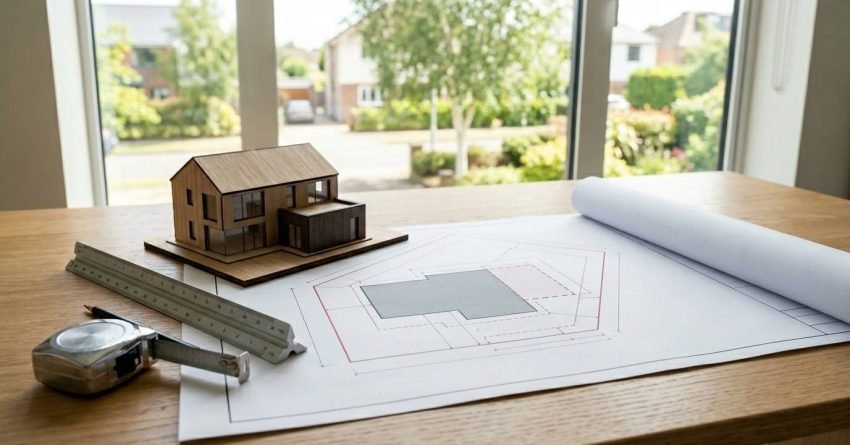
In Sydney, home extension site coverage typically cannot exceed 50–60% of your total lot area, while plot ratio limits generally range from 0.5:1 to 0.65:1 depending on your council and zoning classification. These two controls work together to determine how much of your property you can build on and how much total floor area your extension can add. Understanding both rules before you engage a designer or builder is the single most effective way to avoid costly redesigns, approval delays, and budget blowouts.
Site coverage and plot ratio rules are set by your local council through the Local Environmental Plan and enforced at the development application or complying development stage.
This guide explains how both controls are calculated, how they interact with your extension design, and what steps to take to confirm your property’s specific limits before committing to a plan.
What Is Site Coverage and How Is It Calculated?
Site coverage measures the proportion of your total lot area that is covered by a building or structure when viewed from directly above. It is expressed as a percentage. If your lot is 600 square metres and your council sets a maximum site coverage of 50%, the combined footprint of all structures on your property cannot exceed 300 square metres.
The calculation includes your existing home, any proposed extension, and typically all roofed structures on the lot. The keyword is footprint; site coverage measures the ground-level shadow of a building, not its total floor area. A two-storey extension adds floor area without necessarily increasing site coverage, which is why plot ratio is used alongside it.
Site coverage is one of the most important regulatory constraints for home extensions to understand before committing to a design.
How Councils Define Site Coverage in Sydney
Each Sydney council sets its own site coverage maximum within its Local Environmental Plan (LEP). The most common thresholds in residential zones range from 50% to 60% of the lot area, though some councils apply lower limits in larger-lot or conservation zones. The relevant development standard is usually found in the LEP under the heading “Site Coverage” within the residential zone provisions.
Some councils also apply additional controls through their Development Control Plan (DCP), which may impose stricter limits for specific street types, heritage precincts, or flood-affected land. Always check both documents for your address.
What Structures Count Toward Your Site Coverage
Most councils count the following toward site coverage: the main dwelling, any attached or detached garage, covered pergolas, carports, and any roofed outbuilding. Uncovered decks, driveways, and paved areas are generally excluded from the site coverage calculation, though they are subject to separate impervious surface controls in many DCPs.
If you are planning a covered alfresco area or a garage as part of your extension, include those footprints in your coverage calculation from the outset. Overlooking secondary structures is one of the most common reasons homeowners discover a coverage problem late in the design process.

Plot Ratio Rules for Home Extensions in Sydney
Plot ratio, also called floor space ratio (FSR) in NSW planning legislation, measures the relationship between the total floor area of all buildings on a lot and the total area of the lot itself. It is expressed as a ratio. A plot ratio of 0.5:1 on a 600 square metre lot means the maximum combined floor area of all buildings is 300 square metres.
Unlike site coverage, plot ratio counts every level of a building. A single-storey extension and a two-storey extension with the same footprint will have very different plot ratio impacts. This is why plot ratio is the more restrictive control for homeowners planning to add a second storey or a large multi-room ground-floor addition.
Plot ratio limits are enforced through the same council approval framework that governs setbacks, height, and privacy.
How Plot Ratio Differs from Site Coverage
Site coverage controls how much of the ground your buildings occupy. Plot ratio controls how much total floor space exists across all levels. A two-storey extension can comply with site coverage limits while exceeding the plot ratio limit, because the upper floor adds to total floor area without adding to the ground-level footprint.
Both controls must be satisfied simultaneously. Designing to one without checking the other is a common and expensive mistake.
Typical Plot Ratio Limits Across Sydney Councils
In standard residential zones across Sydney, plot ratio limits for detached dwellings typically range from 0.5:1 to 0.65:1. Some inner-city councils apply higher limits to reflect smaller lot sizes and denser housing patterns, while outer suburban councils with larger lots may apply lower ratios. Medium-density zones and dual occupancy sites are subject to different controls entirely.
The specific ratio for your property is found in the LEP zone provisions table. If no plot ratio is listed for your zone, the control is set in the DCP or does not apply, but confirm this with your council or a planning consultant before proceeding.
Site Coverage and Plot Ratio Limits Across Sydney Councils
The table below shows typical site coverage and FSR limits for standard low-density residential zones across common Sydney council areas. These figures are a general reference only; always verify the current limits in your council’s LEP for your specific address and zone.
| Council | Typical Zone | Max Site Coverage | Max FSR (Plot Ratio) |
| Blacktown City | R2 Low Density | 50% | 0.55:1 |
| Canterbury-Bankstown | R2 Low Density | 50% | 0.5:1 |
| Cumberland | R2 Low Density | 50% | 0.55:1 |
| Georges River | R2 Low Density | 50% | 0.5:1 |
| Hills Shire | R2 Low Density | 40–50% | 0.3:1–0.4:1 |
| Hornsby | R2 Low Density | 40% | 0.4:1 |
| Inner West | R2 Low Density | 60% | 0.65:1 |
| Northern Beaches | R2 Low Density | 40–50% | 0.4:1–0.5:1 |
| Parramatta | R2 Low Density | 50% | 0.55:1 |
| Sutherland Shire | R2 Low Density | 50% | 0.5:1 |
| Waverley | R2 Low Density | 60% | 0.65:1 |
Outer suburban councils with larger lot sizes, such as Hills Shire and Hornsby, consistently apply lower ratios than inner-city councils. If your property sits in a heritage precinct, flood zone, or conservation area, additional controls in the DCP will apply on top of these LEP figures.

How Site Coverage and Plot Ratio Affect Your Extension Design
Site coverage and plot ratio together define the outer boundary of what you can build. Every design decision the size of the footprint, the number of storeys, the inclusion of a garage or covered outdoor area must be tested against both controls before the design is progressed.
The practical effect is that most Sydney homeowners planning a significant extension are working within a constrained envelope. A 500 square metre lot with a 50% coverage limit and a 0.5:1 plot ratio allows a maximum of 250 square metres of footprint and 250 square metres of total floor area. If the existing house already occupies 180 square metres of footprint and 180 square metres of floor area, the available extension capacity is 70 square metres of footprint and 70 square metres of floor area, before setbacks, height limits, and other controls are applied.
On a smaller inner-city lot of 400 square metres with a 60% coverage limit and a 0.65:1 FSR, the maximum footprint is 240 square metres and the maximum total floor area is 260 square metres. If the existing dwelling covers 160 square metres across two storeys, the remaining FSR capacity is 100 square metres, but the remaining footprint capacity is only 80 square metres, meaning a ground-floor extension is more constrained than a second-storey addition in this scenario.
Balancing Footprint, Height, and Floor Area
When coverage and plot ratio limits are tight, experienced designers look for ways to maximise usable floor area within the allowable envelope. Going up rather than out, adding a second storey instead of extending the ground floor, can preserve site coverage capacity while using available plot ratio. Alternatively, removing an existing covered structure before building a new extension can free up coverage allowance.
Setback requirements and height limits interact directly with both controls. A design that satisfies the coverage and FSR numbers can still fail if the proposed building envelope breaches the rear setback or exceeds the maximum wall height for the zone. A qualified building designer or architect will model all controls simultaneously to identify the most efficient design solution for your specific lot.
Complying Development vs. Development Application Pathways
Home extensions in NSW are approved through one of two pathways: complying development or a development application (DA). The pathway available to you depends on whether your proposed extension meets all the prescribed standards set out in the State Environmental Planning Policy (Exempt and Complying Development Codes) 2008, commonly known as the Housing Code.
Under the complying development pathway, a private certifier approves your extension without a council application, provided the design complies with all applicable standards, including site coverage and plot ratio limits. Complying development is faster and less costly than a DA, but it requires strict compliance with every standard. There is no discretion available.
If your extension exceeds the site coverage or plot ratio limits, or if your property is subject to heritage, flood, or other overlays that exclude it from complying development, a DA to council is required. The DA process allows for some discretion, but it is longer, more expensive, and less certain in outcome.
Small Structures and Exempt Development
Not all structures require approval. Under the Housing Code, certain small structures including garden sheds, unroofed decks, and minor outbuildings below specific size thresholds qualify as exempt development and do not require a certifier or council approval. These structures still count toward site coverage if they are roofed, so we include them in the coverage calculation even when no approval is needed. Confirming exempt development thresholds with your certifier before construction prevents compliance problems that are difficult to reverse.
When You Need a DA for Site Coverage Exceedances
A DA is required when your proposed extension cannot comply with the site coverage or plot ratio limits set in the LEP, or when your property is ineligible for complying development for any other reason. In a DA, your council assesses the proposal against the objectives of the development standard, not just the numerical limit. This means an exceedance can be approved if the design demonstrates it meets the underlying planning objectives, but this outcome is not guaranteed and requires a well-prepared application.
Clause 4.6 of the Standard Instrument LEP provides a mechanism to request a variation to a development standard where strict compliance is unreasonable or unnecessary. This is a formal process that requires a written justification and is assessed by council on its merits. Not all councils apply this provision consistently, and success rates vary.
Common Mistakes Homeowners Make with Coverage Calculations
The most frequent error is calculating site coverage based on the proposed extension alone, rather than the combined footprint of all existing and proposed structures. Your existing home, garage, garden shed, and covered pergola all count. Failing to include them produces a coverage figure that appears compliant but is not.
A second common mistake is confusing site coverage with plot ratio. Homeowners who check only one control and assume the other is satisfied often discover late in the design process, or at the certifier stage, that their proposal exceeds the limit they did not check.
A third error is relying on council data portals without verifying the applicable zone and LEP version. Zoning maps are updated periodically, and the controls that applied when a neighbour built their extension no longer apply to your property in some cases. Always confirm the current LEP provisions for your specific lot before committing to a design.
How to Check Your Property’s Site Coverage and Plot Ratio Limits
The starting point is identifying your property’s zoning classification and the applicable LEP. In NSW, the NSW Planning Portal provides access to zoning maps and LEP documents for all councils. Enter your address, identify your zone, and locate the development standards table for that zone in the LEP.
Look for the “Site Coverage” and “Floor Space Ratio” entries in the zone provisions. If a maximum is listed, that is your limit. If no limit is listed, check the DCP for any additional controls. If neither document specifies a limit, confirm with your council in writing before proceeding; verbal advice from a council officer is not binding.
Once you have confirmed your limits, calculate your existing coverage and floor area by measuring the footprints of all structures currently on the lot. The most accurate approach is to measure the external wall dimensions of each structure at ground level, including any attached garage or covered pergola, and add those areas together. A laser measure gives reliable results on irregular shapes, and your original building plans, if available, will show the approved footprint dimensions as a useful cross-check.
The difference between your existing figures and the maximum permitted figures is your available extension capacity, before any other controls are applied.

Working with a Contractor Who Understands Council Rules
Site coverage and plot ratio rules are not just a planning concern; they directly affect construction scope, design feasibility, and project cost. A contractor who understands these controls from the outset can identify compliance risks early, advise on design adjustments before they become expensive, and coordinate with your certifier or planner to keep the approval process on track.
At Sydney Home Renovation, we work through the regulatory constraints of your specific property before any design work begins. That means checking your coverage and plot ratio limits, identifying your approval pathway, and building a project scope that is compliant, realistic, and priced accurately from day one.
Choosing a contractor who understands home extension costs and compliance requirements from the outset protects your budget as well as your approval timeline.
Conclusion
Site coverage and plot ratio rules define the outer limits of what your home extension can achieve on your specific lot. Understanding both controls- how they are calculated, how they interact, and which approval pathway applies is the foundation of a well-planned extension project.
Getting these calculations right before design work begins prevents costly redesigns, approval delays, and budget overruns that consistently affect homeowners who discover compliance problems late in the process.
We at Sydney Home Renovation bring regulatory knowledge and construction expertise together from the first conversation. Contact us to confirm your site coverage and plot ratio position and start planning an extension that is compliant, well-designed, and built to last.
Frequently Asked Questions
What is the maximum site coverage allowed for a home extension in Sydney?
Most Sydney councils set a maximum site coverage of 50% to 60% of the total lot area for residential properties, though the exact limit depends on your council and zoning classification. Always check your Local Environmental Plan for the specific figure that applies to your address.
Is plot ratio the same as floor space ratio in NSW?
Yes. Plot ratio and floor space ratio (FSR) refer to the same control in NSW planning legislation. Both measure the relationship between total building floor area and total lot area, expressed as a ratio such as 0.5:1. The terms are used interchangeably across different councils and planning documents.
Do garages and pergolas count toward site coverage?
Attached and detached garages, carports, and covered pergolas typically count toward site coverage because they have a roof that contributes to the ground-level footprint. Uncovered decks and paved areas are generally excluded, but this varies by council. Check your council’s DCP for the specific definition used.
Can I exceed the site coverage limit for my home extension?
If your proposed extension exceeds the site coverage limit, you need to lodge a development application with council rather than using the faster complying development pathway. In some cases, a Clause 4.6 variation request can be made to justify the exceedance, but approval is not guaranteed and depends on the specific circumstances of your proposal.
How do I find the plot ratio limit for my property?
Access the NSW Planning Portal, enter your property address, identify your zoning classification, and locate the floor space ratio entry in the zone provisions table of your Local Environmental Plan. If no ratio is listed, check your council’s Development Control Plan or contact your council in writing to confirm whether a limit applies.
What happens if my existing home already uses most of the site coverage allowance?
If your existing structures already occupy most of the permitted site coverage, your extension options are limited to adding floor area vertically through a second storey rather than expanding the ground-floor footprint. Removing an existing covered structure before building also frees up coverage capacity, depending on your design priorities.
Do site coverage and plot ratio rules apply to complying development?
Yes. Complying development under the NSW Housing Code requires strict compliance with all applicable development standards, including site coverage and plot ratio limits. If your proposed extension exceeds either limit, it cannot be approved as complying development and requires a development application to council instead.


