
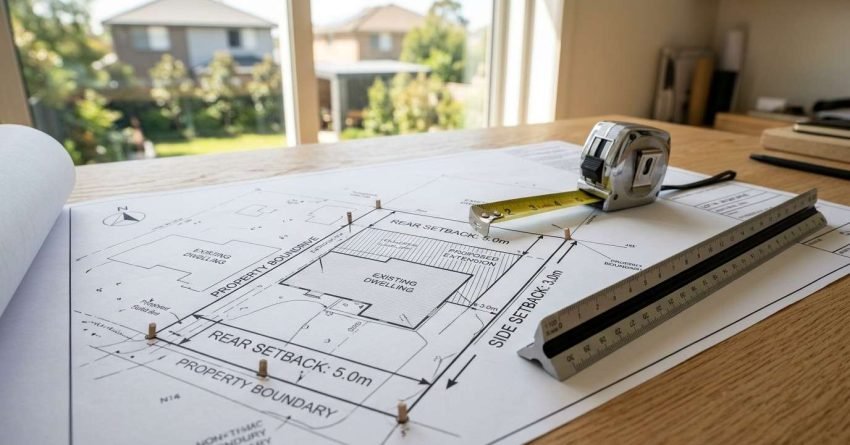
Before building any home extension in Sydney, you must comply with setback requirements: the minimum boundary setback distances your structure must sit from property boundaries, neighbouring buildings, and the street. These rules are set by your local council and the NSW State Environmental Planning Policy (SEPP), and getting them wrong can halt your project entirely.
Setback non-compliance is one of the most common reasons home extension approvals are delayed or refused in Sydney, making early research essential for any homeowner or renovator.
This guide explains minimum setback distances, how zoning affects your build, when you need a DA versus a CDC, and how to verify your council’s specific requirements before you start.
What Are Setback Requirements for Home Extensions?
Setback requirements are the minimum distances a building or structure must be positioned from a property boundary, road, or neighbouring dwelling. For home extensions in Sydney, these rules determine how close your new structure can sit to the front boundary facing the street, the side boundaries shared with neighbours, and the rear boundary at the back of your block.
Setbacks exist to protect neighbourhood character, ensure adequate light and ventilation between properties, maintain privacy, and reduce the risk of fire spread between structures. They are not optional guidelines. They are enforceable planning controls that apply to every residential building project in New South Wales.
The rules that govern setbacks come from two main sources. Your local council’s Local Environmental Plan (LEP) and Development Control Plan (DCP) set the primary controls for your area. The NSW State Environmental Planning Policy (Housing) 2021, commonly called the Housing SEPP, sets a separate, state-wide framework for complying development, which operates alongside council controls.
Minimum Setback Distances for Home Extensions in Sydney
Setback distances in Sydney are not uniform across the city. They vary by council area, zoning classification, lot size, and whether your project is approved as complying development or through a development application. The figures below reflect the standard minimums under the NSW Housing SEPP for complying development on R2 Low Density Residential zoned land, which applies to the majority of suburban Sydney properties.
Always verify the specific controls for your council area and zone before proceeding.
| Boundary | Single-Storey (SEPP Minimum) | Two-Storey (SEPP Minimum) |
| Front | Match existing dwelling setback, or 4.5 m minimum (whichever is greater) | 6 m minimum |
| Side | 0.9 m (lots up to 900 m²) | 1.5 m |
| Rear | 3 m | 6 m |
These are Housing SEPP minimums for complying development on R2 zoned land. Your council’s DCP may require larger distances.
Front Setbacks
For single-storey extensions, the front setback is typically the same as the existing dwelling’s setback from the street boundary, or a minimum of 4.5 metres, whichever is greater. For two-storey extensions, the minimum front setback is generally 6 metres. These distances are measured from the primary road boundary to the nearest part of the new structure.
Side Setbacks
Side setback minimums under the Housing SEPP for complying development are 0.9 metres for single-storey structures on lots up to 900 square metres, and 1.5 metres for two-storey structures. Some councils apply stricter controls through their DCPs, particularly in heritage conservation areas or on narrow lots. Side setbacks are measured from the side boundary to the nearest external wall of the extension.
Rear Setbacks
Rear setbacks for single-storey complying development are generally a minimum of 3 metres from the rear boundary. For two-storey structures, the minimum increases to 6 metres under the Housing SEPP. Rear setbacks are particularly important for extensions that extend toward the back of the block, as they directly affect how much of the rear yard can be built over.
Setback distances directly influence how much usable floor area you can build, which affects your overall home extension costs and project scope.

How Zoning and LEPs Affect Your Extension Setbacks
Every property in Sydney sits within a zoning classification defined by its council’s Local Environmental Plan. The most common residential zones are R2 Low Density Residential, R3 Medium Density Residential, and R4 High Density Residential. Each zone carries different development standards, and setback requirements are among the most significant.
Under an LEP, your council sets the minimum lot size, maximum building height, maximum floor space ratio, and minimum setback distances for each zone. These controls are legally binding and take precedence over general guidelines. A Development Control Plan (DCP) then adds a second layer of site-specific and precinct-specific controls, including setback variations for heritage areas, foreshore land, bushfire-prone zones, and flood-affected properties.
It is important to understand that LEP and DCP controls are not always identical to the Housing SEPP complying development standards. In some council areas, the DCP requires larger setbacks than the SEPP minimum. In those cases, the more restrictive control applies.
Zoning also determines whether your property is eligible for complying development at all. Properties in heritage conservation areas, foreshore protection areas, or certain flood-affected zones are often excluded from the complying development pathway entirely, meaning a full development application is required regardless of the project’s scale.
In practice, setback requirements vary significantly across Sydney’s local government areas. Blacktown Council and The Hills Shire generally align closely with the Housing SEPP minimums for standard R2 lots, while Inner West Council and Northern Beaches Council apply additional DCP controls in many precincts, particularly around heritage conservation areas and foreshore land. Checking your specific council’s DCP is always the definitive step.
When You Need a Development Application vs. Complying Development
Home extensions in Sydney are approved through one of two pathways: a Development Application (DA) lodged with your local council, or a Complying Development Certificate (CDC) assessed by a private certifier or council under the Housing SEPP. The pathway you use determines which setback standards apply and how quickly your project can proceed.
Complying development is a fast-track approval process for straightforward residential projects that meet a defined set of standards. If your extension meets all the Housing SEPP criteria, including the prescribed setback distances, height limits, floor space ratios, and site coverage maximums, a CDC can typically be issued within 20 business days. The setback requirements for complying development are fixed and non-negotiable. If your design does not meet them, you cannot use the CDC pathway.
A Development Application is required when your project does not meet the complying development standards, when your property is excluded from the CDC pathway, or when you want to seek approval for a design that varies from the standard controls. DAs are assessed by council planners against the LEP, DCP, and any other applicable planning instruments. They allow for greater design flexibility but involve longer timeframes, neighbour notification periods, and the possibility of conditions or refusal.
The key distinction for setbacks is this: under a CDC, you must meet the SEPP minimums exactly. Under a DA, you can apply for a variation to the setback controls if you can demonstrate the variation is justified under the relevant planning merit tests. Councils assess setback variation requests against criteria including the impact on neighbouring amenity, solar access, privacy, and the character of the streetscape. Variations are assessed case by case and are not guaranteed.
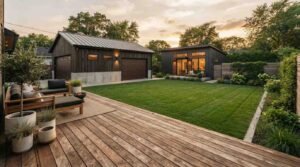
Setback Rules for Decks, Garages, and Secondary Structures
Setback requirements do not apply only to the main extension structure. Decks, pergolas, garages, carports, and secondary dwellings each carry their own setback controls under the Housing SEPP and your council’s DCP, and these often differ from the primary building setbacks.
Attached decks and covered pergolas are generally treated as part of the main dwelling for setback purposes, meaning the same front, side, and rear minimums apply. Freestanding pergolas and garden sheds may qualify for reduced setbacks or exemptions depending on their size and height, but this varies by council. Always check your DCP before assuming a freestanding structure is exempt.
Garages and carports have specific front setback rules in most Sydney councils. Many DCPs require a garage to be set back at least 5.5 metres from the front boundary, or behind the building line of the main dwelling, to prevent the garage from dominating the streetscape. Secondary dwellings, commonly called granny flats, are governed by the Housing SEPP secondary dwelling provisions and carry their own setback minimums that differ from the primary dwelling rules.
What Happens If You Breach Setback Requirements
Building an extension that does not comply with setback requirements is a serious planning breach in New South Wales. The consequences range from council enforcement orders through to mandatory demolition of the non-compliant structure, depending on the severity of the breach and how it is discovered.
If a breach is identified during the construction process, your certifier is required to issue a stop-work order and notify council. Council can then issue a Building Information Certificate, require rectification works, or in serious cases, pursue legal action under the Environmental Planning and Assessment Act 1979. Rectification costs, which include redesigning, demolishing, and rebuilding non-compliant sections, are entirely the owner’s responsibility.
The most common scenario is a breach discovered at the final inspection stage, after significant construction has already occurred. At that point, the cost of rectification is substantially higher than it would have been at the design stage. Getting setback compliance confirmed before construction begins is the most cost-effective approach by a significant margin.
Common Setback Mistakes That Delay Home Extensions
Setback errors are among the most preventable causes of approval delays and redesign costs in Sydney home extension projects. Understanding where homeowners and builders most commonly go wrong can save significant time and money before a single drawing is produced.
The most frequent mistake is assuming that the Housing SEPP minimums apply universally. Many homeowners research the standard SEPP setback distances online and design their extension around those figures, only to discover that their council’s DCP requires larger setbacks for their specific zone or street type. Always check your council’s DCP alongside the SEPP before finalising any design.
A second common error is failing to account for existing encroachments or structures near the boundary. Sheds, pergolas, retaining walls, and existing extensions that sit close to boundaries can affect how setbacks are measured for a new structure. In some cases, existing non-compliant structures can complicate a new approval if they are not addressed as part of the application.
How Setbacks Are Measured
Setbacks are measured from the property boundary to the nearest part of the structure, not the external wall face. In many council areas, this includes eaves, gutters, and roof overhangs. A design that appears compliant when measured to the wall face can fail assessment once the roof projection is included.
The measurement point on the boundary side is the cadastral boundary as shown on your deposited plan, not a fence line. Fences are frequently not on the exact boundary, and relying on a fence position rather than a surveyed boundary is a common source of measurement error. A registered surveyor can confirm your exact boundary positions before design work begins.
Finally, overlooking secondary setback controls, such as those for privacy screens, elevated decks, or above-ground structures, is a common oversight. These elements often carry their own setback requirements that differ from the main building setbacks.

How to Check Setback Requirements Before You Build
Verifying your property’s setback requirements before committing to a design is a straightforward process when you know where to look. Starting with the right sources saves time, prevents redesign costs, and gives you a clear picture of what is achievable on your block.
The first step is to identify your property’s zoning classification. You can do this through your council’s online mapping tool or the NSW Planning Portal. The Planning Portal provides access to your LEP zoning map, the applicable LEP instrument, and links to your council’s DCP.
Once you have confirmed your zone, download and read the relevant sections of your council’s DCP. Most Sydney councils publish their DCPs on their websites, and the residential development chapter will contain the setback controls for your zone. Pay particular attention to any precinct-specific controls, heritage overlays, or special character area provisions that may apply to your street or suburb.
For complying development eligibility, the NSW Housing SEPP is available in full through the NSW Legislation website. Schedule 3 of the Housing SEPP sets out the development standards for single-storey and two-storey housing alterations and additions, including all setback minimums.
If you are uncertain about how the controls apply to your specific property, a pre-lodgement meeting with your council’s duty planner or a consultation with a private certifier can clarify your position before you invest in detailed design work. Working with experienced home extension builders in Sydney who understand local council setback rules from the outset is the most reliable way to avoid costly redesigns and approval delays.
Conclusion
Home extension setback requirements in Sydney are governed by a layered system of state and council controls that vary by zone, lot size, and approval pathway. Understanding the minimum distances for front, side, and rear boundaries, and how your council’s LEP and DCP interact with the Housing SEPP, is essential before any design work begins.
Getting setbacks right from the start protects your approval timeline, prevents costly redesigns, and ensures your extension is built to last without compliance issues down the track.
At Sydney Home Renovation, we guide homeowners through every planning and approval step, from setback verification and council research to design coordination and construction, so your extension moves forward with confidence and without surprises.
Frequently Asked Questions
What is the minimum side setback for a home extension in Sydney?
Under the NSW Housing SEPP for complying development, the minimum side setback is 0.9 metres for single-storey extensions and 1.5 metres for two-storey extensions on standard residential lots. Your council’s DCP sets the final requirement for your zone.
Can I build a home extension right up to my boundary?
In most cases, no. Setback requirements prevent structures from being built directly on a boundary without specific approval. Zero-lot-line construction is only permitted in limited circumstances under specific council controls or with a boundary wall agreement.
Do setback rules apply to covered patios and pergolas?
Yes. Covered patios, pergolas, and verandas attached to the main dwelling are subject to the same setback controls as the primary structure. Freestanding structures carry different setback requirements, so check your council’s DCP for the specific controls that apply.
What happens if my extension doesn’t meet setback requirements?
If your design does not meet the required setbacks, you cannot use the complying development pathway. You need to lodge a Development Application with your council and apply for a variation to the setback controls, which is assessed on planning merit and is not guaranteed.
How do I find out the setback requirements for my specific property?
Check your council’s Development Control Plan and Local Environmental Plan through your council’s website or the NSW Planning Portal at planningportal.nsw.gov.au. For complying development standards, refer to Schedule 3 of the NSW Housing SEPP (Housing) 2021 on the NSW Legislation website.
Are setback requirements different for heritage-listed properties?
Yes. Properties in heritage conservation areas or with individual heritage listings are subject to stricter setback controls and are typically excluded from the complying development pathway entirely. A Development Application assessed by council is required for any extension to a heritage-affected property.
Do rear setbacks change for two-storey extensions?
Yes. Under the Housing SEPP, the minimum rear setback increases from 3 metres for single-storey complying development to 6 metres for two-storey structures. Council DCP controls set different minimums in some areas, and the more restrictive standard always applies.


