
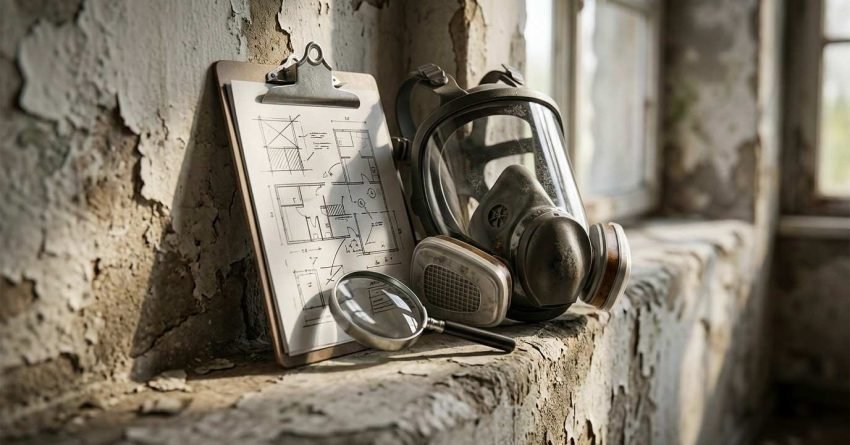
A pre-demolition survey is a mandatory inspection that identifies asbestos-containing materials and other hazardous substances in a building before any demolition or major renovation work begins. In Sydney, skipping this step is not just a compliance failure, it puts workers, residents, and neighbours at serious risk of asbestos fibre exposure, which remains the leading cause of occupational cancer death in Australia.
Getting this right before a single wall comes down protects everyone on site and keeps your project legally compliant from day one.
This guide covers what a pre-demolition survey involves, who is legally responsible, how the process works step by step, what it costs in Sydney, and what happens once hazardous materials are found.
What Is a Pre-Demolition Survey?
A pre-demolition survey is a systematic inspection of a building carried out by a licensed asbestos assessor before demolition or significant structural work begins. Its purpose is to locate, identify, and document every hazardous material present in the structure, with asbestos-containing materials (ACMs) as the primary concern.
The survey produces a written hazardous materials report. That report becomes the foundation for safe work planning, licensed removal, and regulatory compliance before any demolition contractor sets foot on site.
How It Differs from a Standard Asbestos Inspection
A standard asbestos inspection, often called a management survey, is designed for buildings that remain in use. It identifies ACMs that could be disturbed during routine maintenance and recommends management strategies to keep them safe in place.
A pre-demolition survey is far more intrusive. Because the building is coming down, the assessor needs to access every part of the structure, including areas that would normally remain sealed. That means opening wall cavities, lifting floor coverings, inspecting roof spaces, and taking bulk samples from materials that a management survey would leave undisturbed.
The scope is fundamentally different. A management survey manages risk. A pre-demolition survey eliminates it before demolition begins.
Why a Pre-Demolition Survey Is Legally Required in NSW
Under the Work Health and Safety Regulation 2017 (NSW), a person conducting a business or undertaking (PCBU) must ensure a hazardous materials survey is completed before demolition work commences on any structure that may contain asbestos or other hazardous substances. This obligation applies regardless of the building’s age, though any structure built before 1990 carries a significantly elevated risk.
Safe Work Australia’s Code of Practice for the Management and Control of Asbestos in the Workplace reinforces this requirement and sets out the minimum standards for how surveys must be conducted and documented.
Proceeding with demolition without a completed survey exposes the PCBU to substantial penalties under WHS legislation — and more critically, it exposes workers to uncontrolled asbestos fibre release.
Who Is Responsible: Owners, Builders, and Contractors
Responsibility sits with the PCBU, and in a demolition context, that typically means the principal contractor. But property owners carry their own duty of care.
If you commission demolition work on your property, you are responsible for ensuring the survey is completed before work starts. The principal contractor is responsible for ensuring no demolition proceeds without a current hazardous materials report in hand. Both parties share accountability under NSW WHS law, and neither can transfer that obligation to the other.
I see homeowners assume their builder will handle this automatically. Sometimes they do. But the legal exposure belongs to the owner regardless.
What Hazardous Materials Are Identified in the Survey
A pre-demolition survey covers asbestos as the primary concern, but a thorough survey documents all hazardous materials present in the structure. The assessor works through the building systematically, sampling and recording every material that poses a risk during demolition.
Asbestos-Containing Materials (ACMs)
Asbestos was used extensively in Australian residential construction from the 1940s through to the late 1980s. In Sydney, homes built before 1990 commonly contain ACMs in locations including fibro cement sheeting (fibro), vinyl floor tiles and their adhesive backing, roof and eave sheeting, textured ceiling coatings, pipe lagging and insulation, and flexible building boards around wet areas.
The survey distinguishes between friable asbestos which crumbles easily and releases fibres readily, and bonded (non-friable) asbestos, where fibres are locked into a solid matrix. Friable asbestos carries the highest risk and requires Class A licensed removal. Both types must be identified and documented before demolition begins.
Other Hazardous Materials: Lead, Silica, Synthetic Mineral Fibres, and Chemical Residues
Lead-based paint was standard in Australian homes until the late 1970s and remains present in many Sydney properties. Sanding, cutting, or demolishing painted surfaces without controls generates lead dust that is acutely toxic, particularly for children and pregnant women.
Respirable crystalline silica is released when concrete, masonry, and engineered stone products are cut or demolished. Synthetic mineral fibres, including fibreglass batts and rockwool insulation — are also flagged in the survey, as is any evidence of chemical contamination from previous industrial or commercial use of the site.
How the Pre-Demolition Survey Process Works
The survey follows a structured four-step process. Each step builds on the last, and the final output, the hazardous materials register and management plan, is what your demolition contractor and licensed removalist work from.
Step 1: Engage a Licensed Asbestos Assessor
In NSW, a pre-demolition survey must be carried out by a licensed asbestos assessor. This is a person who holds a specific competency under the WHS Regulations, not simply a builder or tradesperson with general asbestos awareness training.
SafeWork NSW maintains a register of licensed asbestos assessors. I always recommend verifying the assessor’s licence directly through that register before engaging them. Credentials matter here, the quality of the survey determines the safety of everything that follows.
Step 2: Site Inspection and Material Sampling
The assessor conducts a thorough visual inspection of the entire structure, including roof spaces, subfloor areas, wall cavities, and service penetrations. Every material suspected of containing asbestos or other hazardous substances is documented.
Where visual identification is insufficient, the assessor takes bulk samples, small physical samples of the material, for laboratory analysis. Sampling follows a representative approach: the assessor collects enough samples to characterise each distinct material type across the building, not just one sample from one location.
Step 3: Laboratory Analysis and Report Preparation
Bulk samples are sent to a NATA-accredited laboratory for analysis using polarised light microscopy (PLM), which identifies asbestos fibre types and confirms whether a material contains ACMs. Results are typically returned within two to five business days, though expedited turnaround is available when project timelines require it.
The assessor then compiles the full hazardous materials report. This document records every identified hazardous material, its location, condition, extent, and risk classification, and it forms the legal record of the survey.
Step 4: Hazardous Materials Register and Management Plan
The completed report feeds directly into a hazardous materials register, a structured document that lists every identified hazardous material on site with its location, type, condition, and recommended control measures. For demolition projects, the register is accompanied by a management plan that specifies the sequence and method for safe removal before demolition proceeds.
This register is a live document. It must be available on site throughout the project and updated as removal work is completed.
How Much Does a Pre-Demolition Survey Cost in Sydney?
In Sydney, a pre-demolition survey for a standard residential property typically costs between $500 and $1,500, depending on the size and complexity of the building. Larger properties, multi-storey homes, and commercial structures attract higher fees due to the increased inspection time and sample count required.
These figures cover the assessor’s time, bulk sampling, laboratory analysis, and the written report. They do not include any subsequent removal work.
What Affects the Price: Property Size, Age, and Complexity
The single biggest cost driver is the number of samples required. A small post-1990 home may need only a handful of samples. A large pre-1970 fibro home in Western Sydney can require 20 or more, each carrying a laboratory fee.
Site access complexity also affects pricing, difficult roof spaces, sealed subfloor areas, and multi-level structures take longer to inspect. Report turnaround time is another variable: standard turnaround is five to seven business days, but expedited reports within 24 to 48 hours carry a premium. Budget for the survey as a non-negotiable line item in your demolition or renovation cost plan.
What Happens After the Survey: Removal, Disposal, and Clearance
Once the hazardous materials report is complete, the removal phase begins. No demolition work proceeds until all identified hazardous materials have been safely removed, disposed of, and cleared by an independent assessor.
Licensed Asbestos Removal: Class A vs Class B
NSW law requires that asbestos removal above prescribed thresholds is carried out by a licensed asbestos removalist. Two licence classes apply.
Class B covers bonded (non-friable) asbestos, the type found in fibro sheeting, vinyl tiles, and similar solid-matrix products. Class A covers friable asbestos, which is the more dangerous form and requires full enclosure, negative pressure systems, and continuous air monitoring during removal. Both licence classes require the removalist to notify SafeWork NSW before work begins on notifiable quantities.
Disposal must occur at a licensed facility. Asbestos waste is double-bagged, labelled, and transported to an approved landfill, it cannot go into general waste or skip bins.
Clearance Inspections and Safe-to-Proceed Certificates
After removal is complete, an independent licensed asbestos assessor, not the removalist, conducts a clearance inspection. This inspection confirms that all identified ACMs have been removed, the area has been decontaminated, and no residual asbestos fibres remain above the clearance standard.
The assessor issues a clearance certificate. This document is the formal safe-to-proceed confirmation that demolition can begin. Without it, no responsible demolition contractor will start work, and no compliant project should.
Common Mistakes Homeowners Make Before Demolition
The most costly mistake I see is skipping the survey entirely on the assumption that a property is “too new” to contain asbestos. In Sydney, homes built as late as 1987 and 1988 still contain ACMs in some materials, the phase-out was gradual, not immediate.
The second most common mistake is engaging an unlicensed person to carry out the survey. A report from an unqualified inspector has no legal standing and provides no protection if asbestos is disturbed during demolition.
Disturbing suspected ACMs before the survey is complete is the third, and most dangerous, error. Cutting into fibro sheeting, sanding old floor tiles, or opening wall cavities without knowing what is inside can release fibres that remain airborne for hours. Once that exposure happens, it cannot be undone.
Conclusion
A pre-demolition survey is not a bureaucratic formality, it is the foundation of a safe, legally compliant demolition or renovation project. Identifying asbestos and hazardous materials before work begins protects everyone on site and keeps your project on the right side of NSW WHS law.
Getting the survey done by a licensed assessor, acting on the report before demolition starts, and securing a clearance certificate after removal are the three steps that separate a well-run project from a costly, dangerous one.
At Sydney Home Renovation, we coordinate the full pre-demolition compliance process as part of our end-to-end renovation service, so you move forward with confidence, not guesswork. Contact us to discuss your project.
Frequently Asked Questions
Do I need a pre-demolition survey for a bathroom renovation in Sydney?
Yes. Any renovation work that involves removing or disturbing walls, floors, or ceilings in a pre-1990 Sydney home requires a pre-demolition or pre-refurbishment asbestos survey before work begins. Bathroom renovations frequently disturb fibro sheeting, vinyl floor tiles, and textured coatings, all common ACM locations.
Who can carry out a pre-demolition asbestos survey in NSW?
Only a licensed asbestos assessor can carry out a pre-demolition survey in NSW. SafeWork NSW maintains a public register of licensed assessors. Verify the assessor’s licence before engaging them, a report from an unlicensed person has no legal standing under WHS Regulations.
How long does a pre-demolition survey take?
The site inspection for a standard residential property takes two to four hours. Laboratory analysis of bulk samples adds two to five business days. The full process from engagement to final report typically takes five to seven business days under standard turnaround, or 24 to 48 hours with an expedited service.
What happens if asbestos is found during demolition?
Work stops immediately. The area is secured and access restricted. A licensed asbestos assessor is engaged to assess the extent of the disturbance, and a licensed removalist is brought in to contain and remove the material safely. SafeWork NSW must be notified for notifiable quantities. Demolition does not resume until a clearance certificate is issued.
Can I remove asbestos myself in NSW?
Homeowner removal of bonded asbestos is permitted in NSW for quantities up to 10 square metres on your own residential property, but only for bonded (non-friable) materials. Friable asbestos requires a Class A licensed removalist regardless of quantity. For any demolition project, I strongly recommend using a licensed removalist for all ACM removal to ensure safe disposal and a valid clearance certificate.
How do I find a licensed asbestos assessor in Sydney?
The SafeWork NSW website maintains a searchable register of licensed asbestos assessors. Search by postcode or suburb to find assessors operating in your area. Confirm their licence class and check that their accreditation is current before signing any engagement.


