The modern bathroom in 2026 is defined by warm neutrals, natural stone, mixed metallic finishes, smart fixtures, and spa-inspired layouts that prioritise wellness without sacrificing function. Sydney homeowners are moving away from cold, all-white spaces toward layered, tactile rooms that feel calm, considered, and built to last.
These trends matter now because material costs, water regulations, and resale expectations in Sydney have shifted significantly, making design decisions financial decisions as much as style choices. In a market where buyers actively compare bathroom quality before making offers, getting the design right is one of the highest-leverage moves a homeowner can make.
This guide breaks down the seven trend categories shaping modern bathrooms today, from finishes and fixtures to layout, lighting, sustainability, and realistic Sydney renovation budgets.
What Defines a Modern Bathroom Design Today
A modern bathroom prioritises clean lines, functional layouts, layered textures, and a calming sensory experience. It is no longer about minimalism for its own sake. Today’s modern bathroom blends warmth, technology, and durability into a space that performs daily while feeling restorative.
The strongest signal of contemporary design is intentionality. Every fixture, finish, and storage solution is chosen for both visual cohesion and long-term performance. Understanding which trends to prioritise and in what order is the foundation of a renovation that holds its value.
Core Principles Behind Contemporary Bathroom Styling
Three principles anchor modern bathroom design: visual calm, tactile contrast, and functional honesty. Visual calm comes from restrained palettes and uncluttered surfaces. Tactile contrast layers stone, timber, matte tile, and metal so the room feels rich without being busy. Functional honesty means fixtures look like what they are: a thoughtful tap, a generous shower, a vanity sized for real use.
How Sydney Homeowners Are Embracing Modern Design
Sydney homeowners increasingly request bathrooms that double as personal retreats. Open shower zones, freestanding baths, oversized mirrors, and natural light are now standard requests across suburbs from the Northern Beaches to the Inner West.
Buyers in the Sydney market expect modern bathrooms in renovated homes, which makes design upgrades a genuine resale lever rather than a personal indulgence. In competitive suburbs like Mosman, Balmain, and Manly, a dated bathroom is one of the fastest ways to lose a buyer’s interest at inspection and one of the fastest ways to win it back with a well-executed renovation.

Material and Finish Trends Shaping Modern Bathrooms
Material selection is where modern bathrooms separate themselves from dated builds. The trend is unmistakably tactile: natural stone, large-format porcelain, fluted timber accents, and matte finishes have replaced glossy ceramics and chrome.
Choosing the right material mix delivers visual depth, durability against Sydney’s humidity, and finish quality that holds up over a decade of daily use.
Natural Stone, Porcelain, and Large-Format Tiles
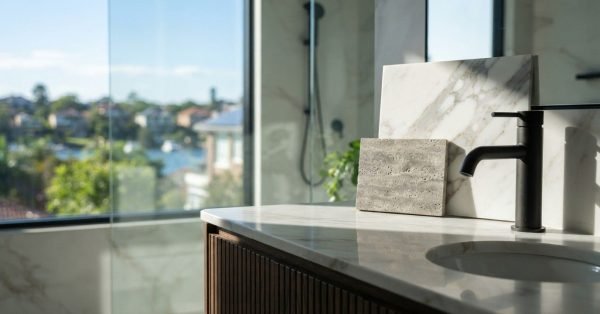
Travertine, limestone-look porcelain, and book-matched marble slabs are the defining surfaces of 2026 bathrooms. Large-format tiles, often 600x1200mm or larger, reduce grout lines and create a seamless, gallery-like feel. Porcelain that mimics stone offers the look without the sealing maintenance, making it a practical favourite for Sydney’s coastal humidity.
Book-matched slabs deliver the most dramatic visual impact but require precise templating and add cost. For most Sydney renovations, a high-quality limestone-look porcelain in a large format achieves 90% of the visual result at a fraction of the price. Rectified edges are essential for large-format tiles; they allow tighter grout joints (as narrow as 1.5mm) that reinforce the seamless, contemporary look.
Matte Black, Brushed Brass, and Mixed Metal Finishes
Tapware has moved well beyond chrome. Matte black remains popular for its graphic punch, but brushed brass and gunmetal are gaining ground for their warmth. Mixed metals are now acceptable when done with intent: brass tapware paired with black shower frames and gunmetal towel rails, unified by a consistent surface temperature.
Finish durability matters as much as aesthetics. PVD-coated tapware physical vapour deposition outperforms standard electroplated finishes in scratch and tarnish resistance, making it the smarter long-term choice for high-use fixtures. WELS-rated tapware in these finishes is now widely available, so there is no trade-off between style and water efficiency.
Choosing Tile Format, Finish, and Grout for Modern Bathrooms
Tile format, surface finish, and grout colour work together as a system, and getting one wrong undermines the others. Large-format tiles in a matte or honed finish read as contemporary and calm. Gloss finishes amplify light in smaller bathrooms but show water marks more readily, which matters in a daily-use space.
Grout colour is one of the most underestimated decisions in a modern bathroom. Tone-on-tone grout matching the tile colour closely reinforces the seamless look that defines contemporary design. Contrasting grout draws attention to the grid pattern, which works in feature walls but reads as busy across a full floor or shower. Epoxy grout in high-traffic wet zones resists staining and discolouration far better than cement-based alternatives, and the upfront cost difference is modest relative to the long-term maintenance saving.
Smart Technology and Fixture Innovations
Modern bathrooms are quietly becoming smart bathrooms. The aim is not gadgetry for its own sake but invisible comfort: warmer floors on cold Sydney mornings, perfectly tempered showers, and water savings that protect long-term running costs.
Smart fixtures also future-proof the renovation. Pre-wired, pre-plumbed installations are far cheaper to add during a renovation than to retrofit later, and the rough-in cost during a full renovation is often negligible compared to the disruption of doing it separately.
Smart Showers, Heated Floors, and Digital Controls
Thermostatic shower systems with digital preset temperatures, in-slab underfloor heating, demister mirrors, and motion-activated LED toe-kick lighting are no longer luxury features. They are mid-tier expectations in Sydney renovations above $30,000.
Thermostatic shower valves hold water temperature within one degree regardless of pressure fluctuations elsewhere in the house a genuine daily comfort improvement, not a novelty. In-slab electric underfloor heating in a standard Sydney bathroom typically adds $800 to $1,500 to the renovation cost and runs for cents per hour. Demister mirrors with integrated LED lighting and touch dimmers replace the need for a separate mirror cabinet and task light, simplifying both the design and the electrical rough-in.
Water-Efficient Fixtures Driving Long-Term Value
WELS-rated tapware, dual-flush toilets, and low-flow rainfall showerheads reduce water bills and meet increasingly strict Australian efficiency standards. For investors and owner-occupiers alike, choosing efficient fixtures is a small upfront decision that compounds in value over years of ownership.
A WELS 4-star showerhead uses around 7 litres per minute compared to 15–20 litres for an unrated fixture. For a household showering daily, that difference adds up to tens of thousands of litres saved annually and a measurable reduction in Sydney Water bills. Specifying WELS 4-star or higher across all tapware and toilets is now standard practice in well-run Sydney renovations.
Ventilation and Humidity Control in Modern Bathrooms
Ventilation is the most overlooked element in modern bathroom design and the one most likely to cause expensive problems if ignored. Sydney’s coastal humidity accelerates mould growth, grout deterioration, and timber swelling in bathrooms that are not properly ventilated.
A correctly sized exhaust fan rated in litres per second for the room’s volume is non-negotiable. For bathrooms with natural stone or timber elements, a continuous-run ventilation system that operates at low speed between uses is worth the additional cost. Heated towel rails also contribute to humidity management by keeping the room temperature slightly elevated after showering, which reduces condensation on cold surfaces. Specifying these elements during the design phase costs far less than remediating mould damage two years into ownership.

Colour, Lighting, and Atmospheric Trends
The cool grey bathroom of the 2010s is over. Modern bathrooms in 2026 lean into warm, grounded palettes: bone, oat, clay, soft terracotta, deep olive, and warm charcoal. These colours photograph beautifully, age well, and create the spa-like calm homeowners now expect.
Lighting is doing as much heavy lifting as colour. A well-lit modern bathroom feels twice as expensive as one with a single ceiling downlight.
Warm Neutrals and Earthy Palettes Replacing Cool Greys
Warm whites paired with limestone tones, sand-coloured tiles, and timber vanity tops deliver a softer, more inviting space. Painted joinery in muted greens, dusty pinks, and deep navy is increasingly used on vanities to add personality without overwhelming the room.
The shift toward warm palettes is also a practical one. Warm neutrals are more forgiving under artificial light than cool greys, which can read as clinical or flat in bathrooms without strong natural light. For Sydney bathrooms that face south or have limited window area, a warm palette is one of the most effective ways to make the space feel welcoming regardless of the time of day.
Layered Lighting and LED Accent Design
A modern bathroom uses at least three light layers: ambient ceiling lighting, task lighting around mirrors, and accent lighting in niches, under vanities, or behind mirrors. Dimmable LED strips with warm colour temperatures (2700K to 3000K) create the difference between a functional bathroom and a restorative one.
Mirror placement and sizing amplify the effect of layered lighting significantly. An oversized mirror running the full width of the vanity or wider reflects both natural and artificial light back into the room, making a modest bathroom feel considerably larger. Positioning task lighting at eye level on either side of the mirror, rather than above it, eliminates the unflattering shadows that overhead-only lighting creates. Coordinating finish palettes across bathroom and kitchen zones also adds resale value, since buyers read visual continuity as a sign of considered, professional renovation work.
Layout, Storage, and Space-Saving Design
Modern bathrooms feel larger than they are because of considered layout decisions. Walk-in showers replace bulky enclosures. Floating vanities lift visual weight off the floor. Concealed storage keeps surfaces clear.
In Sydney’s typical 4 to 8 square metre family bathrooms, these layout moves deliver the biggest perceived value increase per dollar spent. The sequence of decisions matters: layout is locked before finishes, and finishes are locked before fixtures; reversing that order is one of the most common causes of mid-project cost blowouts.
Wet Room Configurations and Walk-In Showers
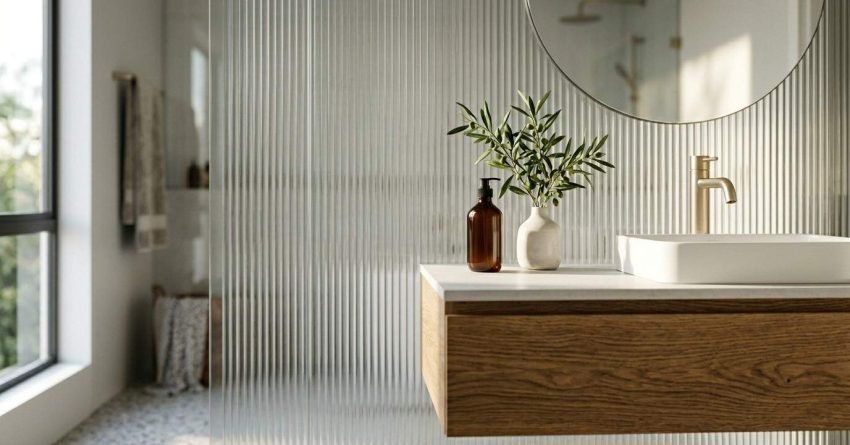
Frameless walk-in showers, often with a single fixed glass panel and no door, are now the default in modern renovations. Linear floor drains, full-height tiling, and tile-matched shower floors create a seamless wet zone that reads as open and intentional.
For bathrooms under 5 square metres, a wet room configuration that removes the shower enclosure entirely and waterproofs the full floor zone is the most space-efficient solution available. It eliminates the visual interruption of a screen, simplifies cleaning, and allows the tile pattern to run unbroken across the entire floor. The waterproofing specification for a wet room is more demanding than a standard shower; a licensed waterproofer and a compliant membrane system are essential, not optional.
Niche and Alcove Design for Storage and Style
Recessed niches are one of the highest-value additions in a modern bathroom renovation, delivering both storage and a natural opportunity for feature tiling or accent lighting. A single niche in the shower wall, typically 300x600mm or 300x900mm, eliminates the need for a shower caddy and keeps the wet zone visually clean.
Niches work best when they are planned before waterproofing begins, not cut in afterward. The most effective placement is at shoulder height on a non-structural wall, tiled in a contrasting material or finish to the surrounding wall. Larger bathrooms benefit from a full-height alcove beside the vanity and a recessed storage column that replaces a freestanding tower and keeps the floor plan open. LED strip lighting inside a niche adds depth and creates a focal point that reads as intentional design rather than afterthought storage.
Floating Vanities and Concealed Storage Solutions
Wall-mounted vanities, recessed mirror cabinets, and full-height storage towers eliminate visual clutter while increasing usable space. Custom joinery sized to the room outperforms off-the-shelf vanities for both function and resale value.
Matching finishes across the bathroom and any adjoining wet areas laundry, ensuite, or powder room creates a sense of design continuity that buyers notice and value. A consistent tapware finish, the same tile family, and coordinated joinery colours across connected spaces signal a renovation that was planned as a whole rather than assembled room by room. That coherence is one of the details that separates a renovation that achieves a strong resale result from one that merely looks updated.

Sustainable and Wellness-Focused Design Elements
Sustainability and wellness are no longer separate trends. They overlap in every modern bathroom. Recycled-content tiles, FSC-certified timber, low-VOC paints, and water-efficient fixtures reduce environmental impact while creating a healthier indoor environment.
Wellness features push this further by treating the bathroom as a daily restoration space rather than a purely utilitarian room. The two goals reinforce each other: a bathroom designed for wellness tends to use better materials, more considered lighting, and more efficient fixtures, all of which also reduce environmental impact.
Eco-Friendly Materials and Low-Impact Fittings
Recycled glass tiles, reclaimed timber accents, terrazzo with post-consumer aggregate, and PEFC-certified bamboo joinery are entering mainstream Sydney builds. Pair these with WELS 4-star or higher tapware and toilets to maximise long-term water savings.
Low-VOC paints and adhesives matter more in bathrooms than in any other room in the house, because bathrooms are small, enclosed, and regularly heated conditions that accelerate off-gassing from standard products. Specifying low-VOC alternatives adds negligible cost and meaningfully improves indoor air quality. For homeowners with young children or respiratory sensitivities, it is a straightforward decision with no downside.
Spa-Inspired Features for Everyday Wellness
Freestanding stone-resin baths, rainfall and body-jet showers, steam showers in larger bathrooms, and built-in shower benches transform a daily routine into a wellness ritual. Even modest bathrooms can incorporate one or two spa elements without blowing the budget.
A built-in shower bench tiled to match the floor and walls costs relatively little to add during construction and delivers daily comfort that a retrofit cannot replicate. Steam shower generators for enclosed shower spaces start at around $1,500 to $2,500 installed, making them accessible at the mid-range budget tier. The key is deciding which wellness features matter most before the design is locked, because adding them during construction is always cheaper than retrofitting them into a finished space.
Choosing a Freestanding Bath for Your Sydney Bathroom
A freestanding bath is the single most visually dominant element in any bathroom that includes one. Getting the selection right size, material, and placement determines whether it reads as a considered centrepiece or an oversized obstacle.
Stone-resin baths are the current standard for modern Sydney renovations. They retain heat better than acrylic, resist chipping, and carry a weight and solidity that reads as premium. Matte-finish exteriors in bone, chalk, or warm white integrate cleanly with contemporary palettes. Size is the most common mistake: a freestanding bath needs at least 400mm of clear floor space on all accessible sides to feel intentional rather than cramped. In bathrooms under 7 square metres, a freestanding bath often works against the layout rather than for it; a built-in bath or a generous shower-only configuration delivers better daily function and comparable resale appeal.
Planning Your Modern Bathroom Renovation in Sydney
A well-designed bathroom and a well-planned renovation are two different things, and both are necessary for a result that holds its value. The design decisions covered in this guide only deliver their full return when they are executed in the right sequence, by the right trades, with a realistic budget locked before work begins.
Getting the Sequence Right
Bathroom renovations follow a fixed trade sequence: demolition, waterproofing, plumbing rough-in, electrical rough-in, tiling, joinery installation, fixture fit-off, and finishing. Decisions made out of sequence choosing tapware before the plumbing rough-in is confirmed, or selecting tiles before the layout is finalised create costly variations mid-project.
The design phase should be complete, including all fixture and finish selections, before any trade books their start date. Changes after waterproofing has been applied or tiles have been ordered carry disproportionate costs relative to the change itself. A detailed scope of works, agreed in writing before the first trade arrives, is the single most effective protection against budget overruns.
Coordinating Trades and Managing the Timeline
A full bathroom renovation in Sydney typically takes three to five weeks from demolition to completion, depending on the scope and the availability of custom joinery or imported tiles. The critical path runs through waterproofing, which requires a mandatory curing period before tiling begins, and joinery, which is often the longest lead-time item.
Coordinating trades so that each one arrives when the preceding work is complete and cured is the project manager’s core job. Gaps in the schedule cost money in holding costs and delay the project’s completion. Working with a contractor who manages the full trade sequence rather than coordinating individual subcontractors yourself is the most reliable way to keep a bathroom renovation on time and on budget.
Budgeting for a Modern Bathroom Renovation in Sydney
Modern design is achievable across a wide budget range, but knowing where the money goes prevents costly mid-project changes. In Sydney, a full bathroom renovation typically lands in three tiers: budget-conscious refresh, mid-range modern, and premium designer.
Understanding which trends deliver the biggest return helps prioritise spending on the upgrades that genuinely add value.
Cost Ranges for Trend-Forward Upgrades
| Tier | Typical Budget | What It Includes |
| Budget-Conscious | $18,000–$25,000 | Quality large-format porcelain, single statement finish, standard fixtures, frameless shower screen |
| Mid-Range Modern | $25,000–$45,000 | Stone-look porcelain, custom joinery, smart fixtures, quality tapware, layered lighting |
| Premium Designer | $50,000+ | Natural stone slabs, full smart integration, custom lighting design, bespoke finishes throughout |
Labour typically accounts for 40–50% of a Sydney bathroom renovation budget. Tiling, waterproofing, plumbing, and electrical are the four trade categories that carry the most cost and the most risk if underspecified. A contingency of 10–15% on top of the agreed scope is standard practice for any renovation involving demolition, because concealed defects (failed waterproofing, corroded pipes, substandard previous work) are common in Sydney’s older housing stock and cannot be priced until the walls are open.
Where Modern Design Adds Long-Term Property Value
The upgrades that consistently return their cost in Sydney include neutral large-format tiling, frameless showers, floating vanities, quality tapware, and warm layered lighting. These elements read as modern to the broadest possible buyer pool, which is what drives resale performance.
Hyper-personal colour choices, oversized statement baths in small rooms, and very high-end smart features tend to deliver weaker returns not because they are poor design choices, but because they narrow the buyer pool. A $15,000 smart shower system appeals to a specific buyer; a $3,000 thermostatic valve with a quality handset appeals to almost everyone.
For renovations that are part of a wider property upgrade, sequencing the bathroom alongside kitchen and living zone improvements rather than in isolation allows finish palettes and joinery styles to be coordinated across the home. That whole-home coherence is one of the most consistent drivers of strong auction results in Sydney’s competitive renovation market.
Conclusion
Modern bathroom design now blends warm materials, smart fixtures, layered lighting, and wellness-focused layouts into spaces that feel calm, considered, and built to last. These trend categories work together to create bathrooms that perform daily while elevating the entire home.
Choosing the right combination depends on your budget, your home, and the resale environment in your Sydney suburb. The most successful renovations balance trend-forward design with disciplined budgeting and trade coordination.
At Sydney Home Renovation, we turn modern bathroom design into a fully costed, on-budget reality. We combine honest pricing, skilled trade coordination, and clear communication so your renovation delivers lasting style and measurable long-term value. Speak with our team to get started.
Frequently Asked Questions
What is the most popular bathroom design trend in Sydney in 2026?
Warm neutral palettes paired with natural stone or stone-look porcelain and matte black or brushed brass tapware are the dominant trend, replacing the cool grey, all-chrome bathrooms of the previous decade.
How much does a modern bathroom renovation cost in Sydney?
A modern bathroom renovation in Sydney typically costs between $18,000 and $45,000, with premium designer projects exceeding $50,000 depending on size, fixtures, and the level of custom joinery and stonework chosen.
Are freestanding baths still on trend in modern bathrooms?
Yes, freestanding baths remain a defining feature of modern bathrooms, especially stone-resin and matte-finish versions, though they work best in bathrooms with enough floor space to avoid feeling cramped.
What colours should I choose for a modern bathroom?
Choose warm neutrals like bone, oat, clay, and warm charcoal, paired with natural timber or stone accents. These tones age well, photograph beautifully, and appeal broadly to future buyers.
Are smart bathroom features worth the extra cost?
Smart features like heated floors, thermostatic showers, and demister mirrors are worth installing during a renovation because retrofitting later costs significantly more. They also add tangible everyday comfort and resale appeal.
What modern bathroom upgrades add the most resale value?
Neutral large-format tiling, frameless walk-in showers, floating vanities, quality tapware, and layered lighting consistently deliver the strongest return. Highly personal colours or oversized statement pieces tend to return less.
Can I achieve a modern bathroom design on a smaller budget?
Yes, focusing on a single statement finish, large-format porcelain tiles, frameless shower glass, warm lighting, and quality tapware delivers a clearly modern look for $18,000 to $25,000 without compromising visual impact.