
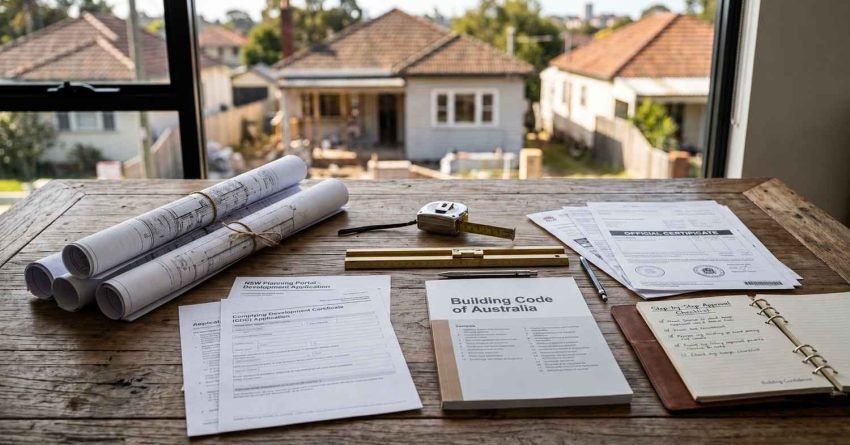
Getting a building permit is the legal authorisation that allows construction, renovation, or structural work to proceed on a residential property in NSW. Without it, work is unlawful, and the consequences reach well beyond a fine.
For homeowners and renovators in Sydney, navigating the permit process means understanding two distinct approval pathways, multiple government bodies, and a sequence of certificates that must be obtained in the right order. Getting this wrong delays projects, inflates costs, and creates serious liability.
This guide covers when a permit is required, who is responsible, the DA vs CDC pathways, the full step-by-step process, timeframes, costs, rejection reasons, and the risks of building without approval.
When Do You Need a Building Permit in Sydney?
Not every renovation or construction project in Sydney requires a building permit but most structural, plumbing, electrical, and significant cosmetic works do. Understanding the threshold is the first step before any project begins.
Work That Always Requires a Permit
Structural alterations, new builds, extensions, garage conversions, and any work affecting load-bearing walls require approval without exception. Plumbing and drainage works, electrical upgrades, and changes to a building’s footprint or height also fall into this category under the Environmental Planning and Assessment Act 1979.
Bathroom renovations that involve moving walls, relocating plumbing, or altering waterproofing membranes typically require a Construction Certificate and inspections, even when the scope appears minor.
Work That May Be Exempt
NSW allows certain low-impact works to proceed without formal approval under the State Environmental Planning Policy (Exempt and Complying Development Codes) 2008. Exempt development includes minor repairs, like-for-like replacements, and small garden structures that meet strict size and setback criteria.
The exemption rules are specific. A project that exceeds a single dimension threshold height, area, or proximity to a boundary loses its exempt status entirely.
How to Check Your Specific Project Requirements
The NSW Planning Portal provides a development application checker where homeowners can enter their property address and proposed works to determine the correct approval pathway. Contacting your local council’s duty planner is also a reliable first step for complex or borderline projects.
Who Is Responsible for Getting a Building Permit?
Responsibility for obtaining a building permit in NSW depends on how the project is structured, whether the homeowner is acting as an owner-builder or engaging a licensed contractor.
Owner-Builder Responsibilities
An owner-builder takes on full legal responsibility for the project, including obtaining all approvals, managing subcontractors, and ensuring compliance with the Building Code of Australia. In NSW, owner-builder work valued above $10,000 requires an owner-builder permit issued by NSW Fair Trading, along with completion of an approved course.
Owner-builders carry personal liability for defects and must disclose owner-builder status when selling the property within six years of completion.
Licensed Contractor Responsibilities
When a licensed contractor is engaged, the contractor typically manages the permit process on the homeowner’s behalf. The contractor holds the licence, coordinates with the Principal Certifier, and ensures inspections are completed at the required stages.
The homeowner remains the property owner and is ultimately responsible for ensuring work is approved, but the practical burden of permit management sits with the contractor.
When a Principal Certifier Is Required
A Principal Certifier (PC) is required for all development that needs a Construction Certificate or Complying Development Certificate in NSW. The PC can be the local council or an accredited private certifier. They are responsible for issuing the Construction Certificate, conducting mandatory inspections, and issuing the final Occupation Certificate.
Understanding the Building Permit Process in NSW
NSW does not use a single “building permit” document. Instead, the approval process involves a sequence of certificates, each serving a distinct legal function. Understanding this structure is essential before submitting any application.
Development Application (DA) vs. Complying Development Certificate (CDC)
These are the two primary approval pathways in NSW, and choosing the right one determines the entire process that follows.
A Development Application (DA) is assessed by the local council against the Local Environmental Plan (LEP) and Development Control Plan (DCP). It involves a merit-based assessment, public notification periods, and council discretion. DAs are required for complex, non-standard, or heritage-affected projects.
A Complying Development Certificate (CDC) is a faster, code-based pathway for projects that meet pre-set standards under the State Environmental Planning Policy. CDCs are assessed by a private certifier or council and do not require public notification. According to the NSW Department of Planning, CDCs now account for a significant proportion of residential approvals in NSW because they offer faster, more predictable outcomes for standard residential work.
The key distinction: a DA involves council judgment; a CDC involves code compliance. If your project meets the CDC standards, it is almost always the faster and more cost-effective pathway.
Construction Certificate (CC): What It Is and When You Need It
A Construction Certificate confirms that the detailed construction plans and specifications comply with the Building Code of Australia and any conditions attached to the DA or CDC. It must be obtained before any physical work begins on site.
The CC is issued by the Principal Certifier, either the council or a private certifier. It is a separate document from the DA or CDC and requires its own application, documentation, and fee.
Occupation Certificate (OC): The Final Approval Stage
An Occupation Certificate is issued at the end of the project, confirming that the completed building is suitable for occupation and complies with the approved plans. Without an OC, the building cannot legally be occupied or used.
For renovations, an Interim Occupation Certificate may be issued for completed sections while other works continue. The final OC closes out the entire approval process.
Step-by-Step: How to Get a Building Permit in Sydney
This is the core process we follow and the one we guide our clients through on every project. Each step builds on the last, and skipping any stage creates compounding problems downstream.
Step 1: Determine the Approval Pathway (DA or CDC)
Before any documentation is prepared, we establish whether the project qualifies for the CDC pathway or requires a full DA. This decision is based on the project type, the property’s zoning, any heritage overlays, and the specific development standards that apply.
We use the NSW Planning Portal and the relevant LEP to confirm the pathway. Getting this right at the start saves weeks.
Step 2: Engage a Principal Certifier or Council
Once the pathway is confirmed, a Principal Certifier is appointed. For CDC projects, this is typically a private certifier. For DA projects, the certifier may be the council or a private certifier appointed after DA approval.
The PC must be engaged before the Construction Certificate application is lodged. Their role is to assess the CC application, conduct mandatory inspections, and issue the final OC.
Step 3: Prepare and Submit Your Application
This step involves assembling the full documentation package. For a DA, this includes a Statement of Environmental Effects, site plans, floor plans, elevations, shadow diagrams, and a BASIX certificate for energy and water compliance where required.
For a CDC, the documentation requirements are similar but assessed against the code rather than council discretion. NSW Fair Trading provides guidance on documentation requirements for licensed contractors managing this process.
Applications are lodged through the NSW Planning Portal, which is the mandatory submission platform for all development applications in NSW.
FURTHER READING
► How to Get a BASIX Certificate in NSW
► BASIX Certificate Cost in NSW: What to Expect
Step 4: Assessment and Conditions of Approval
For a DA, the council assesses the application against the LEP, DCP, and any referral agency requirements. The assessment period varies; standard residential DAs in Sydney typically take 40 to 60 days, though complex applications or those requiring referrals can take significantly longer.
For a CDC, the private certifier assesses compliance against the code. Timeframes are typically 10 to 20 business days for straightforward residential projects.
Both pathways result in a formal approval document with conditions attached. These conditions must be read carefully; they govern what can be built, how it must be built, and what inspections are required.
Step 5: Receive Your Permit and Begin Construction
Once the Construction Certificate is issued, work can legally begin. The CC confirms that the construction plans comply with the Building Code of Australia and the conditions of the DA or CDC.
We review the CC conditions with our clients before breaking ground. Every mandatory inspection point is identified and scheduled into the project programme at this stage.
Step 6: Inspections, Sign-Offs, and Occupation Certificate
Mandatory inspections are conducted by the Principal Certifier at critical stages, typically footings, framing, waterproofing, and final completion. Each inspection must be passed before the next stage of work proceeds.
At project completion, the PC conducts a final inspection and issues the Occupation Certificate. This document is the legal confirmation that the building is complete, compliant, and approved for use. We do not hand over a completed project without it.
How Long Does It Take to Get a Building Permit in Sydney?
Timeframes vary significantly depending on the approval pathway, the complexity of the project, and the responsiveness of the council or certifier involved.
Typical Timeframes for DA vs. CDC Pathways
| Pathway | Typical Timeframe |
| Complying Development Certificate (CDC) | 10–20 business days |
| Development Application (DA) standard residential | 40–60 days |
| DA complex, heritage, or referral required | 3–6 months or longer |
| Construction Certificate (after DA/CDC) | 5–15 business days |
These are indicative timeframes. The NSW Department of Planning’s performance data shows that median DA determination times vary considerably across Sydney’s local government areas, with some councils consistently faster than others.
Factors That Cause Delays
Incomplete documentation is the single most common cause of delays; applications returned for additional information reset the assessment clock. Referrals to external agencies (Heritage NSW, Transport for NSW, Sydney Water) add weeks to the process.
Objections from neighbours during the public notification period can also extend DA timeframes. Choosing the CDC pathway where eligible eliminates the notification period entirely.
How Much Does a Building Permit Cost in Sydney?
Permit costs in Sydney are not fixed; they vary by pathway, project value, council area, and the scope of certifier involvement. Budgeting accurately requires understanding all the fee components.
Council Fees and Private Certifier Fees
DA application fees are set by the Environmental Planning and Assessment Regulation 2021 and calculated as a percentage of the estimated construction cost. For a residential project valued at $100,000, the DA fee is typically in the range of $500 to $1,500, depending on the council.
Private certifier fees for a CDC or Construction Certificate vary by certifier and project complexity. For standard residential renovations, expect $1,500 to $4,000 for the full certification package including inspections.
Hidden Costs and Additional Charges to Budget For
Beyond the primary application fee, projects commonly attract additional costs: BASIX certificate preparation ($200 to $500), structural engineering reports ($800 to $2,500), surveyor fees, long service levy (calculated at 0.35% of the project value under the Building and Construction Industry Long Service Payments Act 1986), and Section 7.11 developer contributions where applicable.
We itemise all anticipated permit costs in our project proposals so clients are not surprised mid-project.

Common Reasons Building Permit Applications Are Rejected
A rejected or returned application costs time and money. Understanding the most common failure points allows us to avoid them before submission.
Incomplete or Incorrect Documentation
The majority of returned applications involve missing documents, inconsistent drawings, or plans that do not match the site survey. Councils and certifiers assess what is submitted; if the documentation does not tell a complete and consistent story, the application is returned.
We conduct a pre-lodgement review of every application package before submission. This single step eliminates most documentation-related returns.
Non-Compliance With Zoning and Development Standards
Applications fail when the proposed works exceed the development standards set by the LEP or DCP height limits, floor space ratios, setbacks, or site coverage. Heritage constraints and bushfire or flood overlays add further compliance requirements that must be addressed in the application.
Checking compliance against the applicable controls before designing the project, not after, is the correct sequence.
How to Respond to a Rejection or Request for Information
A Request for Information (RFI) from a council or certifier is not a rejection; it is a request to provide missing or clarified information. Responding promptly and completely is critical. Delays in responding to an RFI extend the assessment clock.
A formal refusal can be appealed through the Land and Environment Court of NSW or, for CDC applications, through the certifier’s internal review process. We advise clients on the most practical path forward based on the specific grounds of refusal.
Building Without a Permit Risks and Consequences in NSW
Proceeding with construction without the required approvals is one of the most costly mistakes a homeowner or renovator can make. The consequences extend well beyond the construction phase.
Legal Penalties and Stop-Work Orders
Under the Environmental Planning and Assessment Act 1979, councils have the authority to issue stop-work orders, require demolition of non-compliant structures, and impose significant fines. The NSW Department of Planning notes that penalties for unlawful development can reach $1.1 million for corporations and $110,000 for individuals, with additional daily penalties for continuing offences.
A stop-work order halts the entire project immediately, including work that is fully compliant, until the approval issue is resolved.
Impact on Property Sales and Insurance
Unpermitted work creates a disclosed liability on the property. Conveyancers and solicitors conducting due diligence will identify unapproved structures through council records. Buyers can use unpermitted work as grounds to renegotiate price, demand rectification, or withdraw from a contract.
Home insurance policies typically exclude damage arising from or related to unpermitted work. In the event of a claim fire, flood, structural failure the insurer may deny coverage entirely if unapproved work contributed to the loss.
How a Licensed Contractor Simplifies the Permit Process
The permit process involves multiple government bodies, strict documentation requirements, and a sequence of approvals that must be obtained in the correct order. A licensed contractor who understands this process removes the administrative burden from the homeowner and reduces the risk of delays, rejections, and compliance failures.
What a Contractor Handles on Your Behalf
We manage the full approval process from determining the correct pathway and engaging the Principal Certifier, to preparing documentation, lodging the application, responding to RFIs, and scheduling mandatory inspections. Our clients do not need to navigate the NSW Planning Portal, interpret LEP controls, or chase certifiers for inspection bookings.
This end-to-end management is particularly valuable for homeowners undertaking their first renovation, where the permit process is unfamiliar, and the consequences of errors are significant.
FURTHER READING
Questions to Ask Your Contractor About Permits
Before engaging any contractor, confirm: Do they manage the permit process, or is that left to the homeowner? Are permit costs included in the project quote or charged separately? Who is the nominated Principal Certifier, and what is their track record? What happens if the application is returned or rejected? Who bears the cost of resubmission?
A contractor who cannot answer these questions clearly is a contractor who may not be managing the process at all.
Frequently Asked Questions About Building Permits in Sydney
Do I need a building permit for a bathroom renovation in Sydney?
Most bathroom renovations in Sydney that involve moving walls, relocating plumbing, or altering waterproofing require a Construction Certificate and mandatory inspections. Like-for-like fixture replacements without structural or plumbing changes may qualify as exempt development under NSW planning rules.
What is the difference between a DA and a CDC in NSW?
A Development Application is assessed by council against local planning controls and involves public notification. A Complying Development Certificate is assessed by a private certifier against pre-set state codes; it is faster, more predictable, and does not require public notification.
How long does it take to get a building permit in Sydney?
A CDC typically takes 10 to 20 business days. A standard residential DA takes 40 to 60 days, while complex applications involving heritage or referral agencies can take three to six months or longer.
How much does a building permit cost in NSW?
DA fees are calculated as a percentage of construction cost and typically range from $500 to $1,500 for a $100,000 residential project. Private certifier fees for a CDC and Construction Certificate package typically range from $1,500 to $4,000, excluding additional costs like BASIX certificates and engineering reports.
Can I do owner-builder work without a permit in NSW?
No. Owner-builder work valued above $10,000 requires an owner-builder permit from NSW Fair Trading, along with completion of an approved course. All structural, plumbing, and electrical work still requires the relevant approvals regardless of owner-builder status.
What happens if I build without a permit in NSW?
Councils can issue stop-work orders, require demolition, and impose fines of up to $110,000 for individuals. Unpermitted work also creates disclosed liability on the property title, can void home insurance coverage, and complicates or prevents future property sales.
Who issues building permits in Sydney council or a private certifier?
Both can issue approvals in NSW. Councils assess Development Applications and can act as Principal Certifier. Private certifiers assess Complying Development Certificates and Construction Certificates and conduct mandatory inspections. The choice depends on the project type and the approval pathway.
Conclusion
Getting a building permit in Sydney involves a defined sequence: pathway determination, certifier engagement, documentation, assessment, Construction Certificate, inspections, and Occupation Certificate. Each stage is connected, and each must be completed correctly before the next begins.
The DA and CDC pathways, the role of the Principal Certifier, and the documentation requirements are the framework every Sydney renovation operates within. Understanding this framework protects your investment, your property, and your legal standing.
At Sydney Home Renovation, we manage the full permit process on your behalf from the first pathway check to the final Occupation Certificate. Contact us to start your project the right way.


