In Sydney’s current property market, a duplex development typically delivers stronger total profit than a straight land subdivision, but subdivision often wins on simplicity, speed, and lower upfront capital risk.
Both strategies unlock serious value from a single site. The right answer depends on your lot, your zoning, your budget, and how long you’re willing to hold.
We cover both strategies in full here: costs, approvals, ROI, timelines, and the risks that quietly eat into profit on both sides.
What Is a Duplex Development in Sydney?
A duplex is two dwellings built on a single lot, sharing a common wall. In Sydney, duplexes are typically built side by side or front to back, and they can be strata titled or Torrens titled depending on council and zoning rules.
The appeal is straightforward. You build two properties on land you already own, then sell one, rent both, or hold the pair as a long-term income asset.
How Duplex Approval Works Under NSW Planning Rules
Duplex approvals in NSW run through either a complying development certificate (CDC) or a development application (DA), depending on the lot and local environmental plan (LEP).
Under the NSW Government’s Low Rise Housing Diversity Code, dual occupancies are permitted as complying development in R1, R2, R3, and RU5 zones across most councils — provided the lot meets minimum size and frontage requirements. A CDC is faster and more predictable than a DA, which is why site suitability matters so much before you commit.
Typical Duplex Development Costs in Sydney
Building a duplex in Sydney typically costs between $600,000 and $1,000,000 in construction alone, depending on size, finishes, and site conditions. Add design, approvals, landscaping, and holding costs, and total project spend lands between $750,000 and $1,300,000 for a mid-range build.
Land cost sits on top of that. In Sydney’s middle ring suburbs, you’re looking at $900,000 to $1,500,000 for a suitable lot. That puts total project exposure land plus build well above $1.5 million in most cases.
What Is a Torrens Title Subdivision in Sydney?
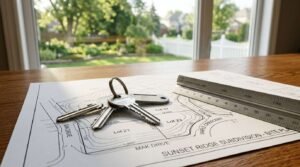
A Torrens title subdivision splits one lot into two or more separate, independently titled lots. Each new lot becomes a standalone property that can be sold, mortgaged, or developed independently.
Subdivision without construction is the simpler version of this strategy. You buy a large lot, get it subdivided, and sell the rear lot to a builder or investor. You’ve created value without picking up a hammer.
How Subdivision Approval Works in NSW
Subdivision in NSW is governed by the Environmental Planning and Assessment Act 1979 and processed through your local council as a development application. The NSW Department of Planning, Housing and Infrastructure sets the legislative framework, but minimum lot sizes, frontage requirements, and infrastructure contributions vary significantly by council and LEP.
A standard residential subdivision DA in Sydney takes four to twelve months to approve, depending on council workload, site complexity, and whether any variations are required. Stormwater, sewer connections, and road access all need to be resolved before a plan of subdivision can be registered with the NSW Land Registry.
Typical Subdivision Costs in Sydney
A straightforward Torrens title subdivision in Sydney survey, DA, engineering, infrastructure contributions, and registration typically costs between $80,000 and $180,000. That’s the cost to create the new title, not including any construction on the subdivided lot.
Council infrastructure contributions (also called Section 7.11 contributions) vary widely. In some Sydney councils, contributions on a new residential lot run from $20,000 to over $60,000 alone. That figure needs to be in your feasibility from day one.

Duplex vs Subdivision: Direct Profit Comparison
This is where the numbers matter most. Both strategies create value, but they do it differently, at different cost levels, and with different risk profiles.
Return on Investment: Which Strategy Delivers More?
A duplex development in a Sydney middle-ring suburb can generate a gross realisation of $2,000,000 to $3,200,000 on a completed two-lot strata or Torrens-titled pair, depending on location and finish. Against a total project cost of $1,500,000 to $2,000,000, the gross profit margin sits between 20% and 40% in a well-run project.
A subdivision without construction on the same site might generate $400,000 to $700,000 in uplift on the rear lot at a cost of $80,000 to $180,000 to create the title. The return on capital deployed is often higher in percentage terms. But the absolute dollar profit is lower.
Duplex wins on total profit. Subdivision wins on return on capital and simplicity.
Timeline and Holding Costs: The Hidden Profit Killer
A duplex project in Sydney runs 18 to 36 months from site acquisition to settlement, design, approvals, construction, and sale. Every month of holding costs money. Construction finance, council holding charges, rates, and insurance all compound.
A subdivision without construction can be completed in 8 to 18 months. Less time in the market means less exposure to interest rate movements, construction cost escalation, and market softening.
Holding costs on a $1.5 million project at 6% per annum run to $90,000 a year. Over an extra 12 months of project duration, that’s a direct hit to profit that doesn’t show up in the headline margin.
Which Strategy Suits Your Sydney Property?
Profitability on paper means nothing if your site can’t support the strategy. Both duplex development and subdivision have hard site requirements that determine feasibility before a single dollar is spent.
Site Suitability: Lot Size, Zoning, and Frontage
For a duplex under the NSW Low Rise Housing Diversity Code, the minimum lot size in most R2 zones is 400m² for a CDC, with a minimum frontage of 12 metres. Some councils require larger lots, 500m² to 600m² under their LEP controls. A site that doesn’t meet these minimums needs a DA variation, which adds time, cost, and approval risk.
For a Torrens title subdivision, minimum lot sizes vary by council but commonly sit at 250m² to 450m² per new lot in established Sydney suburbs. Frontage to a public road or a right of way is non-negotiable for the rear lot. Without it, the subdivision simply can’t be registered.
Investor Profile: Capital Growth vs Rental Yield
A duplex suits investors with higher capital, longer time horizons, and an appetite for construction risk. The reward is a larger asset base, two income streams, and stronger long-term capital growth in a market where Sydney dwelling values have consistently outperformed national averages over the past decade, according to the Australian Bureau of Statistics.
Subdivision suits investors who want faster capital recycling, lower risk exposure, and the ability to redeploy profit into the next deal sooner. It’s a volume strategy: smaller margin per deal, more deals per year.
Neither is universally better. They serve different investor profiles and different financial positions.

Key Risks That Erode Profit in Both Strategies
Construction cost blowouts are the biggest risk in duplex development. Sydney’s building industry has seen significant cost escalation, and a fixed-price contract doesn’t always mean what investors assume it does. Variations, site conditions, and PC sum allowances all create exposure.
For subdivision, the main risk is council. A DA that stalls, a contribution levy that comes in higher than estimated, or a required infrastructure upgrade, sewer main relocation, or stormwater detention can turn a clean feasibility into a loss-making exercise.
Both strategies carry market risk. A 10% softening in Sydney property values between project start and settlement can eliminate the margin on a duplex entirely. Subdivision is more insulated because the capital at risk is lower and the timeline is shorter.
The investors who profit consistently from both strategies in Sydney’s residential development market are the ones who run rigorous feasibility before committing, not after.
Frequently Asked Questions
Is a duplex or subdivision more profitable in Sydney?
A duplex generally produces higher total dollar profit, but subdivision often delivers a better return on capital deployed. The right answer depends on your site, budget, and timeline.
How much land do I need for a duplex in Sydney?
Most Sydney councils require a minimum lot size of 400m² to 600m² for a duplex under complying development or DA pathways. Frontage requirements typically sit at 12 metres or more.
Can I subdivide and build a duplex on the same lot?
Yes, this is called a duplex with Torrens title subdivision, and it’s one of the most profitable strategies available in Sydney. It requires the lot to meet both duplex and subdivision minimums simultaneously.
How long does duplex approval take in NSW?
A CDC approval for a complying duplex typically takes 20 to 40 business days. A DA can take four to twelve months depending on council, site complexity, and whether variations are required.
What is the minimum lot size for subdivision in Sydney?
Minimum lot sizes for Torrens title subdivision vary by council and zone, but commonly range from 250m² to 450m² per new lot in established Sydney residential areas. Check your council’s LEP before assuming feasibility.
Conclusion
Duplex development and Torrens title subdivision both unlock real profit from Sydney land, but they operate at different capital levels, timelines, and risk profiles. Duplex wins on total return; subdivision wins on speed and capital efficiency.
Sydney’s planning environment is shifting. Housing reforms and complying development pathways are making dual occupancy more accessible, which means more competition and tighter margins for underprepared investors.
At Sydney Home Renovation, we help property owners and investors assess both strategies with clear-eyed feasibility analysis and end-to-end project delivery. Reach out to us before you commit to a site; the right call made early is the one that protects your profit.