A complete bathroom renovation in Sydney costs between $18,000 and $45,000 in 2026, and most homeowners we work with spend $25,000 to $30,000 on a standard family bathroom. Size, fixture quality, structural work, and plumbing relocation drive the final figure, with labour absorbing 40 to 50 per cent of the budget.
I built this guide to take the guesswork out of that range. Every trade, material, and hidden cost sits below with current Sydney pricing, so you see exactly where the money goes before you commit.
Use it to set a realistic budget, decide where quality genuinely matters, and protect yourself from the overruns that quietly wreck bathroom projects.
Quick Cost Snapshot: Sydney Bathroom Prices at a Glance
A standard Sydney bathroom renovation costs $25,000 to $30,000 in 2026. Small bathrooms start near $15,000, large ensuites reach $50,000 or more, and labour takes 40 to 50 per cent of every budget regardless of size.
| Bathroom | Size | Typical 2026 cost | Rough cost per m² |
| Powder room or small ensuite | Under 5 m² | $15,000–$25,000 | $3,500–$5,500 |
| Standard family bathroom | 5–8 m² | $25,000–$35,000 | $3,200–$4,800 |
| Master ensuite or large bathroom | Over 8 m² | $35,000–$50,000+ | $3,000–$5,000 |
| Premium or custom build | Any size | $50,000–$60,000+ | $4,500–$7,000 |
| Cosmetic refresh only | Any size | $5,000–$12,000 | n/a |
Those ranges assume licensed trades, certified waterproofing, and full compliance. They exclude asbestos removal, structural repairs, and strata fees, all of which I cover further down.
Average Bathroom Renovation Costs in Sydney (2026)
Bathroom renovation costs move with size, scope and finish quality. Across our Sydney projects, we consistently see prices running around 10 to 15 per cent above national averages, driven by higher trade rates and material delivery costs into dense metropolitan suburbs.
The section below breaks that down by bathroom size so you can match your own floor plan to a realistic starting number.
Small Bathroom Renovation Costs (Under 5m²)
Small bathrooms of roughly 3 to 5m², including ensuites and powder rooms, cost $15,000 to $25,000 for a complete renovation. That figure covers demolition, waterproofing, tiling, new fixtures and all trade labour.
Compact rooms often cost more per square metre than large ones, because plumbing connections, waterproofing and electrical work stay fixed regardless of floor area. Clever layout planning matters far more here than expensive finishes, which is why smart small bathroom renovation planning usually delivers a bigger visual result than a bigger budget.
| Small bathroom tier | Cost | What it includes |
| Basic | $15,000–$18,000 | Standard fixtures, ceramic tiles, existing layout |
| Mid-range | $18,000–$22,000 | Quality fixtures, porcelain tiles, improved finishes |
| Premium | $22,000–$25,000+ | Designer fixtures, stone surfaces, feature tiling |
Medium Bathroom Renovation Costs (5-8m²)
Medium bathrooms represent most Sydney homes and cost $25,000 to $35,000 for a full renovation. This size normally carries a separate shower and bath, a vanity, a toilet,t and workable storage, landing around $3,200 to $4,800 per square metre.
In our experience, this size band also returns the most value, typically recovering 65 to 75 per cent of the renovation spend in added property value.
| Cost component | Typical spend |
| Labour across all trades | $12,000–$16,000 |
| Fixtures and fittings | $6,000–$10,000 |
| Tiles and materials | $4,500–$6,000 |
| Waterproofing and preparation | $2,500–$3,000 |
Large Bathroom Renovation Costs (Over 8m²)
Bathrooms above 8m², usually master ensuites with double vanities, freestanding baths and separated shower zones, cost $35,000 to $50,000 or more. Fixture selection drives most of the variation at this scale.
Premium builds with high-end tapware, natural stone, underfloor heating and custom joinery pass $60,000. Those budgets make sense in owner-occupied homes where daily enjoyment and long service life outweigh immediate resale maths.
Ensuite vs Main Bathroom Cost Differences
Ensuites cost 10 to 20 per cent less than main bathrooms of the same size, mainly because they skip the bath and carry less storage. New ensuites built into older homes reverse that saving, since fresh drainage runs and framing add structural work, which is where ensuite renovation costs diverge sharply from a straight refit.
Main bathrooms serve several people daily, so they justify tougher fixtures and finishes. Double basins, deeper storage and slip-resistant flooring lift both the cost and the everyday usability of a family bathroom.
Sydney Compared With Other Australian Capitals
Sydney sits at the top of the national range alongside inner Melbourne, with Brisbane and Perth generally landing 8 to 15 per cent lower on the same scope. Regional NSW comes in cheaper on labour, and dearer on delivery, which narrows the gap on materials-heavy builds.
Trade availability explains most of the difference rather than material pricing. Tiles, tapware and membranes cost roughly the same nationally, while licensed plumbing and waterproofing hours cost the most in Sydney.
Complete Cost Breakdown by Trade and Material
Knowing where each dollar lands lets you shift budget deliberately instead of trimming the wrong line item. The breakdown below follows the same order as an itemised builder’s quote.
Labour Costs: What Tradespeople Actually Charge
Labour represents 40 to 50 per cent of total bathroom renovation costs in Sydney. Between 2024 and 2026, we have watched trade rates climb roughly 8 to 10 per cent on the back of strong demand and a thin skilled-labour pool.
| Trade | 2026 Sydney rate |
| Licensed plumber | $95–$130 per hour |
| Licensed electrician | $90–$120 per hour |
| Waterproofer | $85–$110 per hour |
| Tiler | $80–$100 per hour, plus $45–$75 per m² installed |
| Carpenter or joiner | $75–$95 per hour |
| Painter | $60–$80 per hour |
| General labourer | $50–$65 per hour |
A standard bathroom absorbs 120 to 180 labour hours across all trades. Structural changes, plumbing relocation, and custom joinery push that past 200 hours.
Quality contractors price project management, site supervision and trade coordination into the quote. That oversight keeps trades in the correct sequence, which is non-negotiable for waterproofing and compliance sign-off.
Demolition and Removal Costs
Demolition and waste removal cost $1,500 to $3,500 depending on size, existing materials, and site access.
- Strip-out labour: $800–$1,500
- Skip bins and waste removal: $400–$800
- Disposal fees: $300–$600
- Asbestos testing where required: $200–$400
Bathrooms in pre-1990 Sydney homes regularly hide asbestos in wall sheeting, floor tiles and adhesives. Licensed removal adds $1,500 to $4,000 to the demolition stage, and I treat that as a scheduling issue as much as a cost issue.
Difficult access changes the maths again. Apartments, townhouses and homes without a direct external path add 20 to 30 per cent to removal costs through extra labour and floor protection.
Plumbing Installation and Relocation Costs
Plumbing work costs $3,500 to $8,000 on a standard bathroom, and relocating fixtures is the single fastest way to blow that figure out.
Keeping the existing layout: $3,500–$5,000
- New pipework and connections
- Fixture installation
- Pressure testing and compliance certification
Relocating fixtures: $6,000–$12,000+
- Moving waste pipes, the most expensive element
- Rerouting water supply lines
- Concrete cutting on slab floors
- Additional waterproofing and structural modification
Moving a toilet costs the most, because waste pipes demand a specific fall gradient. Shifting a pan more than 1.5 metres from the existing waste connection adds $2,000 to $4,000 in plumbing and structural work.
Electrical Work and Lighting Costs
Electrical work costs $2,000 to $4,500, covering lighting, exhaust, heated towel rails, and power points. Wet areas demand compliant electrical zones and correct IP ratings under AS/NZS 3000 and the National Construction Code.
| Electrical item | Installed cost |
| LED downlight | $120–$180 each |
| Exhaust fan | $350–$600 |
| Heated towel rail | $400–$700 |
| Shaver outlet | $180–$250 |
| Waterproof power point | $150–$220 each |
Designer lighting, underfloor heating and smart controls add $1,500 to $3,500. Those upgrades feel excellent daily and return very little at resale, so I steer investment stock away from them.
Waterproofing and Tiling Labour Costs
Waterproofing is the one line I never let a client trim, and it costs $1,800 to $3,500 depending on size and complexity. AS 3740 governs wet-area waterproofing and requires certified installers using approved membrane systems, and getting that detail right is the core of sound bathroom waterproofing practice.
| Waterproofing element | Cost |
| Floor waterproofing | $45–$65 per m² |
| Shower base and walls | $800–$1,200 |
| Bath hob | $400–$600 |
| Certification | $250–$400 |
Tiling labour runs $45 to $75 per m² for standard work and $80 to $120 per m² for complex patterns, large format tiles or feature walls. A typical 6m² bathroom needs 25 to 35m² of tiling once floors, walls and shower zones are counted.
Material Allowances: Budget vs Premium Options
Material grade drives both the upfront figure and how the room ages. I add 15 to 20 per cent above raw material cost to cover wastage, cuts and breakages.
| Material | Supply-only cost |
| Budget ceramic tile | $25–$45 per m² |
| Mid-range porcelain tile | $50–$85 per m² |
| Premium porcelain or stone | $90–$180 per m² |
| Designer or imported tile | $150–$300+ per m² |
| Sheet membrane | $15–$25 per m² |
| Liquid membrane | $20–$35 per m² |
| Tanking system | $30–$50 per m² |
Quality membranes cost marginally more and protect the entire build. Waterproofing failure causes the most expensive damage in any bathroom, so this is the last place to economise.
Bathroom Fixtures and Fittings Cost Guide
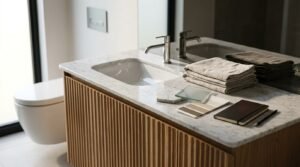
Fixtures represent 25 to 35 per cent of total renovation costs and shape how the room performs every day. Understanding the price tiers lets you spend heavily where you touch things and lightly where you only look at them.
Vanity and Basin Costs (Budget to Luxury)
Vanities range from $400 to $4,000 or more depending on size, material, and hardware quality. This unit carries the room visually and holds most of your storage.
| Vanity tier | Size | Cost |
| Budget | 600–900mm | $400–$800 |
| Mid-range | 900–1200mm | $1,200–$2,200 |
| Premium | 1200–1500mm | $2,500–$4,000 |
| Custom joinery | Any | $4,000–$8,000+ |
Wall-hung vanities cost $200 to $400 more than floor-standing units because they need extra structural support and concealed plumbing. They also open up floor space and simplify cleaning, which earns their keep in tight bathrooms.
Double vanities start near $1,800 in budget ranges and reach $6,000 or more for premium installations.
Toilet and Cistern Pricing
Toilets cost $250 to $1,500, with installation adding $400 to $600, including old pan removal, a new collar, and connection.
| Toilet type | Supply cost |
| Budget close-coupled | $250–$450 |
| Mid-range back-to-wall | $500–$900 |
| Premium wall-hung | $800–$1,500 |
| Smart toilet with bidet function | $2,000–$5,000+ |
Wall-hung pans look streamlined and clean easily, though they need an in-wall cistern at $400 to $700 plus framing work. Installation costs rise by $300 to $500 against a standard floor-mounted toilet.
Water-efficient pans rated WELS 4 stars and above cut water use by 20 to 30 per cent for a small premium. That is an easy yes on both environmental and running-cost grounds.
Shower and Bath Installation Costs
Shower installations cost $1,500 to $5,000 depending on size, construction and finish.
| Shower type | Installed cost |
| Acrylic base with standard screen | $1,500–$2,500 |
| Tiled base with frameless screen | $3,000–$4,500 |
| Custom tiled shower with floor waste | $4,000–$6,000 |
| Luxury rain shower with body jets | $5,000–$10,000+ |
Frameless glass screens cost $800 to $1,800, compared with $400 to $700 for semi-frameless. The premium buys a cleaner look and easier maintenance, which owner-occupiers notice daily.
| Bath type | Installed cost |
| Acrylic drop-in | $600–$1,200 |
| Quality acrylic freestanding | $1,500–$2,800 |
| Cast iron freestanding | $2,500–$5,000 |
| Stone resin designer | $4,000–$8,000+ |
Freestanding baths need floor-mounted tapware, adding $600 to $1,200 in plumbing. They deliver real visual impact and sacrifice storage plus easy cleaning access around the surround.
Tapware and Accessories Budget
Tapware quality varies enormously across the market. Budget $800 to $3,000 for a full set including basin mixer, shower mixer and bath filler.
| Tapware tier | Cost per piece |
| Budget chrome | $80–$150 |
| Mid-range branded | $200–$400 |
| Premium designer | $500–$1,200 |
| Architectural or luxury | $1,200–$3,000+ |
Ceramic disc cartridges in quality tapware last 10 to 15 years, compared with 3 to 5 years in budget alternatives. Mid-range spending of $200 to $400 per piece is the sweet spot on this line, and I recommend it on almost every project.
- Towel rails: $80–$400
- Toilet roll holder: $30–$150
- Robe hooks: $20–$80 each
- Shower shelf or niche: $150–$600
- Mirror: $200–$1,200
Ventilation and Heating Costs
Good ventilation prevents mould and protects the entire build. The National Construction Code requires mechanical ventilation in bathrooms without an openable window.
| Ventilation or heating unit | Installed cost |
| Standard exhaust fan | $250–$450 |
| Quiet low-noise exhaust fan | $400–$700 |
| Heat lamp combination unit | $500–$900 |
| Infrared ceiling heater | $600–$1,200 |
Underfloor heating costs $120 to $180 per m² installed. Most clients heat 4 to 6 m² of floor, adding $800 to $1,200 for genuine comfort through Sydney’s cold months.
Accessible and Ageing in Place Fixture Costs
Accessibility upgrades cost far less during a full renovation than as a later retrofit. Reinforced wall blocking for future grab rails costs almost nothing while the walls stand open.
| Accessible element | Additional cost |
| Grab rails, certified fixing | $150–$400 each |
| Hobless linear-drain shower | $800–$1,800 |
| Widened doorway to 870mm | $900–$2,200 |
| Wall-hung basin with knee clearance | $300–$700 |
| Slip-resistant P4 or P5 flooring | $10–$25 per m² extra |
Families planning to stay long term recover this spend in years of usability. I build the reinforcement in even when the rails come later.
Tiles, Flooring, and Surface Material Costs
Tile selection sets both the look and a large slice of the budget. Large format tiles of 600x600mm and above now dominate Sydney bathroom work, and choosing well at this stage sits at the heart of any bathroom tile selection decision.
Floor Tile Options and Pricing
Floor tiles need appropriate slip ratings for wet areas. Budget $40 to $120 per m² all-up for quality flooring, including supply and installation.
| Floor tile | Supply | Installation |
| Ceramic, budget | $25–$45 per m² | $45–$60 per m² |
| Porcelain, standard | $50–$85 per m² | $50–$70 per m² |
| Porcelain, large format | $70–$120 per m² | $60–$80 per m² |
| Natural stone | $90–$180 per m² | $70–$100 per m² |
Large format tiles cut grout lines and read as one continuous surface, and they demand a perfectly level substrate. Installation costs rise 20 to 30 per cent above 600x600mm because of that preparation and precision.
Rectified tiles with minimal grout lines cost $15 to $25 per m² more than standard edges. That premium suits design-led renovations where the finished look carries the project.
Wall Tile and Feature Wall Costs
Wall tiles cost $35 to $100 per m² installed depending on type and complexity. Feature walls in designer tile, mosaic, or contrasting material add $500 to $2,000 to the tiling total.
| Wall tile | Supply | Installation |
| Standard ceramic | $20–$40 per m² | $40–$55 per m² |
| Porcelain subway | $45–$75 per m² | $50–$65 per m² |
| Designer porcelain | $80–$150 per m² | $60–$80 per m² |
| Mosaic | $100–$250 per m² | $80–$120 per m² |
Mosaics look superb and consume serious installation hours. I keep them to shower niches, splashbacks or a single accent wall to hold the labour cost down.
Floor-to-ceiling tiling in showers is now standard, replacing the old 1800mm stop line. Full-height work adds $400 to $800 and removes the maintenance headaches of painted surfaces in a wet zone.
Benchtop and Vanity Surface Materials
Vanity tops range from $300 to $2,500 depending on material and span.
| Benchtop material | Cost, 900–1200mm |
| Laminate | $300–$500 |
| Polymarble, moulded | $400–$700 |
| Engineered stone, 20mm | $800–$1,400 |
| Natural stone, 20mm | $1,200–$2,500 |
| Solid surface such as Corian | $1,000–$1,800 |
Engineered stone delivers strong durability and stain resistance at mid-range pricing, and it is the default choice on most of our quality builds. Note that engineered stone containing crystalline silica now faces tight national handling rules, so fabrication happens offsite through licensed suppliers.
Natural marble and granite bring genuine character and require sealing plus ongoing care. I reserve them for owner-occupied homes where personal taste leads the decision.
Waterproofing Membrane and Substrate Costs
Substrate preparation decides whether the waterproofing performs. Budget $2,000 to $3,500 for the complete system,m including materials, labour, and certification.
| Substrate element | Cost |
| Cement sheet, walls | $25–$40 per m² |
| Villaboard or Hebel | $30–$50 per m² |
| Tile underlay, floors | $20–$35 per m² |
| Screed and levelling | $35–$60 per m² |
| Membrane system | Material | Labour |
| Sheet membrane | $15–$25 per m² | $30–$45 per m² |
| Two-part liquid membrane | $20–$35 per m² | $25–$40 per m² |
| Tanking system | $30–$50 per m² | $35–$50 per m² |
Established manufacturer systems cost 15 to 20 per cent more than generic products and carry technical support plus real warranties. That margin buys insurance against the most expensive failure in the room.
Hidden Costs and Budget Contingencies
Unexpected costs derail more bathroom budgets than expensive taps ever have. The items below account for most of the overruns I see.
Structural Issues and Unexpected Repairs
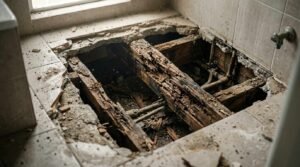
Older Sydney homes reveal structural problems the moment the floor comes up. In our own project history, roughly four in ten bathrooms in homes over 30 years old need unplanned structural work.
| Structural issue | Repair cost |
| Rotten floor joists | $1,500–$4,000 |
| Termite damage | $2,000–$8,000+ |
| Inadequate floor support | $1,000–$3,000 |
| Wall framing rectification | $800–$2,500 |
| Concrete slab repair | $1,200–$3,500 |
Historic leaks spread damage well beyond the visible stain. A pre-quote structural assessment catches much of it, and demolition still exposes the rest.
Building Permits and Compliance Costs
Straight like-for-like bathroom work often proceeds as exempt development, while structural change, drainage relocation and any building work beyond the existing footprint trigger approval. Requirements sit with your local council and the current NSW planning framework.
| Approval or certificate | Cost |
| Complying Development Certificate | $800–$1,500 |
| Construction Certificate | $600–$1,200 |
| Plumbing compliance | $200–$400 |
| Electrical compliance | $150–$300 |
| Waterproofing certification | $250–$400 |
Unapproved building work invites fines and creates real problems at sale, when a purchaser’s solicitor asks for certificates nobody holds. Working through the correct NSW renovation approvals and permits process keeps that record clean, and licensed builders normally lodge the paperwork inside their quote.
Asbestos Removal and Remediation
Homes built before 1990 very likely contain asbestos in bathroom materials. SafeWork NSW requires a licensed removalist for more than 10m² of bonded asbestos and for friable asbestos in any quantity, which makes asbestos handling in older Sydney homes a scheduling item as much as a budget one.
| Asbestos item | Cost |
| Testing, 3–5 samples | $200–$400 |
| Licensed removal, small bathroom | $1,500–$3,000 |
| Licensed removal, medium bathroom | $2,500–$5,000 |
| Clearance certificate | $300–$500 |
| Disposal fees | $400–$800 |
Removal adds one to two weeks to the program once testing, licensed scheduling, and clearance are counted. Budget both the money and the time on any pre-1990 home.
Waste Removal and Site Access Fees
Waste removal costs $400 to $1,200 depending on volume and how easily we can reach the street.
| Access type | Cost impact |
| Ground floor, direct access | Standard pricing |
| Upstairs, internal stairs only | +20–30% labour |
| Apartment with lift access | +15–25% plus building fees |
| Apartment, stairs only | +30–50% labour |
| Heritage or restricted access | +40–60% labour |
What Bathroom Quotes Commonly Exclude
Two quotes at the same number often cover very different scopes. These are the exclusions I see buried in fine print most often.
- Asbestos testing, removal and clearance certification
- Structural repairs discovered after demolition
- Council and certifier fees, plus strata approval costs
- Rock breaking or slab cutting for waste relocation
- Fixture supply beyond a stated dollar allowance
- Painting outside the bathroom, and patching adjoining rooms
- Temporary accommodation and off-site storage
Ask for every one of these in writing before you sign. A builder who prices exclusions openly is telling you something useful about how the rest of the job runs.
Recommended Contingency Percentage
I budget 15 to 20 per cent contingency on bathroom work, which covers surprises, minor scope changes and material price movement.
| Property age | Contingency |
| Under 10 years | 10–15% |
| 10–30 years | 15–20% |
| Over 30 years | 20–25% |
| Heritage or character homes | 25–30% |
Contingency is financial insurance rather than spare cash. Projects that spend it solve real problems, and projects that return it were planned well.
Apartment and Strata Bathroom Renovation Costs
Apartment bathrooms cost 10 to 25 per cent more than an equivalent house bathroom, and the premium sits almost entirely in access, approvals and protection. The room itself is usually smaller, which does nothing to reduce the fixed trade costs.
Additional Strata Costs and Approvals
Owners corporations control common property, and bathroom floors sit directly above someone else’s ceiling. Approval before work starts is non-negotiable, which makes the strata renovation approval process the first line item on an apartment budget rather than an afterthought.
| Strata item | Typical cost |
| By-law preparation and registration | $1,500–$3,000 |
| Building access, lift booking and bonds | $200–$600 |
| Additional insurance certificates | $0–$400 |
| Engineer or hydraulic report where required | $800–$2,500 |
Approval timelines add four to eight weeks before a single tile comes off. That delay costs real money through extended accommodation and contractor rescheduling.
Waterproofing and Acoustic Requirements in Apartments
Apartment waterproofing carries a lower tolerance for error, because a failure damages another owner’s property. Many buildings mandate specific membrane systems, third-party inspection, and a signed certificate lodged with the strata manager.
Acoustic requirements add cost too, with resilient underlays and insulated pipework running $600 to $2,000 on a standard bathroom. Slab thickness also limits waste relocation, which frequently locks you into the existing layout.
Cost-Saving Strategies Without Compromising Quality
Smart savings come from choosing where quality is invisible, not from cutting corners on the parts that keep water out of your walls.
Where to Spend and Where to Save
I prioritise anything structural and anything you touch daily. Purely decorative elements come later without demolition.
Worth the investment
- Waterproofing, using quality systems and certified installers
- Plumbing, using reliable fixtures and correct installation
- Tapware at mid-range quality of $200 to $400 per piece
- Frameless shower screens for durability and easy cleaning
- Quality exhaust fans that actually clear moisture
- Substrate preparation and levelling
Safe savings
- Tiles, where mid-range porcelain performs identically to premium
- Vanities, using quality flat-pack or semi-custom units
- Accessories such as towel rails and roll holders
- Mirrors, choosing standard over designer LED units
- Paint, where quality mid-range products hold up well
- Decorative elements, upgraded later without structural work
The 60/30/10 rule holds up well: 60 per cent on structure and function, 30 per cent on fixtures and fittings, 10 per cent on decorative finishes. We apply the same split when pricing kitchen renovation budgets, because the logic travels across every wet area in the house.
Cosmetic Refresh vs Full Renovation
A refresh suits a structurally sound bathroom with dated surfaces. A full renovation is the answer once waterproofing, drainage, or layout is the real problem.
| Factor | Cosmetic refresh | Full renovation |
| Cost | $5,000–$12,000 | $18,000–$45,000+ |
| Duration | 3–7 days | 4–6 weeks |
| Waterproofing renewed | No | Yes |
| Tiles replaced | No, resurfaced or regrouted | Yes |
| Layout changed | No | Yes, where budget allows |
| Expected lifespan | 5–8 years | 20+ years |
I recommend a refresh on rental turnovers and pre-sale presentation. Anywhere the membrane has failed, the refresh simply hides the problem for a season.
Keeping Existing Plumbing Layout
Holding the existing plumbing positions saves $3,000 to $8,000 on a typical project. Moving fixtures means new waste runs, modified supply lines, extra waterproofing, potential structural changes, and concrete cutting on slab floors.
Design around what is already there wherever the layout functions. New fixtures, tiles, and lighting transform a room completely without touching a single waste pipe.
Genuine exceptions exist. Badly placed fixtures, cramped showers and unworkable layouts justify the relocation cost, so weigh the improvement against the extra spend honestly.
Timing Your Renovation for Better Pricing
Renovation pricing follows demand, and careful timing saves 10 to 15 per cent on labour.
- Best value: late autumn in April and May, winter from June to August, early spring in September
- Most expensive: peak spring in October and November, the December to February holiday period, and the March catch-up rush
Contractors quote sharper and turn up more reliably during quiet periods. You also get more attention when the site is not competing with four other jobs.
Suppliers discount hardest at the end of the financial year in June and post-Christmas through January and February. Buying tiles, fixtures and tapware in those windows saves 15 to 25 per cent on retail.
DIY vs Professional Work: What Makes Sense
DIY scope in bathrooms is narrow, because NSW Fair Trading requires licensed tradespeople for plumbing, electrical, waterproofing and gas work.
| Suitable for DIY | Saving |
| Demolition, asbestos-free only | $800–$1,500 |
| Painting | $600–$1,200 |
| Accessory installation | $200–$400 |
| Flat-pack vanity assembly | $150–$300 |
Plumbing, electrical, waterproofing, tiling, and structural work all belong to licensed professionals. Three of those four carry legal licensing requirements, and tiling punishes inexperience expensively.
Poor DIY work costs more than the trade it replaced. Failed membranes, lippage in tiling, and incorrect drainage falls all end in a second demolition, so keep DIY inside your genuine skill level.
Return on Investment: Value-Adding Renovations
Bathroom renovations return roughly 60 to 75 per cent of their cost in Sydney’s property market, based on the resale outcomes we track with clients. Property type, suburb, and renovation quality all move that number.
Renovations That Increase Property Value
Buyers reward the improvements they notice and expect. Understanding which renovations add property value keeps the budget pointed at the work that returns.
| Improvement | Typical ROI |
| Complete renovation of a dated bathroom | 65–75% |
| Quality fixtures and finishes | 60–70% |
| Additional bathroom where the home lacks one | 70–85% |
| New master ensuite | 65–75% |
| Improved storage and functionality | 55–65% |
| Luxury fixtures beyond the area standard | 30–45% |
| Highly personalised design | 35–50% |
| Smart technology additions | 25–40% |
| Spa features such as jets and steam | 30–45% |
Buyers pay a premium for a renovated bathroom and discount an over-capitalised one. A $45,000 bathroom works in an $800,000 home and overshoots badly in a $500,000 one.
Owner-Occupier vs Investment Property Considerations
The right strategy changes completely with who uses the room.
Owner-occupier priorities
- Daily enjoyment and comfort
- Durability across a 10-year-plus horizon
- Heating, quality fixtures and personal design preference
- Future-proofing for accessibility
Investment property priorities
- Rental appeal and tenant retention
- Cost-effective durability across 5 to 7 years
- Neutral, broad-appeal design
- Low maintenance and simple repairs
Investment bathrooms justify $18,000 to $28,000 for a neutral, hard-wearing result that rents well. Owner-occupiers reasonably spend $30,000 to $50,000 or more to get exactly the room they want.
Across our Sydney client base, a renovated bathroom lifts weekly rent by $30 to $60, which is $1,560 to $3,120 a year. That supports a $15,000 to $25,000 spend on a five- to eight-year payback.
Over-Capitalisation Risks to Avoid
Over-capitalisation happens when the renovation costs more than the value it adds. The common triggers are renovation quality above neighbourhood standard, luxury fixtures in entry-level stock, too many bathrooms in a small property, heavy personalisation and renovating straight into a softening market.
Premium bathroom finishes also make more sense when they sit inside a coherent whole home renovation budget rather than standing alone in an otherwise original house. A single showpiece bathroom in a dated home reads as inconsistent to buyers.
- Research comparable sales in your immediate area
- Match renovation quality to property value
- Cap bathroom spend at 8 to 12 per cent of property value
- Choose neutral designs for investment stock
- Ask local agents what buyers in your bracket expect
A $50,000 bathroom is proportional in a $1.2 million home. The identical job in a $600,000 home never recovers its cost.

How to Budget and Plan Your Bathroom Renovation
Good budgeting prevents the mid-project crisis where money runs out, and the tiler moves to another site. Work through the sequence below before you commit to anything.
Creating a Realistic Renovation Budget
Start with cost research, then set scope. Budgets built backwards from a wish list produce compromises and delays.
- Research real costs for your bathroom size and finish level
- Add 20 per cent contingency
- Itemise everything, including permits, accommodation and storage
- Separate must-haves from nice-to-haves for scope flexibility
- Confirm your finance before engaging a contractor
Complete budget checklist
- Demolition and waste removal
- All trade labour: plumbing, electrical, tiling, waterproofing, carpentry
- Fixtures and fittings: vanity, toilet, shower, bath, tapware
- Tiles and materials: floor, wall, membrane, substrate
- Permits, certificates and strata approvals
- Asbestos testing and removal where applicable
- Project management and supervision
- Contingency of 15 to 20 per cent
- Temporary accommodation and storage where needed
- Final clean and finishing touches
Missing line items cause most funding shortfalls. A complete list up front is the cheapest protection available.
Getting Accurate Quotes from Contractors
Strong quotes itemise everything and let you compare like with like. Single-figure quotes with no breakdown tell you nothing.
Ask every quote to include
- Detailed scope of work and stated exclusions
- Labour costs by trade
- Material specifications and dollar allowances
- Timeline with milestones
- Payment schedule
- Warranty and insurance details
Collect three or four quotes from licensed, insured builders with references you actually call, and treat choosing a renovation contractor as a due diligence exercise rather than a price comparison. The lowest number rarely represents the best value once experience and communication enter the picture.
Red flags
- A quote 20 per cent or more below the others
- Reluctance to itemise
- Pressure for a deposit above 10 per cent
- No verifiable licence or insurance
- Vague timelines and undefined scope
- Slow, unclear communication
NSW Fair Trading sets deposit limits on residential building work and expects progress payments tied to completed stages. Never pay in full ahead of completion.
Payment Schedules and Milestone Planning
A structured schedule protects you and keeps the builder’s cash flow healthy enough to buy materials on time.
| Stage | Payment |
| Contract signing | 10% deposit |
| Demolition and rough-in complete | 25% |
| Waterproofing and tiling complete | 30% |
| Fixture installation complete | 25% |
| Practical completion and defects inspection | 10% |
Never pay ahead of completed work. That single discipline preserves your leverage on quality and timing.
Before releasing each payment
- Inspect the completed stage
- Collect compliance certificates for waterproofing, plumbing, and electrical
- Document anything needing rectification
- File warranties and product documentation
- Confirm site protection and clean-up
Good contractors welcome milestone inspections, because they close disputes before they start.
Renovation Timeline and Cost Milestones
Most Sydney bathrooms run four to six weeks. Mapping money to the program shows you exactly when each payment falls due, and it mirrors the standard bathroom renovation process from strip-out to handover.
| Week | Work | Cost released |
| 1 | Protection, demolition, waste removal | Deposit plus first progress claim |
| 1–2 | Plumbing and electrical rough-in, framing repairs | First progress claim |
| 2–3 | Substrate, waterproofing, membrane cure and certification | Second progress claim begins |
| 3–4 | Floor and wall tiling, grouting, sealing | Second progress claim |
| 4–5 | Vanity, toilet, screen, tapware, accessories | Third progress claim |
| 5–6 | Painting, silicone, defects list, final clean | Final 10% on completion |
Asbestos removal and structural repairs push the program to eight or ten weeks. Long-lead fixtures cause the other common delay, so I order tapware and screens before demolition starts.
Managing Cash Flow During Renovation
Bathroom work concentrates significant outlay into four to eight weeks. Plan the cash flow so no payment lands in an empty week.
- Build the renovation savings before starting.
- Arrange finance pre-approval where you are borrowing
- Keep the contingency in a separate account
- Align payment milestones with your income cycle
- Avoid funding the job on credit cards
Renovation loans through banks and credit unions offer 6 to 12 month interest-free periods for qualified borrowers, which suits households repaying inside the promotional window. Personal loans at 7 to 12 per cent annually make expensive funding for a bathroom.
Home equity facilities sit around 5 to 8 per cent and remain the cheapest borrowing option for owners with available equity. Exhaust savings first, then equity, then unsecured credit.
Conclusion
Sydney bathroom renovations run from $18,000 for small, budget-conscious projects to $50,000 or more for large premium builds, with most homeowners investing $25,000 to $30,000. Knowing how labour, materials, fixtures and hidden costs divide that total is what turns a rough guess into a plan you can actually hold a builder to.
The pattern behind every on-budget project looks the same. Keep the plumbing where it is wherever the layout works, spend properly on waterproofing and substrate, save on decorative finishes, and carry a real contingency for the surprises that older homes always hold.
We combine transparent pricing, skilled workmanship, and practical renovation expertise to deliver bathrooms that meet your budget, timeline, and quality expectations. Contact Sydney Home Renovation for a detailed cost assessment and an obligation-free quote, and move forward on your bathroom with the numbers already settled.
Frequently Asked Questions
How much does a basic bathroom renovation cost in Sydney in 2026?
We deliver basic bathroom renovations for $18,000 to $25,000, covering demolition, certified waterproofing, standard fixtures, ceramic or porcelain tiling and all licensed trade labour.
What is the highest cost in a bathroom renovation?
Labour, at 40 to 50 per cent of the budget, or roughly $10,000 to $18,000 across plumbing, electrical, waterproofing, tiling and carpentry over 120 to 180 hours.
How long does a typical bathroom renovation take?
Most Sydney bathrooms take four to six weeks from demolition to handover. Asbestos removal and structural repairs stretch that program out to eight or ten weeks.
Do I need council approval for a bathroom renovation in NSW?
Straight like-for-like work often proceeds as exempt development. We lodge certificates costing $800 to $1,500 whenever structural, drainage or footprint changes apply.
Should I renovate the bathroom before selling my property?
Renovating pays off on dated bathrooms, returning roughly 60 to 75 per cent of cost. We cap the spend at 8 to 12 per cent of property value.
What is the difference between a cosmetic update and a full renovation?
Cosmetic refreshes cost $5,000 to $12,000 and keep the existing tiles and layout. Full renovations start near $18,000 and rebuild the room from the substrate up.
How much should I budget for unexpected costs?
We budget 15 to 20 per cent contingency, rising to 25 per cent on homes over 30 years old, covering structural surprises, asbestos, permits and scope variations.
Can I live in my home during a bathroom renovation?
Single-bathroom households need alternative facilities for four to six weeks. Homes with a second bathroom stay occupied, with dust and noise during working hours.
What fixtures should I splurge on versus save on?
Spend on waterproofing, plumbing, tapware and frameless screens. Save on tiles, flat-pack vanities, accessories and mirrors, all of which we upgrade later without demolition.
How do I choose the right bathroom renovation contractor?
Compare three or four itemised quotes from licensed, insured builders, verify licences through NSW Fair Trading, inspect completed bathrooms, and confirm the payment schedule before signing.