In 2026, we see most Australian bathroom renovations land between $15,000 and $28,000, and Sydney homeowners consistently pay 15 to 25 percent above that national average. Higher labour rates, tighter compliance, and premium material costs drive the gap.
We quote bathrooms every week, and the single most common problem we see is a budget built on a national average applied to a Sydney job. That mismatch is what turns a planned renovation into a stalled one.
This guide breaks down 2026 costs by state and by size, shows exactly what each dollar buys, names the hidden costs that cause blowouts, and gives you the planning sequence we use with our own clients.
Average Bathroom Renovation Costs in Australia (2026 Overview)
A complete bathroom renovation in Australia costs $15,000 to $28,000 in 2026, with most homeowners spending around $20,000 for a mid-range result. Cosmetic refreshes run $5,000 to $12,000. Luxury custom bathrooms exceed $40,000.
Those figures come from Housing Industry Association renovation data and cover full renovations: demolition, waterproofing, tiling, plumbing, electrical, and all new fixtures.
Where your bathroom sits in that range comes down to three things. Size, the condition of what is behind the walls, and how much of the existing layout you keep.
National Average Cost Breakdown
For a standard 6m² bathroom, the most common size in Australian homes, these are the 2026 baselines we work to.
| Tier | Cost Range | What You Get |
| Budget | $12,000–$18,000 | Basic fixtures, standard tiles, no layout change |
| Mid-range | $18,000–$28,000 | Quality fixtures, premium tiles, minor layout changes |
| Premium | $28,000–$40,000 | Designer fixtures, high-end finishes, real layout changes |
| Luxury | $40,000+ | Custom joinery, premium brands, architectural features |
Master Builders Australia puts labour at 40 to 50 percent of total cost, materials and fittings at 30 to 40 percent, and the remaining 10 to 20 percent across permits, waste removal and contingency.
Bathroom Renovation Cost Per Square Metre
Cost per square metre is the fastest way to sanity-check a quote against your own floor area. We use these bands when we benchmark our own pricing.
| Renovation Standard | Cost per m² | 6m² Bathroom Equivalent |
| Budget | $2,000–$3,000 | $12,000–$18,000 |
| Mid-range | $3,000–$4,700 | $18,000–$28,000 |
| Premium | $4,700–$6,700 | $28,000–$40,000 |
| Luxury | $6,700+ | $40,000+ |
One caution on this metric. Per-square-metre rates fall as bathrooms get larger, because the fixed technical work stays constant while floor area grows. A 3m² ensuite carries a much higher rate per square metre than a 10m² master bathroom at the same specification.
Small Bathroom Renovation Costs (3-5m²)
Small bathrooms and powder rooms cost $10,000 to $20,000 for a complete renovation. Reduced floor area lowers material spend, but labour barely moves, because the plumber, electrician, waterproofer and tiler each complete the same technical sequence in a tighter space.
Small bathrooms also carry their own cost pressures. Limited access, cramped working conditions and space-efficient fixtures all eat into the savings people expect from a smaller footprint.
Medium Bathroom Renovation Costs (5-8m²)
Medium bathrooms are the Australian standard and cost $15,000 to $28,000 for a full renovation. This size gives the best balance of function and cost, with room for a separate shower and bath, real storage and a workable layout without material waste.
Most contractors, us included, build baseline pricing around this size band. That makes it the easiest category to benchmark competing quotes against.
Large Bathroom Renovation Costs (8m²+)
Large bathrooms and master ensuites cost $25,000 to $45,000+. Floor area drives material cost hard, particularly across tiling, waterproofing membrane and flooring, while labour scales with complexity rather than area alone.
Large bathrooms also attract premium inclusions. Freestanding baths, double vanities, separate toilet compartments and multi-outlet shower systems all add to both the material bill and the installation time.
Bathroom Renovation Costs by State (2026)
Labour rates, compliance load, material logistics and market demand create real cost variation across Australia. Here is where each state sits in 2026.
| State / Territory | Typical Cost Range | Hourly Trade Rate | vs National Average |
| NSW (Sydney) | $18,000–$32,000 | $80–$120 | +15% to +25% |
| ACT (Canberra) | $16,000–$29,000 | $80–$115 | +10% to +20% |
| VIC (Melbourne) | $16,000–$30,000 | $75–$110 | +8% to +15% |
| WA (Perth) | $15,000–$27,000 | $75–$105 | Around average |
| QLD (Brisbane) | $14,000–$26,000 | $70–$100 | −5% to −10% |
| SA (Adelaide) | $13,000–$24,000 | $65–$95 | −10% to −15% |
| TAS (Hobart) | $12,000–$22,000 | $60–$90 | −15% to −20% |
Regional areas generally sit 10 to 18 percent below their capital city, with regional NSW at $15,000 to $26,000 and regional Victoria at $14,000 to $24,000. Tasmania and regional WA are the exception, where lower labour rates get partly cancelled out by freight premiums of 10 to 20 percent on specialty fixtures.
Why NSW Costs the Most
NSW, and Sydney specifically, commands Australia’s highest bathroom renovation costs. ServiceSeeking pricing data puts Sydney at $18,000 to $32,000 for a standard renovation.
Four drivers create that premium, and we find it useful to separate them by how much control you actually have.
| Cost Driver | Impact | Your Control |
| Labour rates ($80–$120/hr) | High | Partial: winter scheduling, flexible start dates |
| Compliance and certification | +$1,500–$3,000 | Fixed: non-negotiable under NSW standards |
| Material delivery and site access | Moderate | Partial: consolidate deliveries, plan access |
| Strata and approval overhead | +$500–$1,500 | Partial: start approvals early |
That framing matters. Two of the four drivers respond to how you plan the job, which is where most homeowners leave money on the table.
State-Specific Cost Factors Worth Knowing
Each market has quirks that generic averages hide.
Victoria requires building permits costing $800 to $1,500, and HIA Victoria reports labour rates rising 8 to 12 percent year on year on strong construction demand. Queensland pricing has stabilised after pandemic-era increases according to QBCC, though Far North Queensland adds cyclone-rated fixture compliance. Western Australia carries freight premiums of 8 to 15 percent per Master Builders WA, and many WA homes need limestone-specific foundation work.
South Australia remains the most competitive mainland market. Master Builders SA attributes that to a deep contractor pool and streamlined approvals, with Adelaide Hills and regional SA within 5 to 8 percent of metro pricing.
Detailed Cost Breakdown: What You’re Actually Paying For
Knowing where the money goes is what lets you cut intelligently instead of cutting blind.
Labour Costs (40-50% of Total Budget)
Labour is the largest single line, typically $8,000 to $14,000 on a $20,000 renovation. A bathroom needs six distinct trades, and each one has a fixed minimum regardless of how small your room is.
| Trade | Cost | Duration |
| Demolition and preparation | $1,200–$2,500 | 1–2 days |
| Plumbing (rough-in and install) | $2,500–$4,500 | 3–5 days |
| Electrical | $1,500–$2,800 | 2–3 days |
| Waterproofing | $1,200–$2,200 | 1–2 days |
| Tiling (walls and floors) | $2,500–$5,000 | 3–5 days |
| Carpentry and finishing | $1,500–$2,500 | 2–3 days |
Sydney and Melbourne run 15 to 25 percent above these national figures. Regional areas save 10 to 15 percent. Licensed, insured trades charge more and are worth it, because the callback and warranty exposure on cheap bathroom work lands back on you.
Materials and Fittings (30-40% of Total Budget)
Materials typically cost $6,000 to $11,000 for a standard renovation, and this is where quality tier swings the number hardest.
| Component | Cost Range | Notes |
| Tiles (floor and wall) | $1,500–$4,000 | Includes adhesive, grout, membrane |
| Vanity and storage | $800–$3,500 | Flat-pack to custom joinery |
| Shower screen | $600–$2,500 | Framed to frameless |
| Toilet suite | $300–$1,500 | Standard to wall-hung |
| Tapware and fixtures | $500–$2,500 | Builder-grade to designer |
| Lighting and ventilation | $400–$1,200 | Downlights, exhaust, heat lamp |
Choice product testing found mid-range bathroom products deliver 80 to 90 percent of premium performance at 40 to 60 percent of the cost. That finding underpins most of our own specification advice.
Plumbing and Electrical Work
Plumbing and electrical together run $4,000 to $7,300, and the variable that moves this number most is whether fixtures stay put.
Keeping the existing layout costs $2,000 to $3,500 in plumbing. Relocating fixtures pushes that to $3,500 to $6,000+ once new drainage, water supply, and potential slab penetration enter the job. Hot water system upgrades add $800 to $2,500 where capacity needs increase.
On the electrical side, standard work runs $1,500 to $2,200. Heated towel rails add $400 to $800 and underfloor heating adds $1,200 to $2,500 for a 6m² room. Master Electricians Australia requires RCD protection and IP-rated fixtures throughout, and licensed electricians price that compliance in.
Waterproofing and Tiling
Waterproofing and tiling together cost $4,000 to $9,000. This is the part of the job we tell every client not to touch when they are looking for savings.
Floor waterproofing runs $800 to $1,500, shower waterproofing $1,200 to $2,200 hob to ceiling, and compliance certification $300 to $600. Australian Building Codes Board standards mandate waterproofing across all wet areas, with inspection before tiling proceeds.
Tiling adds $1,500 to $3,500 for floors and $2,000 to $4,500 for walls on a 6m² room. Large-format tiles, intricate patterns, and specialty installation add 20 to 40 percent on top.
Fixtures, Vanities, and Finishing Touches
Fixtures and finishes cost $2,500 to $8,000 and give you the widest budget flexibility in the whole project.
| Tier | Budget | Vanity | Tapware | Toilet |
| Budget | $2,500–$4,000 | Flat-pack, ceramic basin | Chrome | Builder-grade |
| Mid-range | $4,000–$6,000 | Semi-custom, stone top | Brushed nickel or matte black | Wall-hung or back-to-wall |
| Premium | $6,000–$8,000+ | Custom joinery, engineered stone | Designer (Brodware, Caroma) | Designer wall-hung, soft-close |
Reece reports matte black tapware, wall-hung toilets and large-format tiles as the most requested features, with mid-range versions carrying most of the visual impact at a fraction of the price.
Hidden Costs and Budget Blowout Risks
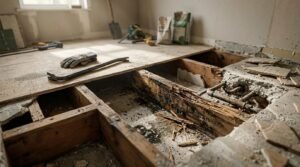
Most blowouts come from what demolition uncovers, not from what you chose in the showroom. A realistic contingency is the difference between an inconvenience and a stalled job.
Structural Issues and Asbestos Removal
Homes built before 1990 frequently contain asbestos in wall sheeting, floor tiles and adhesives. SafeWork Australia requires licensed removalists for any asbestos-containing material.
Asbestos costs stack fast: testing and assessment $400 to $800, licensed removal $1,500 to $4,500, disposal $500 to $1,200, and air quality clearance $300 to $600.
Other structural discoveries carry their own price tags.
- Rotten floor framing: $1,200–$3,500
- Termite damage: $2,000–$6,000+
- Water damage to wall framing: $800–$2,500 per wall
- Mould remediation from poor ventilation: $600–$1,500
None of these are visible until demolition begins, which is exactly why we insist on a 10 to 15 percent contingency on any home over thirty years old.
Plumbing Relocation and Drainage Upgrades
Moving a toilet, shower, or vanity drives costs up through drainage and water supply changes.
- Toilet relocation: $1,500–$4,000 (new drainage, possible slab cutting)
- Shower relocation: $1,200–$3,000 (new waste, membrane adjustments)
- Vanity relocation: $600–$1,500 (new supply and waste)
Drainage problems found during the job add more. Correcting inadequate fall costs $1,000 to $2,500, damaged sewer lines $1,500 to $5,000+, and a new floor waste $400 to $900. Master Plumbers data shows keeping the existing layout saves $2,000 to $5,000 on average.
Building Permits and Compliance Costs
Most states require permits for renovations involving structural changes, plumbing alterations, or waterproofing.
| State | Permit and Compliance Cost |
| NSW | $800–$1,800 |
| VIC | $900–$1,500 |
| WA | $700–$1,400 |
| QLD | $600–$1,200 |
| SA | $500–$1,000 |
On top of that sit waterproofing certification at $300 to $600, electrical safety certificates at $150 to $300, final inspections at $400 to $800, and strata approval at $200 to $500.
Permit fees look minor against a $20,000 budget. The real cost is delay, because a 2 to 6 week approval hold forces trades to demobilise and return, and remobilisation is never free.
Waste Removal and Site Access Challenges
Demolition generates more waste than people expect, and access constraints turn labour hours into money.
Skip bin hire runs $400 to $800 for one to two weeks, asbestos disposal adds $500 to $1,200, and tile and concrete disposal is $200 to $400 on weight charges.
Access premiums compound on top. Apartment renovations with lift access add 10 to 15 percent to labour, narrow-access properties add 5 to 10 percent, multi-storey homes add $500 to $1,200 in material transport, and restricted loading zones add $200 to $600 in permits and logistics.
Costly Mistakes That Blow Bathroom Budgets
Across the jobs we quote, the same five decisions account for most overruns.
- Relocating fixtures without a reason. A layout change you do not need costs $2,000 to $5,000 and buys nothing a better vanity would not deliver.
- Skipping asbestos testing before demolition. Discovery mid-job halts the site and forces emergency licensed removal at premium rates.
- Accepting a “supply and install” lump sum. Without itemisation, you cannot compare quotes or contest a variation later.
- Starting approvals after signing a contract. A 2- to 6-week permit wait with trades booked is the most expensive kind of delay.
- Cutting waterproofing to save $500. Failed waterproofing means a full re-tile, and that is a $6,000 to $9,000 rebuild.
Contingency Planning: The 10-20% Rule
We build contingency into every quote conversation, sized against the age of the home.
| Property Age | Recommended Contingency |
| New (<10 years) | 10% |
| Established (10–30 years) | 15% |
| Older (30+ years) | 20% |
| Heritage or character | 20–25% |
On a $20,000 renovation, that means $2,000 to $4,000 set aside. HIA renovation research found 68 percent of bathroom renovations hit at least one unexpected cost, averaging $2,400.
A properly sized contingency does more than absorb surprises. It lets you fix a problem correctly instead of approving the cheap workaround that costs more in three years.
Budget-Based Renovation Options
Different budgets deliver genuinely different outcomes. Here is what each tier actually buys.
| Tier | Budget | Scope | Best Suited To |
| Budget refresh | $5,000–$12,000 | Cosmetic only; existing tiles and layout stay | Rentals, pre-sale updates |
| Mid-range | $12,000–$25,000 | Full strip-out, new waterproofing, complete retile | Owner-occupiers |
| Premium | $25,000–$40,000 | Layout changes, custom joinery, designer fixtures | High-value homes |
| Luxury | $40,000+ | Architectural design, imported fixtures, spa features | Prestige properties |
Budget Refresh ($5,000-$12,000)
A refresh updates what you see and leaves what you do not. Paint costs $800 to $1,500, a new vanity $600 to $2,000, updated tapware $300 to $800, and new mirror and lighting $400 to $1,200.
What a refresh excludes matters more than what it includes. No retiling, no plumbing relocation, no new shower base, no new waterproofing. That last exclusion is the one to watch, because a refresh over failing waterproofing buys you two years at most.
Mid-Range Renovation ($12,000-$25,000)
This is the Australian standard and where most of our work sits. You get full demolition to studs, new waterproofing to code, complete retiling, mid-range fixtures throughout, new plumbing and electrical, and compliant ventilation.
Material spend at this tier runs $40 to $80 per m² on tiles, $1,200 to $2,500 on a semi-custom vanity with a stone top, and $400 to $1,000 on tapware from Caroma, Methven or the Reece mid-range. The result lasts fifteen to twenty years without looking dated.
Premium Renovation ($25,000-$40,000)
Premium buys layout freedom. Moving fixtures for better flow, large-format porcelain or natural stone at $80 to $150+ per m², bespoke joinery at $3,500 to $6,000, thermostatic shower systems at $2,500 to $5,000, and underfloor heating throughout.
This tier suits homes where the bathroom needs to match the rest of the property. It rarely pays for itself on resale alone, so we recommend it to owners planning to stay.
Luxury Custom Bathroom ($40,000+)
Luxury bathrooms are architectural projects. Professional design input, structural changes to expand the footprint, imported European tapware, natural stone at $150 to $400+ per m², freestanding baths, steam showers and smart controls.
Custom vanities alone reach $6,000 to $15,000+ and imported tapware from Fantini, Dornbracht or Vola runs $4,000 to $10,000+. Budget takes second place to design intent at this level.
Cost-Saving Strategies Without Compromising Quality
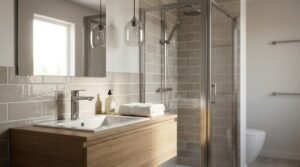
Smart savings come from choosing where not to spend, not from spending less everywhere.
Prioritise High-Impact, Value-Adding Upgrades
Put money where it is seen and touched daily. Quality tiling, proper waterproofing, good lighting, functional storage and quality tapware carry the room.
Pull money back from the places nobody notices. Mid-range toilet suites perform identically to premium for most households. Framed shower screens cost 40 to 60 percent less than frameless with minimal visual difference. Budget towel rails work exactly as well as expensive ones, and hidden plumbing does not need premium brands.
Do Bathroom Renovations Add Value?
Domain renovation ROI research found well-executed mid-range bathrooms return 70 to 85 percent of renovation cost in property value. Luxury bathrooms return only 50 to 65 percent.
That gap is the clearest argument in this guide. Diminishing returns hit bathroom renovations harder than almost any other home improvement, and the mid-range tier is where the value sits.
For a pre-sale renovation, we steer clients firmly toward quality mid-range finishes. Spending premium money on a bathroom you are about to sell destroys roughly a third of every dollar above the mid-range line.
Keep Plumbing in Existing Locations
Keeping your toilet, shower, and vanity where they are saves $2,000 to $5,000 and removes a whole category of risk.
- No drainage modifications: saves $1,500–$3,500
- No slab cutting: saves $800–$2,000
- Simpler waterproofing: saves $300–$600
- Faster install: saves 1–2 days of labour, $800–$2,000
Layout changes earn their cost in four situations: a genuinely dysfunctional current layout, accessibility or ageing-in-place requirements, expansion into adjacent space, or existing drainage faults that need correction regardless.
Choose Cost-Effective Materials That Look Premium
Mid-range materials deliver 80 to 90 percent of premium aesthetics at 40 to 60 percent of the cost. These four swaps carry most of the savings.
| Instead Of | Choose | Saving |
| Marble tiles ($150–$300/m²) | Porcelain marble-look ($60–$100/m²) | $2,500–$4,500 |
| Custom joinery vanity ($4,000–$6,000) | Semi-custom with stone top ($1,500–$2,500) | $2,500–$3,500 |
| Frameless screen ($1,500–$2,500) | Semi-frameless ($800–$1,400) | $700–$1,100 |
| Premium tapware ($1,500–$3,000) | Quality mid-range ($600–$1,200) | $900–$1,800 |
Taken together, those four decisions save $7,100 to $10,900 with no compromise most homeowners would ever notice.
DIY What You Can (Safely), Hire What You Can’t
Selective DIY cuts labour without touching the technical work.
Safe to do yourself: demolition saves $800 to $1,500 with proper safety gear and asbestos testing done first, painting saves $600 to $1,200, and installing accessories saves $200 to $400.
Always hire licensed trades for plumbing, electrical, waterproofing, tiling, and gas work. Master Builders Australia warns that DIY plumbing or electrical work voids insurance coverage and creates direct liability exposure. That risk far outweighs the savings.
Time Your Renovation Strategically
Timing moves both price and availability.
Winter months from June to August give you less-busy contractors, more negotiable pricing, and potential savings of 5 to 10 percent. Avoid December and January entirely, when availability collapses and pricing peaks.
Material timing helps too. End of financial year clears stock, Boxing Day and January sales discount fixtures 20 to 40 percent, and floor stock clearance on discontinued lines runs 30 to 50 percent off. Combining winter execution with sale-period purchasing saves $1,500 to $3,000 on a typical $20,000 job.
How to Budget and Plan Your Bathroom Renovation
Good planning prevents most overruns before a single tile comes off the wall. This is the sequence we walk our own clients through.
Step 1: Define Your Scope and Priorities
Start by separating what must change from what you want to change.
Answer five questions honestly. What is driving this renovation? What must change? What would you like to change? What can stay? How long do you plan to own the property?
Then sort every item into four buckets: essential (safety, compliance, critical function), high priority (major usability and appearance gains), medium priority (genuine improvements that are not critical), and low priority (luxury touches). When quotes come back above budget, this list tells you exactly what to defer.
Step 2: Get Multiple Detailed Quotes
Get at least three itemised quotes from licensed, insured contractors with real bathroom experience.
A proper quote itemises labour by trade and task, itemises materials with specific products and quantities, states a start date and duration, sets a payment schedule, lists exclusions explicitly, and confirms warranty, licensing and insurance.
Five things should stop you from signing.
- Vague “supply and install” pricing that blocks comparison
- Quotes well below the others, which signal missing scope
- Deposits above 20 percent
- No written contract
- “This price is only valid today” pressure
Master Builders Association recommends verifying licensing through your state building authority and confirming insurance before contracts are signed.
Step 3: Allocate Your Budget by Category
Distribute your budget using these proportions as the starting point.
| Category | Share | On a $20,000 Base |
| Labour | 45% | $9,000 |
| Materials and fixtures | 35% | $7,000 |
| Plumbing and electrical | 12% | $2,400 |
| Permits and compliance | 3% | $600 |
| Contingency | 15% | $3,000 |
Total commitment: $22,000 including contingency. Adjust the mix to suit your priorities. Premium fixtures push materials to 40 percent, complex layout changes push labour to 50 percent, and an older home pushes contingency to 20 percent.
Step 4: How Long a Bathroom Renovation Takes
A standard bathroom renovation takes 2 to 4 weeks on site. Small bathrooms are completed in 10 to 14 days, and large custom bathrooms need 4 to 6 weeks.
| Stage | Duration | Notes |
| Demolition and strip-out | 1–2 days | Asbestos testing must precede this |
| Plumbing and electrical rough-in | 3–5 days | Both trades often overlap |
| Waterproofing | 1–2 days | Plus curing time before tiling |
| Waterproofing inspection | 1–3 days | Scheduling dependent, blocks tiling |
| Tiling | 3–5 days | Plus grout curing |
| Fixture and fit-off | 2–3 days | Plumber and electrician return |
| Finishing and defects | 1–2 days | Final inspection |
Add 4 to 8 weeks ahead of site start for approvals, and add lead time for any special-order tile or fixture. The single biggest timeline risk is the waterproofing inspection, because tiling cannot start until it clears.
Step 5: Paying for Your Bathroom Renovation
Most homeowners fund bathroom renovations one of four ways.
Cash savings avoid interest entirely and give you the strongest negotiating position. Redrawing on an existing home loan usually carries the lowest interest rate available to you. A dedicated renovation loan suits larger scopes and keeps the debt separated. Contractor payment schedules spread cost across project milestones without formal finance.
Whichever route you take, keep contingency funds liquid and outside the contractor payment schedule. Contingency you have already committed is not contingency.
Step 6: Track Spending Throughout the Project
Active monitoring catches overruns while they are still fixable.
Build a simple tracking sheet with budget category, budgeted amount, committed amount, actual amount, variance, and notes. Review it weekly against upcoming expenses and remaining contingency.
On payments, four rules protect you. Never pay in full upfront. Tie payments to completed milestones rather than calendar dates. Inspect the work before releasing each payment. Hold 5 to 10 percent until defects are rectified and the final inspection passes.
Fair Trading NSW recommends a schedule of 10 percent deposit, three to four progress payments, and a 5 to 10 percent final payment after completion and defect rectification.
Sydney-Specific Bathroom Renovation Considerations
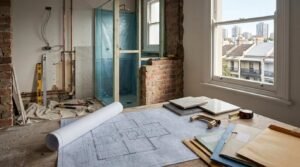
Sydney’s market conditions, regulations, and housing stock create cost pressures that national averages hide completely.
Why Sydney Renovation Costs Run Higher
Sydney tradespeople earn 15 to 25 percent above national averages, and consistent renovation demand keeps that premium stable. Traffic congestion adds travel cost, and inner-city parking adds both cost and access difficulty.
Logistics compound it. Premium showroom selection lifts average material spend, inner-city delivery attracts fees, apartment work requires lift bookings and building coordination, and tip fees run higher with fewer skip placement options.
Regulation adds the final layer. NSW enforces Australia’s most rigorous waterproofing standards, apartment work faces strata approval on top of council, and heritage overlays cover large parts of the inner suburbs.
Domain Sydney renovation data shows inner-city renovations cost 20 to 30 percent more than outer suburbs, with the CBD, Eastern Suburbs, Inner West and North Shore carrying the highest premiums.
Council Regulations and Approval Timelines
Approval requirements and processing times vary sharply between Sydney councils.
| Council Type | Approval Timeline | Examples |
| Fast-track | 2–3 weeks | Bayside, Canada Bay, Parramatta |
| Standard | 3–6 weeks | Sydney, Woollahra, Mosman |
| Heritage-focused | 6–12 weeks | Inner West, North Sydney, Waverley |
You need approval for structural change, plumbing alteration, waterproofing work, significant electrical upgrades, and any work on a heritage-listed or conservation-area property.
Documentation covers plans and specifications, waterproofing membrane details and method, plumbing fixture and drainage layout, structural certification where walls move, and a heritage impact statement where applicable. Approval costs $800 to $1,500 for a standard renovation and $1,500 to $3,000+ for heritage properties.
Start approvals 4 to 8 weeks before your intended site start. That single decision prevents the most common Sydney scheduling failure.
Heritage and Strata Considerations
This is where Sydney diverges most from the rest of the country, and where generic cost guides stop being useful.
Heritage properties carry real cost loading. Heritage-specialist design input costs $1,500 to $4,000, period-appropriate materials command premium pricing, heritage-experienced trades charge 10 to 20 percent more, and approvals stretch to 8 to 16 weeks with restrictions on layout and window changes.
Strata apartments add a parallel approval track most homeowners underestimate.
| Strata Requirement | Cost / Time Impact |
| Strata committee approval | 2–6 weeks |
| Documentation and plans | Included in design fees |
| Lift booking and access coordination | Scheduling constraint |
| Work-hour restrictions (typically 7 am–5 pm weekdays) | Extends project duration |
| Contractor insurance for strata work | Verification required |
| Extended defect liability | Warranty period extension |
Budget an extra $500 to $1,500 and 2 to 4 weeks for strata approval on any Sydney apartment renovation. Committees meet on their own schedule, and that schedule does not accommodate yours.
Finding Trusted Contractors in Sydney
Sydney’s market has excellent contractors and a persistent unlicensed fringe. Verification separates them.
Check the NSW Fair Trading contractor licence, required for any work over $5,000. Request a certificate of currency for public liability at $10M or above, plus workers’ compensation. Review completed bathroom photography, contact two to three recent clients directly, verify the ABN, and read reviews with a sceptical eye.
Six signals should end the conversation.
- No licence, or working under someone else’s licence
- Cash-only pricing
- Deposit demands above 20 percent
- Vague contracts without itemisation
- No insurance certificate available
- Immediate availability, when quality contractors book 4 to 8 weeks ahead
For sourcing, the Master Builders Association and HIA member directories both carry verified credentials, and architects and designers reliably know which trades deliver.
At Sydney Home Renovation, we bring transparent pricing, proven bathroom expertise and full project management to Sydney homeowners and investors. Our licensed, insured team delivers on budget and on schedule, and we keep communication clear from first quote to final defect sign-off.
Conclusion
Bathroom renovation costs across Australia vary by state, size, and scope, and Sydney homeowners typically invest $18,000 to $32,000 for a complete renovation. Understanding that variation, the detailed breakdown behind it, and the hidden costs that sit under the floor is what lets you set a budget that holds.
The renovations that finish on budget share three traits. They keep existing plumbing where it works, they spend at mid-range where the return is strongest, and they carry a contingency sized to the age of the house. Clear scope, itemised quotes and weekly budget tracking do the rest.
At Sydney Home Renovation, we deliver end-to-end bathroom renovations built on transparent cost planning, skilled workmanship and honest communication. We handle the budgeting, the compliance and the trades so the number we quote is the number you pay. Contact us today for a detailed, transparent quote on your bathroom.
Frequently Asked Questions
How much does a bathroom renovation cost in Sydney in 2026?
Sydney bathroom renovations cost $18,000 to $32,000 complete. Small bathrooms start near $15,000, and large master ensuites reach $40,000+, running 15 to 25 percent above national averages.
What is the cheapest way to renovate a bathroom in Australia?
A cosmetic refresh at $5,000 to $12,000 keeps the existing layout and plumbing while updating paint, vanity, tapware and lighting. Avoiding fixture relocation alone saves $2,000 to $5,000.
How long does a typical bathroom renovation take?
Standard renovations take 2 to 4 weeks on site. Small bathrooms finish in 10 to 14 days; large custom bathrooms need 4 to 6 weeks, plus 4 to 8 weeks for approvals.
Do I need council approval for a bathroom renovation in NSW?
Most NSW bathroom renovations need approval for structural changes, plumbing alterations, or waterproofing work. Simple cosmetic updates without relocation generally do not. Confirm with your local council first.
What are the most common hidden costs in bathroom renovations?
Asbestos removal at $1,500 to $4,500, structural repairs at $1,200 to $3,500, plumbing faults at $1,000 to $3,000, and electrical upgrades at $800 to $2,000 top the list.
Should I renovate my bathroom before selling my property?
Mid-range renovations return 70 to 85 percent of cost in property value, making them worthwhile for dated bathrooms. Luxury renovations return only 50 to 65 percent, so stay mid-range pre-sale.
How much should I budget for labour versus materials?
Allocate 40 to 50 percent to labour and 30 to 40 percent to materials. On $20,000, that means roughly $9,000 labour, $7,000 materials, $2,400 plumbing and electrical, $3,000 contingency.
Can I live in my home during a bathroom renovation?
Yes, most homeowners stay put through 2 to 4 weeks of dust, noise, and no bathroom access during work hours. Single-bathroom homes need alternative facilities arranged in advance.
What bathroom upgrades add the most value to my home?
Quality tiling, good lighting, functional storage, modern tapware and proper waterproofing deliver the strongest returns. Premium toilets and luxury extras add cost without proportional value.
How do I choose a reliable bathroom renovation contractor?
Verify NSW Fair Trading licensing, confirm $10M public liability and workers’ compensation, review their bathroom portfolio, contact three recent references, and require itemised written quotes.