
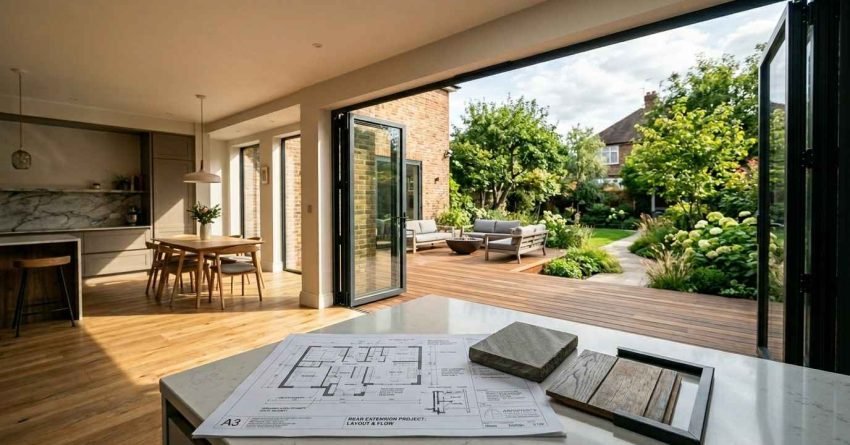
A rear extension is one of the most effective ways to add living space, improve functionality, and increase the long-term value of a Sydney home without the disruption of moving or the cost of a full rebuild. Whether we are opening up a cramped kitchen, creating a light-filled family room, or connecting an interior to an outdoor entertaining area, a well-designed rear extension transforms how a home feels and functions every day.
Getting that result requires more than a good idea. It requires a clear understanding of what is structurally possible, what council will approve, what the build will realistically cost, and which design decisions will deliver lasting value rather than short-term appeal.
Every major dimension of rear extension planning is covered here, from design ideas and structural considerations to planning approval, material selection, cost ranges, and how to choose the right builder in Sydney.
What Is a Rear Extension and Is It Right for Your Home?
A rear extension is a ground-level or multi-storey addition built onto the back of an existing home, extending the footprint into the rear yard. It is one of the most common forms of residential construction in Sydney, particularly in established suburbs where blocks are fixed in width but offer usable depth at the rear.
The appeal is straightforward. Rear extensions allow homeowners to significantly increase usable floor area without altering the street-facing facade, which simplifies planning approval in many cases and preserves the home’s existing character from the front. For families who have outgrown their current layout, investors seeking to increase rental yield, or owner-occupiers wanting to improve liveability without relocating, a rear extension is often the most practical and cost-effective path forward.
The decision to extend at the rear rather than the side or upward depends on several factors: the available rear yard depth, the home’s existing structural configuration, council setback requirements, and the intended use of the new space. A single-storey rear extension is typically the most straightforward approval pathway and the least disruptive to build. A double-storey rear extension delivers significantly more floor area but involves greater structural complexity, higher cost, and a more detailed approval process.
Understanding which format suits your block, budget, and lifestyle is the first real decision you will make, and it shapes every design and budget choice that follows.
Rear Extension Design Ideas for Sydney Homes
Design is where a rear extension moves from a construction project to a genuine improvement in how you live. The most successful rear extensions in Sydney share a common quality: they are designed around how the household actually uses the home, not around what looks impressive in a render.
Sydney’s climate, block orientations, and housing typologies create a distinct set of design opportunities. The combination of year-round outdoor living potential, strong natural light from the north, and the prevalence of older homes with compartmentalised layouts means that most rear extensions in this market are solving the same core problems: opening up the back of the house, connecting interior and exterior spaces, and bringing more light into the centre of the floor plan.
Open-Plan Kitchen and Living Extensions
The most requested rear extension configuration in Sydney is an open-plan kitchen, dining, and living area that replaces a series of smaller, disconnected rooms at the rear of the home. This layout removes internal walls, relocates or expands the kitchen toward the rear, and creates a single continuous living zone that connects directly to the outdoor area.
The functional benefits are significant. A well-executed open-plan rear extension improves sightlines across the home, makes supervision of children easier, and creates a social hub that works for both everyday family life and entertaining. From a property value perspective, open-plan living remains one of the most consistently valued features in the Sydney residential market.
Indoor-Outdoor Flow and Alfresco Integration
Sydney’s climate makes indoor-outdoor connectivity one of the highest-value design moves available in a rear extension. Stacking or sliding glass doors that open the full width of the rear wall, a covered alfresco area that extends the living zone outdoors, and a consistent floor level between interior and exterior are the three elements that define a successful indoor-outdoor connection.
The transition between inside and outside should feel seamless. This means matching or closely coordinating floor materials, ensuring the ceiling height of the alfresco area relates proportionally to the interior, and positioning the outdoor area to capture afternoon shade where the block orientation allows.
Light-Filled Extensions Using Skylights and Glazing
Rear extensions that extend deep into the block can create a light deficit in the middle of the floor plan, the zone furthest from both the front windows and the rear glazing. Skylights, roof lights, and clerestory windows are the primary tools for resolving this problem without compromising privacy or structural integrity.
Polycarbonate and double-glazed roof panels are widely used in Sydney extensions for their thermal performance and light transmission. Frameless or slimline-framed glass walls at the rear of the extension maximise the visual connection to the garden while maintaining thermal comfort when specified with appropriate glazing ratings for Sydney’s climate zone.
Planning Permissions and Council Approval in Sydney
Planning approval is the stage that surprises most homeowners. The rules governing what you can build, how large it can be, and how close it can sit to your boundaries are set by a combination of state environmental planning policies, local council development control plans, and site-specific constraints including heritage overlays, flood mapping, and biodiversity corridors.
In New South Wales, rear extensions are approved through one of two pathways: Complying Development or a Development Application.
Complying Development vs. Development Application
Complying Development (CDC) is a fast-track approval pathway administered by a private certifier rather than council. If a proposed rear extension meets all the numerical standards set out in the State Environmental Planning Policy (Exempt and Complying Development Codes) 2008, including setbacks, height, floor area, and site coverage, a CDC certificate can typically be issued within 20 business days.
A Development Application (DA) is required when the proposed extension does not meet CDC standards, when the site is subject to a heritage overlay, or when the council’s local environmental plan requires merit-based assessment. A straightforward residential DA in Sydney typically takes between 40 and 90 days from lodgement to determination, though timeframes vary significantly by council and application complexity.
Approval pathway at a glance:
| Pathway | Who Assesses | Typical Timeframe | When Required |
| Complying Development (CDC) | Private certifier | ~20 business days | Meets all numerical standards |
| Development Application (DA) | Local council | 40–90 days | Heritage overlay, non-compliant design, merit assessment |
Setback Rules, Height Limits, and Site Coverage
The key numerical controls that determine whether a rear extension qualifies for CDC approval include the rear boundary setback (typically 3 to 6 metres depending on the lot size and zone), the maximum wall height (typically 3.8 metres for a single-storey extension), and the maximum site coverage (typically 50 to 60 percent of the lot area, though this varies by council).
These figures are indicative. The applicable standards depend on your specific council area, zoning classification, and lot dimensions. Engaging a certifier or town planner early in the design process to confirm the applicable controls for your site is one of the most cost-effective steps you can take before investing in detailed design.
Terrace Houses and Heritage Overlays
Rear extensions on terrace houses are common in Sydney’s inner suburbs, but they involve additional planning and design considerations. Terrace houses are often subject to heritage overlays, have limited rear yard depth, and share party walls with neighbouring properties, all of which affect the design options, approval pathway, and structural approach.
In heritage-listed areas, council controls typically require that the extension is not visible from the street, that materials are sympathetic to the existing character, and that the rear facade of the terrace is not significantly altered. Engaging a designer and certifier with direct experience in heritage terrace extensions is essential before committing to a design direction.
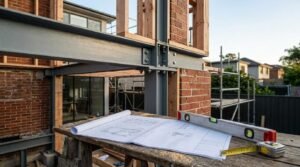
Structural Considerations for a Rear Extension
Every rear extension involves structural decisions that affect the safety, performance, and long-term durability of the build. These decisions are made by a structural engineer in consultation with your builder and architect, and they must be resolved before construction begins, not during it.
The structural scope of a rear extension depends on the existing home’s construction type, the size and configuration of the new addition, and whether any load-bearing walls need to be removed or modified to create the desired open-plan layout.
Foundation and Footing Requirements
The foundation system for a rear extension must be designed to suit the soil conditions on your specific site. In Sydney, reactive clay soils are common in many western and south-western suburbs, requiring deeper footings or a waffle pod slab to manage soil movement. Sandstone-based sites in the eastern suburbs and lower north shore typically allow for shallower footings but may require rock excavation, which adds cost and time to the program.
A geotechnical report, commonly called a soil test, is required for most rear extension projects and informs the structural engineer’s footing design. This is not an optional step. Building on an undersized or incorrectly specified footing system is one of the most expensive structural failures to rectify after the fact.
Roof Integration and Weatherproofing
Connecting a new rear extension roof to the existing home’s structure requires careful detailing at the junction point. Poorly executed roof connections are the most common source of water ingress in rear extensions, and the consequences, including damage to internal linings, insulation, and structural timbers, can be significant and costly to repair.
The roof form of the extension, whether a flat roof, skillion, or pitched roof that matches the existing, affects both the structural approach and the planning approval pathway. Flat and skillion roofs are common in contemporary Sydney extensions for their clean aesthetic and cost efficiency. Pitched roofs that match the existing home are often preferred in heritage-sensitive areas or where council controls require architectural consistency.
How Much Does a Rear Extension Cost in Sydney?
Cost is the question every homeowner asks first, and it is the one that is hardest to answer without knowing the specifics of the project. Rear extension costs in Sydney vary significantly depending on the size of the addition, the complexity of the structural work, the quality of finishes specified, and the site conditions that affect access and foundation requirements.
Having a realistic cost framework before engaging a designer or builder is essential. It prevents scope creep, sets appropriate expectations, and allows you to make informed decisions about where to invest and where to economise.
Cost Ranges by Extension Size and Type
As a general guide, a basic single-storey rear extension in Sydney covering a straightforward structural build with standard finishes typically starts from approximately $2,500 to $3,500 per square metre. A mid-range extension with quality finishes, open-plan layout, and indoor-outdoor connection typically falls in the range of $3,500 to $5,000 per square metre. High-specification extensions with premium materials, complex structural work, or bespoke joinery can exceed $5,000 per square metre.
These figures are indicative and should be treated as a starting point for budgeting conversations, not as fixed quotes. The only way to obtain an accurate cost for your specific project is through a detailed scope of works and a formal tender or fixed-price contract from a licensed builder.
Key Cost Variables: Materials, Labour, and Finishes
The variables that most significantly affect rear extension costs in Sydney include the extent of structural work required (particularly load-bearing wall removal and footing complexity), the specification of kitchen and joinery if the extension incorporates a new kitchen, the glazing specification (standard aluminium-framed vs. thermally broken or frameless systems), and the quality of floor and wall finishes throughout.
Contingency allowances are a critical component of any rear extension budget. A minimum contingency of 10 to 15 percent of the total construction cost is recommended for most projects, with higher contingencies appropriate for older homes where concealed structural or services issues are more likely to be discovered during construction.
A 30-square-metre mid-range extension at $3,500 to $5,000 per square metre typically costs between $105,000 and $150,000, a useful benchmark for initial budget planning before a formal quote is obtained.
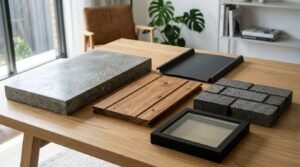
Choosing the Right Materials for Your Rear Extension
Material selection for a rear extension involves two distinct decisions: what the extension should look like in relation to the existing home, and how the materials will perform over time in Sydney’s climate. Both decisions have long-term consequences that are difficult and expensive to reverse after construction.
The materials used for the external envelope cladding, roofing, and glazing are the most visible and the most consequential in terms of thermal performance, maintenance requirements, and planning approval. Internal finishes, while important for liveability and resale value, are more easily updated over time.
Matching Existing Architecture vs. Contrasting Finishes
There are two broadly accepted approaches to the relationship between a rear extension and the existing home. The first is to match the existing materials as closely as possible using the same brick, tile, or weatherboard profile to create a seamless addition that reads as part of the original structure. This approach is often required in heritage-sensitive areas and is generally preferred by councils that apply character-based design controls.
The second approach is to deliberately contrast the extension with the existing home using contemporary materials such as fibre cement cladding, colorbond steel, or polished concrete to create a clear visual distinction between old and new. This approach is widely accepted in Sydney’s planning framework for non-heritage properties and is often the more cost-effective option, as it avoids the difficulty and expense of sourcing matching materials for older homes.
Cladding, Roofing, and Glazing Options
Fibre cement sheet and weatherboard cladding are the most commonly used external wall materials for rear extensions in Sydney, offering a balance of cost, durability, and design flexibility. Colorbond steel roofing is the dominant roofing material for skillion and flat-roof extensions, valued for its low maintenance, thermal performance when insulated correctly, and wide colour range.
Glazing specification has a significant impact on both the thermal performance and the cost of the extension. Standard aluminium-framed double-glazed windows and doors are appropriate for most Sydney climate zones. Thermally broken aluminium or timber-framed systems offer improved performance in cooler climates or for large glazed areas where heat loss and condensation are a concern.
Maximising Natural Light in a Rear Extension
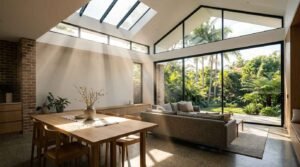
Natural light is one of the most powerful determinants of how a finished extension feels to live in. A rear extension that is well-lit feels larger, warmer, and more connected to the outdoors than one of the same dimensions that relies on artificial lighting. In Sydney, where north-facing rear yards are common in many established suburbs, the opportunity to capture natural light through thoughtful design is significant.
The challenge is that rear extensions, particularly those that extend deep into the block, can create a light deficit in the middle of the floor plan. The further the extension reaches from the rear boundary, the more the central zone of the new space is shielded from both the rear glazing and any existing front windows.
Roof Lights, Clerestory Windows, and Glass Walls
Roof lights and skylights are the most effective tool for resolving the mid-plan light deficit in a rear extension. Positioned over the kitchen bench, dining area, or central circulation zone, a well-placed roof light delivers consistent, diffused natural light throughout the day without the privacy or structural complications of additional side windows.
Clerestory windows, high-level glazing positioned above the line of sight, are an alternative strategy that works particularly well in skillion-roof extensions, where the rising ceiling profile creates a natural opportunity for high-level glazing at the upper end of the roof pitch. They deliver directional light without compromising wall space or privacy.
Glass walls at the rear of the extension, whether full-height glazing, stacking doors, or a combination of fixed and operable panels, are the primary source of natural light for most rear extensions. The specification of these elements, including the frame type, glass rating, and proportion of glazed to solid wall, has a significant impact on both the light quality and the thermal performance of the space.
Orientation and Shadow Considerations in Sydney
Sydney’s solar geometry means that north-facing rear yards receive the most consistent natural light throughout the year, while south-facing rear yards receive limited direct sunlight, particularly in winter. Understanding your block’s orientation before finalising the glazing strategy is essential; a glazing configuration that works well on a north-facing block may deliver poor thermal performance and limited light on a south-facing one.
Shadow from neighbouring structures, existing trees, and the home’s own roof overhang should also be modelled during the design phase. A shadow diagram typically required as part of a DA submission provides a useful tool for understanding how light will move through the extension across different seasons and times of day.
Rear Extension vs. Other Home Extension Options
A rear extension is not always the right answer. For some blocks, budgets, and planning contexts, a side extension, a second storey addition, or a combination of both will deliver a better outcome. Understanding the trade-offs between these options before committing to a design direction prevents costly changes later in the process.
The decision is shaped by four primary factors: the available space on the block, the planning controls that apply to the site, the budget available for construction, and the intended use of the new space.
Rear Extension vs. Side Extension
A side extension adds floor area by building into the side setback of the block, typically alongside an existing garage, laundry, or narrow side passage. It is most viable on wider blocks where the side setback is generous enough to accommodate a useful addition without triggering planning objections from neighbours.
Side extensions are generally less disruptive to the rear yard than a rear extension and can be a practical solution for adding a bedroom, bathroom, or utility space without significantly altering the home’s rear living zone. However, they typically deliver less floor area than a rear extension of equivalent cost, and the resulting spaces can be narrow and poorly lit if the design does not account for the limited window opportunities on a side wall.
Rear Extension vs. Second Storey Addition
A second storey addition delivers the most floor area per square metre of footprint, making it the most efficient option for blocks where the rear yard is limited or where planning controls restrict ground-level expansion. It is also the most complex and expensive option, involving significant structural work to the existing roof and upper floor structure, and typically requiring a full DA rather than a CDC.
The disruption associated with a second storey addition is also considerably greater than a rear extension. In most cases, the home must be vacated during the structural phase of the build, and the construction program is typically longer and more weather-dependent than a ground-level extension.
Quick-Reference Comparison
| Factor | Rear Extension | Side Extension | Second Storey Addition |
| Typical cost range (per m²) | $2,500–$5,000+ | $2,500–$4,500 | $3,500–$6,000+ |
| Floor area potential | High | Low–Medium | Very High |
| Approval pathway | CDC or DA | CDC or DA | DA (typically) |
| Construction disruption | Low–Medium | Low | High |
| Rear yard impact | Significant | Minimal | None |
| Best suited for | Open-plan living, kitchen, alfresco | Bedroom, bathroom, utility | Maximum floor area on small blocks |
Working With a Rear Extension Builder in Sydney
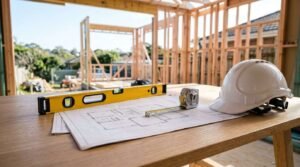
The quality of the outcome of a rear extension project is determined as much by the team you engage as by the design itself. A well-designed extension built by an inexperienced or poorly organised contractor will underperform. A straightforward design executed by a skilled, well-coordinated team will consistently deliver a result that meets expectations on quality, cost, and program.
In Sydney’s residential construction market, rear extensions are delivered through several different engagement models: design-and-build contractors who manage the full process from concept to completion, separate architect-and-builder arrangements where the design and construction are procured independently, and owner-builder arrangements where the homeowner takes on the project management role directly.
What to Look for in a Rear Extension Contractor
The most important qualities to look for in a rear extension contractor are a demonstrated track record of completed projects of similar scope and complexity, a clear and transparent approach to pricing and contract documentation, and the capacity to manage the full scope of trades including structural, electrical, plumbing, and finishing without relying on the homeowner to coordinate between them.
Licensing is a non-negotiable baseline. In New South Wales, any residential building work valued at over $5,000 must be carried out by a licensed contractor holding a current contractor licence issued by NSW Fair Trading. Checking a contractor’s licence status, insurance coverage, and Home Building Compensation Fund eligibility before signing a contract is a basic due diligence step that every homeowner should complete.
The Design-and-Build Process Explained
A design-and-build engagement model consolidates design, approval, and construction under a single contract with one responsible party. This model reduces the coordination risk that arises when design and construction are procured separately, and it typically results in a more buildable design because the construction team is involved in the design process from the outset.
The typical design-and-build process for a rear extension in Sydney moves through concept design, preliminary cost planning, design development, approval documentation, design documentation, and then the construction phase itself. Each stage has defined deliverables and decision points, and a well-run process ensures that the homeowner is informed and in control at every step.
Conclusion
A rear extension is a significant investment in your home’s liveability, functionality, and long-term value. The decisions made at the design and planning stage around layout, materials, structural approach, and approval pathway determine the quality of the outcome and the efficiency of the build.
Every section of this guide connects to a deeper layer of planning detail, from cost benchmarks and structural requirements to material selection and approval pathways. The more clearly you understand each dimension before engaging a designer or builder, the better positioned you are to make decisions that hold up through the full project.
When you are ready to take the next step, we at Sydney Home Renovation are here to guide you from concept to completion with transparent pricing, expert design input, and a proven process that keeps your project on budget and on schedule.
Frequently Asked Questions
How far can a rear extension extend without planning permission in Sydney?
Under the Complying Development pathway in NSW, a single-storey rear extension can typically extend up to 8 metres from the rear of the existing dwelling on lots under 900 square metres, subject to setback, height, and site coverage controls. Confirming the applicable standards with a certifier before finalising your design is strongly recommended.
How long does a rear extension take to build?
A straightforward single-storey rear extension in Sydney typically takes between 10 and 20 weeks to construct once approvals are in place. Total project duration from initial design to practical completion is generally between 6 and 12 months, depending on the approval pathway and project complexity.
Does a rear extension add value to a Sydney home?
Yes, a well-designed rear extension consistently adds value to Sydney residential properties. Extensions that improve liveability, add a functional kitchen or living zone, and connect to outdoor space tend to deliver the strongest return on investment.
What is the average cost of a rear extension in Sydney?
A mid-range single-storey rear extension in Sydney typically costs between $3,500 and $5,000 per square metre, inclusive of structural work, finishes, and project management. A 30-square-metre extension at this specification typically costs between $105,000 and $150,000.
Do I need an architect for a rear extension?
An architect is not legally required for a rear extension in NSW, but engaging one or a building designer with equivalent qualifications is strongly recommended for any extension of meaningful complexity. A well-designed extension delivers better spatial outcomes and typically results in a more efficient and cost-effective build.
Can I build a rear extension on a terrace house in Sydney?
Yes, rear extensions on terrace houses are common in Sydney’s inner suburbs, but they involve additional planning and design considerations. Terrace houses are often subject to heritage overlays, have limited rear yard depth, and share party walls with neighbouring properties, all of which affect the design options and approval pathway.
What is the difference between a rear extension and a granny flat?
A rear extension is an addition to the existing dwelling that forms part of the main home. A granny flat formally known as a secondary dwelling in NSW, is a self-contained dwelling on the same lot, with its own kitchen, bathroom, and living facilities, typically used for rental income or multigenerational living.


