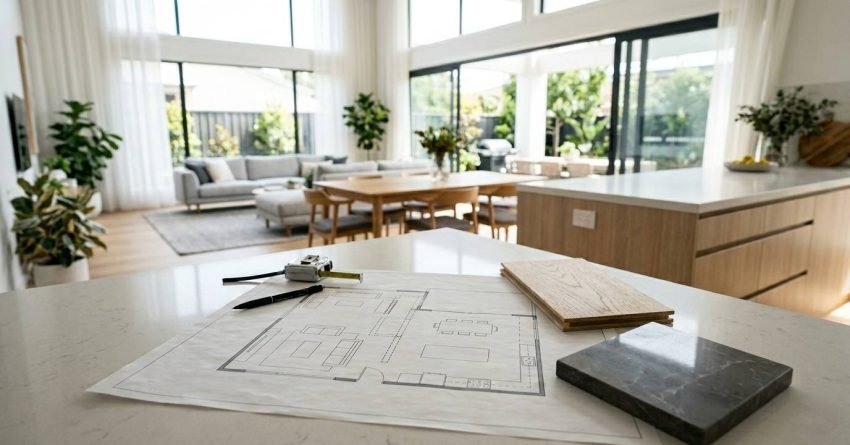
A floor plan redesign transforms the internal layout of your home by removing or relocating walls, reconfiguring spaces, and creating a more open, functional living environment. For Sydney homeowners, it is one of the most impactful structural renovations available, reshaping how a home feels, flows, and performs for everyday life and long-term property value.
Understanding what a floor plan redesign involves and what it costs is essential before committing to any structural work. Poorly planned layout changes create compliance issues, budget blowouts, and structural problems that are expensive to rectify.
This guide covers what a floor plan redesign actually is, why Sydney homeowners are choosing to open up their homes, how to plan and budget your project, what structural and regulatory requirements apply in NSW, the key design decisions that shape the outcome, and how to choose the right contractor to deliver it well.
What Is a Floor Plan Redesign?
A floor plan redesign is the process of altering the internal configuration of a residential property, typically by removing walls, merging rooms, or reconfiguring the relationship between living spaces. In the context of opening up a home, it almost always involves converting a series of smaller, enclosed rooms into a larger, connected living area.
The term covers a wide spectrum of work. At one end, a floor plan redesign might involve removing a single non-structural wall between a kitchen and dining room. At the other, it might mean a comprehensive reconfiguration of an entire ground floor, relocating plumbing, electrical, and structural elements to achieve a fundamentally different spatial arrangement.
Structural vs. Non-Structural Changes
Not all floor plan changes carry the same complexity or cost. Non-structural changes, including removing partition walls, repositioning doorways, or altering room boundaries, are generally more straightforward and less expensive. Structural changes, which involve load-bearing walls, beams, columns, or the building’s primary frame, require engineering input, council approval in most cases, and significantly more careful execution.
Understanding which category your project falls into is one of the first and most important questions to answer before any work begins. Misidentifying a load-bearing wall as a partition wall is one of the most costly mistakes in residential renovation.
What “Opening Up” Actually Means in Residential Construction
In practical construction terms, opening up a home means creating visual and physical continuity between spaces that were previously separated. A home that once had a closed kitchen, a separate dining room, and a disconnected lounge becomes a single, flowing living zone where light, air, and movement travel freely. This typically involves removing walls between the kitchen, dining, and living areas, the three zones most commonly integrated in Australian residential renovation.
It may also include creating indoor-outdoor connections by opening walls to alfresco areas, or improving natural light flow by removing barriers between front and rear sections of the home. The result is a home that feels larger, lighter, and more connected, qualities that align with how Australians increasingly prefer to live and entertain.

Why Sydney Homeowners Are Opening Up Their Floor Plans
The shift toward open-plan living in Australia has been building for decades, but it accelerated significantly in the post-pandemic period. Australian Bureau of Statistics data shows that time spent at home increased substantially from 2020 onward, placing greater pressure on residential spaces to perform across multiple functions simultaneously, including working, learning, cooking, entertaining, and relaxing, often within the same household at the same time.
For Sydney homeowners specifically, the motivation to open up a floor plan is driven by a combination of lifestyle expectations and property market dynamics.
Lifestyle Drivers: How Australians Live Today
The enclosed, compartmentalised floor plans common in homes built before the 1990s no longer reflect how most Australian families use their homes. Separate formal dining rooms, closed-off kitchens, and disconnected living areas create a fragmented experience that feels at odds with contemporary living preferences.
Open-plan layouts allow parents to supervise children while cooking, enable social gatherings to flow naturally between kitchen and living areas, and create a sense of spaciousness that smaller homes achieve without adding a single square metre of floor area. The connection between indoor and outdoor spaces, a defining feature of Australian residential design, is also far easier to achieve when internal walls are removed, and sightlines are extended.
Property Value and Resale Appeal in the Sydney Market
In the Sydney property market, open-plan living is not simply a lifestyle preference. It is a value driver. Properties with well-executed open-plan layouts consistently attract stronger buyer interest and higher sale prices than comparable homes with enclosed, compartmentalised floor plans.
CoreLogic research has consistently identified open-plan living as one of the top features buyers prioritise in the sub-$2 million residential market across Greater Sydney. For property investors and owner-occupiers planning to sell within five to ten years, a floor plan redesign that successfully opens up the home represents one of the highest-return renovation investments available, provided it is executed with quality workmanship and appropriate structural compliance.
Planning Your Floor Plan Redesign: Where to Start
The quality of a floor plan redesign is determined as much by the planning phase as by the construction phase. Homeowners who invest time in thorough pre-construction planning consistently achieve better outcomes, on budget, on schedule, and aligned with their original vision. Those who rush into construction without a clear brief, a realistic budget, and a properly scoped design frequently encounter costly variations, delays, and disappointment.
Assessing Your Home’s Existing Layout
Before engaging any professional, spend time understanding your home’s current layout in detail. Walk through the spaces you want to change and document what is working and what is not. Consider how natural light moves through the home at different times of day, where traffic flows naturally, and which walls feel like barriers to the way you want to live.
Identify the spaces you want to connect, the functions you want to integrate, and the outcomes you are trying to achieve. A clear articulation of your goals, even in plain language without architectural terminology, gives every professional you engage a meaningful starting point.
Setting Goals Before You Engage a Builder
The most common planning mistake is engaging a builder before the project scope is defined. Without a clear brief, builders cannot provide accurate quotes, and homeowners cannot meaningfully compare proposals. Vague briefs produce vague quotes, and vague quotes produce budget surprises.
Before approaching any contractor, define your non-negotiables: which spaces must be connected, what your absolute budget ceiling is, what your timeline constraints are, and what quality level you expect for finishes. These parameters shape every decision that follows.
Working With an Architect or Building Designer
For floor plan redesigns that involve structural changes, working with a qualified architect or building designer is strongly recommended. These professionals translate your goals into a set of drawings that can be used for council approval, structural engineering assessment, and builder quoting. They also help you understand what is structurally and financially feasible before you commit to a direction.
In NSW, any structural alteration to a residential building requires documentation that meets the Building Code of Australia and relevant Australian Standards. An architect or building designer ensures your project is designed to meet these requirements from the outset, reducing the risk of costly redesigns during the approvals process.
Understanding Load-Bearing Walls and Structural Considerations
The single most important structural question in any floor plan redesign is whether the walls you want to remove are load-bearing. A load-bearing wall carries the weight of the structure above it, including roof loads, upper floor loads, or both, and transfers that weight down to the building’s foundations. Removing a load-bearing wall without appropriate structural support is a serious safety risk and a significant compliance issue.
How to Identify Load-Bearing Walls
There is no reliable way for a homeowner to definitively identify a load-bearing wall without professional assessment. Several indicators suggest a wall may be structural: walls that run perpendicular to floor joists, walls positioned in the centre of the home, walls that sit directly above or below other walls on different floors, and walls that support visible beams or ridge lines.
The only reliable method of confirmation is a structural engineer’s assessment, which involves reviewing the building’s original plans (if available), inspecting the roof and subfloor structure, and determining how loads are distributed through the building. This assessment is not optional for any project involving wall removal. It is a legal and safety requirement.
Beam Types: LVL vs Structural Steel
When a load-bearing wall is removed, a beam must be installed to carry the loads that wall previously transferred. The two most common beam types in Sydney residential renovation are laminated veneer lumber (LVL) and structural steel.
LVL beams are engineered timber products that suit most residential spans up to around five metres. They are lighter, easier to handle on-site, and generally less expensive than steel. Structural steel beams, typically universal beams (UB sections), are specified for longer spans, heavier loads, or situations where the beam must sit within the ceiling plane rather than below it. Your structural engineer specifies the correct beam type and size based on the span, the load being carried, and the ceiling depth available. We see LVL used in the majority of standard kitchen-to-living wall removals in Sydney homes, with steel becoming the default for spans above five to six metres or where floor-to-ceiling height is a priority.
Structural Engineering and Council Approval Requirements in NSW
In NSW, any work that involves removing or altering a load-bearing wall requires a structural engineer’s report and, in most cases, council approval or a complying development certificate. The structural engineer specifies the beam size, connection details, and support requirements needed to safely transfer the loads previously carried by the removed wall. These specifications are incorporated into the construction drawings and form part of the approval documentation.
Attempting to remove a load-bearing wall without engineering sign-off is illegal under the Building Code of Australia and creates significant liability for both the homeowner and any contractor involved. It also creates serious problems at the point of sale, when a building inspection may identify unapproved structural work.
How Much Does a Floor Plan Redesign Cost in Sydney?
Cost is the question most homeowners ask first, and it is also the question that is most frequently answered inaccurately, either with figures that are too low to be realistic or too vague to be useful. In Sydney, a floor plan redesign that involves structural wall removal, trade work, and quality finishes is a significant investment. Understanding the cost drivers helps you budget realistically and avoid the financial surprises that derail renovation projects.
Cost Factors That Drive Price Variation
No two floor plan redesigns cost the same, because no two homes are the same. The primary variables that drive cost include the number and type of walls being removed (structural vs. non-structural), the size and material of the beam required to replace a load-bearing wall, the extent of electrical and plumbing relocation required, the condition of the existing structure, the quality of finishes specified, and the complexity of the council approvals process.
Master Builders Australia regularly reports that labour accounts for between 40% and 60% of total residential renovation costs, depending on the project type and finish level. Labour costs in Sydney are among the highest in Australia, reflecting the city’s cost of living and the demand for skilled tradespeople.
Typical Price Ranges for Common Open-Plan Conversions
As a general orientation guide, homeowners in Sydney should expect the following approximate ranges for common floor plan redesign projects.
Removing a single non-structural partition wall, patching, and repainting: $3,000 to $8,000, depending on wall length and finish requirements. On a per-square-metre basis, non-structural wall removal and reinstatement typically runs $300 to $600/m² of wall area, including patching and painting.
Removing a load-bearing wall and installing a structural steel or LVL beam, including engineering, approval, and reinstatement: $15,000 to $35,000, depending on beam span, structural complexity, and finish level. This equates to roughly $1,500 to $3,500 per linear metre of wall removed, inclusive of all structural and approval costs.
A comprehensive ground-floor open-plan conversion involving multiple wall removals, kitchen relocation, electrical and plumbing reconfiguration, and new flooring throughout: $60,000 to $150,000+, depending on scope, materials, and finishes. These figures are indicative only. Every project requires a detailed scope and a site-specific quote from a licensed contractor.
Hidden Costs Homeowners Frequently Overlook
The most common source of budget overruns in floor plan redesign projects is not the primary construction work. It is the costs that were not anticipated at the quoting stage.
Asbestos is one of the most significant hidden cost risks in Sydney. Any home built before 1990 is likely to contain asbestos-containing materials (ACMs) in wall linings, ceiling sheets, floor coverings, or eaves. Under NSW SafeWork regulations, ACMs must be identified by a licensed asbestos assessor before demolition begins, and removal must be carried out by a licensed asbestos removalist. Testing typically costs $300 to $800, while removal costs vary widely depending on the quantity and type of material involved. We always recommend budgeting for asbestos management in any pre-1990 Sydney home before a single wall is touched.
Other commonly overlooked costs include electrical switchboard upgrades required when circuits are reconfigured, plumbing relocation costs when wall cavities are removed, and the cost of matching existing flooring or ceiling finishes after walls are removed. Structural surprises, including discovering that a wall carries more load than anticipated or that the existing beam is undersized, can also add high cost once work is underway. A contingency budget of 10% to 15% of the total project cost is strongly recommended.

Key Design Decisions When Opening Up Your Home
Structural feasibility and budget define what is possible. Design decisions define what is achieved. The choices you make about how spaces connect, how light moves, and how materials flow through the home determine whether your floor plan redesign feels like a considered transformation or a series of disconnected changes.
Kitchen, Dining, and Living Integration
The kitchen-dining-living integration is the most common and most impactful open-plan conversion in Australian residential renovation. When executed well, it creates a single, multi-functional living zone that serves as the social and functional heart of the home. When executed poorly, it creates a large, acoustically challenging space that lacks definition and feels unfinished.
Successful integration requires careful thought about the kitchen’s position relative to the dining and living areas, the placement of the island bench as a spatial anchor, the relationship between the cooking zone and the outdoor entertaining area, and the acoustic and ventilation implications of removing the barriers between these spaces.
Natural Light, Ventilation, and Indoor-Outdoor Flow
One of the most significant benefits of opening up a floor plan is the improvement in natural light and ventilation. Removing internal walls allows light to travel further into the home, reducing reliance on artificial lighting and improving the overall liveability of the space. It also allows cross-ventilation, the movement of air from one side of the home to the other, which is particularly valuable in Sydney’s warm climate.
Indoor-outdoor flow is a defining feature of contemporary Australian residential design. A floor plan redesign that connects the internal living area to an alfresco space, courtyard, or garden through large sliding or bifold doors creates a seamless transition between inside and outside that significantly expands the functional living area of the home.
Flooring, Ceiling, and Finish Continuity
When walls are removed, the surfaces they previously concealed, including floor, ceiling, and adjacent wall finishes, are exposed. Achieving continuity across these surfaces is one of the most practically challenging aspects of a floor plan redesign. Matching existing timber flooring, for example, requires sourcing boards of the same species, grade, and profile, which may no longer be available if the floor was laid decades ago.
Planning for finish continuity before construction begins, and budgeting for it explicitly, prevents the common outcome of a beautifully opened space that is visually disrupted by mismatched materials.
The Renovation Process: From Concept to Completion
A floor plan redesign is not a single trade event. It is a coordinated sequence of professional activities that must be planned, sequenced, and managed carefully to achieve a quality outcome on time and within budget. Understanding the broad shape of the process helps homeowners make informed decisions, communicate effectively with their contractor, and maintain realistic expectations throughout.
Demolition, Structural Work, and Rough-In Trades
The construction phase of a floor plan redesign typically begins with demolition, the controlled removal of walls, ceilings, and finishes to expose the structure beneath. This phase often reveals conditions that were not visible during the pre-construction assessment, including the presence of asbestos-containing materials, unexpected plumbing or electrical within walls, or structural conditions that differ from what the original plans indicated.
Following demolition, structural work proceeds: beams are installed, temporary supports are removed, and the building’s load path is re-established in its new configuration. Once the structure is certified, rough-in trades, including electrical, plumbing, and any mechanical, are reconfigured to suit the new layout. This is the point at which decisions about power point locations, lighting circuits, and plumbing positions must be finalised, because changing them after linings are installed is expensive.
Project Sequencing and Timeline Expectations
The sequencing of trades in a structural renovation follows a logical order that cannot be significantly compressed without creating quality or compliance risks. Structural work must be certified before linings are installed. Rough-in trades must be completed and inspected before walls are closed. Wet areas must be waterproofed and inspected before tiling. Flooring is typically one of the last trades to complete, to avoid damage from subsequent work.
For a mid-complexity floor plan redesign in Sydney, involving one or two structural wall removals, kitchen reconfiguration, and new finishes throughout, a realistic construction timeline is eight to sixteen weeks, depending on the scope of work, trade availability, and the complexity of the approvals process.
Living On-Site vs. Relocating During Construction
Whether you can live in your home during a floor plan redesign depends on the scope and location of the work. For projects confined to one section of the home, living on-site is often possible with some disruption to daily routines.
For comprehensive ground-floor reconfigurations involving kitchen removal, multi-trade work, and significant dust and noise, temporary relocation is usually the more practical choice. In our experience, homeowners who relocate during major structural work consistently report less stress and faster project completion, because the site can be worked continuously without the constraints of occupied living. We discuss this with every client during the planning phase so the decision is made with full information, not as an afterthought.
Council Approvals, Permits, and Compliance in NSW
Regulatory compliance is not optional in residential renovation. It is a legal requirement that protects the safety of occupants, the integrity of the building, and the value of the property. In NSW, the approvals pathway for a floor plan redesign depends on the nature and extent of the work, the zoning of the property, and the specific requirements of the local council.
Development Applications vs. Complying Development Certificates
In NSW, structural residential renovation work is typically approved through one of two pathways. A Development Application (DA) is assessed by the local council and is required when the proposed work does not meet the criteria for complying development, or when the council’s local environmental plan requires DA approval for the specific type of work.
A Complying Development Certificate (CDC) is a faster approval pathway administered by a private certifier, available when the proposed work meets a set of predetermined standards under the State Environmental Planning Policy (Exempt and Complying Development Codes) 2008. For most floor plan redesigns involving structural wall removal, a CDC is the most common approval pathway, provided the work meets the relevant standards.
Heritage Properties and Conservation Area Restrictions
Properties in heritage conservation areas, or those with individual heritage listings, operate under a different set of rules. Most Sydney councils require a DA rather than a CDC for any structural work on a heritage-listed property, regardless of the scope. Some councils also apply heritage controls to entire streetscapes or precincts, meaning a property does not need to be individually listed to be affected.
Internal alterations to heritage properties are assessed against the heritage significance of the building, and some structural changes that are straightforward in a standard home may be refused or require significant modification to preserve heritage fabric. We strongly recommend confirming your property’s heritage status with your local council before engaging any design professional, as this single factor can fundamentally change the approvals pathway and the design options available to you.
When You Need a Structural Engineer’s Report
A structural engineer’s report is required for any work that involves removing or altering a load-bearing element of the building. The report specifies the structural solution, including beam size, connection details, and support requirements, and is submitted as part of the approval documentation. Without it, no certifier or council will approve the work, and no licensed builder should proceed with structural alterations.
The engineer’s report is also a critical document for future property transactions. Buyers and their solicitors increasingly request evidence of engineering sign-off for any structural work completed on a property, and the absence of this documentation can complicate or delay a sale.

Choosing the Right Renovation Contractor for Your Floor Plan Project
The contractor you choose for a structural floor plan redesign has more influence over the outcome of your project than almost any other decision you make. Structural renovation requires a specific combination of skills: the ability to manage complex trade sequencing, the knowledge to identify and resolve structural surprises, the experience to coordinate engineering, certification, and council compliance, and the communication skills to keep you informed throughout.
What to Look for in a Structural Renovation Specialist
Not all licensed builders have experience with structural renovation. When evaluating contractors for a floor plan redesign, prioritise those who can demonstrate a track record of completed structural projects, specifically projects involving load-bearing wall removal, beam installation, and multi-trade coordination. Ask to see examples of completed work, and speak to previous clients about their experience with the contractor’s communication, problem-solving, and budget management.
Verify that the contractor holds a current NSW contractor licence, appropriate insurance (including public liability and home warranty insurance for projects over $20,000), and a clear understanding of the approvals process for your specific project type.
Questions to Ask Before Signing a Contract
Before committing to any contractor, ask these questions: How will you manage the structural engineering and approvals process? What is your process for identifying and communicating variations? How do you handle unexpected structural conditions discovered during demolition? What is your trade sequencing plan, and how do you manage trade availability? What does your contract include, and what is explicitly excluded?
A contractor who answers these questions clearly, specifically, and without hesitation is demonstrating the kind of professional competence that structural renovation demands. Vague or evasive answers are a meaningful warning signal.
Common Mistakes to Avoid When Opening Up Your Home
Even well-resourced, well-intentioned floor plan redesign projects can go significantly off track when key decisions are made without adequate information or professional guidance. Understanding the most common mistakes, and why they happen, is one of the most practical things a homeowner can do before starting a structural renovation.
Underestimating Structural Complexity
The most financially damaging mistake in floor plan redesign is underestimating the structural complexity of the work. Homeowners who receive a low initial quote, often from a contractor who has not conducted a thorough pre-construction assessment, frequently discover that the actual structural requirements are significantly more complex and expensive than the quote reflected.
Structural surprises are not always avoidable, but they are significantly less likely when the pre-construction assessment is thorough, the engineering is completed before quoting, and the contractor has genuine experience with structural renovation.
Ignoring Acoustic and Thermal Performance
Open-plan living creates acoustic challenges that enclosed floor plans do not have. Sound travels freely through open spaces, meaning that noise from the kitchen, including appliances, cooking, and conversation, carries directly into the living and dining areas. In homes with children, this creates a significantly less comfortable living environment than the original enclosed layout.
Thermal performance is similarly affected. Open-plan spaces are harder to heat and cool efficiently than smaller, enclosed rooms, because the volume of air being conditioned is larger and the opportunities for zone control are reduced. Addressing acoustic and thermal performance at the design stage, through ceiling insulation, double-glazed windows, and zoned HVAC systems, is far less expensive than retrofitting solutions after construction is complete.
Poor Budget Planning and Scope Creep
Scope creep, the gradual expansion of a project’s scope beyond its original brief, is one of the most common causes of budget overruns in residential renovation. It typically begins with small additions that seem individually reasonable: upgrading the kitchen splashback, adding a feature wall, extending the flooring into an adjacent room. Each decision adds cost, and the cumulative effect pushes a project significantly over budget.
The most effective protection against scope creep is a clearly defined scope of work in the contract, a contingency budget of 10% to 15% of the total project cost for genuine surprises, and a disciplined approach to evaluating any proposed changes against the original budget and goals before approving them.
Conclusion
A floor plan redesign is one of the most transformative structural investments a Sydney homeowner can make, connecting spaces, improving light and flow, and creating a home that reflects how you actually live. The key dimensions covered here, including structural assessment, planning, cost, design, compliance, and contractor selection, form the complete framework for a well-executed project.
Each of these dimensions connects to a deeper body of knowledge, from load-bearing wall engineering and beam selection to council approvals and open-plan design principles. Getting each one right is what separates a renovation that delivers lasting value from one that creates ongoing problems.
At Sydney Home Renovation, we manage every phase of your floor plan redesign, from the initial structural assessment and approvals through to final finishes and handover. If you are ready to open up your home, we are ready to help you do it properly.
Frequently Asked Questions
Do I need council approval to remove a wall in my Sydney home?
Yes, in most cases. Most structural wall removals in NSW require either a Development Application or a Complying Development Certificate before work begins, depending on the wall type and property zoning.
How do I know if a wall in my home is load-bearing?
You cannot reliably determine this without a professional assessment. A structural engineer inspects the building’s framing, floor joist direction, and roof structure to confirm which walls carry loads.
How long does a floor plan redesign take in Sydney?
A mid-complexity project involving one or two structural wall removals and new finishes typically takes eight to sixteen weeks from construction start, plus four to eight weeks for approvals beforehand.
What is the difference between a structural and non-structural wall removal?
A structural wall carries the building’s weight above it and requires engineering, approval, and a replacement beam. A non-structural partition wall carries no load and involves fewer regulatory requirements, though permits may still apply.
Will opening up my floor plan increase my home’s value in Sydney?
In most cases, yes. Open-plan layouts are consistently among the top features Sydney buyers prioritise, and well-executed conversions typically deliver a positive return on investment, depending on execution quality and market conditions.
What hidden costs should I budget for in a floor plan redesign?
The most commonly overlooked costs include asbestos testing and removal, electrical switchboard upgrades, plumbing relocation, matching existing flooring or ceiling finishes, and structural surprises discovered during demolition.
Can I live in my home during a floor plan redesign?
It depends on the scope. For work confined to one area, living on-site is often possible with some disruption. For comprehensive ground-floor reconfigurations, temporary relocation is usually more practical and reduces the overall project timeline.