
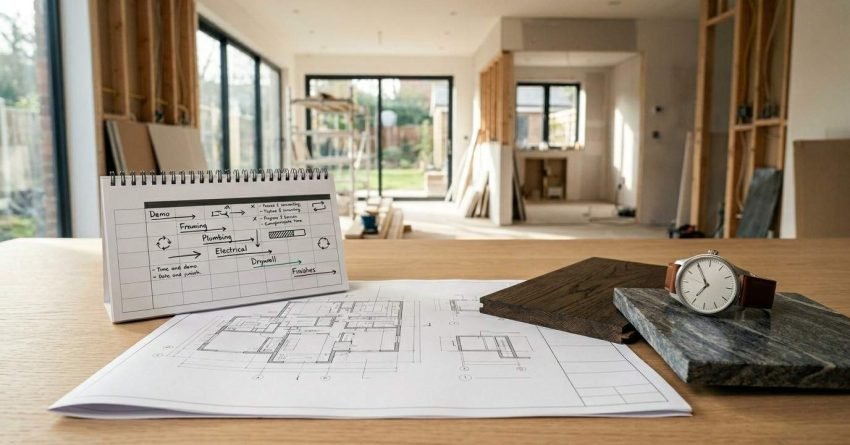
A whole home renovation in Sydney typically takes between 3 and 12 months, depending on the size of the home, the scope of work, and whether structural changes or council approvals are required. Understanding the full timeline before you start is one of the most important steps in planning a successful renovation. Without a realistic picture of how long each stage takes, budgets blow out, trades fall behind, and projects stall at the worst possible moments.
This guide breaks down the key factors that affect renovation timelines, typical durations by project type, a stage-by-stage schedule, and practical strategies to keep your renovation on track from day one.
What Affects the Timeline of a Whole Home Renovation
No two whole home renovations take the same amount of time. Several variables interact to determine how long your project will run, and understanding them early helps you set a realistic schedule before a single wall comes down.
House Size and Scope of Work
The most obvious factor is how much work is involved. A three-bedroom home receiving new flooring, paint, and a kitchen update will move far faster than a five-bedroom property undergoing a full structural reconfiguration. Every additional room, wet area, or trade discipline adds time to the schedule.
Scope also includes decisions about what stays and what goes. Retaining existing plumbing and electrical layouts reduces trade time significantly. Moving walls, relocating bathrooms, or adding extensions introduces structural complexity that extends every downstream stage.
Structural vs. Cosmetic Renovations
Cosmetic renovations add new surfaces, fixtures, and finishes without touching the structure and are the fastest category. A thorough cosmetic update across a medium-sized home can be completed in 8 to 16 weeks when trades are well-coordinated.
Structural renovations involve engineers, certifiers, and a sequenced build process that cannot be rushed. Once structural work begins, each subsequent trade must wait for the preceding stage to be inspected and approved before proceeding. This sequential dependency is the primary reason structural projects take months longer than cosmetic ones.
Council Approvals and Permits in Sydney
Many whole home renovations in Sydney require development approval or a complying development certificate before work can legally begin. Approval timeframes vary by council and project complexity; a straightforward complying development certificate can be issued within 10 business days, while a full development application can take 40 to 120 days or longer if objections are raised or additional information is requested.
Getting clarity on which approval pathway applies to your project is one of the first steps we take with every client, because the approval phase sets the earliest possible start date for construction.
Typical Renovation Timelines by Project Type
We consistently see timelines fall into three broad categories based on project scale and complexity. The table below gives you a quick reference before we break each category down.
| Project Type | Typical Duration | Planning Phase | Build Phase | Key Timeline Driver |
| Small to Medium (cosmetic) | 3–6 months | 4–8 weeks | 8–16 weeks | Material selections + trade booking |
| Large or Full Structural | 6–12 months | 2–4 months | 4–8 months | Approval pathway + trade sequencing |
| Luxury or Heritage | 12+ months | 3–6 months | 6–12+ months | Heritage approvals + procurement lead times |
Small to Medium Home Renovations (3–6 Months)
This category covers homes up to four bedrooms where the work is primarily cosmetic or involves updating one or two key areas such as the kitchen and bathrooms without structural changes. Planning and procurement typically take four to eight weeks, with the physical build running eight to sixteen weeks.
Projects in this range move quickly when selections are finalised before work begins, and trades are booked in advance. Delays in this category are almost always caused by late decisions on materials or fixtures rather than construction complexity.
Large or Full Structural Renovations (6–12 Months)
Full structural renovations including extensions, wall removals, new wet areas, and complete interior reconfiguration consistently run between six and twelve months. The planning and approval phase alone can consume two to four months before a single tool is lifted on site.
The build phase involves multiple trade disciplines working in a strict sequence. Structural framing, rough-in plumbing and electrical, insulation, lining, tiling, joinery, and finishes each depend on the stage before them being complete and inspected. Timeline and whole home renovation cost are directly connected; the longer the build, the more the labour and site management costs compound.
Luxury or Heritage Home Renovations (12+ Months)
Luxury renovations involving high-specification finishes, custom joinery, or imported materials, and heritage homes subject to conservation requirements, regularly exceed twelve months. Heritage properties in Sydney require additional approvals and must use materials and methods that comply with heritage guidelines, which limits the pool of qualified trades and extends procurement timelines.

Stage-by-Stage Breakdown of a Whole Home Renovation
Understanding what happens at each stage and how long each stage takes gives you a realistic picture of the full project arc.
Planning, Design, and Approvals (4–12 Weeks)
This stage covers engaging an architect or designer, developing construction drawings, obtaining engineering reports, and lodging any required approvals. The duration depends almost entirely on approval complexity; cosmetic projects with no structural changes may need only a building permit, which can be issued in days, while projects requiring a DA will sit in this stage for two to four months.
Decisions made during this stage lock in the project scope, budget, and timeline. Changes made after approvals are issued trigger amendment processes that add weeks to the schedule.
Demolition and Structural Work (2–6 Weeks)
Once approvals are in place and the site is prepared, demolition and structural work begin. A full interior strip-out of a medium-sized home typically takes one to two weeks. Structural framing, beam installation, and slab work follow and can run two to four weeks depending on complexity.
Rough-In Trades: Plumbing, Electrical, and Framing (3–6 Weeks)
With the structure complete, rough-in trades install all inside the walls and floors before lining begins. Plumbing, electrical, data cabling, and HVAC rough-ins must all be completed and inspected before plasterboard goes up. Wet areas are among the most trade-intensive stages of any whole home renovation, with waterproofing inspections adding mandatory hold points before tiling can begin.
Coordination between trades at this stage is critical. Scheduling conflicts between plumbers and electricians are one of the most common causes of delays during the rough-in phase.
How Long Each Trade Takes
Individual trade durations vary by home size and scope, but the ranges we see consistently across Sydney projects are a reliable planning baseline.
| Trade | Typical Duration | Sequencing Note |
| Demolition | 1–2 weeks | First on site; clears the way for structural work |
| Structural framing | 1–3 weeks | Must be inspected before rough-ins begin |
| Rough-in plumbing | 1–2 weeks | Runs concurrently with electrical where possible |
| Rough-in electrical | 1–2 weeks | Inspection required before lining |
| Insulation | 2–4 days | Follows rough-in inspections |
| Plastering/lining | 1–2 weeks | Includes set and sand; must cure before painting |
| Tiling (bathrooms + kitchen) | 1–3 weeks | Waterproofing inspection adds a mandatory hold point |
| Joinery installation | 1–2 weeks | Kitchens and wardrobes; appliances follow |
| Painting | 1–2 weeks | Final coats after joinery; touch-ups at handover |
| Flooring | 1–2 weeks | Typically last trade before final clean |
Fit-Out, Finishes, and Final Inspections (4–10 Weeks)
The fit-out stage covers plastering, painting, flooring, tiling, joinery installation, fixture fitting, and all finishing work. Kitchen fit-out deserves particular attention here; joinery lead times of 8 to 14 weeks mean cabinets must be ordered well before construction begins, and appliance installation follows joinery, so a late kitchen order can hold up the entire final stage.
Final inspections by certifiers and trades sign-offs must be completed before occupation certificates are issued. This is the longest stage in terms of visible progress and the one most affected by material availability.
Common Causes of Renovation Delays in Sydney
Even well-planned renovations encounter delays. Knowing the most common causes helps you build contingency into your schedule and take preventive action before problems arise.
Supply Chain and Material Lead Times
Imported tiles, custom joinery, European appliances, and specialty fixtures can carry lead times of 8 to 20 weeks. If these items are not ordered before construction begins, they become the critical path item that holds up the entire fit-out stage. We make it a standard practice to lock in all long-lead materials during the design phase, before approvals are even lodged.
Trades Availability and Scheduling Conflicts
Sydney’s renovation market is consistently busy, and experienced trades book out weeks or months in advance. A tiler who cannot start on schedule because a previous job ran long can push back every subsequent trade in the sequence. Booking trades early and building buffer time between stages is the most effective way to manage this risk.
Scope Creep and Mid-Project Changes
Changes made after construction begins are the single most disruptive cause of delays. Every variation, whether a relocated wall, an upgraded fixture, or an added room, requires revised drawings, potential re-approval, reordering of materials, and rescheduling of trades. A single significant change can add two to four weeks to a project that was otherwise running on time.

How to Keep Your Renovation on Schedule
A realistic timeline is only useful if you have a plan to protect it. These practices consistently separate renovations that finish on time from those that run months over schedule.
Locking In Your Trades Early
In Sydney’s active renovation market, quality trades are booked out. Engaging your builder and key trades plumber, electrician, tiler before your approvals are finalised ensures they are available when your project reaches their stage. Waiting until construction begins to book trades is one of the most reliable ways to add months to your timeline.
Finalising Selections Before Work Begins
Every material, fixture, and finish should be selected, ordered, and confirmed before demolition starts. This includes tiles, tapware, appliances, joinery finishes, flooring, and lighting. Selections made during construction create procurement delays that cascade through every subsequent stage.
Choosing the Right Time of Year to Start
Timing your renovation start date strategically makes a real difference in Sydney. We recommend avoiding a construction start in November or December; the Christmas and New Year shutdown typically idles sites for two to four weeks, and trades are harder to rebook in January. Starting in February or March gives you the longest uninterrupted run before the next holiday period. Sydney’s summer wet season can also affect external works and concrete pours, so structural stages are better scheduled for autumn or winter where the programme allows.
Working With a Project-Managed Renovation Contractor
Working with an experienced home renovation contractor in Sydney who manages trades, timelines, and procurement under one roof is the single most effective way to keep your project on schedule and on budget. A project-managed approach eliminates the coordination gaps between independent trades that cause the majority of preventable delays.

Whole Home Renovation Timeline vs. Budget: Understanding the Connection
Timeline and budget are not separate considerations in a whole home renovation; they are directly linked. Every week a project runs over schedule adds labour costs, extended site management fees, and in many cases, temporary accommodation expenses for homeowners who cannot live in the property during construction.
What Happens When a Renovation Runs Over Schedule
When a renovation runs over time, the financial consequences compound quickly. Temporary accommodation costs typically $300 to $800 per week in Sydney continue accumulating for every week the project extends. Trade rebooking fees apply when a delayed stage pushes a booked trade off the programme, and they must be re-engaged at a later date, often at a higher rate. Site management costs, including skip hire, security, and project supervision, also extend proportionally. A project that runs four weeks over schedule can add $5,000 to $15,000 in unplanned costs before a single variation is counted.
Conversely, compressing a timeline by running multiple trade stages simultaneously without proper sequencing creates rework, inspection failures, and quality problems that cost more to fix than the time saved was worth. The most cost-effective whole home renovations are those where the timeline is realistic, the scope is locked before work begins, and a single point of accountability manages the project from planning through to handover.
Conclusion
A whole home renovation in Sydney is a significant undertaking, and the timeline is shaped by scope, structure, approvals, and how well the project is planned and managed before work begins. Understanding the typical durations for each project type and each construction stage gives you the foundation to set realistic expectations and make informed decisions.
The difference between a renovation that finishes on time and one that runs months over schedule almost always comes down to planning quality, early trade engagement, and clear project management from the start.
At Sydney Home Renovation, we provide end-to-end project management for whole home renovations across Sydney. Contact our team to discuss your project scope, timeline, and budget so we can help you plan a renovation that stays on track from day one.
Frequently Asked Questions
How long does a whole home renovation take in Sydney?
A whole home renovation in Sydney typically takes between 3 and 12 months. Cosmetic renovations on smaller homes can be completed in 3 to 6 months, while large structural renovations or heritage properties regularly take 9 to 12 months or longer.
What is the fastest way to renovate a whole house?
The fastest whole home renovations are those where all selections are finalised before work begins, trades are booked in advance, and a project manager coordinates the build sequence. Avoiding structural changes and keeping plumbing and electrical in existing locations also reduces the timeline significantly.
Do I need council approval for a whole home renovation in Sydney?
Whether you need council approval depends on the scope of work. Cosmetic renovations typically require only a building permit. Structural changes, extensions, or work on heritage properties usually require a complying development certificate or a full development application, which can take 10 days to several months.
Can I live in my home during a whole home renovation?
Living in your home during a whole home renovation is possible during some stages but not practical during demolition, structural work, or when multiple trades are working simultaneously. Most homeowners plan for temporary accommodation during the first 4 to 8 weeks of a full renovation, then return once the rough-in stages are complete.
What causes the most delays in a home renovation?
The most common causes of renovation delays in Sydney are late material selections, long lead times on imported fixtures, trades unavailability, and scope changes made after construction begins. Each of these is preventable with thorough upfront planning and early procurement.
How do I know if my renovation is on track?
A renovation is on track when each stage is completed within its scheduled window, materials are on site before they are needed, and trades are confirmed for upcoming stages. Regular site meetings with your builder and a clear programme of works are the most reliable ways to monitor progress.
How does renovation scope affect the timeline?
Every addition to the renovation scope an extra room, a relocated bathroom, a structural wall removal adds time to the planning, approval, and construction phases. Locking in the full scope before work begins and avoiding mid-project changes is the most effective way to protect your timeline.