
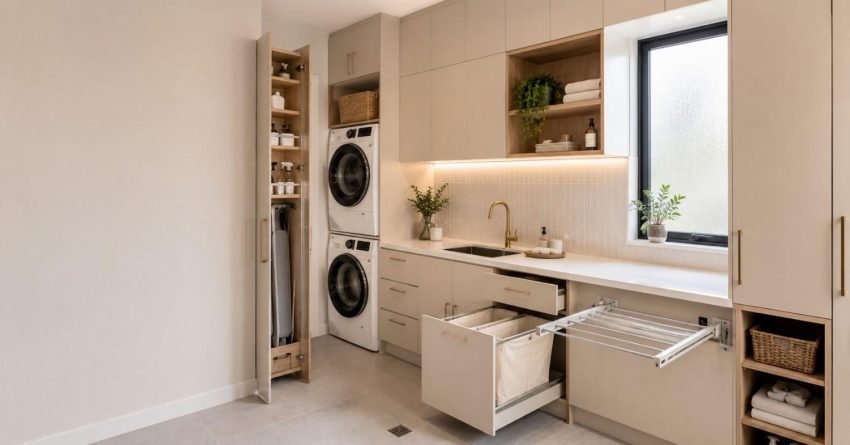
Smart laundry storage turns even the smallest Sydney laundry into a fully functional room by using vertical space, custom joinery, and slimline solutions that pack genuine utility into every square centimetre. The right combination of cabinetry, benches, and concealed fittings delivers calm, organised function without expanding the footprint.
Most Sydney laundries sit between 3 and 6 square metres, which leaves zero room for wasted space, awkward gaps, or storage that doesn’t earn its keep on a daily basis. Whether we’re working with a compact terrace in Surry Hills, a cupboard laundry in a Parramatta apartment, or a full-sized room in a suburban house, the storage strategy has to match the space.
This guide walks through eight proven storage approaches, covering vertical layouts, built-ins, bench solutions, slimline ideas, open shelving, European laundries, and budget-friendly upgrades, plus a practical planning framework to help you decide where to start.
Why Smart Laundry Storage Matters in Sydney Homes
Laundry storage shapes how a household actually functions. In Sydney, where homes range from compact terraces in Surry Hills to apartment laundries in Parramatta, the difference between a useful laundry and a cluttered one usually comes down to storage planning, not floor space.
The Space Challenge in Modern Sydney Layouts
Newer apartments push laundries into cupboards. Older homes tuck them behind kitchens or under stairs. Heritage terraces often have laundries inside enclosed verandahs with sloped ceilings and limited plumbing access.
Each layout demands a different storage strategy. An apartment laundry needs vertical compression and concealed fittings. A terrace laundry often needs custom joinery to work around uneven walls and low ceiling sections. A suburban house laundry has more floor area but still wastes it without a deliberate plan. Trying to apply a generic solution across these three home types wastes both money and usable space.
Storage Needs by Household Size
A couple in a two-bedroom apartment needs a very different storage setup than a family of five in a four-bedroom house. Couples typically need one hamper zone, a compact folding surface, and two to three shelves for detergents and cleaning supplies. Families need separated hamper drawers for sorting, a full benchtop for folding, and enough cabinetry to handle bulk detergent, school uniforms, sports gear, and seasonal linen simultaneously.
We always ask clients how many loads they run per week before recommending a storage configuration. That single number shapes every decision from hamper size to shelf depth.
How Storage Drives Long-Term Laundry Value
Well-planned storage protects fittings, hides clutter, and extends the working life of appliances. It also adds resale appeal. Sydney buyers consistently respond to laundries that present as tidy, considered, and capable of handling a real family’s weekly load.
How to Plan Your Laundry Storage: Where to Start
Before choosing any product or joinery configuration, we work through four questions with every client. Getting these right prevents expensive mistakes and ensures the finished storage actually fits the room and the household.
Measure the room accurately. Record ceiling height, wall width, door swing, window position, and the location of plumbing and electrical points. These measurements determine which storage types are physically possible before any design decisions are made.
Identify your daily workflow. Where do dirty clothes enter the room? Where do clean clothes leave? The storage layout should follow that path, not fight it. Hampers belong near the entry point. Folding surfaces belong near the exit.
Separate must-haves from nice-to-haves. Every laundry needs hamper storage, a folding surface, and space for detergents and cleaning supplies. Everything else pull-out ironing boards, drying racks, linen storage is a priority decision based on budget and available space.
Set a realistic budget range. Storage upgrades in Sydney range from a few hundred dollars for modular and DIY solutions to twelve thousand dollars or more for full custom joinery. Knowing your ceiling before you start prevents over-investment in joinery for a room that doesn’t need it, and under-investment in a room that does.
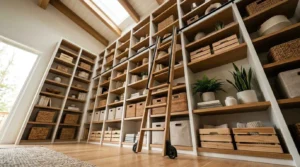
Vertical Storage Ideas That Use Full Wall Height
The space above your washing machine is the single most underused area in any laundry. Pushing storage up to the ceiling instantly multiplies capacity without sacrificing floor area or walkways.
Ceiling-Height Cabinetry
Standard overhead cupboards stop around 2.1 metres, but ceilings in most Sydney homes sit between 2.4 and 2.7 metres. Extending cabinets the full distance closes that gap and turns it into seasonal storage for spare linen, cleaning stock, or rarely used appliances.
The key measurement is the distance between the top of the appliance stack and the ceiling. In most Sydney laundries, this runs between 600 mm and 900 mm, enough for two deep shelves or a full cabinet with adjustable internals. We always recommend adjustable shelf pins rather than fixed shelves so the configuration can change as household needs shift. Ceiling-height units also read as a single visual element, which makes a small room feel more resolved and less cluttered.
Stacked Open Shelving
Two or three open shelves above benches give quick access to detergents, baskets, and folded towels. Open shelving works best when contents stay visually consistent. Matching baskets, labelled jars, and uniform bottles keep the look calm.
Pull-Down Rails and Drying Racks
A retractable rail mounted high on the wall doubles as a drying line on rainy days and stays out of sight when not in use. Wall-mounted folding drying racks are a strong alternative; they extend outward when loaded and fold flat against the wall when empty, taking up no floor space at all.
For laundries with ceiling heights above 2.4 metres, a ceiling-mounted pulley drying rack is worth considering. These systems lift a full load of washing to ceiling height for drying, then lower it for unloading. They are particularly effective in European-style laundries where floor and bench space is limited. The rail or rack should be positioned so it doesn’t obstruct the appliance door swing when extended.
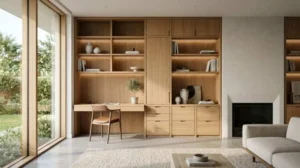
Built-In Cabinetry and Custom Joinery Solutions
Built-in joinery delivers the highest storage-to-footprint ratio of any approach. Every centimetre serves a defined purpose, from hidden hampers to integrated appliance bays.
Floor-to-Ceiling Cupboards
A single run of full-height cupboards along one wall can store everything from brooms to ironing boards to detergents in one tidy line. Internal dividers and pull-outs prevent the deep-cupboard problem of items getting lost at the back.
We typically configure floor-to-ceiling runs with three zones: a base zone for hampers and heavy items, a mid zone at bench height for daily-access storage, and an upper zone for seasonal and bulk items. Internal pull-outs in the base zone are more practical than fixed shelves because they bring the full depth of the cabinet to the front. For the upper zone, a simple fixed shelf with a lip prevents items from shifting during door operation.
Integrated Appliance Towers
Stacking the washer and dryer in a tall cabinet frees floor space for a wide drawer column beside them. This works particularly well in narrow Sydney laundries where every horizontal metre counts.
Standard front-loader washing machines are 600 mm wide and 600 mm deep. A stacking kit raises the dryer to a comfortable unloading height, typically around 900 mm from the floor, which also eliminates the need to crouch when transferring loads. The cabinet surrounding the stack needs a minimum 50 mm clearance on each side for ventilation, and the dryer must have an unobstructed exhaust path. We always confirm these clearances before finalising any appliance tower design.
Under-Cabinet and Interior Cabinet Lighting
Lighting is one of the most overlooked elements in laundry storage design. A well-lit cabinet makes it easy to find items quickly and reduces the chance of grabbing the wrong product in a hurry.
LED strip lighting under wall cabinets illuminates the benchtop and the appliance zone without adding heat. Interior cabinet lighting, either a simple LED puck light or a motion-activated strip, makes deep upper cabinets genuinely usable rather than a place where things disappear. Both options run on low-voltage systems and can be wired into the laundry’s existing circuit during a joinery installation.
Pull-Out Hamper and Basket Drawers
Concealed laundry hampers built into base cabinetry separate whites, colours, and delicates without leaving baskets on the floor. A standard three-section hamper drawer fits into a 600 mm wide base cabinet and holds a full week’s washing for a family of four.
Materials That Survive Sydney’s Humidity
Laundry environments are genuinely harsh. Steam from the dryer, condensation from the washing machine, and occasional water splashes from the trough all attack cabinetry materials over time.
Moisture-resistant board, sometimes called MR board or HMR board, is the minimum standard for laundry joinery. It resists swelling and delamination in humid conditions where standard particleboard fails within a few years. Sealed laminate finishes outperform painted finishes in wet zones because the laminate layer is non-porous. For hardware, powder-coated metal handles and soft-close hinges with stainless or zinc internals outlast chrome-plated fittings in humid rooms. We avoid raw timber and untreated MDF in any zone near the washing machine, trough, or an unventilated cupboard.
Bench Top and Under-Bench Storage Ideas
A continuous benchtop above your appliances gives you a folding surface and unlocks the cabinetry beneath. Smart under-bench design transforms this zone into the most productive area in the room.
Folding Bench with Hidden Drawers
A 600 mm deep benchtop creates a stable folding surface. Underneath, shallow drawers store pegs, soap, and stain treatments while deeper drawers hold towels and linen.
The ideal bench height for folding is between 870 mm and 900 mm, the same ergonomic range as a kitchen benchtop. Going lower creates back strain during extended folding sessions. The bench surface should overhang the appliances by at least 20 mm on each side so items don’t roll off the edge. For the drawer configuration beneath, we typically run two shallow drawers at the top for daily-use items and one deep drawer below for linen, with full-extension runners so the entire drawer depth is accessible.
Under-Bench Pull-Out Bins
Recycling, dirty linen, and rags belong out of sight. Pull-out bin systems in base cabinets handle this cleanly and prevent odours from escaping into the room.
A double pull-out bin in a 450 mm wide cabinet handles general waste and recycling. For laundry-specific use, a single deep pull-out with a removable liner works well for rags and cleaning cloths. Ventilated bin inserts with perforated sides reduce odour build-up significantly compared to solid-sided bins in enclosed cabinets.
Slide-In Ironing Board Compartments
A vertical slot beside the cabinetry holds a folded ironing board flat against the wall. The slot needs to be at least 150 mm wide and 1,400 mm tall to accommodate a full-size ironing board, with a minimum 50 mm clearance from any adjacent cabinet door to allow the board to slide in and out without obstruction. A simple hook or magnetic catch at the top of the slot keeps the board secure when not in use.
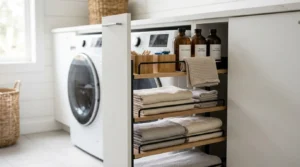
Slimline and Narrow Laundry Storage Solutions
Narrow laundries reward depth, not width. Choosing storage that is taller, thinner, and pull-out based unlocks usable capacity inside spaces that look hopeless on paper.
Slim Pull-Out Pantries
A 150 mm wide pull-out unit beside the washing machine holds detergents, sprays, and brushes in clear view. Pull-out designs prevent items from being lost behind one another.
These units are available in widths from 100 mm to 300 mm and can be freestanding or built into a joinery run. The 150 mm width is the most practical for laundry use, wide enough for standard detergent bottles standing upright, narrow enough to fit beside most appliances without reducing the walkway. Internal wire shelves allow air circulation and make it easy to see the full contents at a glance.
Over-Door and Behind-Door Racks
The back of a laundry door rarely earns its keep. Adding a tiered rack instantly creates space for cleaning supplies, mop heads, or ironing accessories. Over-door racks require a door clearance check: the rack depth plus the door thickness must clear the door frame and any adjacent cabinetry when the door swings open.
Vertical Cleaning Cupboards
A tall, slim cupboard with internal hooks holds brooms, mops, and vacuum attachments upright. The most effective configurations use a combination of fixed hooks at the top for long-handled items and a shallow shelf at mid-height for smaller accessories. Door clearance is the critical measurement: the cupboard door needs enough swing room to open fully without hitting the washing machine or an adjacent wall. In very tight laundries, a sliding door on the cleaning cupboard eliminates the swing problem entirely.
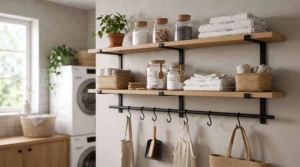
Open Shelving, Hooks, and Rail Systems
Not every laundry needs full cabinetry. Open systems suit smaller budgets, rental upgrades, and homeowners who prefer visible, easy-access storage.
Floating Shelves Above Appliances
Two timber or laminate shelves above the washer and dryer create instant capacity. Brackets matter here. Heavy-duty concealed fixings prevent sagging under loaded baskets.
For laundry shelving, we recommend brackets rated to at least 25 kg per shelf; a full basket of wet washing is heavier than most people expect. Concealed keyhole brackets give a cleaner look than visible L-brackets and distribute load more evenly across the shelf length. Shelf depth above appliances should match the appliance depth (typically 600 mm) so items at the back of the shelf remain accessible without reaching over the machine.
Wall-Mounted Rail and Hook Systems
A horizontal rail with movable hooks stores brushes, dustpans, spray bottles, and washing aids in one tidy strip. This system suits renters and DIY upgrades because it requires only basic wall fixings. A 900 mm rail with six to eight movable hooks handles the full range of laundry accessories for most households. The rail should be positioned at a height where the longest hanging item, typically a mop, clears the floor by at least 50 mm.
Decorative Baskets and Bins
Natural fibre baskets soften the visual weight of laundry contents and group small items into clear categories. Matching bin sizes keep shelves looking deliberate rather than cluttered. For open shelving in humid laundries, we prefer woven seagrass or synthetic rattan over natural jute; both handle moisture better and resist mould more effectively in poorly ventilated rooms.
European Laundry and Combined Bathroom Layouts
European-style laundries hidden inside cupboards or combined with bathrooms are common across Sydney apartments. These layouts demand storage planning from the very first design decision.
Concealed Cupboard Laundries
A European laundry compresses everything into a single 900 mm or 1200 mm cupboard. Vertical stacking, slimline shelving above the appliances, and a single pull-out basket below handle the essentials.
The 900 mm configuration fits a front-loader washing machine only, with a condensing dryer stacked above it and a single shelf above that. The 1200 mm configuration allows a side-by-side washer and dryer arrangement with a shelf above, which is more practical for households that run frequent loads. Both configurations require a ventilated door or a louvred panel: a solid door traps heat and moisture from the dryer and accelerates cabinet deterioration. We always specify a minimum 10 mm gap at the top and bottom of the door panel for airflow.
Dual-Purpose Storage in Bathroom Laundries
Combined bathroom laundries share storage between two rooms. The most effective approach is to treat the two functions as separate zones within the same space: laundry storage on one wall, bathroom storage on the adjacent wall rather than mixing them together.
Shared zones work well for linen, which serves both the bathroom and the laundry. A single tall linen cupboard positioned between the two functional zones handles towels, spare sheets, and bathroom supplies without duplicating storage. Waterproofing is the critical difference in a combined bathroom laundry; all cabinetry within the wet zone must be built to bathroom waterproofing standards, not standard laundry specifications.
Budget-Friendly Ways to Add Laundry Storage
Storage upgrades do not require a full renovation. Many Sydney homeowners add meaningful capacity for under two thousand dollars by selecting the right combination of modular and DIY solutions.
Affordable Modular Storage Units
Flat-pack laundry units from major retailers fit most standard widths and install in a weekend. The trade-off is durability. Modular units typically last five to eight years before showing wear.
The best modular options for Sydney laundries are those built from moisture-resistant board rather than standard particleboard; the product specification sheet will confirm this. Major hardware retailers stock laundry-specific flat-pack ranges that include base cabinets, wall cabinets, and benchtops in standard 600 mm and 900 mm widths. These fit the majority of Sydney laundry configurations without modification.
What Laundry Storage Upgrades Cost in Sydney
Understanding the cost range before committing to a storage solution prevents both over-spending and under-spending. DIY and modular upgrades: shelves, rails, over-door racks, flat-pack cabinets typically run between $200 and $1,500 depending on the number of units and the quality of fittings.
Semi-custom joinery, where a cabinetmaker builds to standard dimensions but with some configuration flexibility, generally falls between $2,000 and $5,000 for a complete laundry. Full custom joinery designed specifically for the room’s exact dimensions, with premium hardware and finishes, ranges from $5,000 to $12,000 or more depending on materials, linear metres, and the complexity of internal fittings. The investment in custom joinery is most justified in laundries that will be used daily for ten or more years, or in homes where the laundry is visible from a living area and finish quality matters for resale.
DIY Upgrades Without Renovating
Adhesive hooks, tension rods, stackable bins, and over-door organisers create real storage gains for very little cost. Group purchases by category to avoid a piecemeal look that undermines the rest of the room. A coordinated set of matching baskets, a single rail system, and two floating shelves can transform a bare laundry wall for under $300 and install in an afternoon without any trades.
Conclusion
Smart laundry storage combines vertical cabinetry, custom joinery, slimline pull-outs, and open shelving to maximise every centimetre of even the smallest Sydney laundry footprint. The right solution depends on the home type, the household size, and the budget, not on a generic list of products.
The best storage plan starts with accurate measurements, a clear workflow, and a realistic budget range. Generic solutions waste both money and space, and the most common mistake we see is choosing storage based on appearance before confirming it physically fits the room.
At Sydney Home Renovation, we design and build laundry storage solutions tailored to your home, your habits, and your budget. Contact us today to start planning a laundry that finally works the way it should.
Frequently Asked Questions
How much storage does a standard Sydney laundry need?
A typical household needs around two linear metres of cabinetry combined with one tall cupboard. This handles detergents, baskets, cleaning gear, and seasonal items without overcrowding the room.
What is the most space-efficient laundry storage solution?
Floor-to-ceiling custom joinery delivers the highest storage-to-footprint ratio. It uses dead zones above appliances and behind doors that modular units cannot reach in narrow Sydney layouts.
Can I add storage to a small European laundry?
Yes. Slimline pull-outs beside the appliances, stacked shelving above them, and a single hamper drawer below convert a basic cupboard laundry into a functional working space.
How much does custom laundry joinery cost in Sydney?
Custom laundry joinery in Sydney typically ranges between $5,000 and $12,000 depending on materials, hardware, and the number of linear metres included in the design.
What materials work best for laundry storage in humid conditions?
Moisture-resistant board, sealed laminate finishes, and powder-coated metal hardware perform best. We avoid raw timber and untreated MDF in zones near washing machines, sinks, and unventilated cupboards.
What should I do first when planning laundry storage?
Measure the room accurately before choosing any product. Record ceiling height, wall width, door swing, and plumbing positions. These measurements determine which storage types are physically possible.
Does lighting matter in laundry storage design?
Yes. LED strip lighting under wall cabinets and motion-activated interior cabinet lighting make storage genuinely usable. Deep upper cabinets without lighting become dead zones where items are forgotten.


