A well-planned ensuite balances three things at once: an efficient layout, durable materials, and a budget that holds together from concept to handover. For Sydney homeowners, that balance is what separates a confident renovation from a costly compromise.
Ensuites are now a baseline expectation in modern Sydney homes, and design decisions made early shape every cost and finish that follows. The position of a single wet wall, the choice between a walk-in shower and a freestanding bath, the tile format selected before demolition begins each of these locks in downstream costs that are expensive to reverse mid-build.
This guide covers ensuite layout options, space-saving and luxury design ideas, smart material choices, lighting and storage essentials, waterproofing compliance, renovation costs, common mistakes, and how to plan your renovation with confidence from day one.
What Makes an Ensuite Different from a Main Bathroom
An ensuite is a private bathroom accessed directly from a bedroom, typically the master suite, and built around the needs of one or two people rather than a full household. That single difference reshapes layout priorities, fittings, and budget allocation entirely.
Where a main bathroom must serve guests, children, and shared family use across different times of day, an ensuite is optimised for a single routine. That changes everything from the size of the vanity to the placement of the shower head.
Key Functional and Design Priorities
Ensuites prioritise efficiency over volume. The focus is a streamlined shower, vanity, and toilet configuration with finishes that match the bedroom’s aesthetic rather than a general-purpose wet area.
Storage is more compact by design. Water pressure planning matters more in an ensuite because close-quarters plumbing means hot water delivery times and flow rates affect the daily experience directly. We also see acoustic separation treated as an afterthought; far too often the wall between the ensuite and the bedroom needs to be planned for sound, not just waterproofing.
Acoustic Separation and Bedroom Privacy
Toilet flush noise, exhaust fan vibration, and shower plumbing rattle all travel through lightweight stud walls with no acoustic treatment. In our experience, adding acoustic insulation batts to the shared wall between the ensuite and bedroom adds minimal cost at the framing stage and eliminates one of the most common post-renovation complaints.
Specifying a quiet-rated exhaust fan and a soft-close toilet seat are two other low-cost decisions that make a measurable difference to bedroom comfort.
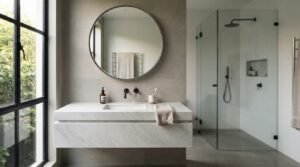
Smart Ensuite Layout Options for Sydney Homes
Layout drives every cost downstream. The position of plumbing, the wall the shower sits on, and the order of fixtures around the room determine framing changes, waterproofing zones, and how much space is actually usable. Three layouts dominate Sydney ensuite renovations.
Single Wet Wall Layout
All plumbing fixtures sit along one wall: toilet, vanity, and shower in a single line. This is the most cost-effective layout because it concentrates pipework, waste lines, and waterproofing into one zone.
It works best in narrow ensuites between 3 and 5 square metres and keeps labour costs predictable. We recommend this layout as the default starting point for any ensuite under 5 square metres; it is the easiest to price, the easiest to waterproof correctly, and the easiest to maintain.
Parallel Wall Layout
Fixtures are split across two facing walls, typically with the vanity and toilet on one wall and the shower opposite. This layout opens up floor space, improves circulation, and suits ensuites between 5 and 7 square metres.
Plumbing costs rise slightly because two wet walls require independent waterproofing zones. The trade-off is a noticeably more generous feel underfoot, which matters in ensuites that serve a master suite used daily by two people.
Three Wall U-Shape Layout
Fixtures wrap around three walls, leaving a central walkway. This layout suits larger ensuites above 7 square metres and allows for double vanities, a freestanding bath, or a generous walk-in shower.
When this layout forms part of an upper-level expansion, structural planning becomes critical. Floor layouts, plumbing stacks, and load paths all interact; decisions made at the structural stage determine what is possible at the fitout stage, so engaging a builder and plumber together early prevents costly redesigns.
How Much Does an Ensuite Renovation Cost in Sydney?
Renovation cost is the question we hear first, and it deserves a direct answer rather than a footnote in the FAQ.
A standard ensuite renovation in Sydney typically ranges from $18,000 to $35,000 for a like-for-like refresh with quality mid-range finishes. Luxury builds with stone surfaces, freestanding baths, and custom joinery regularly exceed $50,000. The three biggest cost drivers are layout changes, material grade, and the condition of existing waterproofing and plumbing.
What Drives Ensuite Renovation Costs
Moving plumbing is the single largest cost variable. Keeping fixtures on an existing wet wall and working within the current footprint holds costs down. The moment a toilet or shower moves to a new wall, you add new waste lines, new waterproofing zones, and additional tiling labour.
Material grade is the second driver. Porcelain tiles, brushed-metal tapware, and frameless glass screens sit at a different price point than ceramic tiles and chrome fittings, but the gap is smaller than most homeowners expect, and the durability difference is significant over a ten-year horizon.
We always recommend building a 10 to 15 percent contingency into the budget before demolition begins. Hidden waterproofing failures, deteriorated substrate, and out-of-square walls are common in Sydney’s older housing stock and cannot be fully assessed until the tiles come off.
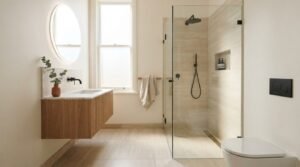
Space-Saving Design Ideas for Small Ensuites
Sydney’s older terraces, semi-detached homes, and apartments often leave only 3 to 4 square metres for an ensuite. Smart design recovers usable space without compromising comfort or compliance.
Wall-Hung Vanities and Toilets
Wall-hung fixtures lift the visual weight off the floor, making small ensuites feel larger and easier to clean underneath. They require a concealed in-wall cistern frame for the toilet and additional wall reinforcement for the vanity, which adds modest cost but delivers a noticeably more open feel.
The floor-to-ceiling visual line created by wall-hung fixtures is one of the most effective space-expanding techniques available in a small ensuite. It costs more upfront and pays back in perceived space every day.
Walk-In Showers, Sizing, and Screen Options
A walk-in shower with a single frameless glass panel removes the visual barrier of a shower screen and stops the room from feeling chopped into sections. The NCC minimum shower floor area is 900 x 900 millimetres; we treat this as an absolute floor, not a target. In practice, a 1,000 x 1,000 millimetre shower base transforms the daily experience in a small ensuite.
Linear floor drains allow a continuous tile pattern from the main floor into the shower, further expanding the perceived space. Frameless screens outperform semi-frameless in both appearance and long-term maintenance because there are fewer metal channels to collect soap scum and mould. Pair the screen with large-format, light-coloured tiles to amplify the effect.
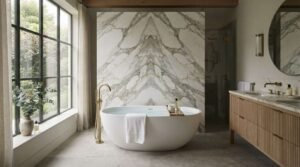
Luxury Ensuite Design Ideas for Larger Spaces
When floor area allows, the design conversation shifts from efficiency to experience. Luxury ensuites are defined less by expensive fittings and more by considered proportions, layered materials, and standout focal points.
Freestanding Baths and Double Vanities
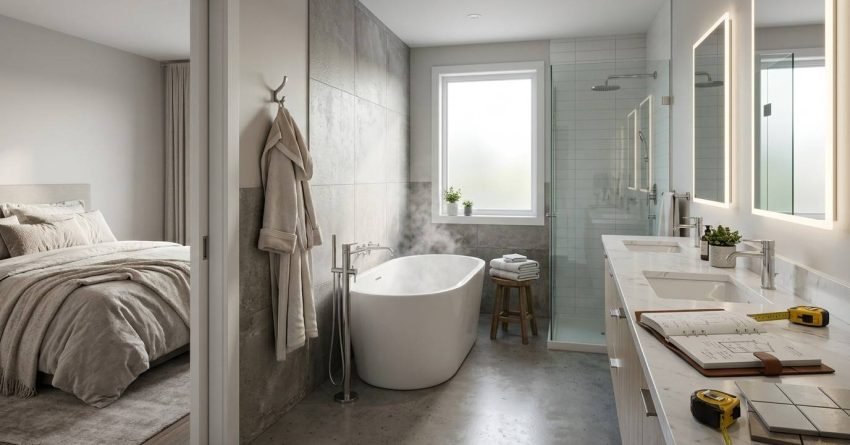
A freestanding bath positioned against a feature wall or under a window becomes the room’s anchor. In Sydney master suites, we see the best results when the bath sits on the wall opposite the entry point; it reads as a destination rather than an obstacle.
Freestanding baths work best in ensuites above 6 square metres with a clear floor zone of at least 800 millimetres on the access side. Below that threshold, a built-in bath or no bath at all delivers better daily function. Double vanities reduce daily friction in shared master suites and visually balance larger layouts. Both add to plumbing and joinery costs but deliver strong long-term value at resale.
Feature Walls, Niches, and Stone Finishes
Stone slab feature walls, recessed shower niches with feature tile, and continuous vein-matched surfaces lift an ensuite from functional to high-end. These details require careful tiler skill and tighter project coordination.
They are also the elements buyers and valuers notice first. In our experience, a well-executed stone feature wall in an ensuite adds more perceived value than almost any other single finish decision in the room.
Material and Finish Choices That Add Long-Term Value
Material selection is where renovation budgets stretch or collapse. Choosing well early prevents callbacks, premature replacement, and the kind of dated finishes that hurt resale value within a few years.
Tiles: Format, Finish, and Grout Selection
Porcelain tiles outperform ceramic in wet-area durability and are now available at a similar price point. For floor tiles, a 600 x 600 millimetre format works well in ensuites under 5 square metres. In larger ensuites, a 600 x 1,200 millimetre format reduces grout lines and creates a cleaner visual plane.
Grout colour is a decision most homeowners underestimate. Dark grout stains and ages poorly in wet areas. We recommend a mid-tone grout that is close to the tile body colour; it hides variation without the maintenance burden of a contrasting dark grout.
Tapware and Cabinetry Selection
For tapware, brushed nickel, matte black, and brushed brass remain dominant in Sydney design trends. Solid-brass bodies with quality ceramic cartridges matter more than the finish itself; a quality cartridge lasts decades; a cheap one fails within a few years regardless of how good the finish looks.
Cabinetry should be made from moisture-resistant board with soft-close hardware and sealed edges to prevent swelling at the base. Mirror cabinets sized to the full width of the vanity maximise storage without adding visual clutter. A shaving cabinet recessed into the wall saves 80 to 100 millimetres of depth in a tight ensuite.
A practical rule for ensuite finishes: spend on what you touch and see daily tapware, shower screens, and the vanity top and economise on what is hidden or easily replaced later, such as decorative accessories.
Lighting and Natural Light
Effective ensuite lighting uses three layers: ambient ceiling light, task lighting at the vanity, and a subtle accent or LED strip for evening use.
Task lighting at the vanity works best when positioned either side of the mirror rather than above it. Overhead-only lighting casts shadows across the face that make grooming difficult. Side-mounted lights or a backlit mirror eliminate this problem entirely.
A skylight or high-set window dramatically improves the feel of a small ensuite and reduces daytime electricity use. In Sydney’s terrace and semi-detached housing stock, a roof-mounted skylight is often the only way to introduce natural light into an internal ensuite, and it is almost always worth the investment.
Ventilation and Storage
A properly sized exhaust fan vented to the exterior is non-negotiable in Sydney’s humid summers. Recirculating fans are not compliant for wet areas under the NCC and create ongoing mould problems that are expensive to remediate. The fan should be sized to the room volume and ducted directly to the exterior, not into a ceiling cavity.
Heated towel rails double as drying racks and low-output heating. In Sydney’s mild winters, a 60 to 80 watt heated towel rail is often sufficient to take the chill off a small ensuite without a dedicated heat lamp.
Storage should be planned inside the vanity, in mirror cabinets, and via shower niches rather than added later through freestanding furniture that dates quickly. A recessed niche in the shower wall, tiled to match the surround, adds storage with zero floor footprint and looks intentional rather than retrofitted.
Common Ensuite Design Mistakes to Avoid
Most ensuite regrets trace back to a small number of recurring errors. Avoiding them costs nothing at the planning stage and protects both budget and outcome.
Relocating plumbing unnecessarily is the most expensive mistake we see. When an existing wet wall would have worked, moving fixtures to a new wall adds waste lines, waterproofing, and tiling labour that can push a budget out by $3,000 to $8,000 for no functional gain.
Undersizing the shower below 900 x 900 millimetres is the most common comfort mistake. Forgetting to plan for a robe hook or towel rail within arm’s reach of the shower is the most common daily-use mistake. Selecting trend-driven finishes that date within five years is the most common resale mistake. Each of these can be designed out at the planning stage with no impact on cost.
Treating acoustic separation as optional is a mistake we see most often in apartment and terrace renovations. A single layer of acoustic insulation batt in the shared wall costs under $200 and eliminates years of noise complaints.
Waterproofing Standards and NCC Compliance
Poor waterproofing is the single most expensive defect to remediate and almost always requires removing tiles, screed, and substrate to fix properly. We treat waterproofing as the most critical trade on any wet-area project.
Under the NCC, wet areas require a continuous waterproofing membrane applied to the floor and walls to a minimum height of 1,800 millimetres in shower zones and 150 millimetres above the floor on all other wet-area walls. The membrane must be applied by a licensed waterproofer and inspected before tiling begins. Skipping the inspection to save time is a false economy; a failed waterproofing membrane discovered after tiling costs multiples of what the inspection would have cost.

Planning Your Ensuite Renovation with Confidence
A successful ensuite renovation follows a clear sequence: confirm scope and layout, lock in a realistic budget with a 10 to 15 percent contingency, finalise all material selections before demolition, and engage trades who specialise in wet-area work. Decisions made in this order prevent the most common cause of overruns, which is changing selections mid-build.
Trade Sequencing and Lead Times
The correct trade sequence for an ensuite renovation is: demolition, structural and framing, rough-in plumbing and electrical, waterproofing and inspection, tiling, fit-off plumbing and electrical, joinery installation, and final fixtures. Disrupting this sequence most often by starting tiling before waterproofing is inspected creates defects that are expensive to fix.
Lead times matter more than most homeowners expect. Custom joinery typically takes four to six weeks from order to delivery. Imported tiles can take eight to twelve weeks. We recommend finalising all selections and placing orders before demolition begins, not after. A renovation that starts without confirmed material lead times almost always stalls mid-build.
Ensuite Renovation and Property Value in Sydney
A well-executed ensuite renovation consistently ranks among the highest-return improvements in Sydney’s residential market. An ensuite in a master suite that previously lacked one adds both functional value and market appeal, particularly in the sub-$2 million owner-occupier segment where buyers compare properties closely.
The return is strongest when the ensuite finish level matches the rest of the home. Over-specifying an ensuite in a modest home recovers less than a proportionate finish would. We help clients calibrate finish level to their property’s market position so the investment lands where it delivers the most value.
Conclusion
Ensuite design rewards clarity early. Layout, materials, lighting, and storage decisions made before demolition protect your budget, your timeline, and the long-term value of the finished room.
Sydney homeowners who plan carefully end up with ensuites that look considered, function effortlessly, and hold their value well past the renovation itself. The difference between a renovation that runs smoothly and one that blows out almost always comes down to decisions made in the first two weeks of planning.
At Sydney Home Renovation, we help homeowners and investors plan, design, and build ensuites that balance cost, quality, and long-term value with complete transparency from the first conversation to final handover. If you are ready to plan your ensuite renovation, we are ready to help you get it right.
Frequently Asked Questions
How much does an ensuite renovation cost in Sydney?
A standard ensuite renovation in Sydney typically ranges from $18,000 to $35,000, with luxury builds exceeding $50,000. Final cost depends on layout changes, material grade, fittings selected, and the condition of existing plumbing and waterproofing.
What is the minimum size for a functional ensuite?
The practical minimum is around 3 square metres, fitting a toilet, vanity, and 900 x 900 millimetre shower along a single wet wall. Below this, layout becomes cramped, and resale appeal drops noticeably.
Should I put a bath in my ensuite?
A bath is generally only worthwhile in ensuites above 6 square metres or when it serves a clear lifestyle or resale purpose. In smaller ensuites, a quality walk-in shower delivers better daily use and stronger return on investment.
How long does an ensuite renovation take?
Most ensuite renovations take three to five weeks from demolition to final handover. Timelines extend when structural changes, custom joinery, or imported finishes are involved, so confirm lead times during planning.
Do I need council approval for an ensuite renovation?
Internal ensuite renovations within an existing footprint usually fall under exempt or complying development in NSW. Approval is generally required when you alter structural walls, change the building footprint, or add an ensuite as part of an extension.
What is the best layout for a small ensuite?
A single wet wall layout is the most efficient for small ensuites under 5 square metres. It concentrates plumbing, simplifies waterproofing, controls cost, and leaves more usable floor area for movement and storage.
How do I make a small ensuite feel larger?
Use wall-hung fixtures, large-format light-coloured tiles, a frameless glass shower screen, and layered lighting including natural light where possible. Continuous tiling from main floor into shower removes visual breaks and expands the perceived space.
How do I choose the right tiles for my ensuite?
Porcelain outperforms ceramic in wet areas. Choose a 600 x 600 millimetre format for small ensuites and 600 x 1,200 millimetre for larger ones. Select a mid-tone grout close to the tile body colour to minimise maintenance and avoid premature ageing.
Does an ensuite add value to a Sydney home?
Yes. A well-executed ensuite consistently delivers strong return in Sydney’s residential market, particularly in master suites that previously lacked one. Matching the finish level to the property’s market position maximises the return on investment.