The best bathroom layout for a small space is the one that places the toilet, basin, and shower along a single plumbing wall while preserving at least 600mm of clear floor space in front of each fixture. That single principle drives every smart small-bathroom design decision in Sydney homes.
Small bathrooms now make up a large share of Sydney renovations, especially in apartments, terraces, and older suburban homes. The right layout protects your budget, increases resale value, and makes daily use comfortable.
This guide compares the best small bathroom layouts, matches them to real Sydney floor sizes, explains space-saving strategies, and covers common mistakes, costs, and planning steps for confident decisions.
What Makes a Bathroom Layout Work in a Small Space
We find that a small bathroom layout works when every fixture has functional clearance, plumbing runs are short, and the visual line of sight from the doorway feels open rather than crowded. The goal is not to fit more in. The goal is to fit the right things in the right order.
The Three Non-Negotiable Clearances
Three measurements decide whether a layout is comfortable or cramped. You need at least 600mm of clear floor space in front of the toilet, 700mm in front of the basin, and 900mm × 900mm inside a standard shower.
| Fixture | Minimum Clearance | Recommended Clearance |
| Toilet | 600mm in front | 700mm in front |
| Basin / Vanity | 700mm in front | 800mm in front |
| Shower | 900mm × 900mm internal | 1,000mm × 1,000mm internal |
| Door swing | 820mm clear arc | Cavity slider eliminates conflict |
When any of these are compromised, the bathroom feels tight regardless of how attractive the finishes look. AS 1428.1 sets the accessible design benchmarks, and we use those figures as our minimum starting point on every project.
Plumbing Wall Logic and Cost Impact
The single biggest cost driver in a small bathroom is the plumbing wall. Keeping the toilet, basin, and shower drains aligned along one wet wall cuts labour hours, reduces waterproofing risk, and avoids slab cutting in ground-floor apartments.
Moving plumbing across a room can add several thousand dollars to a renovation that otherwise stays modest. We always map the existing drain stack before recommending a layout change.
Accessibility and Universal Design in Small Bathrooms
A well-planned small bathroom can meet universal design standards without sacrificing style or space. We recommend a hobless shower threshold, an 820mm clear door opening, and blocking in the walls for future grab bars even if you don’t install them now.
These decisions cost almost nothing at the build stage and add genuine resale appeal. Buyers increasingly look for bathrooms that work across life stages, and Sydney’s ageing population makes this a practical investment.

The Best Bathroom Layouts for Small Sydney Homes
Five layouts consistently outperform the rest in compact Sydney bathrooms. Each suits a different shape and size of room. Use this table to match your floor shape to the right starting point, then read the detail below.
| Layout | Best Room Shape | Plumbing Walls | Cost Tier | Best For |
| Three-in-a-Row (Linear) | Long and narrow | 1 | $ Low | Terraces, older apartments |
| L-Shaped | Roughly square | 1–2 | $$ Mid | Apartments, townhouses |
| Galley (Parallel) | Narrow rectangle | 2 | $$–$$$ Mid-High | Through-bathrooms |
| Corner Shower | Very small square | 1 | $ Low–Mid | Ensuites under 4m² |
| Wet Room | Any small shape | 1 | $$$ High | Premium small bathrooms |
Three-in-a-Row (Linear) Layout
The linear layout places the toilet, basin, and shower along one long wall. It is the most cost-efficient design because every fixture shares the same plumbing wall, drainage stack, and waterproofing membrane.
It suits long, narrow bathrooms typically found in terrace houses and older apartments. We recommend an alcove shower with a frameless screen at the end of the run to keep the sightline open.
L-Shaped Layout
The L-shaped layout uses two adjacent walls, usually placing the shower on the short wall and the toilet and basin along the longer wall. It works well in roughly square rooms and creates a clearer entry sightline because the shower sits to the side rather than directly opposite the door.
A corner-entry frameless shower works particularly well here. It preserves wall length for a full-width vanity without crowding the entry.
Galley (Parallel) Layout
A galley layout splits fixtures across two opposing walls. The shower goes on one wall, the toilet and basin on the other. This layout is efficient for through-bathrooms and narrow rectangles, but it requires plumbing on both walls, which raises labour and waterproofing costs.
We use it selectively; it earns its extra cost when the room shape leaves no other option.
Corner Shower Layout
The corner shower layout tucks a square or pentagonal shower into one corner, freeing wall length for the vanity and toilet. It is the most space-efficient layout for rooms under 4m² where a standard 900mm shower would dominate the floor.
A pentagonal corner shower gains roughly 15–20% more internal floor area than a square unit in the same corner footprint. That difference is meaningful in a very tight ensuite.
Wet Room Layout
A wet room removes the shower screen entirely and waterproofs the full floor with a single gradient fall to a linear drain. It is the most visually open layout for very small bathrooms because the absence of a screen makes the room feel up to 30 percent larger.
It requires full-room waterproofing to AS 3740, which adds cost but delivers a premium finish. We find wet rooms perform best in bathrooms where the vanity and toilet sit on one wall, and the full floor can drain freely.
Choosing a Layout by Bathroom Size
Floor area dictates which layouts are realistic. Sydney bathrooms generally fall into three size brackets.
Under 3m² Powder Room and Compact Ensuite
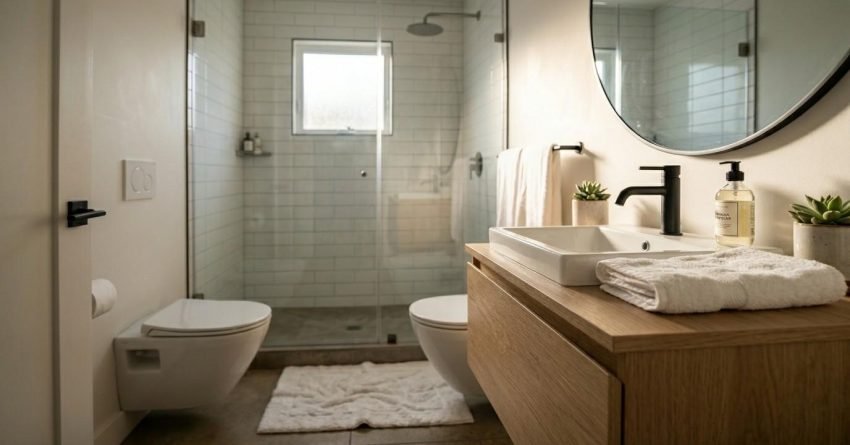
At under 3m², you are working with a powder room or a very tight ensuite. A wall-hung toilet and a 900mm corner shower are usually the only viable combination. The basin should be wall-mounted with no vanity cabinet to preserve floor visibility.
A cavity slider instead of a hinged door recovers the full swing arc, typically 400–500mm of usable floor space in a room this size. Some Sydney homeowners with very tight footprints integrate a compact European laundry into this space, which works when plumbing, ventilation, and storage are planned together from the start.
3–5m² Standard Small Bathroom
The 3–5m² bracket is the most common small bathroom in Sydney apartments and townhouses. A linear or L-shaped layout fits comfortably with a 900mm shower, a 600mm vanity, and a standard toilet.
This is where layout choice has the biggest impact on perceived size. Getting the fixture order right and keeping all plumbing on one wall is what separates a bathroom that feels generous from one that feels squeezed.
5–7m² Compact Family Bathroom
Above 5m², you have room for an L-shape with a 1200mm vanity, a separate 900mm shower, and even a compact freestanding bath if you choose carefully. Wet room layouts also become genuinely practical at this size.
We often recommend a 1500mm bath alcove opposite the vanity wall in this bracket, which keeps the floor clear and gives the room a considered, spacious feel.

Space-Saving Design Strategies That Stretch a Small Bathroom
Smart design choices make a small bathroom feel significantly larger without changing the floor plan. Wall-hung toilets and floating vanities expose more floor, which tricks the eye into reading the room as bigger. Large-format tiles with minimal grout lines create visual continuity across the floor and walls.
A frameless glass shower screen replaces a visual barrier with a transparent one. Mirrored cabinets above the vanity double as storage and reflected light.
Recessed niches in the shower wall remove the need for shelf clutter. A single well-placed niche at shoulder height keeps bottles off the floor and out of the sightline.
Lighting also matters. Layered lighting a ceiling light, a vanity light, and a soft accent strip eliminates shadowed corners that make small rooms feel smaller.
Built-In Storage That Works With Your Layout
Storage planning should follow the layout, not fight it. In a linear layout, a full-height recessed cabinet between the shower and the door uses dead wall space without projecting into the floor area.
In an L-shaped layout, the corner above the toilet is the natural home for open shelving or a semi-recessed cabinet. We specify 150mm-deep recessed niches in shower walls as standard; they hold everything a daily shower needs without adding a single millimetre to the room’s footprint.
Above-toilet shelving works in any layout where the cistern is concealed in the wall. A wall-hung toilet with an in-wall cistern frees 100–150mm of floor depth and creates a clean shelf surface at the same time.
Common Small Bathroom Layout Mistakes to Avoid
The most expensive mistake is moving plumbing unnecessarily. Every relocated drain or supply line adds labour, waterproofing work, and sometimes slab penetration costs that can run into thousands of dollars.
The second mistake is oversizing fixtures. A 1500mm vanity in a 4m² bathroom leaves no clear floor and forces awkward circulation. The third is door swing conflict: a hinged door that collides with the vanity or toilet. A cavity slider solves this in one decision and costs little more than a standard door installation.
The fourth common error is poor ventilation planning. AS 1668.2 requires a minimum extraction rate of 10 litres per second for a bathroom, and the fan must duct to outside air, not into a ceiling cavity. Without proper extraction, a small bathroom traps moisture and damages cabinetry, paint, and waterproofing within a few years. We always specify a ducted exhaust fan with a timer as a non-negotiable item.
The fifth mistake is choosing finishes before the layout is locked. Tiles, vanities, and tapware all behave differently in different layouts. Locking the layout first means every finish decision is made in context.
Budgeting Your Small Bathroom Layout in Sydney
A small bathroom renovation in Sydney typically falls between $18,000 and $35,000 depending on layout complexity, fixture grade, and structural work. Linear layouts sit at the lower end. Wet rooms and full plumbing relocations push toward the upper end.
Labour usually accounts for 40 to 50 percent of total cost in Sydney. Waterproofing, tiling, and plumbing are the three trades that vary most with layout choice, and keeping all three on a single wet wall is the most reliable way to control that variation.
From a resale perspective, linear and wet room layouts consistently perform well in Sydney’s apartment market. Buyers respond to clean sightlines and low-maintenance finishes, and both layout types deliver those qualities when executed well. A well-planned small bathroom renovation in Sydney typically returns $1.50–$2.00 for every dollar spent in the current market.

How to Plan Your Small Bathroom Layout
We follow the same five-step sequence on every small bathroom project, and we recommend homeowners use it too.
Step 1: Measure the room accurately. Floor area, ceiling height, door position, and window location all affect which layouts are viable. Measure twice before drawing anything.
Step 2: Locate the existing drain stack and supply lines. This single step determines your lowest-cost layout option. Any layout that keeps fixtures on the existing wet wall saves money.
Step 3: Map clearances before fixtures. Draw the minimum clearance zones first: toilet, basin, shower, door swing. The fixtures fill the remaining space, not the other way around.
Step 4: Choose the layout that fits the clearances and the room shape. Use the comparison table above. If two layouts both fit, choose the one with fewer plumbing walls.
Step 5: Lock the layout before selecting any finishes. Tiles, vanities, tapware, and lighting all need to be chosen in the context of a confirmed layout. Changing the layout after finishes are ordered is one of the most common causes of budget blowout.
Conclusion
The best bathroom layout for a small space balances clearance, plumbing efficiency, and visual openness. Matching the right layout to your floor shape and existing drain position protects your budget and makes daily use genuinely comfortable.
Linear, L-shaped, galley, corner shower, and wet room layouts each suit specific Sydney homes. The right choice depends on floor size, plumbing location, and how you live, and getting that match right from the start is what separates a renovation that delivers lasting value from one that costs more to fix later.
At Sydney Home Renovation, we plan small bathroom layouts that maximise space, control cost, and deliver lasting value. Contact our team to start your project with confidence.
Frequently Asked Questions
What is the smallest practical bathroom size in Sydney?
A functional three-piece bathroom needs about 3m² minimum. Anything smaller works only as a powder room we recommend a wall-hung toilet, a wall-mounted basin, and a 900mm corner shower arranged along one plumbing wall.
Is a wet room a good idea for a small bathroom?
Yes. We find wet rooms suit small bathrooms well because removing the shower screen creates open sightlines and makes the room feel larger. They require full-floor waterproofing to AS 3740 and a slight floor fall to a linear drain.
Which small bathroom layout is cheapest to build?
The three-in-a-row linear layout is the cheapest because all fixtures share a single plumbing wall, reducing pipework, waterproofing, and labour hours. We recommend it as the default starting point for any long, narrow bathroom.
Should I put the toilet next to the door or away from it?
We place the toilet away from the direct sightline of the door whenever possible. Positioning it behind a partial wall or in the far corner improves visual appeal and privacy in small bathrooms.
Can I fit a bathtub in a small bathroom?
A compact 1500mm bath fits in some 5m² bathrooms, especially with an L-shaped layout. Below 5m², a quality shower delivers better daily function: we recommend prioritising the shower unless a bath is a firm requirement.
Do I need council approval to change a bathroom layout in Sydney?
Most layout changes inside an existing bathroom do not require council approval, but plumbing changes must comply with NSW plumbing regulations. Apartment strata by-laws often require written approval before work starts; we handle that documentation as part of our project process.
How long does a small bathroom renovation take?
A standard small bathroom renovation in Sydney takes around two to three weeks once demolition starts. Wet rooms and significant plumbing changes can extend timelines by several days; we build that buffer into every project schedule.