Yes, we can help you redo a kitchen for $50,000 in Sydney, but what that budget delivers depends on your kitchen size, existing layout, material choices, and trade requirements. For most Sydney homeowners, $50,000 sits at the upper end of a mid-range renovation.
It’s capable of delivering a fully functional, well-finished kitchen when the budget is planned carefully. Understanding where that money actually goes is what separates a successful renovation from a costly overrun.
Labour, joinery, benchtops, appliances, and trades each claim a significant share before a single tile is laid. This guide breaks down every cost category in detail, from cabinet and benchtop allowances to hidden expenses and realistic expectations, so you can plan your kitchen renovation with confidence.
What Does a $50,000 Kitchen Renovation Actually Include?
A $50,000 kitchen renovation budget in Sydney can cover a complete transformation of an existing kitchen space, including new cabinetry, benchtops, splashbacks, appliances, flooring, and trade work. This works provided the layout stays largely unchanged and mid-range materials are selected throughout.
This budget doesn’t typically extend to luxury stone benchtops, high-end European appliances, and a full structural reconfiguration all at once. We always tell clients that prioritisation is essential here.
A full kitchen gut involves stripping the space back to bare walls and floor, then replacing all cabinetry, plumbing, electrical, and finishes from scratch. In Sydney, we can achieve a full gut renovation for a small to medium kitchen (up to approximately 15 square metres) within $50,000 when mid-range products are specified and the footprint stays the same.
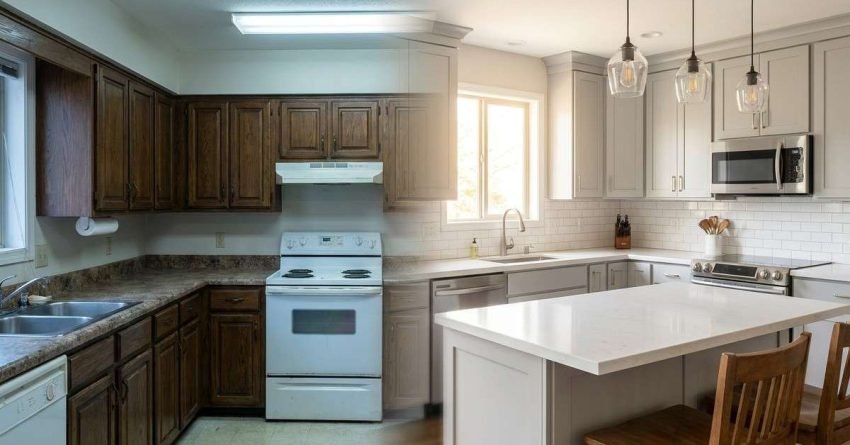
A cosmetic refresh, which means replacing cabinet doors, benchtops, and splashbacks while retaining the existing carcasses and plumbing positions, costs considerably less. We typically see this land between $15,000 and $25,000, leaving meaningful budget headroom for appliance upgrades or flooring improvements.
The distinction matters because many homeowners budget for a cosmetic refresh but expect a full gut result. Aligning expectations with the actual scope is critical before any contractor is engaged.
At $50,000, we’re working within the mid-range finish tier. This means polyurethane or laminate cabinetry rather than custom timber or two-pack paint, engineered stone or quality laminate benchtops rather than Calacatta marble, and ceramic or porcelain tile splashbacks rather than handmade zellige.
It also means quality appliances from brands like Bosch, Westinghouse, or Fisher and Paykel rather than Miele, Gaggenau, or Wolf. Premium finishes are achievable within $50,000 only when the kitchen is small and the scope is tightly controlled.
$50,000 Kitchen Renovation Cost Breakdown in Sydney
Breaking the $50,000 budget into its component parts reveals where the money is actually allocated. The figures below reflect typical Sydney market rates for a mid-range kitchen renovation and are planning benchmarks rather than fixed quotes.
| Cost Category | Typical Budget Allocation | Percentage of Total |
| Cabinetry and Joinery | $12,000 – $18,000 | 24–36% |
| Labour (all trades) | $10,000 – $15,000 | 20–30% |
| Appliances | $5,000 – $10,000 | 10–20% |
| Benchtops | $3,000 – $6,000 | 6–12% |
| Splashback | $1,500 – $3,500 | 3–7% |
| Flooring | $2,000 – $4,000 | 4–8% |
| Plumbing and Electrical | $3,000 – $6,000 | 6–12% |
| Contingency (10–15%) | $4,000 – $6,000 | 8–12% |
The largest single cost in any kitchen renovation is cabinetry and joinery. This is where most budget overruns originate, either through scope expansion or underestimating the true cost of quality cabinet supply and installation.
Labour Costs for a Kitchen Renovation in Sydney
Labour is the second-largest cost category we see in a Sydney kitchen renovation. For a mid-range project, total trade labour typically ranges from $10,000 to $15,000, covering the combined work of a licensed builder, cabinetmaker, plumber, electrician, and tiler.
Sydney trade rates are among the highest in Australia, and this is one reason homeowners in NSW pay some of the highest average trade wages nationally. A licensed plumber charges between $120 and $180 per hour. An electrician typically bills between $110 and $160 per hour, and a tiler working on splashbacks and flooring will charge between $60 and $100 per square metre.
Labour costs increase significantly when the kitchen layout changes. Moving the sink, relocating gas points, or shifting the cooktop position each require additional plumbing and electrical work that can add $2,000 to $5,000 to the labour total before materials are even purchased.
If you’re weighing DIY against hiring trades, we’d caution against DIY on plumbing, electrical, and gas work in Sydney. These trades legally require licensed practitioners, and cutting corners here creates compliance risk that can void insurance.
Cabinet and Joinery Costs
Kitchen cabinetry is the most visible and most expensive component of any renovation we manage. In Sydney, a standard mid-range kitchen with polyurethane or laminate doors, soft-close hinges, and drawer runners typically costs between $12,000 and $18,000 for supply and installation.
Custom joinery, where cabinets are built to exact specifications by a local cabinetmaker, costs more. We typically quote $18,000 to $28,000 for a comparable kitchen, while flat-pack cabinetry from suppliers like IKEA or Kaboodle reduces this to $4,000 to $8,000 for materials, though installation still adds $2,000 to $4,000.
For a $50,000 total budget, we usually recommend semi-custom polyurethane or laminate cabinetry from a local supplier. It delivers the best balance of quality, finish, and cost.
Benchtop and Splashback Allowances
Benchtops are a high-visibility element that significantly affects the perceived quality of the finished kitchen. We typically allocate $3,000 to $6,000 for benchtops within a $50,000 renovation, depending on material and linear metres.
| Benchtop Material | Approximate Cost per Linear Metre (Installed) |
| Laminate | $200 – $400 |
| Engineered Stone (20mm) | $600 – $900 |
| Engineered Stone (40mm) | $900 – $1,400 |
| Porcelain Slab | $800 – $1,200 |
| Natural Marble or Granite | $1,200 – $2,500+ |
Engineered stone in a 20mm profile is the most common benchtop choice we install within a $50,000 kitchen budget. It delivers a premium appearance at a manageable cost.
Splashbacks typically consume $1,500 to $3,500 of the budget. Subway tile, large-format porcelain, and glass splashbacks all sit comfortably within this range, while full-height stone splashbacks matching the benchtop add $2,000 to $5,000 and are generally reserved for higher-budget projects.
Appliance Budget Within $50,000
Appliances represent a flexible portion of the budget. Within a $50,000 total, we recommend a realistic appliance allowance of $5,000 to $10,000, covering a quality oven, cooktop, rangehood, dishwasher, and refrigerator from mid-range brands.
A practical appliance package at this budget tier might include a 60cm or 90cm freestanding oven ($1,200–$2,500), a gas or induction cooktop ($600–$1,500), a rangehood ($500–$1,200), a built-in dishwasher ($800–$1,500), and a refrigerator if replacing ($1,200–$2,500).
Upgrading to premium European appliances like Miele, Smeg, or Gaggenau can consume $15,000 to $25,000 of the budget on appliances alone. That leaves insufficient funds for quality cabinetry and trade work, so we generally steer $50,000 clients toward mid-range brands instead.
Plumbing, Electrical, and Trade Costs
Plumbing and electrical work are non-negotiable costs in any kitchen renovation. Even when the layout doesn’t change, both trades are required to disconnect and reconnect services, update compliance items, and install new fixtures.
We typically budget $1,500 to $3,500 for plumbing, $1,500 to $3,000 for electrical, and $500 to $1,500 for gas fitting where applicable. When the layout changes, such as moving the sink to an island bench, plumbing costs alone can increase by $3,000 to $6,000.
This is one of the most common sources of budget overrun we see, and it’s the primary reason we recommend keeping the existing layout for $50,000 budgets.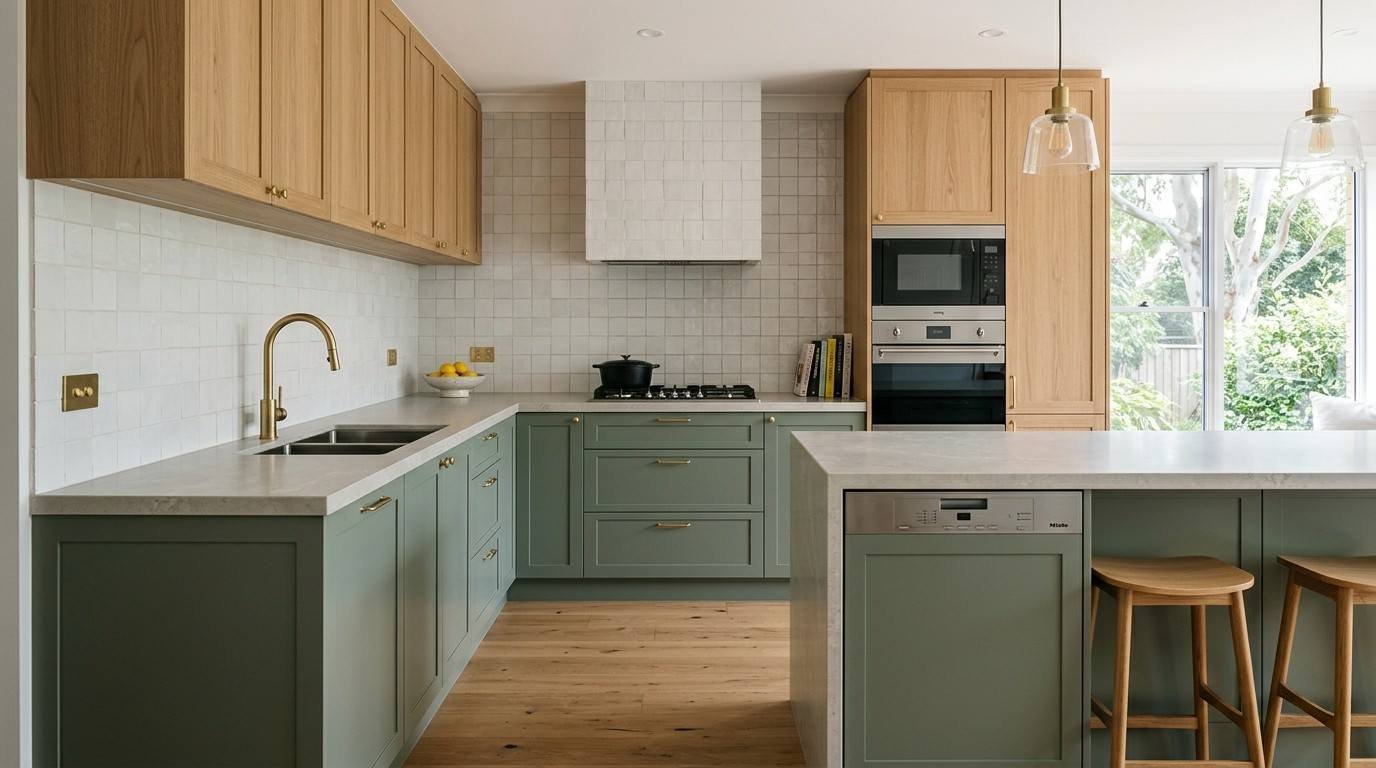
What Size Kitchen Can You Renovate for $50,000?
Kitchen size directly determines how far a $50,000 budget stretches. A smaller kitchen requires fewer linear metres of cabinetry, less benchtop material, and reduced tiling area, all of which lower the overall cost.
A small kitchen under 10 square metres, common in Sydney apartments, terrace houses, and older semi-detached homes, is well-suited to a $50,000 budget. We typically see a complete gut renovation at this size cost $25,000 to $45,000, leaving $5,000 to $25,000 of headroom for premium appliances or stone benchtops.
A medium kitchen between 10 and 20 square metres, the most common size in Sydney suburban homes, is achievable within $50,000 but requires careful management. At this size, we typically quote $40,000 to $65,000 for a full renovation, making $50,000 realistic but tight and requiring mid-range selections throughout with minimal layout changes.
For kitchens larger than 20 square metres, $50,000 is generally insufficient for a complete renovation. A partial renovation replacing cabinetry and benchtops while retaining existing flooring and appliances may work, but a full transformation at this size typically requires $65,000 to $100,000 or more.
Where Does the $50,000 Budget Get Spent First?
Trade work, including plumbing, electrical, and gas, must be completed before any finishes are installed. These costs are largely fixed regardless of material choices, and we always advise against cutting corners on licensed work since it creates compliance risk and can void building insurance.
Structural work, including wall removal, floor levelling, or ceiling repairs, also takes priority. In Sydney’s older housing stock, particularly Federation, interwar, and post-war homes, structural surprises are common once walls are opened.
We strongly recommend allocating 10 to 15 percent of the total budget as contingency for structural and compliance issues.
Within a $50,000 budget, certain upgrades deliver disproportionate value. Stone benchtops over laminate add perceived quality for $2,000 to $4,000 more, soft-close drawers improve daily function for minimal extra cost, an integrated rangehood offers a cleaner aesthetic, an undermount sink typically costs $200 to $500 more than drop-in, and LED strip lighting under cabinets runs $300 to $600 installed.
We prioritise these upgrades because they affect the kitchen every day and get noticed immediately by buyers and valuers. Spending on concealed structural work that nobody sees, while skimping on visible finishes, is a mistake we see reduce both satisfaction and resale value.
Hidden Costs That Can Blow a $50,000 Kitchen Budget
Hidden costs are the most common reason kitchen renovations exceed their original budget. In Sydney, several specific risk factors are worth understanding before work begins.
Sydney’s older housing stock presents a significant asbestos risk. Homes built before 1990, which the Australian government confirms covers a large proportion of Sydney’s suburban housing, may contain asbestos in wall sheeting, floor tiles, or ceiling materials.
Asbestos removal by a licensed removalist costs between $1,500 and $5,000 depending on contamination extent, and this cost is rarely included in initial quotes. Structural surprises, including rotted framing or subfloor damage, are discovered only once demolition begins and can add $2,000 to $10,000 depending on severity.
Most kitchen renovations in Sydney don’t require a Development Application provided the work is classified as exempt or complying development under NSW planning portal guidelines. Structural wall removal, footprint changes, or work on heritage-listed properties may trigger a DA requirement, which can cost $3,000 to $10,000 in council and consultant fees.
We always recommend confirming the approval pathway with your contractor or a building certifier before committing to a scope of work.
Scope creep is the gradual expansion of a project through small decisions made during the build. We commonly see clients decide to replace adjacent flooring mid-project, upgrade from laminate to stone after seeing the cabinetry installed, or add a kitchen island that wasn’t in the original scope.
Each decision may seem modest on its own, but collectively these additions can add $5,000 to $15,000 to a renovation originally scoped at $50,000. Establishing a firm scope before work begins and requiring written variation approvals is the most effective way we’ve found to prevent scope creep from derailing the budget.
Realistic Expectations: What $50,000 Can and Can’t Achieve
The honest answer is yes, we can deliver a genuinely transformed, high-functioning kitchen for $50,000 with the right scope and realistic material expectations. But it requires discipline, clear priorities, and understanding what this budget tier can and can’t achieve.
Within a $50,000 budget for a small to medium kitchen, we can realistically deliver complete cabinetry replacement in mid-range polyurethane or laminate, engineered stone benchtops in a 20mm profile, a new tile splashback, quality mid-range appliances, new sink and tapware, updated flooring, all required trade work, and new LED lighting.
This represents a complete, functional kitchen renovation that will serve a family well for 15 to 20 years with proper maintenance.
At $50,000, we generally advise against expecting custom timber or two-pack cabinetry, thick-format stone benchtops, premium European appliances, full structural reconfiguration, new kitchen island additions, or full-height stone splashbacks unless the kitchen is very small. Understanding these boundaries before engaging us prevents the disappointment of expecting a premium result from a mid-range budget.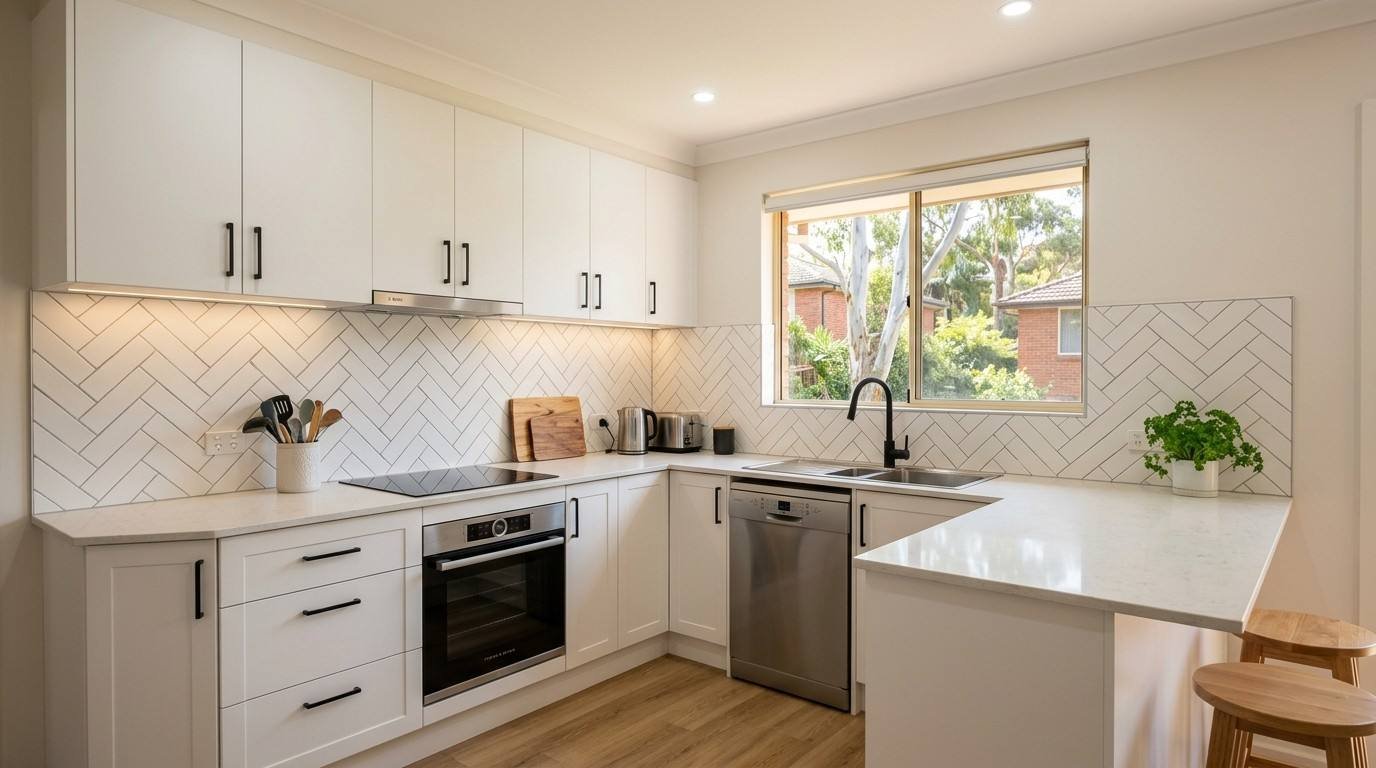
How to Make $50,000 Go Further
The single most effective way we’ve found to reduce kitchen renovation costs is keeping the existing layout. Retaining the current positions of the sink, cooktop, and dishwasher eliminates extensive plumbing and electrical relocation work, saving $3,000 to $8,000 in trade costs.
We can redirect that saving toward higher-quality cabinetry, a stone benchtop upgrade, or premium appliances, all of which have a greater impact on the finished result than a layout change most occupants won’t notice after the first week.
The gap between mid-range and premium materials has narrowed considerably in recent years. Engineered stone closely replicates natural marble, high-quality matte laminate is difficult to distinguish from two-pack paint, and large-format porcelain tiles replicate natural stone with greater durability.
For homeowners who want a higher-specification kitchen but can’t fund the full scope at once, we often recommend staging. Stage one covers structural, plumbing, and electrical work plus cabinetry and benchtops ($30,000–$38,000), while stage two adds appliances, splashback, and flooring ($12,000–$18,000).
Staging lets you live in a functional kitchen between stages and spread the financial commitment over 12 to 24 months.
Is a $50,000 Kitchen Renovation Worth It in Sydney?
The kitchen is consistently identified as one of the highest-return renovation investments in residential property. A well-executed kitchen renovation in Sydney typically adds between 5 and 15 percent to property value, according to Domain’s renovation ROI research, depending on renovation quality and the home’s price bracket.
For a Sydney property valued at $1.2 million, a $50,000 kitchen renovation that adds 8 percent to value generates $96,000 in additional value, nearly double the renovation cost. These returns depend heavily on aligning finishes with the property’s price bracket, and over-capitalising by spending $100,000 on a kitchen in an $800,000 suburb reduces or eliminates that return.
For owner-occupiers, the return includes both financial value and daily quality of life. For investment property owners, a modernised kitchen can support higher rental rates and reduce vacancy periods, though we always recommend consulting a tax adviser on how capital improvements are treated versus immediately deductible repairs.
Conclusion
A $50,000 kitchen renovation in Sydney is genuinely achievable for small to medium kitchens when the scope is well-defined, the layout is retained, and mid-range materials are selected strategically. The key to staying on budget is understanding where the money goes, since cabinetry, labour, and trade work consume the majority, and building in a contingency for hidden costs common in Sydney’s older housing stock.
Prioritising value-adding upgrades, avoiding scope creep, and working with a contractor who provides transparent pricing from the outset are the three factors that most consistently determine whether your renovation finishes on budget.
At Sydney Home Renovation, we help homeowners and property investors plan and execute kitchen renovations with honest cost guidance, detailed scoping, and skilled workmanship, so your $50,000 delivers exactly what you planned for. Contact our team today for a transparent, obligation-free renovation assessment.
Frequently Asked Questions
Is $50,000 enough for a full kitchen renovation in Sydney?
Yes, we consider $50,000 sufficient for a complete kitchen renovation in Sydney for small to medium kitchens up to approximately 15 square metres. The budget covers cabinetry, benchtops, splashback, appliances, flooring, and trade work with mid-range materials.
What is the average cost of a kitchen renovation in Sydney?
We see average costs range from $20,000 for a basic cosmetic refresh to $80,000 or more for a premium full renovation. A mid-range complete renovation typically falls between $35,000 and $65,000, placing $50,000 firmly in the mid-range tier.
How long does a $50,000 kitchen renovation take?
We typically complete a $50,000 kitchen renovation in four to eight weeks from demolition to completion, depending on scope and trade availability. Custom joinery can extend this timeline by two to four weeks.
Can I renovate a kitchen for $50,000 without moving plumbing?
Yes, and we consider keeping existing plumbing positions one of the most effective ways to maximise this budget. Retaining the current sink location eliminates $3,000 to $6,000 in relocation costs.
What appliances can I afford in a $50,000 kitchen budget?
We recommend a realistic allowance of $5,000 to $10,000, covering a quality oven, cooktop, rangehood, and dishwasher from brands like Bosch, Westinghouse, or Fisher and Paykel. Premium European brands require a significantly higher appliance budget.
Should I use a builder or separate trades for a $50K kitchen?
We generally recommend using a licensed builder to coordinate all trades. A single point of responsibility reduces coordination failures, ensures compliance, and provides clearer accountability if issues arise.
How do I avoid going over budget on a kitchen renovation?
We advise locking in a detailed scope before work begins, retaining the existing layout, selecting mid-range materials that look premium, building in a 10 to 15 percent contingency, and requiring written approval for any scope variations.