
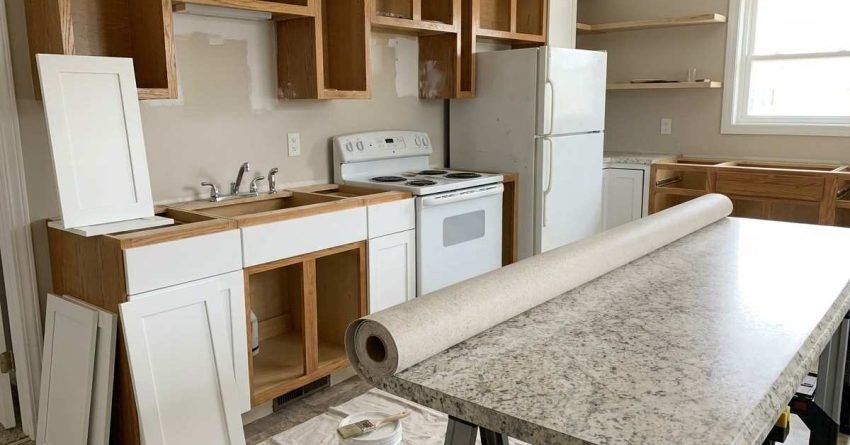
Yes, we can help you get a new kitchen for $8,000 in Sydney, but it takes strategic planning, smart material choices, and a clear understanding of what that budget realistically covers. Most homeowners at this price point are looking at a cosmetic kitchen refresh rather than a full gut renovation, and the difference matters.
An $8,000 kitchen renovation is one of the most searched budget brackets in Australia. It sits at the intersection of affordability and visible impact, which makes it attractive to owner-occupiers updating a dated space and to investors lifting property value before a sale or lease.
Below, we break down exactly what $8,000 buys in a Sydney kitchen renovation in 2025 labour costs, material allowances, realistic scope, hidden expenses, and where to prioritise spending for maximum return.
What Does a Kitchen Renovation Actually Cost in Sydney?
Kitchen renovation costs in Sydney vary dramatically depending on scope, size, materials, and whether the layout changes. A basic cosmetic refresh sits at the lower end. A full structural renovation with premium finishes can exceed six figures.
The price gap between a budget refresh and a mid-range renovation isn’t just about materials. It reflects the complexity of trades involved, the extent of demolition, whether plumbing and electrical points move, and the quality tier of cabinetry and benchtops we select.
Average Kitchen Renovation Price Ranges in 2025
Sydney kitchen renovation costs in 2025 generally fall into these brackets:
| Renovation Level | Typical Cost Range | What’s Included |
| Budget Refresh | $5,000 – $10,000 | Cabinet refacing, new hardware, paint, splashback, basic benchtop replacement |
| Mid-Range Renovation | $15,000 – $30,000 | New cabinetry, stone benchtops, new appliances, tiling, updated plumbing |
| High-End Renovation | $35,000 – $70,000+ | Custom cabinetry, premium stone, layout changes, structural work, top-tier appliances |
These figures reflect Sydney pricing, where labour rates and material costs tend to run higher than regional NSW. According to Hipages’ 2024 renovation cost guide, the average Australian kitchen renovation costs between $17,000 and $35,000, with budget-conscious projects starting from around $5,000.
Why $8,000 Is a Realistic Starting Point
An $8,000 budget isn’t a fantasy figure. It’s a practical starting point for homeowners who want to transform the look and feel of a kitchen without relocating plumbing, moving walls, or replacing every component.
At this price, we work with the existing kitchen layout. The footprint stays the same, and plumbing and electrical points remain where they are. What changes is the visible surface cabinet doors, benchtops, splashback, tapware, handles, and paint.
This budget stretches furthest in small galley or single-wall kitchens, where fewer linear metres of cabinetry and benchtop need covering. In larger open-plan kitchens, the same $8,000 buys a thinner slice of the total surface area, so we recommend scaling material choices accordingly.
This approach works particularly well for kitchens built in the 1990s and 2000s, where the carcasses (the internal cabinet boxes) are still structurally sound but the doors, laminate, and hardware look dated. Rather than ripping everything out, we refresh what people see and touch.
What Can You Get in a Kitchen Renovation for $8,000?
The scope of an $8,000 kitchen renovation depends on kitchen size, the condition of existing structures, and how funds are allocated across trades and materials. Here’s what typically fits within this budget in Sydney.
Cabinet Refacing and Repainting
Cabinet replacement is the single biggest cost in any kitchen renovation. New custom cabinetry for a standard Sydney kitchen starts at $8,000 to $12,000 on its own, which immediately exceeds the entire budget.
The alternative is cabinet refacing or repainting keeping the existing cabinet boxes and replacing or resurfacing the doors and drawer fronts. Professional spray-painting typically costs $2,000 to $4,000 for a standard kitchen, depending on the number of doors and finish selected.
New vinyl-wrapped or laminate replacement doors run $2,500 to $5,000 installed. Both approaches deliver a dramatic visual change at a fraction of full replacement cost.
New Benchtops on a Budget
Benchtops are the second most visible element in any kitchen. Laminate benchtops remain the most budget-friendly option, with supply and installation typically running $800 to $2,000 for a standard layout.
Engineered stone, like Caesarstone or Essastone, starts higher at $2,000 to $4,500 installed, depending on edge profile and cutout requirements. Prioritising engineered stone means scaling back elsewhere in the budget.
Timber benchtops offer a middle ground, with solid hardwood options available from around $1,500 installed, though they require ongoing maintenance.
Replacing Sink, Tapware, and Hardware
New tapware, a sink, and cabinet hardware are relatively low-cost upgrades that punch well above their price in visual impact. A quality kitchen mixer tap costs $150 to $500, a stainless steel undermount or drop-in sink runs $200 to $600, and cabinet handles for a full kitchen typically total $150 to $400.
Including installation by a licensed plumber, this category usually totals $700 to $1,500. It’s one of the highest-return line items in a budget kitchen renovation.
Splashback and Tiling Upgrades
A new splashback transforms a kitchen instantly. Subway tiles remain one of the most cost-effective options, with supply and installation typically costing $800 to $1,800 depending on area covered.
Acrylic or glass splashback panels range from $600 to $2,000 installed. Peel-and-stick options exist under $300 but we don’t recommend them for long-term durability or resale value.
For an $8,000 budget, a tiled splashback in a standard kitchen is achievable without consuming a disproportionate share of funds.
Full Kitchen Cost Breakdown for an $8,000 Budget
Understanding how $8,000 divides between labour and materials is critical for avoiding budget blowouts. In Sydney, labour typically accounts for 35% to 50% of a kitchen renovation budget, with materials making up the remainder.
Labour Costs for a Budget Kitchen Renovation
A budget refresh involves fewer trades than a full renovation, but skilled professionals are still needed for key tasks:
- Painter (cabinet spray-painting): $1,200 – $2,500
- Tiler (splashback): $500 – $1,200
- Plumber (sink and tapware installation): $300 – $700
- Benchtop installer: $400 – $800 (often bundled into supply price)
- General handyman/carpenter (hardware, minor adjustments): $300 – $600
Total labour for a cosmetic refresh typically falls between $2,700 and $5,000, leaving $3,000 to $5,300 for materials.
Material Allowances and Where to Save
Material costs are where we have the most control. The key is knowing which materials deliver visible impact and which are hidden behind cabinet doors where nobody looks.
Budget-friendly choices that still look professional:
- Laminate benchtops instead of engineered stone save $1,000 to $3,000
- Vinyl-wrap cabinet doors instead of solid timber or 2-pac save $1,500 to $4,000
- Subway ceramic tiles instead of natural stone or large-format porcelain save $500 to $1,500
- Standard stainless steel sink instead of granite composite saves $200 to $500
Sourcing materials from trade suppliers or during sale periods at retailers like Bunnings, IKEA, or kitchen wholesalers can reduce costs by 15% to 30% compared to retail pricing.
Sample $8,000 Kitchen Budget Table
| Item | Budget Allocation | Notes |
| Cabinet repainting/refacing | $2,500 – $3,500 | Professional spray-paint or new vinyl-wrap doors |
| Laminate benchtop (supply + install) | $1,000 – $1,800 | Standard laminate, post-formed edge |
| Splashback tiling (supply + install) | $800 – $1,500 | Subway tile, standard layout |
| New sink + tapware (supply + install) | $500 – $1,000 | Stainless steel sink, quality mixer tap |
| Cabinet hardware (handles, knobs) | $150 – $400 | Brushed nickel or matte black |
| Painting (walls, ceiling) | $300 – $600 | Walls and ceiling in kitchen area |
| Contingency (5–10%) | $400 – $800 | Unexpected repairs, minor adjustments |
| Total | $5,650 – $9,600 | Scalable depending on choices |
This table shows $8,000 is tight but workable. The lower end of each line item keeps us comfortably within budget, while mid-range choices across the board push toward the upper limit, which is where the contingency buffer becomes essential.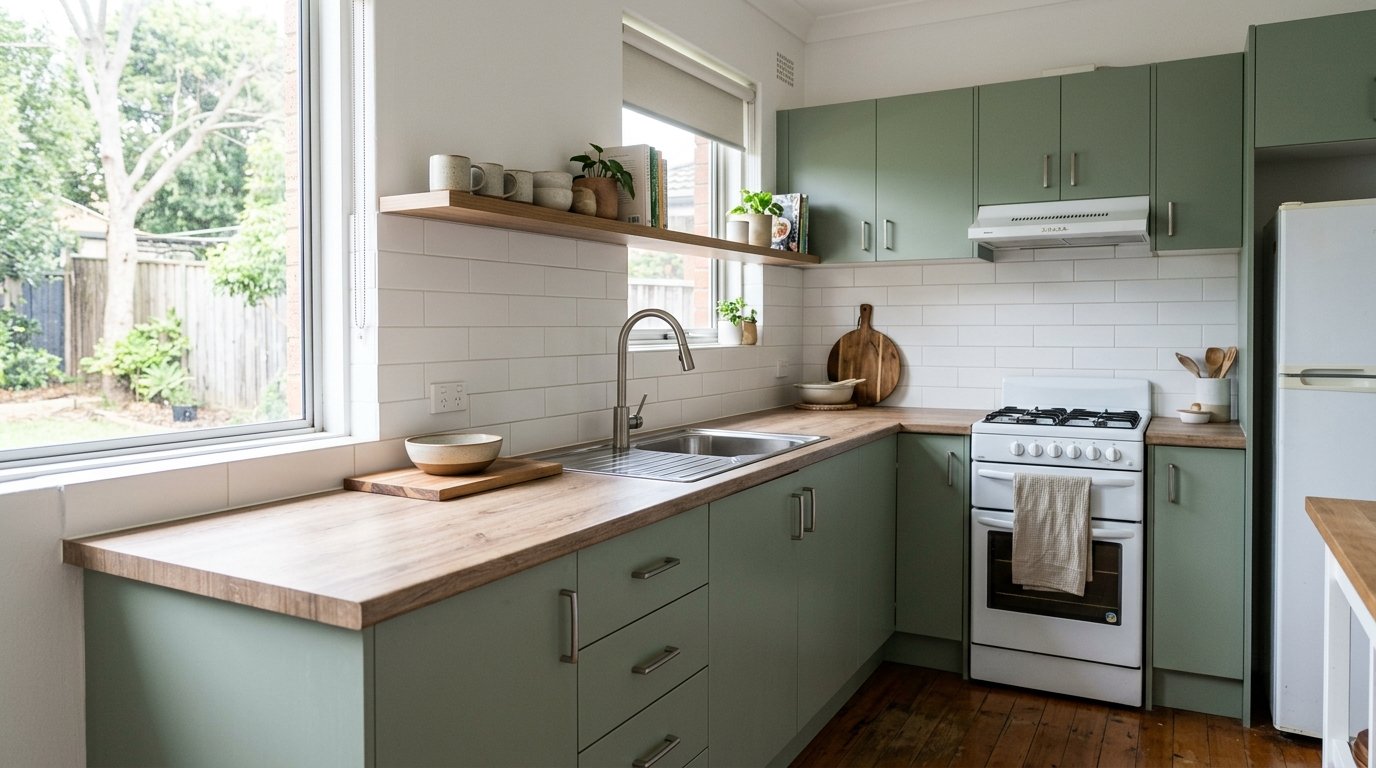
Where to Spend and Where to Save
Not every dollar in a kitchen renovation delivers equal return. Some upgrades are immediately visible and affect daily use. Others are cosmetic details we can defer or source cheaply without compromising quality.
High-impact upgrades worth prioritising:
- Cabinet doors and fronts what people see first
- Benchtops the largest horizontal surface in the room
- Tapware small cost, outsized visual and functional impact
- Splashback covers the most visible wall area
Areas where we cut costs without losing quality:
- Cabinet carcasses if structurally sound, refacing achieves the same visual result
- Appliances keep existing ones unless failing, and stage upgrades later
- Flooring expensive and disruptive; leave for a future phase if condition allows
- Internal shelving and organisers add incrementally over time
- Lighting defer if functional; a single pendant or LED strip ($100–$300) adds atmosphere cheaply if not
Hidden Costs That Can Blow an $8,000 Kitchen Budget
Hidden costs are the most common reason budget kitchen renovations exceed their target.
Plumbing and Electrical Surprises
Moving the sink location or adding new power points escalates costs quickly. Moving a sink even one metre can add $500 to $2,000 in plumbing work due to waste pipe rerouting and water supply extension.
Adding or relocating power points requires a licensed electrician and costs $150 to $400 per point. A switchboard upgrade to meet current NSW regulations can add $800 to $2,000 on top of that.
Our rule for an $8,000 budget: keep plumbing and electrical points exactly where they are. The moment services move, the project enters mid-range renovation territory.
Structural and Compliance Issues
Older Sydney homes sometimes reveal problems once work begins. Water damage behind splashbacks, termite damage in wall framing, or asbestos-containing materials in pre-1990 homes can all trigger unplanned costs.
Asbestos testing costs $50 to $100 per sample. If asbestos is found in tiles, sheeting, or adhesive, licensed removal starts at $1,000 and can exceed $5,000 depending on the extent.
We recommend a builder inspection before committing to a budget. It typically costs $200 to $500 but can save thousands in unexpected expenses.
Waste Removal, Permits, and Temporary Kitchen Setup
Skip bin hire in Sydney costs $250 to $500 for a small bin, and demolition waste from even a cosmetic refresh adds up faster than expected.
Council permits generally aren’t required for cosmetic kitchen renovations that don’t alter the building structure. Plumbing or electrical work still requires compliance certificates from licensed tradespeople under NSW regulations.
A temporary kitchen setup is a minor inconvenience for a refresh that typically takes one to two weeks.
Can You DIY Parts of a Kitchen Renovation to Stay Under $8,000?
DIY work reduces labour costs significantly, but it comes with risks. Poor-quality DIY finishes can reduce property value, and some work is legally required to be completed by licensed professionals in NSW.
Safe DIY tasks that can save $500 to $2,000 on labour:
- Painting walls and ceilings
- Removing old cabinet hardware and installing new handles
- Demolishing old splashback tiles (with appropriate safety gear)
- Installing peel-and-stick or adhesive splashback panels
- Cleaning and preparing surfaces before trades arrive
Work that must be done by licensed tradespeople in NSW:
All plumbing work sink installation, tapware connection, dishwasher plumbing, and gas fitting requires a licensed plumber or gasfitter. All electrical work, including power points, hardwired lighting, and switchboard work, requires a licensed electrician. Waterproofing and structural modifications require licensed specialists and, in some cases, council approval.
Attempting unlicensed plumbing or electrical work in NSW can result in fines exceeding $11,000 for individuals and void home insurance coverage.
How to Plan an $8,000 Kitchen Renovation in Sydney
Planning is the difference between a successful $8,000 kitchen renovation and a stressful budget blowout.
We start by listing everything to change in the kitchen, then rank each item by visual impact and daily functionality. This priority list becomes the decision framework when quotes come in higher than expected.
We always recommend at least three written quotes from Sydney-based contractors. Each quote should include itemised labour costs by trade, material specifications, a timeline with start and completion dates, a payment schedule, and what’s included and excluded. Verbal quotes are unreliable.
Timeline and Project Coordination
A cosmetic kitchen refresh typically takes five to ten working days from demolition to completion, following this sequence:
- Day 1–2: Demolition
- Day 2–3: Plumbing and electrical work (if any)
- Day 3–5: Benchtop templating and installation
- Day 4–6: Splashback tiling
- Day 5–7: Cabinet painting or door installation
- Day 7–8: Hardware, tapware, sink installation
- Day 8–10: Touch-ups, cleaning, final inspection
Coordinating trades is where many DIY-managed renovations fall apart. A renovation contractor manages this coordination as part of the service, which often justifies the project management margin through time and cost savings.
When $8,000 Is Not Enough
An $8,000 budget works well for cosmetic refreshes, but some kitchens need more than surface-level work. Consider increasing the budget if:
- Cabinet carcasses are warped, water-damaged, or structurally failing
- The layout is fundamentally dysfunctional, with poorly positioned appliances
- Plumbing is corroded or non-compliant, such as galvanised steel pipes in pre-1970s homes
- Electrical wiring is outdated and needs a switchboard upgrade or rewiring
- We plan to sell within 12 months competitive Sydney buyers increasingly expect stone benchtops and modern cabinetry, and a mid-range renovation ($15,000–$25,000) may deliver stronger ROI at sale
Financing and Staged Renovation Strategies
If $8,000 is the available cash but the kitchen needs more, staging is a practical alternative to debt. Stage 1 ($8,000) covers the cosmetic refresh. Stage 2 ($5,000–$10,000, six to twelve months later) covers appliance and flooring upgrades. Stage 3 ($5,000–$15,000, twelve to twenty-four months later) addresses cabinetry or layout changes if needed.
This staged approach spreads costs over time and avoids interest payments. For those who prefer completing everything at once, personal renovation loans through major banks typically offer rates between 6% and 12% for amounts under $50,000.
Conclusion
Getting a new kitchen for $8,000 in Sydney is achievable when we focus on high-impact cosmetic upgrades, keep plumbing and electrical in place, and plan every dollar against a clear priority list.
A well-planned $8,000 kitchen refresh can transform a dated space into a clean, modern, functional kitchen that adds genuine value to a home. The difference between a successful budget renovation and a stressful blowout comes down to preparation, realistic scope, and working with experienced professionals.
We help Sydney homeowners plan and deliver kitchen renovations that stay on budget and on schedule. Contact Sydney Home Renovation today for a transparent, itemised quote and practical guidance on making your kitchen budget work harder.
Frequently Asked Questions
Is $8,000 enough for a full kitchen renovation in Sydney?
$8,000 covers a cosmetic kitchen refresh, not a full gut renovation. We typically deliver cabinet refacing, a new laminate benchtop, splashback tiling, new tapware, and hardware within this budget.
What is the cheapest way to renovate a kitchen in Australia?
We keep the existing layout and cabinet carcasses, then refresh visible surfaces. Repainting cabinet doors, replacing handles, installing a new laminate benchtop, and adding a tiled splashback delivers the biggest visual change for the lowest cost.
How long does a budget kitchen renovation take?
A cosmetic kitchen refresh typically takes five to ten working days from start to finish, including demolition, trade work, and final hardware fitting. Delays usually happen when trades aren’t coordinated properly.
Can I renovate my kitchen myself to save money?
We recommend handling painting, demolition, hardware installation, and surface preparation yourself. All plumbing, electrical, and gas work must be completed by licensed tradespeople in NSW.
What adds the most value in a kitchen renovation?
New cabinet fronts, quality benchtops, and modern tapware deliver the highest return per dollar. These are the elements buyers and occupants notice first, and splashbacks add strong visual impact at low cost.
Should I replace kitchen cabinets or reface them?
If the cabinet carcasses are structurally sound, we recommend refacing since it’s significantly cheaper and delivers a similar visual result. Refacing costs $2,000 to $5,000, while full replacement starts at $8,000 to $12,000.


