
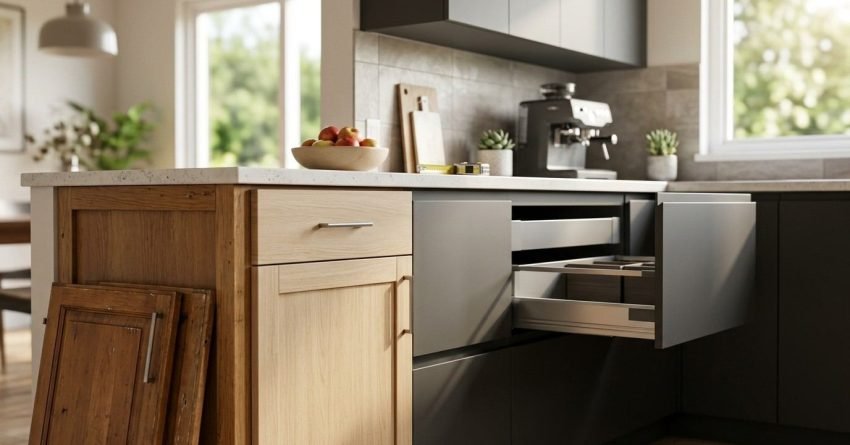
Cabinet refacing costs roughly 40 to 60 percent less than full cabinet replacement in Sydney, making it the more budget-friendly option when your cabinet boxes are structurally sound. The right choice depends on your cabinet condition, renovation goals, and how long you plan to stay in the property.
Both options carry hidden costs that catch homeowners off guard. Understanding exactly what each involves, what drives the price up, and where the real value lies will protect your budget and help you avoid a costly mistake.
This guide breaks down real Sydney costs for refacing and replacement, compares them side by side, identifies the hidden expenses most contractors don’t mention upfront, and gives you a clear framework for deciding which option makes financial sense for your home.
What Is Cabinet Refacing and What Does It Include?
Cabinet refacing is a renovation process that updates the visible surfaces of your existing cabinets without removing or replacing the underlying cabinet boxes. Instead of a full demolition and rebuild, a tradesperson applies new material to the cabinet frames and installs new doors, drawer fronts, and hardware to give the kitchen a fresh appearance at a fraction of the cost.
Refacing works on the principle that the structural carcass of most cabinets, when properly built and maintained, can last decades. The parts that show wear, fade, or go out of style are the doors, drawer fronts, and exposed surfaces, not the boxes themselves.
Refacing targets exactly those components.
What Parts of the Cabinet Are Replaced During Refacing?
During a cabinet refacing project, the following components are removed and replaced:
- All cabinet doors and drawer fronts
- Hinges, handles, and drawer pulls (hardware)
- Exposed end panels on visible cabinet sides
- Kickboards and plinths at the base of lower cabinets
- Cornice and light pelmets where applicable
The new doors and drawer fronts are manufactured to match the dimensions of your existing openings. The exposed frame surfaces are covered with a matching veneer, laminate, or vinyl wrap material that bonds directly to the existing cabinet box.
What Stays in Place When You Reface Cabinets?
The following components remain untouched during a standard refacing job:
- Cabinet carcasses (the box structure, shelves, and internal dividers)
- Cabinet layout and configuration
- Existing plumbing and electrical connections behind or beneath cabinets
- Benchtop, unless a separate upgrade is requested
- Flooring beneath lower cabinets
Because the boxes stay in place, there is no demolition, no structural work, and no need to disconnect plumbing or move electrical points. This is the primary reason refacing costs significantly less than full replacement.
What Is a Full Cabinet Replacement and What Does It Involve?
Full cabinet replacement is the complete removal of all existing cabinetry and the installation of entirely new cabinet units. This is a more invasive process that involves demolition, disposal, and a full reinstallation, often requiring coordination across multiple trades including carpentry, plumbing, and electrical.
Replacement gives you complete design freedom. You can change the layout, increase storage capacity, raise or lower cabinet heights, and choose from a wider range of materials and finishes.
It is the right choice when existing cabinets are structurally compromised, when a layout change is needed, or when a full kitchen renovation is underway.
What Gets Removed and Replaced in a Full Cabinet Renovation?
A full cabinet replacement involves:
- Complete demolition and removal of all existing upper and lower cabinets
- Disconnection of plumbing under the sink and any in-cabinet electrical
- Removal of the existing benchtop
- Patching and preparation of walls, floors, and ceiling where cabinets were fixed
- Supply and installation of all new cabinet units
- Reinstallation of plumbing and electrical connections
- New benchtop installation
- New hardware, kickboards, and finishing trims
Disposal of old cabinetry adds to both the cost and the project timeline. Most Sydney contractors include skip bin hire or rubbish removal in their quotes, but it is worth confirming this upfront.
What Types of Cabinets Are Used in a Full Replacement?
Sydney homeowners choosing full replacement typically select from three cabinet categories.
Flat-pack cabinets are the most affordable option. Brands like IKEA and Kaboodle are widely available and offer a broad range of finishes. They are self-assembled or installer-assembled and suit budget-conscious renovations where layout flexibility is limited.
Semi-custom cabinets are pre-manufactured in standard sizes but offer more finish options, better construction quality, and more configuration choices than flat-pack. They represent the mid-range price point and are the most common choice for Sydney kitchen renovations.
Custom cabinets are built to exact specifications by a cabinet maker. They offer the highest quality, the most design flexibility, and the longest lifespan, but come at a significantly higher price point.

Cabinet Refacing vs Replacement Cost Comparison in Sydney
Cost is the central question for most homeowners comparing these two options. The price gap between refacing and replacement is significant, but the right choice is not always the cheapest one.
Understanding what drives each cost helps you evaluate value, not just price.
How Much Does Cabinet Refacing Cost in Sydney?
Cabinet refacing in Sydney typically costs between $3,500 and $12,000 for a standard kitchen, depending on the size of the kitchen, the number of doors and drawers, and the material selected.
A breakdown of typical refacing costs in Sydney:
| Component | Estimated Cost Range |
| Vinyl wrap refacing (small kitchen, 10-15 doors) | $3,500 – $5,500 |
| Laminate refacing (medium kitchen, 15-25 doors) | $5,500 – $8,500 |
| Timber veneer refacing (medium to large kitchen) | $7,000 – $12,000 |
| New hardware (handles, hinges) | $300 – $1,200 |
| New kickboards and end panels | $400 – $900 |
These figures are indicative for the Sydney market. According to Master Builders Australia’s residential cost guidance, prices vary based on the contractor, the complexity of the job, and material selections.
A detailed quote from a licensed Sydney renovation contractor will give you accurate figures for your specific kitchen.
How Much Does Full Cabinet Replacement Cost in Sydney?
Full cabinet replacement in Sydney costs considerably more due to demolition, disposal, and the full scope of supply and installation. Typical price ranges are:
| Cabinet Type | Estimated Cost Range (Supply + Install) |
| Flat-pack cabinets (small kitchen) | $8,000 – $14,000 |
| Semi-custom cabinets (medium kitchen) | $14,000 – $25,000 |
| Custom cabinets (medium to large kitchen) | $22,000 – $45,000+ |
These figures cover cabinet supply and installation only. Benchtop replacement, plumbing reconnection, electrical work, and tiling are additional costs that must be factored into the total project budget.
Side-by-Side Cost Breakdown: Refacing vs Replacement
| Cost Category | Cabinet Refacing | Full Replacement |
| Cabinet supply | Doors, fronts, veneer only | Full cabinet units |
| Labour | Lower (no demolition) | Higher (demo + install) |
| Trades required | Carpenter only | Carpenter, plumber, electrician |
| Disposal costs | Minimal | Skip bin or rubbish removal |
| Benchtop | Usually retained | Usually replaced |
| Timeline | 2-5 days | 1-3 weeks |
| Typical total cost | $3,500 – $12,000 | $8,000 – $45,000+ |
| Savings vs replacement | 40-60% less | Baseline |
The cost difference is substantial. For a medium-sized Sydney kitchen, refacing can save homeowners between $8,000 and $18,000 compared to a full replacement using semi-custom cabinets.
Can You Reface Cabinets Yourself to Save Money?
DIY cabinet refacing kits are available in Sydney hardware stores and can reduce material costs, but the trade-off is significant. Vinyl wrap application requires precise heat-bonding technique, and a poorly applied wrap will bubble, lift, or peel within months.
Most homeowners who attempt DIY refacing save on labour but risk a lower-quality finish that needs professional correction later. If your goal is long-term durability and a result that holds up to daily kitchen use, professional installation remains the more reliable investment even at a higher upfront cost.
Cabinet Refacing vs Painting: What’s the Real Difference?
Painting existing cabinet doors is the cheapest possible update, often costing under $2,000 for a full kitchen. However, painted cabinets are far less durable than refaced ones.
Paint chips, scratches, and shows wear around handles and edges within one to two years of daily use. Refacing replaces the surface entirely with a bonded material designed to withstand moisture, heat, and impact, giving it a substantially longer lifespan than a painted finish for a moderate cost increase.
What Factors Affect the Cost of Cabinet Refacing in Sydney?
Refacing quotes vary widely between Sydney contractors. Understanding what drives the price helps you assess whether a quote is fair and where you can make cost-effective material choices without compromising the result.
Cabinet Size, Layout, and Door Count
The single biggest cost driver in any refacing project is the number of doors and drawer fronts being replaced. A small galley kitchen with 12 doors costs significantly less to reface than an open-plan kitchen with 30 or more doors across upper and lower cabinets.
Cabinet height also matters. Taller upper cabinets require larger door panels, which increases material cost.
Unusual configurations, such as corner cabinets with bi-fold or carousel doors, add complexity and labour time.
Material Choice: Vinyl Wrap, Timber Veneer, or Laminate?
Material selection is the second major cost variable in refacing. The three most common options in Sydney are vinyl wrap, laminate, and timber veneer.
Vinyl wrap is the most affordable refacing material. It is applied as a heat-bonded film over MDF door panels and is available in a wide range of colours and textures, including woodgrain and matte finishes. Vinyl wrap is durable, easy to clean, and suits most residential kitchens.
Laminate, also called Polytec or Laminex in the Australian market, is a harder, more durable surface than vinyl wrap. It is bonded directly to the door substrate and offers a more premium finish, with better resistance to heat, moisture, and impact.
Timber veneer is a thin layer of real timber bonded to an engineered substrate. It provides a genuine timber aesthetic at a lower cost than solid timber cabinetry, though it is the most expensive refacing material and requires more careful maintenance.
Labour Costs for Cabinet Refacing in Sydney
Labour for cabinet refacing in Sydney typically represents 30 to 45 percent of the total project cost. A skilled cabinet maker or joiner will charge between $65 and $120 per hour depending on experience and the complexity of the work.
Most refacing jobs are completed by a single tradesperson over two to five days. The labour scope includes removing old doors and hardware, preparing and applying veneer to exposed frames, fitting new doors and drawer fronts, adjusting hinges for alignment, and installing new hardware.

What Factors Affect the Cost of Full Cabinet Replacement in Sydney?
Full replacement involves more variables, more trades, and more potential for cost escalation than refacing. Knowing what drives the price helps you set a realistic budget and avoid surprises mid-project.
Cabinet Material and Construction Quality
The material used to construct the cabinet carcasses and doors has the greatest impact on replacement cost. Moisture-resistant particleboard, the standard for most flat-pack and semi-custom cabinets, is the most affordable structural option.
Moisture-resistant MDF offers a smoother finish for painted doors. Plywood carcasses are the premium structural choice, offering superior strength and longevity, and are standard in custom cabinet making.
Door material choices follow the same hierarchy as refacing: vinyl wrap and laminate at the budget end, timber veneer and solid timber at the premium end.
Custom vs Flat-Pack vs Semi-Custom Cabinets
The cabinet category you choose determines both the cost and the quality of the outcome.
Flat-pack cabinets are the entry-level option. They are cost-effective and widely available, but they require precise measurement and careful installation to achieve a quality result.
Semi-custom cabinets are manufactured in standard sizes but offer a broader range of finishes, better hardware, and more configuration options. They are the most popular choice for Sydney kitchen renovations because they balance cost, quality, and design flexibility.
Custom cabinets are built to your exact specifications by a local cabinet maker. Every dimension, finish, and internal fitting is tailored to your kitchen, delivering a result that flat-pack and semi-custom cannot match in fit, finish, and longevity.
Installation, Trades, and Project Coordination Costs
Full replacement requires coordination across multiple trades. In addition to the cabinet maker or joiner, a full replacement typically involves:
- A licensed plumber to disconnect and reconnect the sink, dishwasher, and any in-cabinet water lines
- A licensed electrician to disconnect and reconnect rangehood wiring, under-cabinet lighting, and any power points inside or adjacent to cabinets
- A benchtop fabricator and installer if the benchtop is being replaced
- A tiler if splashback tiles need to be removed or replaced to accommodate new cabinet heights
Each trade adds cost and requires scheduling coordination. In Sydney, plumber call-out rates typically range from $120 to $180 per hour, and electricians charge similar rates.
Even a straightforward reconnection job can add $500 to $1,500 to the total project cost.
Hidden Costs of Cabinet Refacing vs Replacement
Hidden costs are the most common source of budget blowouts in kitchen renovation projects. Both refacing and replacement carry costs that are rarely included in initial quotes and are frequently overlooked by homeowners planning their budgets.
Hidden Costs in Cabinet Refacing Projects
Benchtop condition: Refacing leaves the benchtop in place. If the benchtop is damaged, stained, or incompatible with the new door colour, replacing it becomes necessary and adds $1,500 to $5,000 to the project cost.
Cabinet box damage discovered mid-project: Once doors are removed, hidden damage to the cabinet carcasses may be revealed, including water damage behind the sink, swollen particleboard, or delaminating shelves. Repairing or replacing damaged boxes adds cost that was not in the original quote.
Appliance gaps and filler panels: New doors are sometimes slightly different in profile or thickness to the originals. Filler panels, scribing strips, and adjustments to accommodate appliances like dishwashers or ovens can add $300 to $800 to the final cost.
Hardware upgrades: Standard hinges and drawer runners included in refacing quotes are often basic quality. Upgrading to soft-close hinges and full-extension drawer runners adds $400 to $1,200 depending on the number of doors and drawers.
Hidden Costs in Full Cabinet Replacement Projects
Wall and floor repairs: Removing old cabinets almost always reveals patching requirements. Walls behind cabinets are rarely painted or finished, and floors beneath lower cabinets may have gaps, old adhesive, or uneven surfaces that need addressing before new cabinets are installed.
Splashback replacement: If the existing splashback tiles run behind the upper cabinets, changing the cabinet height or depth may require partial or full splashback replacement. This adds $800 to $3,500 depending on the tile material and area.
Electrical and plumbing upgrades: Older Sydney homes may have plumbing or electrical configurations that do not meet current standards. A renovation that exposes these systems can trigger compliance requirements under NSW building regulations, adding unexpected cost.
Delivery and access fees: Custom and semi-custom cabinets are delivered in large panels and boxes. Difficult access, such as narrow driveways, upper-floor apartments, or tight stairwells, can add delivery surcharges of $200 to $600.
Extended timeline costs: Replacement projects that run longer than the quoted 1-3 weeks create real disruption. Homeowners may face additional costs for temporary kitchen setups, eating out, or short-term accommodation if the kitchen is the household’s primary cooking space, and delays compound if custom cabinet lead times blow out.
When Is Cabinet Refacing the Better Financial Choice?
Refacing is not always the right answer, but in the right circumstances it delivers exceptional value. The key is accurately assessing whether your existing cabinet boxes are worth keeping.
Signs Your Cabinet Boxes Are Still Structurally Sound
Refacing is a sound financial decision when your cabinet carcasses meet these criteria:
- No visible water damage, swelling, or delamination on the box panels
- Shelves are flat, stable, and not sagging under normal load
- The cabinet layout suits your current and future needs
- Doors open and close without the frame twisting or racking
- No evidence of pest damage, mould penetration, or rot inside the boxes
- The cabinet configuration does not need to change
If your boxes pass these checks, you are paying for a structural asset that still has significant life remaining. Replacing it adds cost without adding proportional value.
Renovation Scenarios Where Refacing Delivers Better ROI
Investment properties: For landlords renovating a rental property in Sydney, refacing delivers a fresh, modern kitchen at a cost that is far easier to recover through rental yield or sale price uplift. The return on a $6,000 refacing job is typically faster and more predictable than a $20,000 full replacement.
Pre-sale renovations: If you are preparing a property for sale and the kitchen layout is functional, refacing updates the aesthetic without overcapitalising. Sydney buyers respond positively to fresh, modern kitchens, but the marginal value of custom cabinets over well-executed refacing is rarely reflected in the sale price.
Budget-constrained renovations: When the total renovation budget is limited, refacing frees up funds for higher-impact upgrades such as benchtop replacement, new appliances, or splashback tiling, which together can transform the kitchen’s appearance more effectively than cabinets alone.
When Does Full Cabinet Replacement Make More Financial Sense?
There are clear situations where refacing is not the right answer and full replacement is the more financially sound decision, despite the higher upfront cost.
Signs Your Cabinets Need Full Replacement
Full replacement is the appropriate choice when:
- Cabinet boxes show water damage, swelling, or structural failure
- The existing layout is inefficient and needs reconfiguration
- Cabinet heights or depths do not suit the space or your storage needs
- The kitchen is part of a full renovation that includes new flooring, benchtops, and appliances
- The cabinets are more than 20 to 25 years old and showing significant wear throughout
- Pest damage, mould, or rot has compromised the structural integrity of the carcasses
- You are combining the kitchen renovation with a layout change that moves plumbing or electrical points
Attempting to reface cabinets that are structurally compromised is a false economy. The new doors and veneer will look fresh, but the underlying problems will continue to worsen and will eventually require full replacement anyway, meaning you pay twice.
Long-Term Value and Return on Investment for Replacement
Full cabinet replacement, when done well, adds measurable long-term value to a Sydney property. A high-quality kitchen is consistently cited by Domain’s renovation value research as one of the top value-adding renovations for residential properties, particularly in the mid-to-upper price brackets where buyers have higher expectations.
Custom or semi-custom cabinets with quality hardware, soft-close mechanisms, and durable finishes have a functional lifespan of 20 to 30 years when properly maintained. Over that timeframe, the higher upfront cost amortises to a lower annual cost than a refacing job that may need to be repeated in 10 to 15 years.
For owner-occupiers planning to stay in their home for more than five years, full replacement with quality materials is often the better long-term financial decision, even if the upfront cost is higher.
Cabinet Refacing vs Replacement: Which Adds More Value to Your Sydney Home?
The value question is distinct from the cost question. The cheapest option is not always the one that delivers the best return, and the most expensive option is not always the one that adds the most value to your property.
How Sydney Buyers and Renters Respond to Kitchen Upgrades
Sydney’s property market is competitive, and kitchen presentation has a direct impact on buyer perception and rental appeal. A dated kitchen with worn doors and faded finishes signals deferred maintenance to buyers, even when the underlying structure is sound.
Refacing addresses this perception effectively and at a fraction of replacement cost.
For properties in the sub-$1.5 million price range, a well-executed refacing job with a quality benchtop and updated hardware is often indistinguishable from a full replacement to the average buyer. The visual outcome is what drives perceived value, not the construction method behind it.
For premium properties above $2 million, buyer expectations shift. Custom cabinetry, integrated appliances, and high-end finishes become baseline expectations rather than upgrades, and full replacement with custom cabinets is more likely to be reflected in the sale price.
For rental properties, the calculus is simpler. Tenants respond to clean, functional, and modern kitchens, and a refacing job that delivers a fresh aesthetic at lower cost allows landlords to maintain competitive rental appeal without overcapitalising on a property that will face ongoing wear and tear.

How to Get an Accurate Quote for Cabinet Refacing or Replacement in Sydney
Getting an accurate quote requires preparation. Vague briefs produce vague quotes, and vague quotes lead to scope creep, variations, and budget blowouts.
The more specific your brief, the more reliable your quote will be.
What to Include in Your Cabinet Renovation Brief
Before contacting Sydney renovation contractors, prepare the following information:
- Accurate measurements of your kitchen, including the number of upper and lower cabinets, doors, and drawer fronts
- Photos of the existing cabinets, including close-ups of any damage or wear
- Your preferred material and finish (vinyl wrap, laminate, timber veneer, or a specific product)
- Whether you want new hardware included or will source it separately
- Whether the benchtop is being retained or replaced
- Your preferred timeline and any fixed deadlines (such as a settlement date or tenancy changeover)
- Your total budget range
Providing this information upfront allows a contractor to give you a detailed, itemised quote rather than a ballpark figure that is likely to change once the project starts.
Questions to Ask Your Sydney Cabinet Renovation Contractor
Before committing to a contractor, ask these questions:
- Is your quote fixed-price or subject to variations?
- What happens if hidden damage is found once the project starts?
- Are all trades (plumber, electrician) included in your quote or quoted separately?
- What is your process for managing project timelines and keeping the job on schedule?
- Can you provide references from recent Sydney kitchen refacing or replacement projects?
- What warranty do you provide on materials and workmanship?
- Are you licensed and insured for this type of work in NSW?
A contractor who answers these questions clearly and confidently, and who provides a detailed written quote, is demonstrating the transparency and professionalism that protects your budget and your project outcome.
Conclusion
Cabinet refacing and full replacement both have a place in a well-planned kitchen renovation strategy. Refacing delivers significant cost savings when your cabinet boxes are structurally sound, while full replacement is the right investment when layout changes, structural damage, or long-term value goals demand it.
The decision comes down to an honest assessment of your cabinet condition, your renovation goals, and your budget.
At Sydney Home Renovation, we help homeowners and property investors make that assessment with confidence. We provide transparent, itemised quotes for both refacing and replacement, so you understand exactly what you are paying for and why, before any work begins. If you are planning a kitchen renovation in Sydney and want honest guidance on which option makes financial sense for your property, contact Mr. Local Services today for a detailed consultation and written quote.
Frequently Asked Questions
Is cabinet refacing cheaper than full replacement?
Yes, cabinet refacing is consistently cheaper than full replacement. In Sydney, refacing typically costs between $3,500 and $12,000, while full replacement ranges from $8,000 to $45,000 or more. Refacing saves most homeowners between 40 and 60 percent compared to full replacement.
How long does cabinet refacing last compared to new cabinets?
Quality cabinet refacing using laminate or timber veneer typically lasts 10 to 15 years with normal use and proper care. New custom or semi-custom cabinets have a functional lifespan of 20 to 30 years depending on maintenance.
Can you reface cabinets if the boxes are damaged?
No. Cabinet refacing is only suitable when the existing cabinet carcasses are structurally sound. Water damage, swelling, delamination, mould, or pest damage means refacing will not solve the underlying problem.
Does cabinet refacing add value to a home in Sydney?
Yes, cabinet refacing adds value by improving the kitchen’s visual appeal, which directly influences buyer perception and rental competitiveness. For properties under $1.5 million, refacing often delivers comparable visual results to full replacement.
How long does cabinet refacing take vs full replacement?
Cabinet refacing typically takes two to five days for a standard Sydney kitchen. Full cabinet replacement takes one to three weeks depending on scope, cabinet lead times, and the number of trades involved.
What is the cheapest way to update kitchen cabinets in Sydney?
The cheapest effective update is vinyl wrap refacing combined with new hardware, delivering a fresh aesthetic for as little as $3,500 to $5,500. Painting existing doors is cheaper but delivers a lower-quality, less durable result.
Should I reface or replace cabinets before selling my home in Sydney?
For most Sydney properties, refacing is the better pre-sale strategy because it delivers a fresh kitchen aesthetic at a cost that is easier to recover in the sale price, avoiding the overcapitalisation risk of full replacement.


