
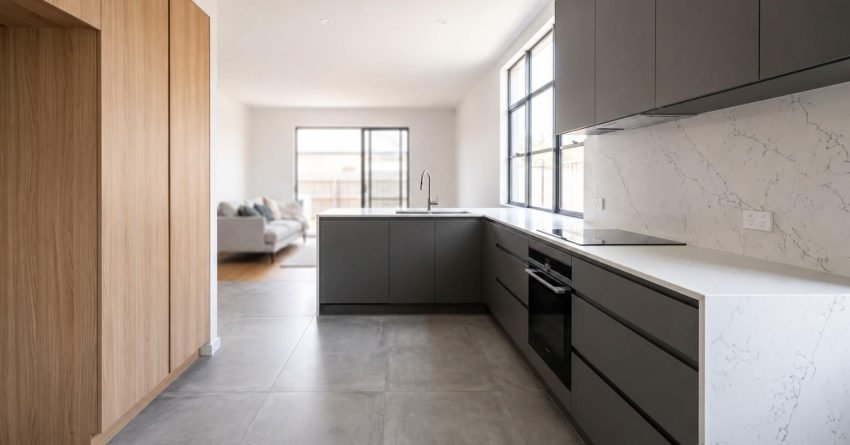
The 3×4 kitchen rule is a practical layout guideline that defines the minimum functional floor space a kitchen needs to work efficiently. It typically means a 3-metre by 4-metre footprint, or 12 square metres of usable kitchen area. We find that understanding this rule before planning begins is often the difference between a kitchen that flows well and one that creates daily frustration.
Whether you are renovating an existing kitchen or planning a new layout, the 3×4 rule gives you a reliable benchmark for assessing whether your space can fit standard cabinetry runs, appliances, and safe circulation zones. It directly shapes your renovation scope, your labour estimate, and the material quantities your project needs.
This guide explains what the 3×4 kitchen rule means, how it works in practice, why it matters for budgeting, and how we apply it to real Sydney kitchens.
The 3×4 Kitchen Rule Explained
The 3×4 kitchen rule refers to the widely accepted minimum kitchen dimension standard of 3 metres in width by 4 metres in length. This produces a 12-square-metre functional footprint. It is not an arbitrary number.
It reflects the minimum space needed for a practical cabinetry layout, safe appliance clearances, and adequate circulation for one or two people working in the kitchen at once. In residential design, we treat the 3×4 rule as a baseline. Kitchens that meet or exceed this footprint are generally functional and renovatable within standard cost parameters, while kitchens below it often need design compromises, custom cabinetry, or structural changes that add complexity and cost.
Where Does the 3×4 Rule Come From?
The 3×4 kitchen rule has roots in residential building standards and ergonomic design research that developed through the mid-twentieth century as kitchen design became a formal discipline. Australian building guidelines, including principles referenced within the National Construction Code, have long recognised minimum habitable space requirements aligned with this idea.
The rule gained wider recognition through kitchen designers, builders, and renovators who noticed that kitchens below the 3×4 threshold consistently produced the same complaints: insufficient bench space, poor appliance clearances, and inadequate storage. Over time, it became a practical shorthand across the Australian renovation industry for quickly assessing whether a kitchen space suits a standard renovation scope.
How the Rule Applies to Layout Planning
When we reference the 3×4 rule on-site, we are using it to work out whether the existing floor plan supports a functional layout without structural intervention. A kitchen measuring 3 metres wide allows for a standard 600mm cabinetry run on one wall, with a 900mm to 1200mm circulation corridor remaining. The 4-metre length accommodates a sink, cooktop, and refrigerator zone with sensible spacing between each.
For planning purposes, the rule helps establish whether your project sits within a standard scope or needs additional design work, custom joinery, or structural changes. These carry cost implications we factor into your budget from the outset.
How the 3×4 Rule Works in Practice
Understanding the rule conceptually is one thing. Applying it to your actual kitchen needs a clear process.
The rule works as a practical filter. It helps you and us quickly determine whether your kitchen’s existing dimensions support a functional renovation without major structural changes.
Measuring Your Kitchen Against the Standard
To measure your kitchen against the 3×4 standard, we need the clear floor dimensions of the kitchen space, excluding any adjoining dining or living areas in an open-plan configuration. We measure the width from wall to wall at the narrowest point, and the length from the back wall to the boundary of the kitchen zone.
If your kitchen measures at least 3 metres wide and 4 metres long, it meets the baseline standard. If it falls short in either dimension, we note by how much. A kitchen that is 2.7 metres wide, for example, sits 300mm below standard, which is enough to affect cabinetry depth, appliance placement, and circulation clearances.
3×4 Rule Quick Reference: Key Measurements
| Element | Standard Guideline |
| Minimum kitchen footprint | 3m wide x 4m long (12 sqm) |
| Standard cabinetry run depth | 600mm |
| Single-cook aisle width | Minimum 900mm |
| Two-cook aisle width | Minimum 1200mm |
| Work triangle total distance | 4m to 8m combined |
| Galley kitchen minimum width | 2.4m (with cabinetry both sides) |
The Work Triangle and the 3×4 Rule
The work triangle is a foundational kitchen design concept describing the relationship between three primary work zones: the sink, the cooktop, and the refrigerator. Ergonomic design principles generally place the combined distance of the three sides between 4 metres and 8 metres for efficient workflow.
The 3×4 rule and the work triangle connect closely. A kitchen meeting the 3×4 footprint generally has enough space to achieve a workable triangle without forcing the zones too close together or too far apart. When a kitchen falls below the 3×4 threshold, the triangle is often compromised, either cramming the zones together or forcing awkward configurations that reduce both function and resale appeal.
When the Rule Does and Does Not Apply
The 3×4 rule applies most directly to standalone kitchens in houses, townhouses, and larger apartments where the kitchen occupies a defined, enclosed or semi-enclosed space. We use it as the standard benchmark when assessing scope, preparing quotes, and planning cabinetry layouts for these property types.
The rule is less directly applicable in studio apartments, micro-unit developments, or heritage properties, where spatial constraints come from the existing building structure rather than design preference. In these cases, we work within the available footprint using custom solutions, but the 3×4 rule still serves as a useful reference point for understanding the trade-offs involved.

Why the 3×4 Kitchen Rule Matters for Renovation Planning
The 3×4 kitchen rule is not just a design guideline. It is a planning tool with direct financial consequences.
Whether your kitchen meets, exceeds, or falls short of the 3×4 standard influences your renovation scope, your labour estimate, your material quantities, and your total project cost.
Impact on Kitchen Renovation Costs in Sydney
In Sydney, kitchen renovation costs vary significantly based on the size and configuration of the space. A kitchen that meets the 3×4 standard and needs no structural changes typically falls within a more predictable cost range, letting us quote accurately based on standard cabinetry runs, appliance allowances, and labour rates.
Kitchens below the 3×4 threshold often need custom joinery, modified appliance selections, or structural work to improve functionality, all of which add cost. Kitchens that significantly exceed the 3×4 footprint involve larger material quantities and longer labour hours, which also increases the total investment. Knowing where your kitchen sits relative to the standard helps you set a realistic budget before engaging a contractor.
How Layout Decisions Affect Labour and Material Budgets
Every layout decision in a kitchen renovation carries a cost implication. When a kitchen meets the 3×4 standard, we can plan using off-the-shelf cabinetry modules, standard bench depths, and stock appliance sizes, keeping material costs predictable and labour hours manageable.
When a kitchen deviates from the standard, we adapt. Narrower kitchens may need shallower cabinetry, which typically costs more per unit than standard-depth options. Shorter kitchens may need creative storage solutions that add joinery complexity and labour time. We cost these adaptations accurately from the start to avoid budget surprises mid-project.
Structural Implications of Ignoring the 3×4 Rule
Ignoring the 3×4 rule during planning does not just create functional problems. It can create structural and compliance issues too.
Some homeowners attempt to renovate a kitchen that is genuinely too small for the planned scope without addressing the underlying spatial constraints. This can result in cabinetry that obstructs doorways, appliance clearances that miss manufacturer requirements, or ventilation configurations that fail to meet Australian Standards. Addressing these issues after work begins costs significantly more than planning for them upfront. We identify these risks during the initial assessment and advise on the most cost-effective path forward, whether that means adjusting the design scope, removing a non-load-bearing wall, or reconfiguring the layout within the existing footprint.
The 3×4 Rule and Kitchen Renovation Budgeting
One of the most practical applications of the 3×4 rule is in renovation budgeting. It gives you a reliable framework for understanding how your kitchen’s dimensions will influence total project cost before you request a single quote.
Typical Cost Ranges for Kitchens That Follow the 3×4 Rule
In Sydney, a kitchen renovation for a space meeting the 3×4 standard, involving new cabinetry, benchtop, splashback, appliances, and updated plumbing and electrical connections, generally ranges from $15,000 to $45,000 depending on the quality of finishes selected. Entry-level renovations using flat-pack or semi-custom cabinetry and mid-range appliances sit toward the lower end. Fully custom joinery, stone benchtops, and premium appliance packages push costs toward the upper end.
These figures assume no structural changes are required. If the kitchen needs extending, walls removed, or plumbing relocated significantly, additional costs of $5,000 to $20,000 or more can apply depending on the scope of structural work.
Hidden Costs When Renovating Outside the 3×4 Standard
Renovating a kitchen outside the 3×4 standard introduces hidden costs that are easy to overlook during initial budget planning. Custom cabinetry to fit non-standard dimensions typically costs 20 to 40 percent more than standard modular options.
Appliance selections may be limited to compact or integrated models, which carry a price premium over freestanding alternatives. If structural work is needed, building permits, engineering assessments, and additional trades add to the project cost. These expenses are not always visible at the quoting stage, which is why we treat a thorough pre-renovation assessment against the 3×4 standard as an essential first step.
Prioritising Your Renovation Spend
The 3×4 rule gives you a practical framework for prioritising where your budget delivers the most value. If your kitchen already meets the standard, your budget can focus on finishes, appliances, and functional upgrades without requiring structural investment. This is where you get the strongest return on renovation spend, particularly if renovating for resale or rental yield.
If your kitchen falls below the standard, the most value-adding investment is often addressing the spatial constraint first, whether through a minor structural change or a layout reconfiguration, before spending on premium finishes. A beautifully finished kitchen that is too small to function well will not deliver the return that a well-proportioned kitchen with mid-range finishes will.
Common Mistakes Homeowners Make When Applying the Rule
Understanding the 3×4 kitchen rule is straightforward. Applying it correctly is where many first-time renovators run into problems.
Misreading Measurements
The most frequent mistake is measuring the total room dimensions rather than the usable kitchen footprint. In open-plan layouts, homeowners often include the dining or living area in their measurement, arriving at a figure that appears to meet the standard when the actual kitchen zone does not. This leads to a scope planned for a larger space than actually exists, resulting in cabinetry that does not fit and cost overruns mid-project.
We always measure the kitchen zone specifically, the area bounded by the cabinetry walls and the functional kitchen boundary, rather than the broader room.
Overlooking Plumbing, Electrical, and Ventilation Constraints
A kitchen that meets the 3×4 dimensional standard can still present real challenges if the existing plumbing and electrical infrastructure is not positioned to support the planned layout. Moving a sink to a new wall, for example, requires extending or rerouting drain lines and water supply, adding both cost and time. Ventilation is another commonly missed factor. Rangehood ducting typically needs a minimum clearance above the cooktop and a clear run to an external wall or roof space, and retrofitting this into an existing layout can add unexpected cost if it was not assessed early.
Confusing the Rule With Other Kitchen Design Guidelines
The 3×4 rule is sometimes confused with other standards, including minimum aisle width requirements, bench height guidelines, or the work triangle principle. All of these relate to kitchen functionality, but they address different aspects of the design. The 3×4 rule specifically addresses overall floor area and dimensional footprint. It does not replace the need to assess aisle widths, appliance clearances, or ergonomic bench heights separately.

The 3×4 Rule for Different Kitchen Types in Sydney Homes
Sydney’s housing stock is diverse, from Federation-era terrace houses with narrow, enclosed kitchens to modern open-plan apartments and suburban homes with large kitchen-dining zones. The 3×4 rule applies differently across these configurations.
Galley Kitchens and the 3×4 Standard
Galley kitchens, with cabinetry running along two parallel walls, are common in Sydney terrace houses, older apartments, and townhouses. In a galley configuration, the rule applies to the total floor area of the kitchen corridor, but the functional assessment also needs to account for aisle width between the two runs.
A galley kitchen that is 2.4 metres wide with cabinetry on both sides leaves approximately 1.2 metres of aisle space, adequate for a single cook but tight for two. If the kitchen is only 2 metres wide, standard 600mm cabinetry on both sides leaves just 800mm of aisle, below the recommended minimum.
Layout Shapes and the 3×4 Rule
The 3×4 footprint can support several layout shapes, and each one uses the space differently. A single-wall layout suits narrower kitchens well, while an L-shape layout makes efficient use of a 3×4 footprint by placing the work triangle across two adjoining walls rather than one. A U-shape layout generally needs more than the minimum 3×4 footprint to avoid cramping the three work zones, so we assess U-shape requests against actual measured space rather than assuming the standard footprint will accommodate it.
Fitting an Island Into a 3×4 Kitchen
A freestanding island is difficult to fit within a strict 3×4 footprint once you account for clearance on all sides. Most island installations need at least 900mm to 1000mm of clearance around the perimeter for safe movement and appliance access, which generally pushes the required footprint beyond the base 3×4 minimum. We assess island feasibility as part of the same pre-renovation review, since it often changes whether structural work is worthwhile.
Open-Plan Kitchens and Layout Flexibility
Open-plan kitchens in Sydney’s newer homes offer more flexibility in how the 3×4 rule applies. Because the kitchen zone flows into a dining or living area, the functional footprint can often be expanded or reconfigured without structural work, simply by adjusting the island position, extending a cabinetry run, or redefining the kitchen boundary.
In these layouts, the rule works best as a minimum benchmark for the dedicated kitchen zone specifically. Even in a large open-plan space, a kitchen zone that is too narrow or too short creates functional problems regardless of adjoining space.
Small Apartment Kitchens: Adapting to Tight Spaces
Small apartment kitchens in Sydney, particularly in inner-city suburbs where unit sizes have decreased, frequently fall below the 3×4 standard. In these spaces, the rule is less a target to achieve and more a reference point for understanding the compromises involved.
We adapt the 3×4 principle in small apartments by maximising vertical storage, specifying compact appliances, and using lighter cabinetry finishes and continuous benchtop runs that create the perception of more space. The goal is delivering as much functional kitchen space as possible within the available footprint, with the 3×4 standard serving as the benchmark we use to explain design trade-offs clearly.
How We Apply the 3×4 Rule to Your Project
At Sydney Home Renovation, the 3×4 kitchen rule is part of our standard pre-renovation assessment process. Before we prepare a quote or recommend a scope, we assess your kitchen’s existing dimensions, layout configuration, and service positions against the 3×4 standard, giving you a clear picture of what your space can support and what it will cost.
This upfront assessment protects you from budget surprises. When we identify that a kitchen falls below the threshold, we present the options clearly: adapt the design to work within the existing footprint, or invest in structural changes to bring the space up to a functional standard. Both paths are valid, and the right choice depends on your budget, your goals, and the long-term value you want from the renovation.
Getting an Accurate Quote Based on Layout
An accurate kitchen renovation quote is only possible once the layout has been properly assessed. Quotes prepared without understanding the kitchen’s dimensions, service positions, and structural constraints are almost always incomplete, and incomplete quotes lead to cost overruns.
Our quoting process begins with a detailed site assessment that measures your kitchen against the 3×4 standard, reviews existing plumbing and electrical positions, and identifies any structural constraints affecting the scope. This gives you a quote reflecting the actual cost of your project, not an optimistic estimate that grows once work begins.
Conclusion
The 3×4 kitchen rule is a foundational benchmark in kitchen renovation planning, one that directly influences layout decisions, renovation scope, and total project cost. Understanding whether your kitchen meets, exceeds, or falls short of this standard gives you a clear starting point for budgeting accurately and avoiding hidden costs.
For Sydney homeowners and property investors, applying the 3×4 rule early in the planning process is one of the most effective ways to avoid the cost overruns and scope creep that derail so many renovation projects. It connects your spatial reality to your budget reality, and that connection separates a well-planned renovation from an expensive one.
We at Sydney Home Renovation help you apply the 3×4 rule to your specific kitchen, assess your renovation options honestly, and deliver a finished result that meets your goals and your budget. Contact us today to arrange a site assessment and get a transparent, detailed quote for your kitchen renovation.
Frequently Asked Questions
What does the 3×4 kitchen rule mean?
The 3×4 kitchen rule refers to the minimum recommended kitchen footprint of 3 metres wide by 4 metres long, a total of 12 square metres. It is a baseline for assessing whether a kitchen has enough space for a functional layout, standard cabinetry, and safe appliance clearances.
Is the 3×4 rule a building code requirement in Australia?
The 3×4 kitchen rule is not a specific provision within the National Construction Code, but it aligns with the minimum habitable space and functional design principles referenced in Australian residential building standards. We treat it as a practical industry benchmark rather than a formal regulatory requirement.
How does the 3×4 rule affect my kitchen renovation budget?
A kitchen that meets the 3×4 standard can typically be renovated within a predictable cost range using standard cabinetry and appliances. Kitchens below the standard often need custom joinery, compact appliances, or structural changes, all of which add cost.
Can I renovate a kitchen that does not meet the 3×4 standard?
Yes, kitchens below the 3×4 standard can absolutely be renovated. The scope and design approach need to adapt to the available space, which may involve custom cabinetry, compact appliances, or creative layout solutions.
What is the minimum kitchen size for the 3×4 rule to apply?
The 3×4 rule defines the minimum recommended standard, 3 metres by 4 metres, or 12 square metres. Kitchens below this size are not excluded from renovation, but they fall outside the standard benchmark and need a more tailored design approach.
Does the 3×4 rule apply to open-plan kitchen layouts?
In open-plan layouts, the 3×4 rule applies to the dedicated kitchen zone rather than the total open-plan floor area. Even in a large open-plan space, a kitchen zone that is too narrow or too short creates functional problems regardless of adjoining space.
How do I know if my Sydney home kitchen meets the 3×4 rule?
We measure the clear floor dimensions of your kitchen zone: width at the narrowest point and length from the back wall to the kitchen boundary. If your kitchen is at least 3 metres wide and 4 metres long, it meets the 3×4 standard.


