The kitchen island is losing ground in 2026. We’re seeing Sydney homeowners lead this shift firsthand, choosing peninsula benches, butler’s pantries, integrated banquettes, and extended perimeter benchtops instead.
These alternatives deliver more storage, better workflow, and smarter use of floor space. For homeowners planning a kitchen renovation, this shift matters directly.
Choosing the wrong layout locks you into a design that fights your lifestyle for years. We’ve put together every major island alternative gaining traction in Sydney right now, covering what each option costs, how each layout performs, and which choice adds the most long-term value to your home.
Why Sydney Homeowners Are Moving Away From the Kitchen Island
The kitchen island dominated residential design for nearly two decades. It became the default centrepiece of open-plan living, a symbol of modern, social cooking.
In 2025, we’re watching that default get questioned, and for good reason. Sydney homes, particularly in established suburbs where block sizes are smaller and floor plans are tighter, expose the island’s core weakness: it consumes floor space without always earning it back in function.
The Space Problem: When Islands Work Against You
A standard kitchen island requires a minimum of 900mm of clear circulation space on all sides, a benchmark reflected in Livable Housing Australia’s design guidelines. In practical terms, a modest island with two walkways demands roughly 2.7 to 3 metres of kitchen width before the island itself is even factored in.
Many Sydney kitchens, particularly in terraces, semi-detached homes, and apartments, don’t have that clearance. The result is a kitchen that feels congested, where two people can’t pass each other comfortably.
We’re finding builders and designers across Sydney’s inner west, eastern suburbs, and northern beaches increasingly advising clients to skip the island entirely during renovation planning. That budget gets redirected toward layouts that genuinely serve the space.
Changing Lifestyles and How We Use Kitchens Today
The way Australians use their kitchens has shifted. Cooking has become more casual and less performative.
The open-plan kitchen that once needed a dramatic island centrepiece now needs to function as a quiet, efficient workspace that disappears into the living area when not in use. Remote work has also changed kitchen use patterns, with home offices and study nooks now competing for the same open-plan square footage that islands once occupied.
The social function of the island gathering, casual dining, homework is being absorbed by other design solutions. They do the same job with less floor space and more versatility.
What Is Replacing the Kitchen Island in 2026
Five distinct alternatives are replacing the kitchen island in Sydney homes right now. Each solves a different problem, suits a different floor plan, and carries a different price point.
Peninsula Benches: The Space-Smart Alternative
The peninsula bench is the single most popular kitchen island alternative in 2025. It functions like an island on three sides but connects to the perimeter cabinetry on the fourth, eliminating one circulation zone entirely.
This connection reduces the floor space requirement significantly. A peninsula can work in a kitchen that’s 2.4 metres wide, a dimension where an island simply won’t fit, and it still provides seating, prep space, and storage.
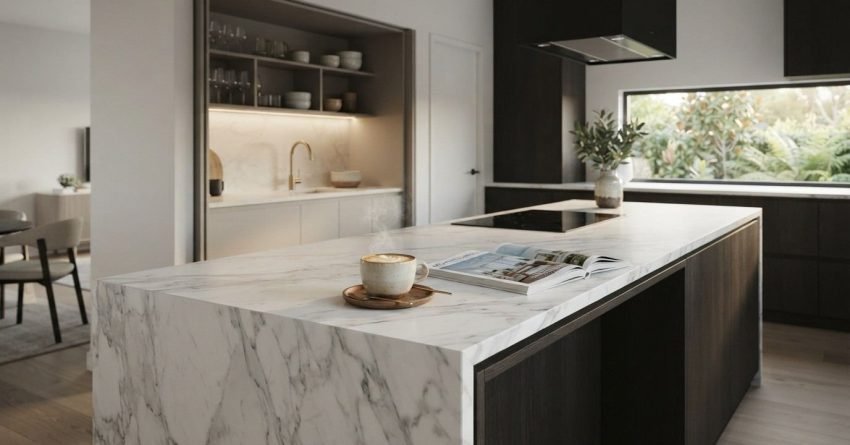
We’re seeing peninsula benches in Sydney specified with waterfall stone ends, integrated power points, and under-bench cabinetry that matches the perimeter run. The result is a cohesive, high-function layout that reads as intentional rather than compromised.
Integrated Dining Banquettes and Built-In Seating
The built-in banquette is making a strong return in Sydney kitchen renovations. Rather than placing an island in the centre of the kitchen, homeowners are pushing a dining table to the perimeter and building a fixed upholstered bench seat into the corner or along one wall.
This approach reclaims the centre of the room entirely. The kitchen workflow stays unobstructed, and the banquette itself provides hidden storage beneath the seat.
Banquettes work particularly well in kitchens that open directly to a living area. The seating zone can be visually separated from the cooking zone without a physical barrier in the middle of the floor.
Butler’s Pantries and Sculleries as the New Prep Zone
The butler’s pantry, a secondary prep and storage room adjacent to the main kitchen, is arguably the most significant kitchen design shift of the past five years in Sydney. It’s replacing the island not just as a design choice but as a functional philosophy.
The island was meant to provide extra prep space, storage, and a place to hide mess. The butler’s pantry does all of that and more behind a door, keeping the main kitchen clean and uncluttered while the scullery absorbs the appliances, bulk storage, second sink, and prep work.
For homeowners renovating larger Sydney properties, we consider the butler’s pantry a near-standard inclusion now. It adds genuine liveability and supports resale value.
Freestanding Kitchen Tables Making a Comeback
The freestanding kitchen table, a piece of furniture rather than a fixed architectural element, is returning to Sydney kitchens as a flexible, low-commitment alternative to the island. A well-chosen kitchen table provides prep space, casual dining, and a social gathering point.
Unlike an island, it can be moved, replaced, or removed entirely without a renovation. It doesn’t require plumbing, electrical work, or structural modification.
This option suits homeowners who want the function of an island without the permanence. It also suits rental properties where flexibility and cost efficiency matter more than architectural statements.
Extended Perimeter Benchtops With Waterfall Ends
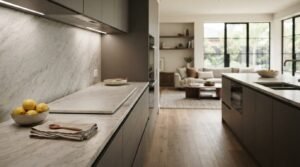
Rather than adding a separate island, many Sydney homeowners are extending their perimeter benchtops to create a continuous, generous work surface that wraps the kitchen. A waterfall stone end, where the benchtop material drops vertically to the floor at one end, provides the visual anchor an island would have delivered without occupying the centre of the room.
This approach maximises linear bench space and simplifies the cabinetry layout. It’s particularly effective in galley and L-shaped kitchens where perimeter space is already well-utilised.
Kitchen Layout Trends Replacing the Island in Sydney Homes
The shift away from kitchen islands isn’t just about individual design elements. It reflects a broader rethinking of kitchen layout: how space is organised, how workflow is structured, and how the kitchen integrates with the rest of the home.
Open-Plan Galley Kitchens Gaining Popularity
The galley kitchen, two parallel runs of cabinetry facing each other, is experiencing a significant revival in Sydney. Once associated with small apartments and dated design, we’re seeing the modern galley kitchen reinterpreted as a highly efficient, professional-grade layout that maximises every square metre.
In open-plan homes, the galley configuration lets the kitchen function as a defined zone within the larger living space without requiring a physical island to mark the boundary. The kitchen can be closed off visually with a butler’s pantry or concealed behind cabinetry when not in use.
L-Shaped and U-Shaped Layouts Without a Central Island
L-shaped and U-shaped kitchen layouts are being specified without islands far more frequently in 2025. Both configurations provide generous perimeter bench space and storage, creating natural workflow triangles between the sink, cooktop, and refrigerator without needing a central element.
In Sydney homes where the kitchen opens to an outdoor entertaining area, the L-shaped layout works particularly well. It positions the cooking zone along one wall and the prep and dining zone along the return.
The Rise of the Concealed Kitchen in Open-Plan Living
One of the most distinctive trends we’re seeing in Sydney’s higher-end renovations is the concealed kitchen, a kitchen designed to disappear when not in use. Appliances are hidden behind cabinetry panels, and the cooktop is covered by a flush lid.
This approach is the antithesis of the island kitchen, which was designed to be seen and celebrated. The concealed kitchen prioritises the living space over the kitchen space, treating cooking as a private activity rather than a social performance.
Smart storage plays a growing role in this trend. Integrated appliance garages, induction cooktops that disappear under solid lids, and pop-up power points let the kitchen fully recede into the living area between uses.
What to Consider Before Removing or Skipping a Kitchen Island
Deciding against a kitchen island isn’t always straightforward. There are practical, functional, and financial considerations to work through before committing to an island-free layout.
How Much Floor Space Do You Actually Need?
The minimum floor space recommendation for a kitchen island is a total kitchen width of at least 3.5 metres, with 900mm of clear circulation on each side. A kitchen that doesn’t meet this threshold turns an island into congestion rather than convenience.
For Sydney homes with kitchens under 3 metres wide, the decision is usually clear: an island isn’t viable. For kitchens between 3 and 3.5 metres, a peninsula or extended benchtop will almost always outperform an island in both function and feel.
We always recommend measuring your actual available floor space before making any decisions. Many homeowners discover during the planning phase that their kitchen was never large enough for an island to work properly. They simply inherited one from a previous renovation.
Workflow and the Kitchen Work Triangle Without an Island
The kitchen work triangle, the relationship between the sink, cooktop, and refrigerator, remains the foundation of efficient kitchen design as outlined by the National Kitchen and Bath Association. An island can support this triangle, but it isn’t required for the triangle to function well.
In L-shaped, U-shaped, and galley layouts, the work triangle can be optimised entirely within the perimeter cabinetry. The key is keeping the total distance between the three points within the recommended range of 4 to 8 metres.
Removing or skipping an island doesn’t compromise kitchen workflow. In many cases, it improves it by eliminating the circulation conflicts islands create in tighter spaces.
Resale Value: Does Removing an Island Hurt or Help?
This is the question most Sydney homeowners ask us, and the answer depends entirely on the property and the market. In larger homes where an island is expected, and the floor plan supports it, removing one can reduce buyer appeal.
In smaller homes where an island creates congestion, removing it, or never installing one, is the better outcome for resale. Sydney buyers in 2025 are increasingly sophisticated about kitchen design, and a well-executed peninsula bench, a thoughtfully designed butler’s pantry, or a clean galley layout attracts strong buyer interest.
The renovation decision should be driven by what the floor plan genuinely supports. Fashion from a decade ago shouldn’t drive the layout.
When Layout Changes Need Council or Certifier Sign-Off
Removing a kitchen island rarely triggers approval on its own. Moving plumbing, gas lines, or load-bearing elements often does.
We recommend confirming scope with a certifier or your local council early, especially in strata properties or heritage-overlay suburbs where extra conditions can apply.
What a Kitchen Layout Change Involves, Step by Step
Switching away from an island typically follows a predictable sequence once we start planning with a client. We measure the existing floor plan and confirm which services (plumbing, gas, electrical) sit under or near the current island footprint.
From there, we design the replacement layout, whether that’s a peninsula, butler’s pantry, or extended bench, and confirm whether any certifier sign-off applies. Demolition and service capping happen before new cabinetry, benchtops, and finishes go in.
Most island-to-alternative layout changes within an existing kitchen footprint run 3 to 6 weeks once approvals and materials are confirmed. Projects that add a butler’s pantry in new floor space typically take longer, since they involve additional structural and service work.
Cost Comparison: Kitchen Island vs. Island Alternatives in Sydney
Understanding the cost difference between a kitchen island and its alternatives is essential for renovation budgeting. The price gap is significant, and in most cases, the alternatives deliver better value per dollar spent.
How Much Does a Kitchen Island Cost in Sydney?
A basic kitchen island in Sydney, laminate benchtop, flat-pack cabinetry, no plumbing or electrical, starts at approximately $3,000 to $5,000 installed. A mid-range island with stone benchtop, custom joinery, and integrated power points typically costs between $8,000 and $15,000.
A high-end island with premium stone, custom cabinetry, integrated appliances, and plumbing can reach $20,000 to $35,000 or more. These figures don’t include the structural or electrical work required if the island needs new circuits, gas connections, or floor modifications.
In older Sydney homes, those additional costs can add several thousand dollars to the total.
Peninsula Bench vs. Island: Price and Practicality
A peninsula bench costs less than a comparable island in almost every scenario. Because it connects to the existing perimeter cabinetry run, it requires less independent joinery and no additional plumbing runs to a central location.
A mid-range peninsula bench in Sydney, stone benchtop, custom joinery, integrated seating overhang, typically costs between $5,000 and $10,000, depending on length and material specification. That represents a saving of $3,000 to $5,000 compared to an equivalent island.
Butler’s Pantry Addition: What Sydney Homeowners Are Spending
A butler’s pantry is a more significant investment than an island, but it delivers a fundamentally different level of function. In Sydney, a basic butler’s pantry, laminate shelving, a second sink, and basic cabinetry starts at approximately $8,000 to $12,000.
A mid-range scullery with stone benchtop, integrated appliances, and custom joinery typically costs between $15,000 and $25,000. For homeowners already undertaking a full kitchen renovation, the incremental cost of adding a butler’s pantry is often lower than these standalone figures suggest, since plumbing, electrical, and structural work is already being coordinated as part of the broader project.
Quick Comparison: Island vs. Peninsula vs. Butler’s Pantry
| Feature | Kitchen Island | Peninsula Bench | Butler’s Pantry |
| Typical Cost (mid-range) | $8,000–$15,000 | $5,000–$10,000 | $15,000–$25,000 |
| Minimum Kitchen Width Needed | 3.5m+ | 2.4m+ | No minimum (separate room) |
| Circulation Zones Required | Two | One | None |
| Adds Concealed Storage | Limited | Limited | Extensive |
| Best Suited To | Large open-plan homes | Terraces, semis, mid-size kitchens | Larger renovations, higher-end resale |
Design Tips for Kitchens Without an Island
Removing or skipping a kitchen island creates design opportunities many homeowners don’t anticipate. The key is redirecting the budget and design intent toward elements that deliver equivalent or superior function.
Storage Solutions When You Lose the Island
The island’s most practical contribution to a kitchen is storage, drawers, shelves, and cabinetry that would otherwise not exist. When you remove the island, that storage needs to be recovered elsewhere.
Tall pantry cabinetry is the most efficient replacement. A full-height pantry column, 600mm deep, floor to ceiling, provides more usable storage than most island base cabinets without consuming floor space.
Open shelving is also gaining traction as a lighter-touch storage solution. It suits kitchens where display and easy access matter more than concealed bulk storage, and it works particularly well paired with a butler’s pantry that absorbs the less attractive everyday clutter.
Lighting Strategies for Island-Free Kitchen Layouts
Kitchen islands typically anchor the pendant lighting scheme. Without an island, the lighting strategy needs to be rethought.
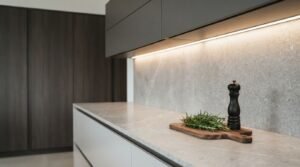
Recessed downlights positioned directly above the perimeter benchtops provide task lighting without requiring a central anchor point. LED strip lighting integrated into the underside of overhead cabinetry delivers focused, shadow-free illumination across the full bench length.
For kitchens with a peninsula, a single pendant or a short run of two pendants above the seating overhang maintains the visual warmth of pendant lighting without the commitment of a full island arrangement.
Benchtop Materials That Work Harder in Smaller Kitchens
In island-free kitchens, the perimeter benchtop carries more visual and functional weight. Material selection matters more, not less, when the benchtop is the primary surface in the room.
Engineered stone remains the most popular benchtop material in Sydney kitchen renovations for its durability, low maintenance, and design versatility. Porcelain slabs are gaining ground as a premium alternative, offering larger format options with minimal joins.
Timber benchtops add warmth to island-free kitchens but require more maintenance than stone. They work well as an accent surface rather than the primary work surface.
Is a Kitchen Island Still Worth It in 2026?
The kitchen island isn’t obsolete. In the right home, with the right floor plan and budget, it remains a genuinely valuable design element.
The problem is that it’s been applied indiscriminately, installed in kitchens that were never large enough to support it. For Sydney homes with kitchens wider than 3.5 metres, strong natural light, and open-plan living areas that benefit from a visual anchor, a well-designed island still makes sense.
For the majority of Sydney homes, terraces, semis, apartments, and modest suburban houses, we find the alternatives covered in this guide deliver better outcomes.
Quick Reference: When an Island Still Works
| Scenario | Island Recommended? |
| Kitchen width 3.5m+ | Yes |
| Kitchen width under 3m | No |
| Open-plan living needing a visual anchor | Yes, if space allows |
| Terrace or semi-detached home | Usually no |
| Renovation budget prioritising storage over seating | Consider butler’s pantry instead |
The shift away from the kitchen island in 2025 isn’t a trend. It’s a correction, a return to design decisions driven by function, proportion, and genuine liveability rather than aspiration and imitation.
Conclusion
The kitchen island is being replaced in 2025 by smarter, more space-efficient alternatives. Peninsula benches, butler’s pantries, integrated banquettes, and extended perimeter benchtops deliver better function for the floor plans most Sydney homes actually have.
Choosing the right kitchen layout is one of the most consequential decisions in any renovation. The wrong choice costs money twice, once to build it, and again to fix it.
At Sydney Home Renovation, we help homeowners and property investors make that decision with confidence, combining honest layout advice, transparent cost planning, and skilled workmanship to deliver kitchens that perform as well as they look. Contact us today to discuss your kitchen renovation.
Frequently Asked Questions
What is the most popular kitchen island alternative in 2025?
The peninsula bench is the most popular kitchen island alternative in 2025. It connects to the perimeter cabinetry on one end, reducing floor space needs while still providing seating, prep space, and storage.
Is a peninsula bench better than a kitchen island?
A peninsula bench outperforms a kitchen island in kitchens under 3.5 metres wide. It requires less floor space, costs less to build, and eliminates one circulation zone entirely.
How much does it cost to renovate a kitchen without an island in Sydney?
A kitchen renovation without an island in Sydney typically costs between $20,000 and $45,000 for a mid-range finish. Redirecting island budget toward a butler’s pantry or extended benchtop often delivers better value.
What is a butler’s pantry and is it worth adding to my kitchen?
A butler’s pantry is a secondary prep and storage room adjacent to the main kitchen, typically including a second sink and concealed appliance storage. It’s worth adding where the floor plan allows, adding real liveability and resale appeal.
Can I remove my existing kitchen island during a renovation?
Yes, we remove existing kitchen islands regularly during renovations. Any plumbing or electrical connections need to be capped or relocated by licensed tradespeople, and the floor may need patching where the island was fixed.
What kitchen layout works best for small Sydney homes?
The galley layout and L-shaped layout without a central island work best for small Sydney homes. Both maximise perimeter bench space and storage while keeping the centre of the kitchen clear.
Does removing a kitchen island add or reduce property value?
Removing a kitchen island adds value when the island was creating congestion in a floor plan that couldn’t support it. It reduces value only when the island was a genuine asset in a larger kitchen where buyers would expect one.