
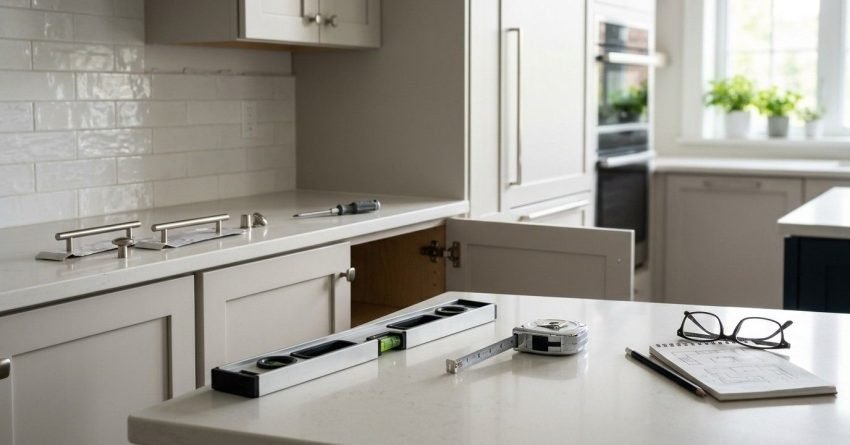
A new kitchen installation in Sydney typically includes demolition, cabinetry, benchtops, plumbing, electrical work, splashbacks, flooring, appliances, and finishing trades. We coordinate these across multiple licensed contractors to deliver a fully functional kitchen from bare walls to complete fit-out.
Understanding exactly what is and isn’t included in a kitchen install is the single most important step before signing any quote. Scope gaps between what you expect and what your contractor has priced are the leading cause of budget blowouts on kitchen renovations.
In this guide, we break down every component of a new kitchen installation, from structural preparation and joinery through to electrical, plumbing, appliances, and final finishes, with Sydney-specific cost context so you can plan, budget, and brief your contractor with complete clarity.
What Does a New Kitchen Installation Actually Cover?
A new kitchen installation covers the full scope of work required to remove an existing kitchen and replace it with a new one, or to fit out a kitchen space from scratch. It is not a single trade job. It is a coordinated, multi-trade project that typically involves a builder or renovation contractor, a licensed plumber, a licensed electrician, a cabinet maker or joinery supplier, and finishing trades including tilers and painters.
The scope of a kitchen install varies significantly depending on whether you are doing a like-for-like replacement or a full reconfiguration that involves moving walls, relocating plumbing, or upgrading electrical circuits. A like-for-like install is faster and less expensive. A reconfiguration adds structural, plumbing, and electrical complexity that increases both cost and timeline.
At its core, a complete kitchen installation includes:
- Demolition and strip-out of the existing kitchen
- Structural preparation of walls, floors, and ceilings
- Supply and installation of cabinetry and joinery
- Benchtop fabrication and installation
- Splashback installation
- Plumbing connections for sink, tapware, and dishwasher
- Electrical work including power points, circuits, and lighting
- Appliance installation and connection
- Flooring installation or preparation
- Painting, sealing, and final finishing trades
Each of these components carries its own labour cost, material cost, and lead time. Understanding what each involves helps you read quotes accurately, compare contractors fairly, and avoid being caught off guard by variations.
The Difference Between a Kitchen Renovation and a Full Kitchen Install
A kitchen renovation is a broad term that can mean anything from replacing cabinet doors and a benchtop through to a complete gut-and-rebuild. A full kitchen installation specifically refers to the complete removal of an existing kitchen and the installation of an entirely new one, including all cabinetry, surfaces, plumbing, and electrical work.
The distinction matters for budgeting. A cosmetic renovation that retains the existing cabinet carcasses and plumbing positions costs significantly less than a full install that replaces everything.
| Factor | Cosmetic Renovation | Full Kitchen Install |
| Cabinetry | Doors/fronts replaced only | Fully replaced |
| Plumbing/electrical | Retained in place | Reconnected or relocated |
| Typical cost impact | Lower | Higher |
When requesting quotes, we always recommend clarifying whether the scope is a full installation or a partial renovation, as the two are priced very differently.

Structural and Preparation Work Included in a Kitchen Install
Before any new cabinetry or benchtops go in, the existing kitchen must be removed and the space prepared to receive new work. This preparation phase is often underestimated in budget planning, yet it directly determines the quality and longevity of everything installed on top of it.
Structural and preparation work is typically carried out by the builder or renovation contractor at the start of the project. It includes demolition, wall and floor preparation, and any subfloor or waterproofing work required before trades begin.
Demolition and Strip-Out of the Existing Kitchen
Demolition involves the complete removal of existing cabinetry, benchtops, splashbacks, appliances, and flooring within the kitchen footprint. This includes disconnecting plumbing and capping off electrical circuits safely, work that must be carried out by licensed trades in NSW.
In Sydney, demolition and strip-out for a standard kitchen typically takes one to two days. The cost is usually included within the overall project quote from a renovation contractor, but if you are managing trades separately, we recommend budgeting for skip bin hire, labour, and licensed disconnection fees as separate line items.
Asbestos is a genuine consideration in Sydney homes built before 1990. Homes in this age bracket generally require an asbestos inspection and licensed removal before demolition can proceed, which adds cost and time to the preparation phase.
Wall, Floor, and Ceiling Preparation
Once the existing kitchen is stripped out, we assess and prepare walls, floors, and ceilings. This includes patching plasterboard where old cabinetry was fixed, repairing any damage from the strip-out, and ensuring surfaces are level, square, and structurally sound before new work begins.
Wall preparation is particularly important where new tiling or splashbacks will be installed. Surfaces must be flat and properly primed to ensure adhesion and a professional finish.
Floor preparation involves checking that the subfloor is level and structurally sound. Uneven floors affect cabinet installation, since base cabinets must be installed level regardless of the floor beneath them.
Waterproofing and Subfloor Work
Waterproofing is not always required in a kitchen, but it becomes relevant where the kitchen sits above a lower floor, where the subfloor is timber, or where the flooring specification requires a moisture barrier. In these cases, we apply a waterproofing membrane to the floor substrate before tiling or flooring installation.
Subfloor work may also include replacing damaged or soft sections of particleboard or timber flooring substrate. This is particularly common in older Sydney homes where moisture ingress around the sink or dishwasher has caused deterioration over time.
Cabinetry and Joinery: The Core of Any Kitchen Installation
Cabinetry is the largest single cost component in most kitchen installations and the element that most defines the look, functionality, and perceived quality of the finished kitchen. A kitchen install is fundamentally a joinery project. Everything else is built around the cabinet layout.
In Sydney, cabinetry is supplied through one of three channels: a custom cabinet maker who designs and builds to your exact specifications, a semi-custom supplier who offers configurable options within a standard range, or a flat-pack supplier such as IKEA or Kaboodle where you purchase pre-made components assembled and installed on site.
Each option has a different cost profile, lead time, and quality outcome. The right choice depends on your budget, the complexity of your kitchen layout, and the finish standard you are targeting.
Base Cabinets, Wall Cabinets, and Pantry Units
A standard kitchen installation includes base cabinets, wall cabinets, and pantry units. Together, these three cabinet types form the structural and storage framework of the kitchen.
Base cabinets are typically 600mm deep and 720mm high before the benchtop is added, with a finished height of approximately 900mm once the benchtop is in place. They house drawers, pull-out bins, under-sink plumbing, and appliance cavities for dishwashers and ovens.
Wall cabinets are fixed to the wall at a standard height above the benchtop, typically with a 600mm gap between the benchtop surface and the underside of the overhead cabinet. Pantry units are full-height cabinets, typically 2100mm to 2400mm, used for food storage, appliance housing, or integrated refrigerator cavities.
Overhead Cabinets and Storage Solutions
Overhead cabinets and storage solutions have evolved significantly in recent years. Beyond standard wall cabinets, a modern kitchen installation may include lift-up overhead doors, open shelving sections, integrated rangehood cavities, and corner storage solutions such as carousel units or pull-out corner drawers.
These elements are specified during the design phase and priced as part of the joinery scope. More complex storage solutions, particularly corner units and soft-close drawer mechanisms, add to the cabinetry cost but deliver meaningful functional improvements that most homeowners and property investors consider worthwhile.
Custom vs. Flat-Pack Cabinet Options in Sydney
The choice between custom and flat-pack cabinetry is one of the most significant budget decisions in a kitchen installation. Custom cabinetry in Sydney is designed and built to the exact dimensions of your space, using your chosen materials, finishes, and hardware. It offers the highest quality outcome and the greatest design flexibility, but it carries a premium price point and a longer lead time, typically four to eight weeks from order to delivery.
Flat-pack cabinetry uses standard module sizes that are assembled on site. It is significantly less expensive than custom joinery and can be a practical choice for investment properties or budget-conscious renovations. Standard module sizes may not perfectly suit your kitchen dimensions, which can require filler panels or layout compromises.
Semi-custom options, offered by suppliers such as Polytec, Laminex, and various Sydney-based cabinet makers, sit between these two extremes at a mid-market price point.
How Kitchen Layout Affects Installation Scope
The shape of your kitchen layout has a direct effect on both cost and complexity. A galley layout with two parallel runs of cabinetry is typically the most cost-efficient to install, since plumbing and electrical runs are shorter and more contained.
An L-shaped or U-shaped kitchen adds more benchtop and cabinetry perimeter, which increases material cost but often improves storage and workflow. Adding an island bench introduces its own plumbing and electrical requirements, since power and sometimes water need to be run to a freestanding structure rather than a wall.
We consider the “work triangle” (the relationship between sink, cooktop, and refrigerator) during design. A poorly planned layout can increase both installation cost and day-to-day usability issues.
Benchtops and Surfaces Included in a Kitchen Install
The benchtop is the most used surface in any kitchen and one of the most visible elements of the finished space. Benchtop selection affects both the aesthetic outcome and the long-term durability of the kitchen.
A kitchen installation includes the supply, fabrication, and installation of the benchtop, including templating, cutting to size, edge profiling, and fixing in place. Cutouts for the sink and cooktop are included in the fabrication scope.
Stone, Laminate, and Timber Benchtop Options
Engineered stone (commonly sold under brand names such as Caesarstone, Silestone, or Quantum Quartz) is the most popular benchtop material in Sydney kitchen renovations. It offers a durable, non-porous surface in a wide range of colours and finishes. Engineered stone benchtops in Sydney typically range from $400 to $1,200 per linear metre supplied and installed, depending on the stone specification and edge profile selected.
Laminate benchtops are the most affordable option and have improved significantly in quality and appearance in recent years. Laminate benchtops typically range from $150 to $400 per linear metre installed, making them a practical choice for investment properties and budget renovations.
Timber benchtops, typically using hardwoods such as spotted gum, blackbutt, or American oak, offer a warm, natural aesthetic that suits certain kitchen styles. Timber benchtops typically range from $300 to $800 per linear metre installed, though they require more maintenance than stone or laminate.
Natural stone, including marble, granite, and travertine, is the premium option. It is priced higher than engineered stone and requires sealing, but it offers a unique aesthetic that cannot be replicated by engineered alternatives. Recent Housing Industry Association renovation cost data shows stone benchtops remain the most requested upgrade in Sydney kitchen renovations.
Splashback Installation: Tiles, Glass, and Stone
The splashback is the surface between the benchtop and the overhead cabinets, protecting the wall from cooking splatter and moisture. It is included in the scope of a kitchen installation and is typically installed by a tiler or glazier depending on the material selected.
Tile splashbacks are the most common choice in Sydney kitchens. Subway tiles, large-format porcelain, and handmade ceramic tiles are all popular options across different budget levels.
Glass splashbacks, typically painted glass or printed glass, offer a seamless, easy-clean surface with no grout lines. Engineered stone splashbacks that match the benchtop material create a cohesive, high-end look and are increasingly common in premium Sydney kitchen renovations.
Plumbing Work Included in a New Kitchen Installation
Plumbing is a licensed trade in NSW, and all plumbing work in a kitchen installation must be carried out by a licensed plumber. The plumbing scope in a standard kitchen installation covers the connection of the sink, tapware, and waste, as well as the dishwasher connection and any hot water supply work required.
A kitchen layout change that relocates the sink expands the plumbing scope to include moving the supply lines and waste pipe to the new position. This is more complex and more expensive than a like-for-like connection.
Sink, Tapware, and Waste Connections
The kitchen sink connection includes the hot and cold water supply lines, the waste connection to the drainage system, and the installation of the tapware. In a standard like-for-like installation, a plumber can typically complete this in two to four hours.
Sink selection affects the plumbing scope. Undermount sinks, which are fixed beneath the benchtop rather than sitting in a cutout, require the benchtop to be fabricated with the sink cutout before installation. Topmount sinks are simpler to install and are the standard choice in budget and mid-range kitchens.
Tapware selection is typically the homeowner’s responsibility, with the plumber supplying labour for installation. Mixer taps, pull-out spray taps, and filtered water taps all have different installation requirements and price points.
Dishwasher Plumbing and Hot Water Connections
Dishwasher installation requires a cold water supply connection, a waste connection to the drainage system, and an electrical connection. The plumbing component sits within the plumbing scope of the kitchen installation, while the electrical connection sits within the electrical scope.
A first-time dishwasher installation, rather than a replacement, requires new supply and waste lines to be run to the dishwasher cavity. This adds to the plumbing cost and may require access to the subfloor or wall cavities.
Hot water connections for the sink are typically supplied from the existing hot water system. An undersized or aging hot water system is something we flag early, since it may need replacement or upgrade as part of the renovation scope.
Electrical Work Included in a Kitchen Install
Electrical work in a kitchen installation must be carried out by a licensed electrician in NSW. The electrical scope covers power points, dedicated circuits for high-draw appliances, appliance connections, and lighting. In older Sydney homes, the existing electrical infrastructure may not meet current standards or capacity requirements for a modern kitchen.
Power Points, Circuits, and Appliance Connections
A modern kitchen requires multiple power points, typically positioned above the benchtop for small appliances, inside pantry units for appliance storage, and within appliance cavities for integrated appliances. The number and placement of power points is determined during the design phase.
Dedicated circuits are required for high-draw appliances including the oven, cooktop, dishwasher, and rangehood. Older Sydney homes commonly need the switchboard upgraded to accommodate additional circuits, a cost that is separate from the kitchen installation itself but often identified during the planning phase.
Kitchen Lighting: Downlights, Under-Cabinet, and Pendants
Kitchen lighting is included in the electrical scope and is one of the most impactful elements of the finished kitchen. A well-lit kitchen requires a combination of general overhead lighting, task lighting directly above work surfaces, and feature lighting.
Recessed downlights are the standard overhead lighting choice in Sydney kitchens. LED downlights are the current standard, offering energy efficiency and long service life.
Under-cabinet lighting, typically LED strip lights installed beneath the overhead cabinets, provides direct task lighting on the benchtop surface. It is wired during the electrical rough-in phase and must be planned before cabinets are installed.
Pendant lights above a kitchen island or breakfast bar are a feature lighting element that adds visual interest. Pendant installation requires the electrical rough-in to be completed before the ceiling is finished.
Appliances: What Is and Isn’t Typically Included
Appliances are one of the most variable elements of a kitchen installation scope. In some cases, the renovation contractor supplies and installs all appliances as part of a complete package. In others, the homeowner supplies their own appliances, and the contractor is responsible for installation only.
As a general rule, appliance supply is not included in a standard kitchen installation quote unless explicitly stated. Appliance installation, meaning the physical fitting, connection, and commissioning, is typically included in the electrical and plumbing scope.
Cooktop, Oven, and Rangehood Installation
The cooktop, oven, and rangehood are the three primary cooking appliances in a kitchen installation. Their installation involves electrical connections for all three and gas connections for gas cooktops.
Cooktop installation includes the cutout in the benchtop, the electrical or gas connection, and the final commissioning. Induction and electric cooktops require a dedicated electrical circuit, and induction models in particular offer strong energy efficiency compared to older gas or ceramic tops, an increasingly common upgrade as Sydney homeowners look to reduce running costs. Gas cooktops require a licensed gasfitter for the gas connection, a separate licensed trade from the electrician.
Oven installation involves fitting the oven into its cavity within the cabinetry, making the electrical connection, and commissioning the appliance. Rangehood installation includes fixing the rangehood to the wall or ceiling and connecting the ducting to an external vent, or installing a recirculating filter system for recirculating models.
Integrated vs. Freestanding Appliance Fit-Out
Integrated appliances, including integrated dishwashers, refrigerators, and rangehoods, are designed to be concealed behind cabinet panels, creating a seamless, furniture-like appearance. They require precise coordination between the cabinet maker and the appliance supplier.
Freestanding appliances are simpler to install and replace, and they are the standard choice in budget and mid-range kitchens. They do not require custom cabinet panels and are generally less expensive to install than integrated alternatives.

Flooring Included in a New Kitchen Installation
Flooring is included in the scope of a kitchen installation, though the extent of the work depends on whether the existing floor is being retained, replaced, or extended. In a full kitchen installation where the entire floor is being replaced, the flooring scope includes removal of the existing floor covering, preparation of the substrate, and supply and installation of the new floor.
Tile, Hybrid, and Timber Flooring Options for Kitchens
Porcelain and ceramic tiles are the most common flooring choice in Sydney kitchens. Large-format tiles (600x600mm and above) are the current trend, creating a seamless, contemporary look with minimal grout lines.
Hybrid flooring, a rigid-core, waterproof plank product, has become increasingly popular in Sydney kitchens over the past several years. It offers the warm appearance of timber with the water resistance required in a kitchen environment, and it is faster to install than tiles.
Engineered timber flooring is a premium option that delivers genuine timber aesthetics with improved dimensional stability compared to solid timber. It requires more care than tiles or hybrid flooring in areas of heavy water exposure.
Painting, Finishing, and Final Trades in a Kitchen Install
The finishing phase of a kitchen installation is where the project transitions from a construction site to a completed, liveable kitchen. It includes painting, silicone sealing, hardware installation, and a final inspection.
Wall Preparation, Priming, and Painting
Painting in a kitchen installation covers the walls above the splashback, the ceiling, and any exposed wall sections. It follows the completion of all tiling, cabinetry, and benchtop work.
Wall preparation includes filling and sanding any patched areas, applying a primer coat, and ensuring a smooth, even base for the final paint coats. Low-sheen or semi-gloss acrylic paints are the standard choice for kitchen walls, offering a surface that can be wiped clean without damaging the paint film.
Silicone Sealing, Hardware Fitting, and Final Inspection
Silicone sealing is applied at all junctions between the benchtop and the splashback, between the benchtop and the sink, and at the base of the splashback. It prevents water ingress at these critical junctions.
Hardware fitting, including cabinet handles, drawer pulls, and soft-close mechanisms, is completed in the final phase. A final inspection checks that all cabinets are level and square, all appliances are commissioned, and all plumbing and electrical connections are safe and compliant.
What Warranty Applies to a New Kitchen Installation?
A new kitchen installation in NSW is covered by statutory home building warranty periods under the Home Building Act 1989. Structural defects are typically covered for six years, while non-structural defects are covered for two years from the date of completion.
We always provide written scope documentation and defects liability terms before work begins, since this protects both parties if an issue emerges after handover. A kitchen installation project valued over $20,000 in NSW also requires home building compensation cover, which we arrange as part of our contract.
Cabinetry manufacturers and appliance brands typically carry their own separate product warranties. These sit alongside, not instead of, the statutory builder’s warranty covering workmanship and installation.
Living Without a Kitchen During the Install
A full kitchen installation typically takes your existing kitchen fully offline for the duration of the on-site build. This is one of the most practical concerns we hear from homeowners, particularly families and those working from home.
Most clients set up a temporary kitchen using a bench fridge, microwave, and portable induction cooktop in a garage, laundry, or dining area. We recommend planning this space before demolition begins, not after, so essential appliances are relocated in the same weekend as the strip-out.
For like-for-like installs lasting one to two weeks, most households manage comfortably with a temporary setup. Complex reconfigurations lasting a month or more are worth planning around more carefully, particularly for larger families.
What Does a New Kitchen Installation Cost in Sydney?
Kitchen installation costs in Sydney vary widely depending on the size of the kitchen, the quality of materials specified, the complexity of the layout, and whether the project involves structural changes or trade upgrades.
Budget, Mid-Range, and Premium Kitchen Install Price Ranges
A budget kitchen installation in Sydney, using flat-pack cabinetry, laminate benchtops, and standard appliances, typically ranges from $15,000 to $25,000 for a standard-sized kitchen.
A mid-range kitchen installation, using semi-custom cabinetry, engineered stone benchtops, and quality appliances, typically ranges from $25,000 to $45,000. This is the most common price range for owner-occupier renovations in Sydney.
A premium kitchen installation, using fully custom cabinetry, natural or premium engineered stone, and integrated appliances, typically ranges from $45,000 to $80,000 or more.
| Kitchen Tier | Cabinetry | Benchtop | Appliances | Typical Cost Range (Sydney) |
| Budget | Flat-pack | Laminate | Standard freestanding | $15,000–$25,000 |
| Mid-Range | Semi-custom | Engineered stone | Quality freestanding | $25,000–$45,000 |
| Premium | Custom | Natural/premium stone | Integrated | $45,000–$80,000+ |
These ranges are indicative and should be used for initial budget planning only. A detailed quote from a licensed renovation contractor is the only reliable basis for accurate budget planning.
What a Line-Item Kitchen Quote Looks Like
A well-structured quote breaks the project into clear line items rather than a single lump sum. This typically includes demolition and disposal, cabinetry supply and install, benchtop supply and fabrication, splashback, plumbing labour, electrical labour, appliance installation, flooring, and painting, each priced separately.
We recommend asking your contractor to itemise the quote this way specifically. It makes it far easier to compare quotes between contractors and to see exactly where a variation has been added if the scope changes mid-project.
Hidden Costs and Variations That Affect Your Final Quote
Several cost items are commonly excluded from initial kitchen installation quotes and can add meaningfully to the final project cost if not identified in advance.
Asbestos removal is required in Sydney homes built before 1990 where asbestos-containing materials are identified during demolition. Structural changes, including removing or modifying walls, require a structural engineer’s assessment and can add several thousand dollars to the project budget.
Electrical switchboard upgrades are commonly required in older Sydney homes where the existing switchboard cannot accommodate additional circuits. A switchboard upgrade typically costs between $1,500 and $4,000 depending on the scope of work required.
A common real-world example we see is a homeowner discovering mid-project that their switchboard cannot support a new induction cooktop circuit. This variation alone can add over a thousand dollars once it’s identified during rough-in, which is why we flag switchboard capacity during the initial site inspection rather than after work has started.
Plumbing relocations and flooring extensions into adjacent living areas are two further variation sources that are easy to miss in an initial quote but straightforward to flag upfront.
How Long Does a New Kitchen Installation Take in Sydney?
The timeline for a new kitchen installation in Sydney depends on the size and complexity of the project, the lead time for cabinetry and materials, and the availability of trades.
Typical Kitchen Renovation Timeline by Project Size
| Project Type | Cabinetry Lead Time | On-Site Installation | Total Timeline |
| Like-for-like budget install | 2–4 weeks | 5–7 days | 3–5 weeks |
| Mid-range renovation | 4–6 weeks | 7–10 days | 5–8 weeks |
| Premium custom kitchen | 6–10 weeks | 10–15 days | 8–14 weeks |
| Complex reconfiguration | 6–10 weeks | 2–4 weeks | 10–16 weeks |
The cabinetry lead time is typically the longest single item on the project timeline. We always recommend ordering cabinetry as early as possible once the design is finalised, since this is the most effective way to minimise total project duration.
On-site installation involves multiple trades working in sequence. Demolition and preparation come first, followed by rough-in plumbing and electrical, then cabinetry installation, then benchtop templating and fabrication, then splashback and flooring, then final connections, and finally painting and finishing.
Do You Need Council Approval for a Kitchen Installation in NSW?
Most standard kitchen installations in NSW do not require council development approval. Under the State Environmental Planning Policy (Exempt and Complying Development Codes) 2008, kitchen renovations that do not involve structural changes, changes to the building footprint, or changes to the external appearance are generally classified as exempt development.
Permits, Licensed Trades, and Compliance Requirements
A DA is generally not required for a standard kitchen renovation, but several compliance requirements still apply. All plumbing work must be carried out by a licensed plumber and notified to the relevant water authority. All electrical work must be carried out by a licensed electrician, and a Certificate of Compliance must be issued upon completion.
A kitchen renovation that involves removing or modifying a load-bearing wall requires a structural engineer’s assessment, and a complying development certificate or DA may be required depending on the scope of the structural work.
In strata properties, including apartments and townhouses, additional approvals from the owners corporation may be required before renovation work can begin. We always recommend obtaining written approval from the owners corporation before commencing any kitchen renovation in a strata property.
How to Choose the Right Kitchen Installer in Sydney
Choosing the right kitchen installer is as important as choosing the right materials. The quality of the installation determines whether your new kitchen performs as intended and stands up to daily use over the long term.
What to Look for in a Kitchen Renovation Contractor
A qualified kitchen renovation contractor in Sydney should hold a current NSW builder’s licence, carry public liability insurance and home building compensation cover, and be able to provide references from recent kitchen renovation projects.
We recommend looking for a contractor who provides a detailed, itemised written quote that clearly specifies what is and isn’t included in the scope of work. A quote that is vague about scope is a quote that is likely to generate variations.
Ask how the contractor manages trade coordination. A contractor who manages all trades directly, rather than leaving you to coordinate plumbers, electricians, and tilers separately, reduces your risk and simplifies the project management burden.
We also recommend clarifying the payment schedule upfront. Most reputable contractors structure payments against completed milestones, such as demolition, cabinetry installation, and final handover, rather than requesting large deposits ahead of work.
Ask for a fixed-price contract where possible, with clearly defined variation conditions. A contractor who is transparent about pricing and variation processes is a contractor you can trust to deliver your kitchen renovation on budget.
Conclusion
A new kitchen installation in Sydney is a multi-trade, multi-phase project that covers demolition, cabinetry, benchtops, plumbing, electrical, appliances, flooring, and finishing work. Understanding every component and what each one costs is the foundation of a well-planned, on-budget renovation.
The difference between a kitchen renovation that stays on budget and one that blows out almost always comes down to scope clarity, trade coordination, and honest upfront pricing. Knowing what to ask, what to look for in a quote, and where hidden costs typically emerge puts you in control of the outcome.
At Sydney Home Renovation, we deliver complete kitchen installations with transparent pricing, detailed scopes, and end-to-end trade coordination, so you know exactly what you’re getting before work begins. Contact our team today to discuss your kitchen renovation and receive a detailed, obligation-free quote.
Frequently Asked Questions
What trades are involved in a new kitchen installation?
A new kitchen installation typically involves a builder or renovation contractor, a licensed plumber, a licensed electrician, a cabinet maker or joinery supplier, a tiler, and a painter. A licensed gasfitter is also required for gas cooktop connections.
Is plumbing and electrical work included in a kitchen install quote?
It depends on the contractor and how the quote is structured. Some contractors include all trades in a single fixed-price quote, while others price cabinetry separately from plumbing and electrical. Always confirm this before signing.
How much does a new kitchen installation cost in Sydney?
A new kitchen installation in Sydney typically costs between $15,000 and $25,000 for a budget fit-out, $25,000 to $45,000 for a mid-range renovation, and $45,000 to $80,000 or more for a premium custom kitchen.
What is not included in a standard kitchen installation?
Items commonly excluded include appliance supply, asbestos removal, structural wall modifications, electrical switchboard upgrades, and flooring extensions into adjacent rooms. Always review your quote carefully before work begins.
Do I need to supply my own appliances for a kitchen install?
In most cases, yes, appliance supply is the homeowner’s responsibility unless the contractor has explicitly included it. The contractor is typically responsible for installing and connecting the appliances you supply.
How long does a kitchen installation take from start to finish?
A standard kitchen installation in Sydney takes between three and eight weeks from start to completion, depending on complexity and cabinetry lead time. On-site installation typically takes five to fifteen days.
Do I need council approval for a new kitchen in NSW?
Most standard kitchen renovations in NSW do not require council approval and are classified as exempt development. Structural changes may require additional approvals, and strata properties typically require owners corporation approval.
Is there a warranty on a new kitchen installation?
Yes. Structural defects are covered for six years and non-structural defects for two years under NSW statutory home building warranty rules. We provide written defects liability terms with every project.
Can I live in my house during a kitchen renovation?
Yes, most homeowners stay in the property and set up a temporary kitchen using a bench fridge, microwave, and portable cooktop. We recommend planning this space before demolition begins.


