
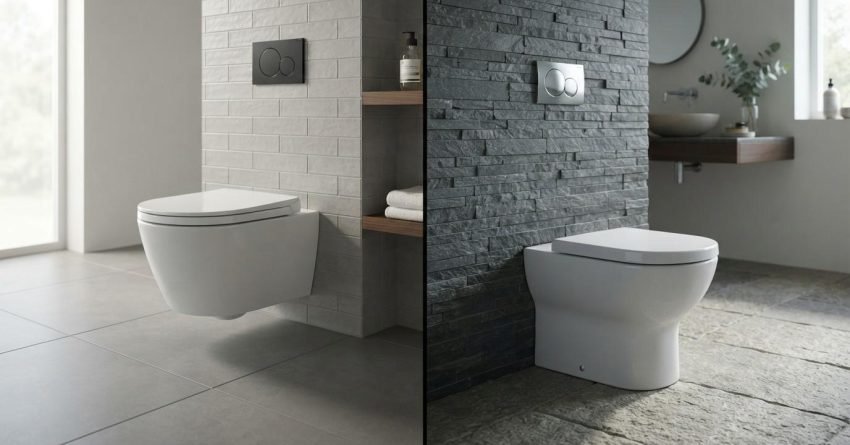
Wall-hung toilets cost $1,500–$4,500+ more to install than floor-mounted toilets in Sydney once you factor in the carrier frame, in-wall cistern, structural framing, and additional tiling labour. The pan itself often costs more too. That gap is real, and it matters when you’re building a renovation budget.
Knowing where that cost comes from helps you decide whether the premium is worth it for your specific bathroom, property type, and long-term goals.
This guide breaks down both toilet types on installation complexity, supply and fitting costs, maintenance realities, and which option suits different renovation scenarios.
What Is a Wall-Hung Toilet?
A wall-hung toilet is a pan that mounts directly to a structural carrier frame concealed inside the wall, with the cistern hidden behind the wall cavity and only the flush plate visible on the surface.
The pan floats off the floor entirely. There’s no visible cistern, no floor connection, and no exposed pipework. That clean, minimal look is exactly why wall-hung toilets dominate high-end bathroom renovations in Sydney right now.
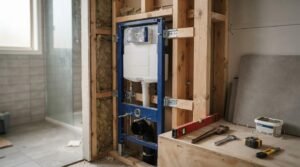
The trade-off is complexity. Installing one requires a structural carrier frame, an in-wall cistern, a reinforced wall cavity, and precise tiling work around the flush plate. None of that is simple.
How the In-Wall Cistern Works
The cistern sits inside the wall cavity, mounted to the carrier frame. A dual-flush plate on the tiled wall surface connects to the cistern via push rods or pneumatic actuators, triggering the flush mechanism without any visible hardware.
Brands like Geberit and Grohe dominate the carrier frame and cistern market in Australia. The frame itself is a steel structure that bolts to the floor and the wall framing, carrying the full load of the pan and the person using it.
The flush plate is the only visible component. It sits flush with the tile surface and comes in a range of finishes: chrome, matte black, brushed nickel to match the bathroom design.
Wall-Hung Toilet Dimensions and Space Requirements
A wall-hung pan typically projects 480–560mm from the finished wall face, which is slightly less than most floor-mounted toilets. That saved projection is meaningful in a compact bathroom.
The wall cavity needs a minimum depth of 120mm to house the carrier frame and cistern. In a standard stud wall, this usually works. In a concrete or masonry wall, a false wall or bulkhead is required, which adds cost and reduces floor area.
Pan height is adjustable during installation, typically set between 380–430mm from finished floor level, which is a genuine ergonomic advantage over fixed-height floor toilets.
What Is a Floor-Mounted Toilet?
A floor-mounted toilet connects directly to the floor waste and sits on the bathroom floor, with the cistern either attached to the pan (close-coupled) or concealed in a back-to-wall unit.
It’s the standard toilet configuration in Australian homes. Installation is straightforward, parts are widely available, and any licensed plumber can service one without specialist knowledge.
Floor-mounted toilets range from basic close-coupled units to sleek back-to-wall designs that look nearly as clean as a wall-hung option at a fraction of the installation cost.
Close-Coupled vs Back-to-Wall Floor Toilets
A close-coupled toilet has the cistern sitting directly on top of the pan. It’s the most common and most affordable configuration. Everything is visible, everything is accessible, and repairs are simple.
A back-to-wall toilet conceals the cistern inside a floor-level cabinet or wall unit, with only the pan visible. It achieves a cleaner look than close-coupled without the structural complexity of a wall-hung installation.
Back-to-wall units cost more than close-coupled but significantly less than wall-hung when total installation costs are compared. For renovators who want a modern aesthetic without the wall-hung price tag, back-to-wall is worth serious consideration.
Floor-Mounted Toilet Dimensions and Space Requirements
Most floor-mounted toilets project 650–750mm from the wall, which is noticeably more than a wall-hung pan. In a small bathroom, that extra 100–150mm of projection makes a real difference to how the space feels.
The rough-in distance the measurement from the finished wall to the centre of the floor waste is typically 160mm for S-trap and 90–140mm for P-trap configurations. Getting this measurement right before purchasing a toilet is critical. A mismatch means the pan won’t fit without relocating the floor waste, which adds plumbing cost.
Installation Complexity and Labour Costs in Sydney
Installation is where the cost gap between wall-hung and floor-mounted toilets becomes most visible. A floor-mounted toilet swap is a straightforward plumbing job. A wall-hung installation is a multi-trade project.
Sydney plumbers charge $120–$180 per hour for bathroom work as of 2026, and wall-hung installations involve significantly more hours, more trades, and more materials than a standard floor toilet fit-off.
Wall-Hung Toilet Installation Requirements
Installing a wall-hung toilet involves a licensed plumber, a carpenter or builder for the carrier frame and wall framing, and a tiler to finish around the flush plate. In a full bathroom renovation, these trades are already on site. In a toilet-only replacement, you’re coordinating and paying for all three separately.
The carrier frame installation alone takes 3–5 hours for an experienced plumber. Add framing, waterproofing, tiling, and flush plate fitting, and a wall-hung installation in Sydney typically runs $1,800–$3,500 in labour depending on wall type and whether a false wall is needed.
Concrete or masonry walls require a false wall build-out, which adds $500–$1,200 in carpentry and materials on top of the plumbing labour.
Floor-Mounted Toilet Installation Requirements
A standard floor-mounted toilet installation removing the old unit and fitting a new one to an existing floor waste takes a licensed plumber 1–2 hours. Total labour cost in Sydney runs $180–$400 for a straightforward swap.
If the floor waste needs relocating to match a new toilet’s rough-in, add $300–$600 for that work. Back-to-wall units with concealed cisterns take slightly longer to fit; expect 2–3 hours and $350–$600 in labour.
No additional trades are required for a standard floor-mounted installation. That simplicity is a genuine cost advantage.
Supply and Fitting Costs: What to Budget in Sydney
Supply costs vary significantly between toilet types, and the total cost of ownership includes both the product and the installation. Looking at supply price alone gives an incomplete picture.
Here’s what realistic budgets look like in Sydney for 2025.
Wall-Hung Toilet Price Range
Wall-hung toilet systems are priced as a package: pan, carrier frame, in-wall cistern, and flush plate. Buying these components separately from different brands creates compatibility risks, so most suppliers sell them as a system.
| Tier | Pan + Frame + Cistern + Flush Plate | Notes |
| Entry-level | $800–$1,400 | Basic brands, limited finish options |
| Mid-range | $1,400–$2,800 | Geberit frame, Caroma or Villeroy & Boch pan |
| Premium | $2,800–$6,000+ | Geberit or Grohe system, designer pan, premium flush plate finish |
Add $1,800–$3,500 in installation labour to every tier above. Total installed cost for a wall-hung toilet in Sydney runs $2,600–$9,500+ depending on product choice and wall type.
Floor-Mounted Toilet Price Range
Floor-mounted toilets offer a much wider price range and far lower installation costs.
| Tier | Product Cost | Notes |
| Entry-level close-coupled | $200–$500 | Caroma, Fowler – reliable, widely available |
| Mid-range close-coupled | $500–$1,000 | Rimless pan, soft-close seat, dual flush |
| Back-to-wall unit | $600–$2,000 | Cleaner look, concealed cistern, more install time |
| Premium back-to-wall | $2,000–$4,500 | Designer brands, TOTO, Villeroy & Boch |
Add $180–$600 in installation labour. Total installed cost for a floor-mounted toilet in Sydney runs $380–$5,100 depending on product and configuration.
The cost gap between a mid-range wall-hung system and a mid-range back-to-wall floor toilet is typically $2,000–$4,000 installed. That’s a meaningful number in any renovation budget.
Maintenance, Repairs, and Long-Term Ownership Costs
Both toilet types are reliable when installed correctly. The difference is what happens when something goes wrong and how easy and expensive it is to fix.
Floor-mounted toilets win on repairability. Wall-hung toilets win on hygiene and cleaning ease. Neither is maintenance-free.
Accessing the In-Wall Cistern for Repairs
The in-wall cistern is accessed by removing the flush plate and reaching through the service gap behind it. Geberit and Grohe systems are designed with this in mind; the cistern components are serviceable without demolishing the wall.
In practice, replacing a fill valve or flush valve in a wall-hung cistern takes a plumber 1–2 hours and costs $200–$450 in Sydney including parts. That’s more than the same repair on a floor toilet, but it’s not the wall-demolition nightmare some people expect.
The real risk is a cistern leak inside the wall cavity. A slow leak that goes undetected causes water damage to the wall framing and can require significant remediation. Regular visual checks of the wall surface around the flush plate catch most issues early.
Floor-Mounted Toilet Maintenance Considerations
A close-coupled toilet is one of the most serviceable fixtures in a bathroom. The cistern lid lifts off, every component is visible, and most repairs fill valve, flush valve, flapper cost $80–$200, including a plumber’s call-out.
The base seal between the pan and the floor waste is the most common failure point on older floor toilets. A failed base seal causes odours and, eventually, water damage to the subfloor. Replacement costs $150–$350 and is a straightforward job for any plumber.
Back-to-wall units are slightly less accessible than close-coupled, but still far easier to service than a wall-hung system. The cistern access panel on most back-to-wall units opens without tools.
Which Toilet Suits Your Bathroom Renovation?
The right toilet depends on your bathroom size, your budget, your property type, and how long you plan to hold the property. There’s no universal answer, but there are clear patterns.
Best Choice for Small Bathrooms
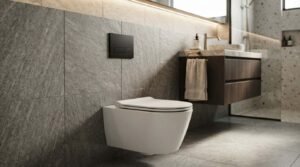
A wall-hung toilet is the stronger choice in a small bathroom, and the reason is floor clearance. With no pan base on the floor, the entire floor surface is visible and uninterrupted. That visual continuity makes a small bathroom feel noticeably larger.
The reduced projection, typically 80–120mm less than a floor-mounted toilet, also helps in tight spaces where every centimetre matters. Cleaning is easier too. No floor junction means no grout line to scrub around the base.
The premium is real, but in a small bathroom where the toilet dominates the visual field, the design and spatial payoff justifies the cost for most owner-occupiers.
Best Choice for Investment Properties and Rentals
A mid-range floor-mounted toilet is the right call for an investment property. Lower supply cost, lower installation cost, easier repairs, and no specialist knowledge required for a plumber attending a tenant callout.
A back-to-wall floor toilet gives a clean, modern look that photographs well and appeals to tenants without the installation complexity or repair risk of a wall-hung system. Budget $600–$1,200 installed for a solid back-to-wall unit in a rental bathroom.
Wall-hung toilets in rental properties create maintenance exposure. A tenant-reported flush issue requires a plumber familiar with the specific carrier frame system. That’s a narrower pool of tradespeople and a higher call-out cost.
Best Choice for High-End Renovations
Wall-hung toilets are the default choice in high-end bathroom renovations in Sydney, and the design logic is sound. A floating pan, a flush plate that disappears into the tile surface, and zero visible hardware create a bathroom that reads as genuinely premium.
Pair a Geberit Duofix frame with a rimless pan from Villeroy & Boch or Caroma Urbane II, a matte black flush plate, and a soft-close seat, and the result is a fixture that anchors the entire bathroom design.
For a renovation targeting resale value above the median, the wall-hung toilet is a visible signal of quality that buyers notice and respond to.
Conclusion
Wall-hung and floor-mounted toilets both have a clear place in bathroom renovations; the decision comes down to budget, bathroom size, and property type.
For owner-occupiers renovating a primary bathroom, the wall-hung toilet delivers genuine design and spatial value that justifies the premium. For investment properties, a quality back-to-wall floor toilet is the smarter spend.
At Sydney Home Renovation, we help you make that call with real cost data and honest advice, so your renovation budget goes exactly where it should. Get in touch to start planning your bathroom renovation today.
Frequently Asked Questions
Is a wall-hung toilet more expensive to install than a floor-mounted toilet?
Yes, significantly. A wall-hung toilet installation in Sydney costs $1,800–$3,500 in labour alone, compared to $180–$600 for a floor-mounted toilet. The total installed cost difference typically runs $2,000–$4,500 depending on wall type and product choice.
Can a wall-hung toilet be installed on any wall?
No. The wall must be capable of housing a carrier frame and supporting the load. Stud walls work in most cases. Concrete or masonry walls require a false wall build-out, which adds cost. A licensed plumber or builder assesses wall suitability before installation begins.
How long does a wall-hung toilet installation take?
A full wall-hung toilet installation, including carrier frame, in-wall cistern, framing, waterproofing, tiling, and flush plate fitting, takes 2–4 days across multiple trades. A floor-mounted toilet swap takes a plumber 1–3 hours.
Are wall-hung toilets harder to repair?
Cistern repairs are more involved than on a floor toilet, but modern systems like Geberit are designed for service access through the flush plate. Most repairs cost $200–$450 in Sydney. The main risk is an undetected leak inside the wall cavity, which requires regular monitoring.
Which toilet adds more value to a bathroom renovation?
A wall-hung toilet adds more perceived value in owner-occupier and high-end renovation contexts. Buyers and valuers associate the floating pan with premium finishes. For investment properties, a quality back-to-wall floor toilet delivers better return on spend.
What is the weight limit for a wall-hung toilet?
Most carrier frames from Geberit, Grohe, and equivalent brands are rated to support 400kg. The frame carries the load, not the wall tiles or the pan fixings. This is sufficient for all standard residential use.
Do floor-mounted toilets look outdated in modern bathrooms?
Not at all. Back-to-wall floor toilets with concealed cisterns, rimless pans, and soft-close seats look entirely contemporary. The close-coupled configuration reads as more traditional, but a well-chosen back-to-wall unit holds its own in a modern bathroom renovation.


