
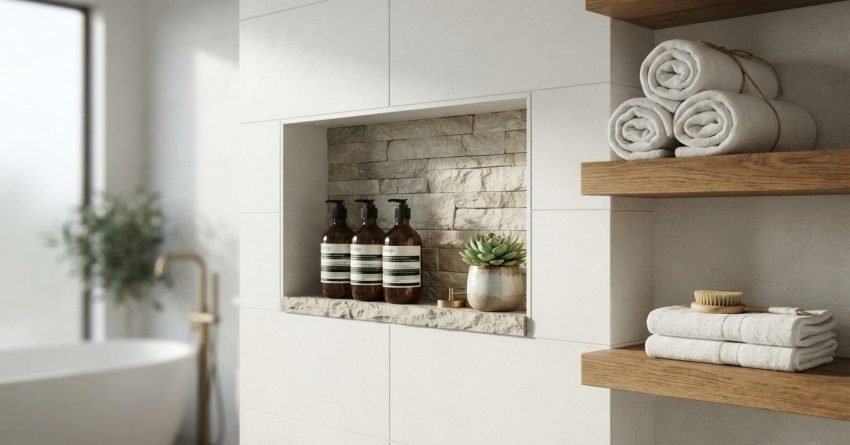
The right bathroom shelving transforms a cluttered, cramped space into something that actually works, and in Sydney bathrooms, where space is almost always at a premium, the shelf type you choose matters more than most people realise. I’ve seen renovations where a single well-placed recessed niche or a run of floating shelves completely changed how a bathroom felt and functioned. The difference between a bathroom that works and one that frustrates you every morning often comes down to storage decisions made during the renovation.
Getting shelving right means thinking about moisture, wall construction, tile layout, and how you actually use the space. This guide covers the six most practical bathroom shelving options for Sydney homes, with real costs, installation considerations, and honest advice on what suits different bathroom sizes and budgets.
1. Floating Shelves for a Clean, Modern Look
Floating shelves are the most popular shelving choice I see in Sydney bathroom renovations right now. They suit almost every bathroom style from Hamptons to contemporary, and they work in both small ensuites and larger family bathrooms.
The appeal is straightforward. They look clean, they’re relatively affordable, and they give you visible storage without the bulk of a cabinet. But they do need to be installed correctly, especially in a bathroom environment where moisture is constant.
Best Materials for Floating Bathroom Shelves
Timber is the most common choice, but not all timber performs the same way in a bathroom. Solid hardwood with a sealed finish holds up well in dry zones, think above the toilet or beside the vanity. MDF is cheaper but swells with moisture exposure, so I never recommend it near a shower or bath.
Glass shelves are a strong option for a sleek, modern look. Toughened glass doesn’t absorb moisture; it’s easy to clean, and it keeps the visual space open. Stainless steel and powder-coated steel brackets are the most durable fixing option and handle the humidity without rusting.
How to Style Floating Shelves in a Small Bathroom
In a small bathroom, floating shelves work best when they’re kept minimal. One or two shelves above the toilet or beside the mirror give you storage without making the room feel smaller. Keep the shelf depth to around 200–250mm so it doesn’t project too far into the space.
Styling matters too. A mix of functional items, hand towels, soap, a small plant and a couple of decorative pieces keeps the shelf looking intentional rather than cluttered. The key is leaving some breathing room on the shelf itself.
2. Recessed Niche Shelves Built Into the Wall
A recessed shower niche is the shelving solution I recommend most often during bathroom renovation planning conversations. It sits flush with the wall, it doesn’t project into the shower space, and when it’s tiled correctly, it looks like it was always meant to be there.
The trade-off is that it needs to be planned before tiling begins. You can’t add a recessed niche to a finished shower without removing tiles and potentially disturbing the waterproofing membrane, which is a high cost.
Where to Position a Recessed Niche in the Shower
Position matters more than most people expect. The niche needs to sit between wall studs, which typically means a maximum internal width of around 300–400mm in a standard timber-framed wall. Steel-framed walls require a different approach and sometimes a structural solution.
Height-wise, I recommend positioning the niche at chest to shoulder height, roughly 1,400–1,600mm from the floor. That puts it within easy reach without requiring you to bend down or reach up. Avoid positioning it on an external wall where possible, as insulation and moisture management become more complex.
Tiling and Waterproofing a Recessed Shelf Niche
Waterproofing a recessed niche is non-negotiable under Australian Standard AS 3740, which governs wet area waterproofing in residential construction. The niche interior floor, sides, and back must be fully waterproofed before tiling. Any gap in the membrane is a future leak.
The tile layout inside the niche needs to be planned as part of the overall shower tile design. A feature tile on the niche back wall is a popular choice and adds a visual focal point. Grout selection matters too; epoxy grout in the niche holds up better than cement-based grout in a constantly wet environment.
3. Over-Toilet Shelving Units for Vertical Storage
Over-toilet shelving is one of the most practical storage solutions for a bathroom that’s short on wall space. The area above the toilet is almost always unused, and a well-chosen unit there can add significant storage without touching the floor plan.
This option works particularly well in narrow bathrooms where wall space beside the vanity is limited. It’s also one of the more budget-friendly shelving solutions, since it doesn’t require tiling or waterproofing work.
Freestanding vs. Wall-Mounted Over-Toilet Shelves
Freestanding over-toilet units sit on the floor and straddle the toilet cistern. They’re easy to install no drilling required and they can be moved or removed without any damage. The downside is stability. In a busy family bathroom, a freestanding unit can shift or wobble, and the floor footprint adds visual clutter.
Wall-mounted over-toilet shelving is more secure and looks cleaner. It requires fixing into wall studs or using appropriate wall anchors for the substrate; plasterboard alone won’t hold a loaded shelf safely. For a renovation, wall-mounted is almost always the better long-term choice.
Weight Limits and Fixing Requirements
Every shelf has a load rating, and bathroom shelves carry more weight than people expect; bottles, towels, and toiletries add up quickly. As a general guide, a standard wall-mounted shelf fixed into studs handles 15–25kg per shelf comfortably. Plasterboard anchors alone are rated much lower and shouldn’t be relied on for heavily loaded shelves.
Always fix into the stud where possible. If the stud position doesn’t align with where you want the shelf, a horizontal timber batten fixed between two studs gives you a solid fixing point anywhere along its length.
4. Corner Shelves to Use Every Centimetre
Corner shelves are the most space-efficient shelving option in a bathroom. Corners are almost always dead space especially in the shower recess, and a well-chosen corner shelf turns that wasted area into functional storage.
I see a lot of Sydney bathrooms where the shower has no internal storage at all. A corner shelf or two inside the shower recess solves that immediately, without adding bulk to the shower walls.
Corner Shelf Options for the Shower Recess
Tile-in corner shelves are the cleanest option for a shower recess. These are ceramic or porcelain shelves that are set into the tile layout during installation, so they sit flush with the surrounding tiles. They’re durable, easy to clean, and look like a deliberate design feature rather than an afterthought.
Tension pole corner caddies are a no-drill alternative that works in an existing shower. They’re held in place by a spring-loaded pole between the floor and ceiling. They’re practical and affordable, but they don’t look as polished as a built-in option and can be harder to clean around.
Corner Shelving Outside the Shower Zone
Outside the shower, a corner shelf unit, either wall-mounted or freestanding, makes use of space that’s otherwise ignored. A small corner unit beside the vanity or in the corner opposite the door gives you storage for towels, toiletries, or decorative items without taking up floor space along the main walls.
Timber corner units work well in dry zones. For anything near the bath or in a high-humidity area, powder-coated steel or a sealed hardwood is a better choice than raw timber or MDF.
5. Ladder Shelves and Freestanding Bathroom Storage
Ladder shelves have become a popular bathroom storage option over the last few years, and I understand why. They’re versatile, they don’t require any installation, and they add a design element to the bathroom as well as storage.
They work best in larger bathrooms where there’s floor space to spare. In a small ensuite, a ladder shelf can feel like it’s in the way rather than helping.
Styling a Ladder Shelf in a Bathroom
The most functional way to use a ladder shelf in a bathroom is to mix storage types across the rungs. Rolled towels on the lower rungs, baskets for toiletries in the middle, and a small plant or candle at the top keep it looking styled rather than just stacked.
Lean-to ladder shelves need a flat wall surface and enough floor clearance to sit stably. Some styles come with wall fixings for added security, worth using in a household with young children.
Moisture Resistance and Material Selection
Bathroom humidity is hard on materials that aren’t designed for it. Bamboo and teak are the best natural material choices for a bathroom ladder shelf; both have natural moisture resistance and hold up well in a humid environment. Solid pine or MDF will deteriorate over time without a very good sealer, and even then they’re not ideal.
Powder-coated steel ladder shelves are the most durable option and the easiest to maintain. They won’t warp, swell, or discolour with humidity, and they suit a contemporary or industrial bathroom aesthetic well.
6. Built-In Vanity Shelving and Cabinet Storage
Built-in vanity shelving is the most integrated storage solution in a bathroom renovation. It’s part of the vanity unit itself, either open shelving beside or below the basin, or enclosed cabinet storage with doors. Done well, it makes the bathroom feel considered and complete rather than assembled from separate pieces.
This is where the bathroom renovation budget has the most influence on the outcome. The gap between a flat-pack vanity with basic shelving and a custom-built joinery piece is significant in both cost and result.
Open Shelving vs. Closed Cabinet Storage
Open vanity shelving looks great in a styled bathroom and gives you easy access to towels and everyday items. The practical downside is dust and moisture accumulation on everything stored there. In a bathroom that gets heavy daily use, open shelving requires more frequent tidying to look intentional rather than chaotic.
Closed cabinet storage hides the clutter and protects contents from moisture and dust. It’s the more practical choice for a family bathroom. A combination of some open shelving for display and some closed storage for everyday items is often the best of both.
Custom vs. Flat-Pack Vanity Shelving in Sydney
Flat-pack vanity units are widely available across Sydney and suit most standard bathroom layouts. They’re cost-effective and can look very good with the right tapware and finishes. The limitation is that they come in fixed sizes, so if your bathroom has an unusual layout or you want a specific configuration, flat-pack often means compromise.
Custom joinery gives you exactly what you need: the right dimensions, the right finish, and shelving configured for how you actually use the space. In Sydney, custom bathroom joinery typically costs between $2,000 and $6,000 depending on size, material, and complexity. That’s a meaningful investment, but for a bathroom that’s being fully renovated, it’s often worth it for the long-term result.
Choosing the Right Bathroom Shelving for Your Renovation
With six shelving options on the table, the right choice comes down to three things: your bathroom size and layout, the moisture environment of each shelf location, and your renovation budget. Getting all three right means the shelving works practically and holds up over time.
Matching Shelf Style to Bathroom Size and Layout
Small bathrooms under 5 square metres benefit most from recessed niches, corner shelves, and over-toilet units. These options add storage without reducing the visual or physical space. Floating shelves work in small bathrooms too, but only if they’re kept minimal and positioned carefully.
Larger bathrooms and ensuites have more flexibility. Ladder shelves, built-in vanity storage, and a combination of floating shelves and recessed niches all work well when there’s room to breathe. The goal in any size bathroom is storage that feels deliberate, not storage that was added as an afterthought.
Waterproofing and Moisture Considerations for Sydney Homes
Any shelving inside a wet area, the shower recess or bath surround, must comply with AS 3740, the Australian Standard for waterproofing of domestic wet areas. This applies to recessed niches, tile-in corner shelves, and any shelf that’s built into a tiled wet area surface.
Outside the wet area, moisture management is still important but less regulated. Sydney’s humidity, particularly in coastal suburbs, means materials matter even in the dry zone. Sealed timber, powder-coated steel, and glass all perform well. Raw MDF and untreated timber don’t.
Budget Ranges for Bathroom Shelving in Sydney
Shelving costs vary significantly depending on type, material, and whether installation is included. Here’s a realistic guide for Sydney in 2026:
- Floating shelves (supply and install): $150–$600 per shelf depending on material and size
- Recessed shower niche (built during renovation): $300–$800 including waterproofing and tiling
- Over-toilet shelving unit (supply and install): $100–$500
- Corner tile-in shelf (supply and install): $80–$250 per shelf
- Ladder shelf (supply only, no install): $80–$400
- Flat-pack vanity with shelving: $500–$2,500 supply and install
- Custom vanity joinery: $2,000–$6,000 depending on size and specification
Labour costs in Sydney for a licensed tiler or carpenter run between $80 and $120 per hour. Any wet area work, such as recessed niches, tile-in shelves, needs a licensed tradesperson to ensure waterproofing compliance.
Conclusion
Bathroom shelving is one of the most practical decisions in any renovation and one of the most overlooked until the bathroom is already tiled and it’s too late to add a niche. The right shelving type depends on your bathroom size, your wet area layout, and how much of the work is happening during a renovation versus being retrofitted later.
We work with Sydney homeowners every day on exactly these decisions, helping them get the storage right before the tiles go down, not after. The difference between a bathroom that functions well for years and one that frustrates you daily often comes down to planning made early.
At Sydney Home Renovation, we help you make those calls with confidence, from recessed niche placement and waterproofing compliance to vanity joinery and the full renovation build. Get in touch and let’s plan your bathroom shelving properly from the start.
Frequently Asked Questions
What is the best shelving for a small bathroom?
Recessed shower niches, corner shelves, and over-toilet units are the best choices for a small bathroom. They add storage without reducing floor space or making the room feel smaller. Floating shelves work too, but keep them minimal: one or two shelves maximum.
Are floating shelves suitable for a wet area?
Floating shelves are not suitable inside the shower recess or bath surround. They belong in the dry zone above the toilet, beside the vanity, or on a wall away from direct water contact. Inside a wet area, a recessed niche or tile-in corner shelf is the right solution.
How much does bathroom shelving cost in Sydney?
Bathroom shelving in Sydney ranges from around $80 for a basic corner shelf to $6,000 or more for custom built-in vanity joinery. Most homeowners spend between $300 and $1,500 on shelving as part of a bathroom renovation, depending on the type and number of shelves installed.
Do recessed niche shelves require waterproofing?
Yes. Any recessed niche inside a shower recess must be fully waterproofed under AS 3740 before tiling. The floor, sides, and back of the niche all need a continuous waterproofing membrane. Skipping this step is a common cause of water damage behind shower walls.
Can I add shelving to an existing bathroom without renovating?
Yes, in most cases. Floating shelves, over-toilet units, ladder shelves, and freestanding corner units can all be added to an existing bathroom without a full renovation. Recessed niches and tile-in corner shelves require tiling work and can’t be added without disturbing existing tiles and waterproofing.


