
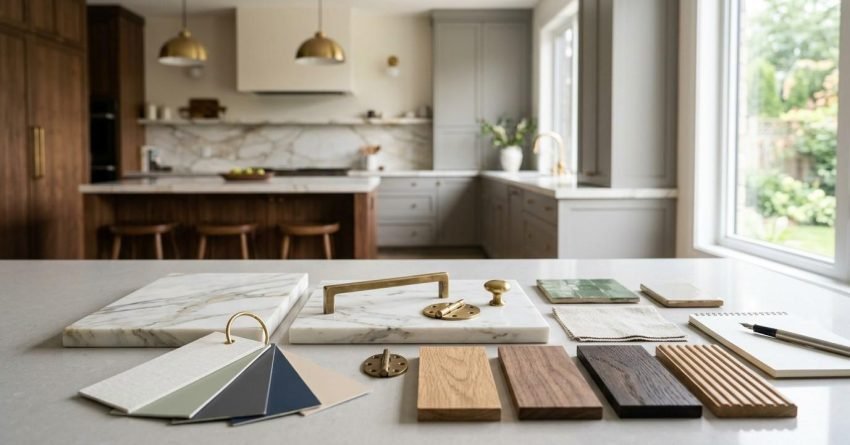
The kitchen delivers the highest return for most Sydney homeowners, typically recouping 75-100% of renovation costs at resale, with bathrooms following at 70-80%. Your right starting point depends on your property’s condition, your budget, and whether you renovate for enjoyment or return.
Renovating in the wrong order causes budget blowouts, delays, and rework that we see far too often.
In this guide, I break down which room deserves your money first, covering ROI, sequencing, budget allocation, and room-by-room costs for Sydney properties.
Why Renovation Order Matters for Your Budget and Timeline
Renovating rooms in the wrong sequence creates expensive problems that first-time renovators discover too late. Starting with cosmetic updates before addressing structural or mechanical issues means tearing out new work to fix underlying faults.
The order you renovate directly impacts total project cost. Plumbing and electrical rough-ins need completion before walls close up, and HVAC modifications require access to ceiling cavities and wall spaces.
Ignore that sequence, and you pay twice for demolition, materials, and labour.
Sequencing also affects how you live during construction. Tackling the kitchen while bathrooms stay functional keeps your household operational, whereas renovating all wet areas at once saves on plumber mobilisation but leaves you without essential facilities.
How Renovation Sequence Affects Total Project Costs
Every trade that returns to your site charges a call-out fee. Electricians, plumbers, and tilers working across multiple stages add mobilisation costs that accumulate fast.
We consolidate wet area work wherever the program allows, and that coordination cuts these expenses by 15-25% on a typical project.
Poorly scheduled material deliveries create storage fees, weather damage, and site congestion that slows trades down. Planning your renovation order lets you buy tiles, fixtures, and fittings in bulk at better prices while materials arrive exactly when needed.
Council Approvals and What They Do to Your Sequence
Permit sequencing matters for both compliance and cost control. Many Sydney councils treat structural work, plumbing modifications, and electrical upgrades as separate approvals, and each carries its own lead time.
Two pathways cover most residential work. A Complying Development Certificate suits projects that meet pre-set standards and moves fastest, while a full Development Application goes to council for merit assessment and runs considerably longer.
Knowing which pathway applies before you start prevents stop-work orders and retrospective approval fees.
Approval timing also dictates what you can start. Structural changes and home extension work sit behind consent, so we sequence internal wet area work to run while paperwork clears rather than leaving the site idle.
How Property Age Changes Your Renovation Order
Property age overrides almost every default sequencing rule I apply. Pre-1980 homes carry hazardous material risk, ageing services, and structural movement that all demand attention before anything cosmetic happens.
Homes built before 1990 frequently contain asbestos in wall sheeting, floor coverings, and eaves. Australian regulators confirm asbestos was used in residential construction until its 2003 national ban, according to Safe Work Australia.
In these properties, we test first and sequence around the results.
Homes from 1980-2000 usually need services upgrades rather than structural repair. Switchboards, wiring, and galvanised supply lines reach the end of life in this bracket.
That makes the kitchen the natural starting point, because the open walls let us upgrade capacity for the whole house at once.
Post-2000 properties give you genuine freedom of choice. Structure and services remain sound, so you renovate purely on ROI and lifestyle priority.
The Hidden Costs of Renovating in the Wrong Order
Demolishing recently completed work ranks among the most frustrating renovation expenses. Installing new flooring before discovering plumbing leaks means ripping up tiles you just paid to lay, and painting walls before electricians finish guarantees touch-ups and a second coat.
Temporary facilities add up when sequencing fails. Renting portable toilets, using laundromats, or eating takeaway for weeks because you renovated the wrong room first strains both budget and patience.
Trade availability becomes the third hidden cost. Quality contractors book months ahead in Sydney’s market, and changing your renovation order mid-project means accepting whoever is free rather than your preferred tradesperson.
Kitchen Renovations: The Highest ROI Starting Point
Kitchens consistently deliver the strongest return for Australian homeowners, which makes them the logical first choice for value-focused renovators. In our experience selling and settling renovated properties, an updated kitchen influences buyer decisions more than any other room.
The kitchen works as the home’s central hub where families gather, and guests congregate. That high-visibility, high-use space creates immediate lifestyle improvement that justifies the spend for owner-occupiers.
A Sydney kitchen renovation runs from $25,000 for a budget refresh to $80,000+ for a premium overhaul. Mid-range projects between $40,000-$55,000 hit the best balance of quality and resale recovery.
What Makes Kitchens Worth Renovating First
Kitchens contain the most complex intersection of trades in any home. Plumbing, electrical, gas fitting, cabinetry, benchtops, tiling, and appliance installation all converge in one space, and completing that complexity first establishes infrastructure every later renovation leans on.
Upgrading kitchen electrical capacity often requires switchboard modifications that benefit the entire house. Dedicated appliance circuits, extra power points, and improved lighting create the electrical backbone for future room upgrades.
Plumbing modifications during a kitchen renovation open the door to whole-house fixes. Replacing old galvanised pipes, upgrading supply line diameter, or installing water filtration costs far less while the walls are already open.
Kitchen Renovation Cost Breakdown for Sydney Homes
Cabinetry represents 35-45% of most kitchen budgets, ranging from $8,000 for flat-pack to $35,000+ for custom joinery. Soft-close hinges, full-extension drawers, and durable finishes deliver daily satisfaction and buyer appeal.
Benchtops consume 15-20% of the budget depending on material. Laminate starts near $1,500, engineered stone runs $3,500-$7,000, and natural stone exceeds $10,000 for an average kitchen.
Appliance packages vary dramatically by brand. Budget suites start around $3,000, mid-range packages run $6,000-$12,000, and premium European brands pass $25,000, so matching appliance quality to your overall renovation standard keeps the result cohesive.
Labour for Sydney kitchen installations typically lands between $8,000-$15,000 depending on complexity, demolition, and structural work. Projects involving wall removal, floor levelling, or major plumbing relocation sit at the top of that range.
Bathroom Renovations: Essential for Functionality and Value
Bathrooms rank second only to kitchens for renovation ROI. Outdated bathrooms actively deter buyers and drag property values down by more than the renovation costs to fix.
Functional bathrooms shape daily quality of life. Leaking showers, poor ventilation, and dated fixtures create constant friction that affects the whole household.
A bathroom renovation in Sydney ranges from $15,000 for basic updates to $45,000+ for luxury main bathroom transformations. The average mid-range project costs $25,000-$35,000 including quality fixtures, tiling, and professional installation.
When to Prioritise Bathroom Over Kitchen Renovation
Waterproofing failure demands immediate attention. Leaking showers cause structural damage, mould growth, and health hazards that compound every month you wait.
Waterproofing defects remain one of the most common building faults reported in NSW residential work, and NSW Fair Trading treats them as a major defect category. Addressing them outranks any cosmetic upgrade elsewhere in the house.
Properties with one bathroom serving multiple occupants gain enormously from a renovation or second bathroom. Adding an ensuite transforms household function and lifts property value in a way cosmetic work never matches.
Bathrooms with original 1970s to 1990s fixtures frequently contain asbestos in wall linings, floor coverings, or backing boards. Professional removal during renovation clears both the health risk and the compliance problem that surfaces at sale.
Bathroom Renovation Costs and Budget Allocation
Waterproofing and tiling represent 30-40% of bathroom budgets, from $4,000 for basic ceramic to $15,000+ for large-format porcelain or natural stone. Quality membrane application costs $1,500-$3,000 and prevents failures that cost multiples of that to repair.
Fixtures and fittings take 25-35% of the budget. Toilet, vanity, shower screen, tapware, and accessories run $3,000 for builder-grade to $15,000+ for premium brands, with $6,000-$8,000 hitting the value sweet spot.
Plumbing labour typically costs $3,000-$6,000 depending on whether fixtures stay in position or move. Relocating a toilet, shower, or vanity pushes that figure up sharply.
Electrical work covering exhaust fans, heated towel rails, lighting, and power points adds $1,500-$3,500. Underfloor heating adds a further $1,000-$2,000 for an average bathroom.
Living Areas and Bedrooms: Lower Priority but High Impact
Living rooms and bedrooms deliver lower ROI than wet areas but create real lifestyle improvement for owner-occupiers. These spaces respond best to cosmetic updates rather than structural change.
Flooring upgrades across living areas transform presentation at modest cost. Replacing worn carpet with quality timber or hybrid flooring runs $80-$150 per square metre installed.
Paint delivers the highest impact-to-cost ratio of any renovation activity. Professional painting costs $30-$50 per square metre and instantly modernises dated colour schemes.
Cost-Effective Living Space Improvements
Lighting upgrades create a dramatic ambiance change without construction. New fittings, dimmer switches, and LED downlights cost $2,000-$5,000 for typical living areas while cutting running costs.
Window treatments affect both appearance and energy performance. Quality curtains or plantation shutters cost $500-$1,500 per window and improve insulation and light control.
Built-in storage maximises usable space in bedrooms and living areas. Custom wardrobes run $3,000-$8,000 per unit depending on size and internal fit-out.
When Living Areas Should Come First
Properties with structural issues in living areas need immediate attention. Cracked walls, sagging ceilings, and uneven floors point to problems that worsen and undermine every later renovation.
Homes with inadequate heating or cooling benefit from HVAC upgrades before cosmetic work. Ducted air conditioning or split systems cost $5,000-$15,000 and require ceiling and wall access that wrecks finished surfaces.
Open-plan conversions that remove walls between kitchen, dining, and living come before individual room renovations. A whole home renovation sets the floor plan that determines everything downstream, so structural change leads the program.
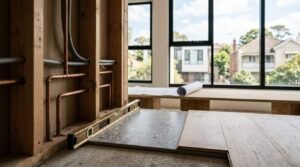
Strategic Renovation Sequencing for Maximum Value
The optimal sequence for most Sydney properties follows a fixed logic. We work through it in this order on nearly every project:
- Safety and structure: foundation movement, roof leaks, termite damage, and asbestos assessment
- Services: switchboard, wiring, plumbing rough-in, and HVAC upgrades
- Wet areas: kitchen, bathrooms, and laundry together to consolidate trades
- Continuous flooring: timber, hybrid, or carpet across living zones
- Cosmetic finishes: painting, lighting, joinery, and window treatments
- Exterior: render, decking, driveways, and landscaping
Addressing structure before cosmetics prevents expensive repairs to brand-new finishes. Foundation problems, roof leaks, and termite damage all need resolution before you invest in interior work they will damage.
Wet areas follow structure because they carry the heaviest trade coordination load. Completing kitchen and bathroom plumbing, electrical, and waterproofing builds the infrastructure every simpler renovation depends on.
How Long Each Renovation Stage Takes
Structural and safety work runs 1-3 weeks for targeted repairs, and longer where footings or roof framing need attention. Asbestos removal adds 2-5 days and cannot overlap with other trades on site.
Services rough-in takes 1-2 weeks across a typical house. Wet areas dominate the program at 6-12 weeks when kitchen, main bathroom, and laundry run together.
Continuous flooring needs 3-5 days plus acclimatisation time for timber. Painting and cosmetic finishes take 1-2 weeks, and exterior work adds 3-6 weeks depending on scope.
A full sequence therefore lands between 4 and 7 months for most Sydney homes. Compressing that timeline costs money rather than saving it, because overlapping trades create rework.
Where Flooring Fits in the Renovation Order
Flooring generates more sequencing confusion than any other element. My rule is simple: continuous flooring goes down after wet areas are finished and before final painting and skirting.
Laying timber or hybrid before kitchen and bathroom work exposes it to trade traffic, water, and adhesive damage. Laying it after the painters finish forces cutting-in and touch-up work you pay for twice.
Tiled wet area floors are the exception and go in with their own room, sealed under the waterproofing system.
Laundries, Exteriors and Secondary Spaces
Laundries share plumbing walls with bathrooms in most Sydney homes, so we renovate them in the same program. A laundry renovation done alongside the bathroom saves a full plumber mobilisation and one waterproofing call-out.
Exterior work sits last in almost every sequence. Rendering, painting, decking, and landscaping all suffer damage from ongoing internal trade access and skip bin traffic.
Scaffolding and skip placement also compete for the same space. Running exteriors while internal trades still need site access creates congestion that slows both, so we hold render and landscaping until the last internal coat is dry.
The exception is roof and drainage repair, which jumps to the front of the queue whenever water enters the building.
Renovation Order for Owner-Occupiers
Owner-occupiers chasing lifestyle improvement renovate the room causing the most daily frustration first. A dysfunctional kitchen ruins every meal, while a dated bathroom sets the tone of every morning.
Factor household disruption into your sequence. Kitchen renovations run 4-6 weeks and demand an alternative cooking setup, and bathroom work over 2-3 weeks means temporary facilities in a single-bathroom home.
We help clients stage this properly. Setting up a temporary kitchen with a bench, microwave, and fridge in the dining room costs almost nothing and removes the pressure to rush trades.
Living On Site or Moving Out
Staying on site saves accommodation costs but stretches the program. Trades work slower around occupied rooms, and dust containment adds time to every stage.
Moving out costs $200-$400 per night in Sydney for suitable short-term accommodation, which reaches $6,000-$12,000 across a six-week wet area program. That expense buys back speed, because empty sites let multiple trades work simultaneously.
We recommend staying on site for single-room work and moving out for whole-house programs. The break-even point sits around the moment two wet areas come out at once.
Budget Staging Across Multiple Years
Budget staging across multiple years buys higher-quality finishes in every space rather than compromise everywhere. Finishing one room properly before starting the next avoids the half-done feeling that follows over-ambitious schedules.
Stage boundaries need to respect the sequence, not just the calendar. Splitting services work across two financial years means opening the same walls twice, which wipes out the saving.
We group stages so each one ends at a natural completion point. Wet areas in year one and cosmetics in year two work cleanly, while flooring split across stages never does.
Renovation Order for Investment Properties
Investment renovations prioritise ROI and tenant appeal over personal taste. Kitchens and bathrooms drive the strongest rental returns and take priority.
Durable, low-maintenance finishes beat premium materials that need careful treatment. Quality laminate benchtops, porcelain tiles, and commercial-grade fixtures survive tenant use and still present well at inspection.
Timing work between tenancies minimises lost rent. Scoping the job to fit a typical 2-4 week vacancy demands tight trade coordination and honest scheduling.
Work that cannot fit that window belongs in a planned vacancy instead. Attempting a full wet area renovation in a two-week turnaround produces either rushed workmanship or unplanned rent loss, and both cost more than scheduling properly.
Room-by-Room Cost and ROI Comparison
Room | Typical Sydney Cost | ROI at Resale | Typical Duration | Priority |
Kitchen | $25,000-$80,000 | 75-100% | 4-8 weeks | Highest |
Main bathroom | $15,000-$45,000 | 70-80% | 2-4 weeks | High |
Ensuite or second bathroom | $12,000-$30,000 | 65-75% | 2-3 weeks | High |
Laundry | $5,000-$15,000 | 50-60% | 1-2 weeks | Medium |
Living areas | $10,000-$30,000 | 50-65% | 2-4 weeks | Medium |
Bedrooms | $5,000-$20,000 | 40-55% | 1-3 weeks | Lower |
Exterior and landscaping | $10,000-$50,000 | 50-70% | 3-6 weeks | Last |

Common Renovation Mistakes That Blow Budgets
Underestimating contingency causes more budget failures than any other factor. Industry practice puts contingency at 15-20% of project value, yet most homeowners set aside only 5-10%.
Scope creep does the rest. Each “while we’re at it” addition looks reasonable alone, but together they push project costs up by 30-50%.
Over-capitalisation is the mistake that hurts at settlement rather than during the build. Installing $80,000 of kitchen into a modest property caps out against local ceiling prices, and the market simply refuses to pay it back.
Choosing finishes before setting a budget leads to disappointment or overspend. Falling for premium tiles and tapware before you know the numbers forces hard decisions mid-project.
Which Renovations Return the Least
Bedroom fit-outs sit at the bottom of the return table at 40-55%. Buyers expect a clean, neutral bedroom and pay nothing extra for bespoke joinery or feature walls.
Highly personalised work returns the worst of all. Bold tile choices, statement wallpaper, and custom colour schemes narrow your buyer pool and often need painting over before sale.
Swimming pools and elaborate landscaping rarely recover their cost in Sydney’s middle market. Both add ongoing maintenance that some buyers actively discount for, so we steer clients toward wet areas first.
How to Avoid Cost Blowouts
Detailed specifications before you request quotes produce accurate pricing. “Mid-range tiles” means something different to every supplier, so specify exact products, quantities, and installation methods to get comparable numbers.
Fixed-price contracts protect you against cost increases on a defined scope. Understanding precisely what sits inside and outside the contract prevents variation disputes later.
Regular site meetings with progress payments tied to milestones keep control in your hands. Weekly check-ins catch problems while corrections are cheap.
What You Can Do Yourself and What Needs a Licensed Trade
Owner labour saves real money on the right tasks. Demolition, site clean-up, painting, and flat-pack assembly all sit safely within DIY range and trim thousands from a project.
Everything touching water, gas, or electricity requires a licensed tradesperson in NSW. Waterproofing, plumbing, and electrical work all demand licensed practitioners and certificates of compliance under NSW Fair Trading licensing requirements.
Unlicensed work in these categories voids insurance and surfaces during pre-sale inspection. We have removed and redone plenty of it, and the rework always costs more than the original job.
Hidden Costs Most Renovators Forget
Asbestos testing and removal adds $2,000-$10,000 to renovations in pre-1990 homes. Budget for testing before you finalise numbers, because discovery mid-project creates expensive delays.
Council approval fees, certification, and compliance inspections add $1,500-$5,000 depending on scope. Some renovations need development applications costing $500-$2,000 plus consultant fees on top.
Temporary accommodation during major work runs $200-$400 per night for suitable alternatives. Multi-week projects that knock out essential facilities force a relocation that reshapes your total investment.
Conclusion
Choosing which room to renovate first comes down to balancing ROI, current condition, budget, and lifestyle priority. Kitchens and bathrooms deliver the strongest returns while making the biggest difference to daily life in Sydney homes.
Strategic sequencing protects your investment. Handle structure first, run the complex wet areas together, and finish with cosmetics to minimise rework and hold the budget line.
At Sydney Home Renovation, we help homeowners work through these decisions with transparent cost planning and guidance built around your property and goals. Contact our team to discuss your priorities and build a renovation plan that maximises value and stays on budget.
Frequently Asked Questions
Should I renovate my kitchen or bathroom first?
Renovate the kitchen first, where both rooms need similar work. Kitchens return 75-100% of cost versus 70-80% for bathrooms. Waterproofing failure changes that answer immediately.
How much should I budget for a complete home renovation in Sydney?
Complete Sydney home renovations cost $150,000-$400,000 depending on size, scope, and finish. Budget $40,000-$60,000 for kitchens, $25,000-$40,000 per bathroom, and $30,000-$50,000 for living areas.
What renovation adds the most value to a house in Australia?
Kitchen renovations add the most value, returning 75-100% of costs at resale. Bathrooms follow at 70-80%. Both wet areas influence buyer decisions and valuations more than any other room.
Is it worth renovating before selling a house?
Renovating before sale pays off where updates fix obvious deficiencies that deter buyers. Kitchens and bathrooms over 15 years old benefit most. Premium finishes in modest properties rarely recover their cost.
How long does a typical kitchen renovation take in Sydney?
Sydney kitchen renovations take 4-8 weeks from demolition to completion. Cosmetic updates finish in 3-4 weeks. Structural changes, custom cabinetry, and complex installations extend the program to 6-10 weeks.
What is the most expensive part of a bathroom renovation?
Tiling and waterproofing cost the most at 30-40% of the total budget. Membrane application, floor and wall tile supply, and professional installation run $6,000-$15,000 for an average bathroom.
Can I renovate one room at a time to spread costs?
Renovating room by room spreads cost effectively and lifts finish quality in each space. Coordinate plumbing and electrical across rooms to cut trade call-out fees and sequence the work to limit disruption.


