
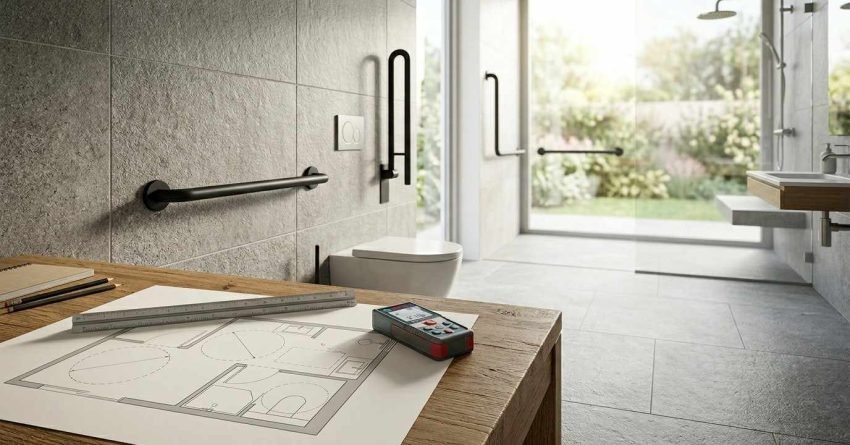
A wheelchair accessible bathroom in Sydney must meet Australian Standard AS 1428.1, providing a minimum 1540mm turning circle, 850mm doorway clearance, and barrier-free shower access. These requirements ensure safe, independent use for wheelchair users in every home.
Planning an accessible bathroom early protects long-term independence, supports aging in place, and adds real resale value for both Sydney homeowners and property investors alike.
This guide covers compliance standards, essential dimensions, fixture choices, safety features, realistic budget ranges, and common mistakes to avoid when designing your wheelchair accessible bathroom.
What Defines a Wheelchair Accessible Bathroom
A wheelchair accessible bathroom is a fully barrier-free wet area designed so a person using a manual or powered wheelchair can enter, move, transfer, and use every fixture independently. It removes thresholds, widens entries, and positions fittings within safe reach ranges.
Accessibility design follows universal design principles, meaning the space works for wheelchair users, ambulant people with mobility aids, older adults, carers, and able-bodied family members without requiring separate adaptations. The same room functions for every user.
The audience is broader than many homeowners expect. Permanent wheelchair users represent only one group. Sydney homeowners also pursue accessible bathrooms for parents aging in place, NDIS participants, post-surgery rehabilitation, family members with progressive conditions, and dual-occupancy investment properties marketed to retirees.
Adaptable vs. Accessible: What’s the Difference?
An adaptable bathroom is designed and built so it can be converted to full accessibility later; structural backing is installed, floor levels are set correctly, and space is allocated, but compliant fixtures are not yet fitted. A fully accessible bathroom meets AS 1428.1 right now, with every fixture, clearance, and fitting in place.
We see homeowners choose the adaptable path when budget is tight, but future need is anticipated. The accessible path is the right choice where a wheelchair user is living in the home today or where NDIS or SDA compliance is required immediately.
Australian Standards and Compliance Requirements
Three documents govern accessible bathroom design in Sydney. Each plays a different role, and understanding their interaction prevents costly rework.
AS 1428.1 Design for Access and Mobility is the primary technical standard. It sets the exact dimensions, clearances, grab rail positions, fixture heights, and approach paths required for a compliant accessible bathroom. Builders and certifiers reference this document directly.
The National Construction Code sets the mandatory accessibility provisions for class 1a homes and adaptable dwellings. Most private residential renovations are not legally required to meet full NCC accessibility provisions, but they are required where the home is being modified specifically for an accessible occupant.
Livable Housing Australia (LHA) guidelines define Silver, Gold, and Platinum levels of accessibility. Platinum level applies where full wheelchair use is anticipated. Many SDA-funded projects must meet Platinum specifications.
Local context matters in Sydney. NSW councils may require a private certifier sign-off where structural works, plumbing relocation, or waterproofing changes occur. Strata properties add a further approval layer that many homeowners underestimate. In a strata building, works affecting common property, including waterproofing membranes, structural walls, or shared drainage, require owners corporation approval before any contractor commences. We recommend submitting a detailed scope of works to the strata manager at least four to six weeks before your planned start date to avoid delays.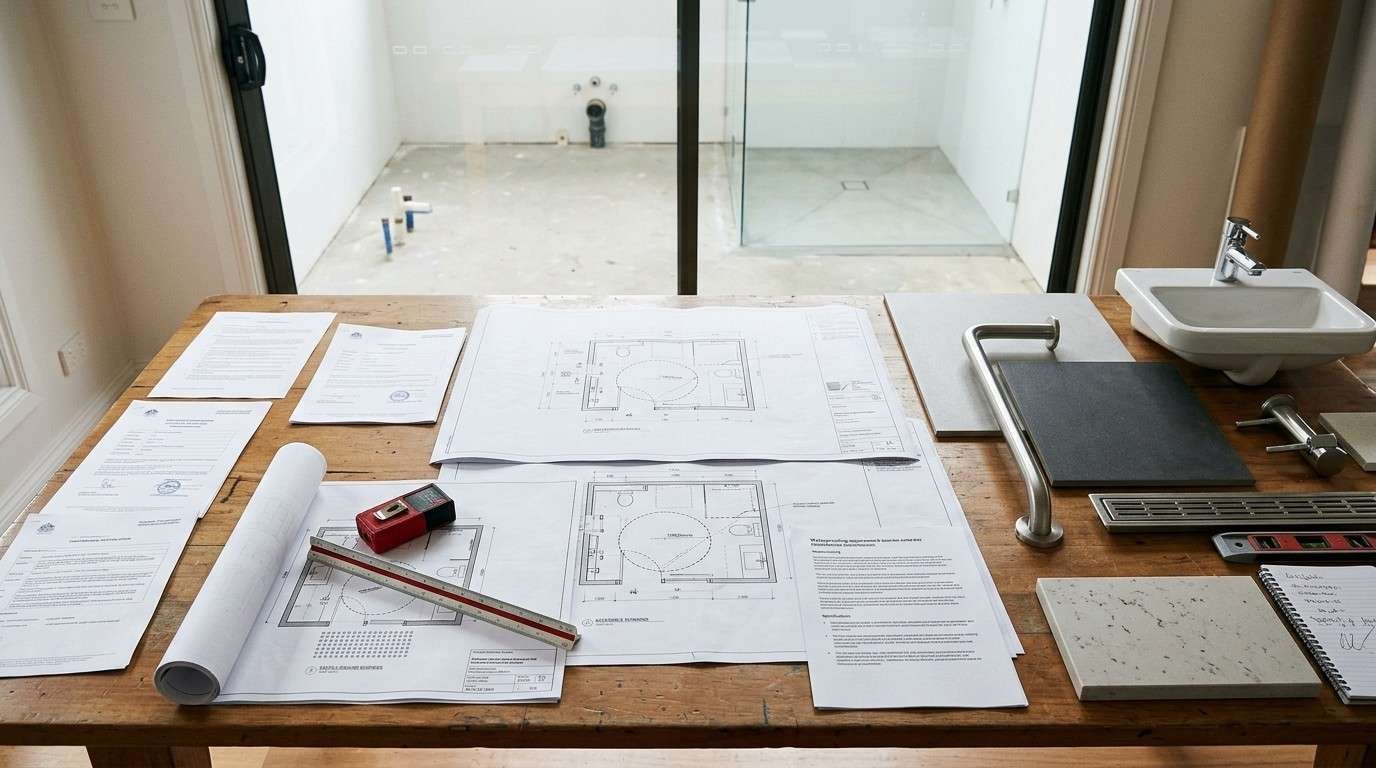
Essential Dimensions and Clearances
Dimensions are where most accessibility errors occur. Getting these correct from the design stage prevents demolition and reframing later.
Minimum room size and turning circle. AS 1428.1 requires a clear 1540mm diameter turning circle inside the bathroom, free of fixtures, doors, and obstructions. Most compliant accessible bathrooms measure at least 2.4m by 2.7m internally, though larger footprints provide better usability.
Doorway widths. The minimum clear opening for an accessible bathroom door is 850mm. This is the actual clear width when the door is open, not the door leaf size. Cavity sliders are the most space-efficient option because they eliminate the door swing arc entirely, preserving interior turning space. Outward-swinging hinged doors are a practical alternative in strata settings where wall cavities cannot be modified, but they require a clear 1200mm landing on the approach side to remain compliant.
Approach space. A clear 1200mm by 1200mm landing is required on the approach side of the door. Hallway widths feeding into the bathroom should be at least 1000mm, with 1200mm preferred where wheelchair turning is needed.
Fixture clearance zones. Each fixture requires a defined manoeuvring space. The toilet needs a clear side-transfer zone of at least 950mm wide. The shower requires a 1160mm by 1160mm clear floor area minimum, with a roll-in entry. The basin requires 800mm by 1350mm clear knee and toe space underneath.
Threshold heights. All thresholds must be flush. Any change in floor height above 5mm becomes a tripping hazard and a wheelchair barrier.
Accessible Fixtures and Fittings
Fixture selection drives both compliance and daily usability. Specifying the wrong product can fail certification even when dimensions are correct.
Roll-in showers are the standard for full wheelchair access. The shower floor must be flush with the surrounding bathroom floor, drained by a linear grate or stepped gradient. A folding shower seat is mounted at 480mm above the finished floor level. The hand-held shower rail allows height adjustment between 900mm and 1900mm.
Accessible toilets are wall-faced or close-coupled with the pan centre positioned 450mm to 460mm from the side wall. The seat height should be 460mm to 480mm above the floor, taller than a standard pan. Backrest support and a flush button reachable from a seated position are required.
Grab rails are mandatory at the toilet and shower. A horizontal rail beside the toilet, a vertical rail at the entry to the shower, and an L-shaped rail at the shower seat are typical configurations. All grab rails must withstand a 1100 newton load and must be installed into 19mm structural plywood backing fixed to the framing, not into plasterboard alone. We always install the backing at the time of framing, before linings go on, because retrofitting it later means opening the wall.
Wheelchair-friendly basins are wall-hung with no pedestal or vanity below, leaving clear knee space. The basin rim sits at 800mm to 830mm above the floor. Tapware must be lever-operated or sensor-activated. Insulate or shroud exposed pipework to prevent burns to legs with reduced sensation.
Flooring, Surfaces, and Safety Features
Surfaces and lighting determine whether a technically compliant bathroom is actually safe to use day after day.
Slip-resistant flooring is non-negotiable in wet areas. Floor tiles should have a minimum slip rating of P4 or R10 in dry zones and P5 or R11 in the shower area. Large-format tiles reduce grout lines that can catch wheelchair castors. Vinyl sheet flooring with welded seams is another compliant option preferred in NDIS-funded fitouts. The level-entry shower construction also requires a continuous waterproofing membrane extending at least 150mm up all adjoining walls, a detail that is frequently underspecified and causes waterproofing failures within the first few years.
Contrast and visual cues. People with low vision benefit from luminance contrast between walls, floors, fixtures, and grab rails. A minimum 30 percent luminance contrast between adjacent surfaces is the recommended benchmark. Dark grab rails against light walls, or a contrasting tile band at the floor-wall junction, satisfy this requirement.
Lighting should deliver even illumination across the room with no dark zones near the toilet or shower. Switches and controls must be positioned between 900mm and 1100mm above the floor, reachable from a seated position. Motion sensors prevent fumbling for switches.
Temperature controls. Thermostatic mixing valves (TMVs) are required to limit water temperature at all outlets to 43.5 degrees Celsius, preventing scald injuries for users with reduced sensation or slow reaction times.
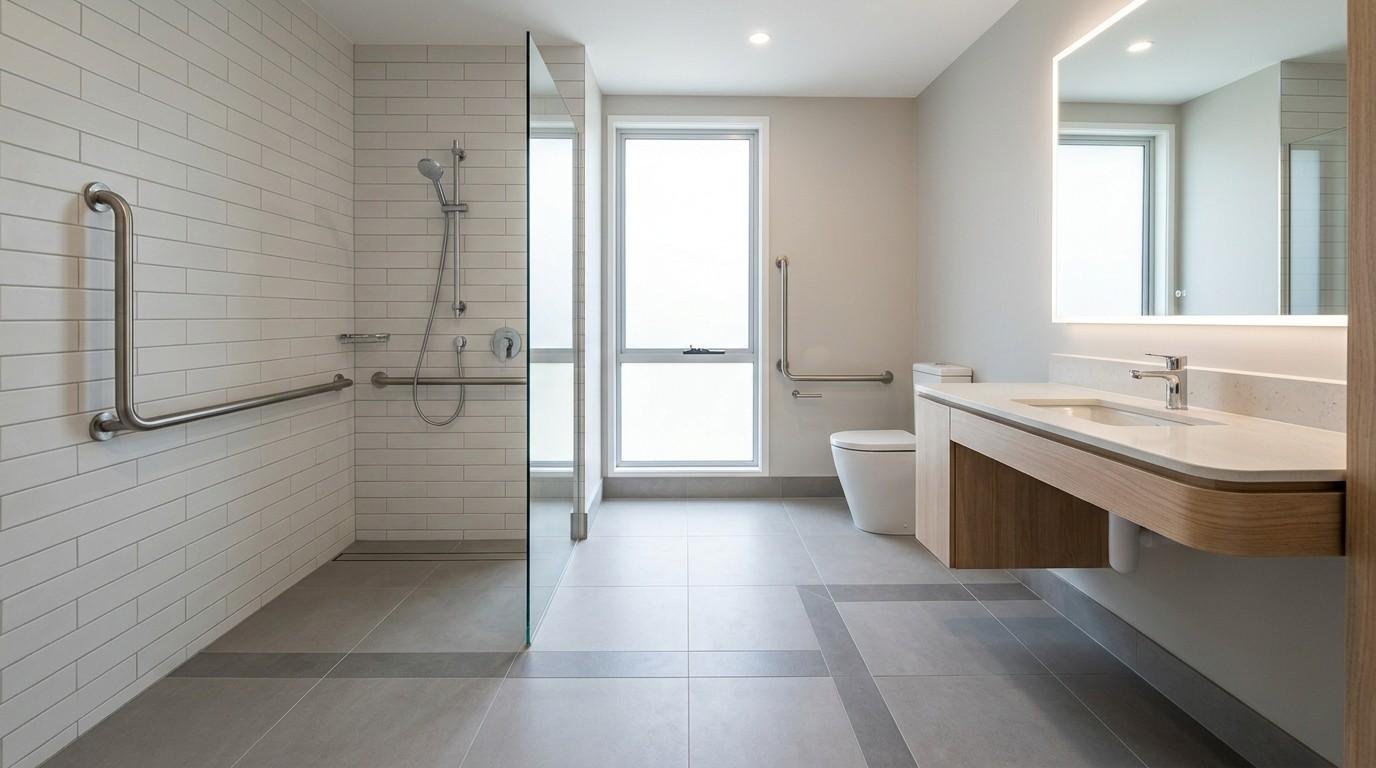
Cost Considerations for Accessible Bathroom Design
Accessible bathroom renovations in Sydney typically cost more than standard bathroom builds because of larger floor areas, structural framing for grab rails, additional waterproofing for roll-in showers, and specialist fittings.
Typical Sydney cost ranges. A compliant accessible bathroom renovation in Sydney generally falls between $30,000 and $55,000 for a standard retrofit. Full structural reconfiguration, premium finishes, or SDA-grade specifications can push budgets to $70,000 or more.
Hidden costs to plan for. Structural framing reinforcement to take grab rail loads, electrical relocation for accessible switch heights, plumbing reroutes for wall-hung basins and pans, additional waterproofing membrane for level-entry showers, and certifier and access consultant fees are commonly underestimated.
NDIS and SDA funding. Eligible NDIS participants may access funding through Home Modifications (under Capacity Building) or Specialist Disability Accommodation (SDA) for new accessible builds. Each pathway has specific evidence, assessment, and contractor accreditation requirements. Work with an occupational therapist and a registered builder familiar with NDIS documentation.
Planning for Future Accessibility Needs
Many Sydney families we work with are not yet at the point of full wheelchair use but want to future-proof their home for aging in place or a progressive condition. In these cases, we design the structural elements, floor levels, backing, and clearances to full AS 1428.1 standard from the start, while fitting standard fixtures now. Upgrading to compliant grab rails, a roll-in shower, and a wall-hung basin later becomes a straightforward fixture swap rather than a structural rebuild.
This staged approach typically adds $3,000 to $6,000 to the initial build cost but avoids a full renovation spend of $30,000 or more when accessibility becomes urgent.
Common Design Mistakes to Avoid
The most common accessibility failures are predictable, repeated, and preventable. Avoiding them protects both budget and certification.
Designing the bathroom first and adding accessibility later. Accessibility must be built into the floor plan, not bolted onto a standard layout. Retrofitting compliant dimensions into a small bathroom almost always requires removing a wall.
Mounting grab rails into plasterboard alone. Without 19mm structural plywood backing or proprietary fixing studs, grab rails will pull out under load. This is a certification fail and a serious safety risk.
Choosing tiles by appearance instead of slip rating. A beautiful matte porcelain tile that fails the P4 wet rating is unsafe and non-compliant in a wet zone.
Forgetting the approach space outside the door. A perfect interior layout means nothing if the hallway approach cannot accommodate a wheelchair turn into the doorway.
Skipping the occupational therapist. This is the mistake we see most often on projects that later require rework. An OT assessment maps the specific user’s reach envelope, transfer pattern, dominant side, and equipment dimensions information that generic AS 1428.1 standards cannot capture. The OT’s report also provides the clinical evidence NDIS requires before approving Home Modifications funding. Engaging an OT before finalising the design, not after, is the single most cost-effective step in the process.
Aligning the accessible bathroom with broader structural and electrical works across the home avoids the cost of mobilising trades twice and ensures the whole property supports independent living long-term.
Conclusion
A compliant wheelchair accessible bathroom combines AS 1428.1 standards, correct dimensions, certified fixtures, slip-resistant surfaces, and thoughtful layout planning to deliver lasting independence and safety.
Designing accessibility into your renovation from the start protects both your build budget and your long-term home value, while removing the costly risk of non-compliant rework later.
We at Sydney Home Renovation help homeowners and investors plan accessible bathroom renovations with honest pricing, certified workmanship, and clear compliance guidance from concept to completion. Get in touch to discuss your project and receive a detailed scope tailored to your home and your needs.
Frequently Asked Questions
What is the minimum size for a wheelchair accessible bathroom in Sydney?
A compliant accessible bathroom requires at least a 1540mm internal turning circle clear of fixtures. We find most Sydney builds measure 2.4m by 2.7m minimum, though larger footprints improve daily usability significantly.
Does AS 1428.1 apply to private home bathrooms?
AS 1428.1 is not legally mandatory in standard private homes, but it applies where renovations are designed for an accessible occupant, funded by NDIS, or built to Livable Housing Platinum standards for compliance.
Can I get NDIS funding for an accessible bathroom renovation?
Eligible NDIS participants can access Home Modifications funding through their Capacity Building budget. An occupational therapist assessment, builder quotes, and NDIS approval are required before any modification work commences on site.
What is the difference between roll-in and step-in showers?
A roll-in shower has a completely flush, barrier-free entry suitable for wheelchair access. A step-in shower has a low threshold and is appropriate for ambulant users with mobility aids but not full wheelchair use.
How much does a wheelchair accessible bathroom cost in Sydney?
Typical accessible bathroom renovations in Sydney range between $30,000 and $55,000 for compliant retrofits. SDA-grade fitouts, premium finishes, or full structural reconfiguration commonly increase budgets to $70,000 or above.
Are grab rails legally required in accessible bathrooms?
Grab rails are required by AS 1428.1 at the toilet, shower entry, and shower seat in compliant accessible bathrooms. They must be installed into structural backing capable of supporting an 1100 newton load safely.
Do I need council approval for an accessible bathroom renovation?
Most internal bathroom renovations in Sydney qualify as exempt or complying development, but structural changes, waterproofing alterations, or strata properties may require certifier or council approval. Always confirm before works commence.


