
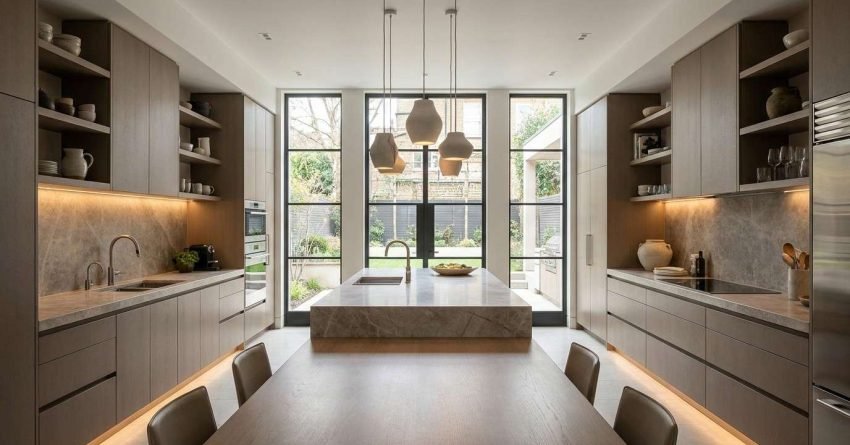
The golden ratio in kitchen design is a mathematical proportion, approximately 1:1.618, that we use to create spaces that feel naturally balanced and functionally efficient. When we apply it to cabinetry heights, island dimensions, countertop depths, and spatial flow, we produce kitchens that look right without the homeowner always being able to explain why. Understanding this principle helps Sydney homeowners evaluate design decisions with more confidence and avoid layouts that feel off after the build is complete.
The Golden Ratio Defined for Kitchen Spaces
The golden ratio is a proportion found throughout nature, architecture, and art, tracing back to ancient structures like the Parthenon and closely tied to the Fibonacci sequence. In kitchen design, we use it as a framework for sizing and spacing elements so no single feature dominates or disappears. The result is a kitchen that feels cohesive rather than assembled.
When we divide any space- a cabinet run, a benchtop, a room – the larger section should be roughly 1.618 times the size of the smaller section. This ratio creates a visual tension the human eye reads as pleasing. We apply it to upper and lower cabinet heights, the split between open shelving and closed storage, and the relationship between an island and the surrounding floor space.
The 1:1.618 Rule and How It Applies to Cabinetry
Standard kitchen cabinetry already approximates the golden ratio without most homeowners realising it. Upper cabinets typically sit at around 720mm in height, while base cabinets with benchtop sit at approximately 900mm. The ratio between these two measurements sits close to 1:1.25, not exact, but directionally aligned with proportional design logic, a relationship the National Kitchen and Bath Association documents in its planning guidelines.
In custom joinery, we get more deliberate. We might set upper cabinet height at 600mm and base cabinet height at 970mm, producing a split closer to the ideal 1:1.618. The visual effect is a kitchen that feels taller, more open, and better resolved than one built to standard dimensions alone.
The Work Triangle and Proportional Flow
The work triangle, the spatial relationship between the sink, cooktop, and refrigerator, is a functional application of proportional thinking. It is not a direct expression of the golden ratio. It operates on the same principle: the distances between these three points should be balanced so no single leg creates unnecessary movement or visual imbalance.
When we apply the golden ratio alongside work triangle logic, the primary work zone typically occupies roughly 61.8% of the total floor area, with circulation and secondary zones filling the remaining 38.2%. This split is rarely calculated explicitly, but experienced designers arrive at it intuitively through proportional reasoning. We have seen this play out consistently across Sydney kitchen renovations where the work zone was planned first, and circulation space followed.
How proportion principles translate into layout decisions depends on the floor plan, room dimensions, and how the kitchen connects to adjacent living spaces. That is where design intent meets construction reality.
Where the Golden Ratio Shows Up in Kitchen Layout
Once we understand the ratio as a principle rather than a formula, we start to see it applied across every dimension of a well-designed kitchen. It is not a rigid rule. It is a proportional target that guides decisions when there is no obvious right answer.
Countertop Depth, Island Sizing, and Ceiling Height
Standard benchtop depth in Australian kitchens is 600mm. An island designed to the golden ratio sits at approximately 970mm in depth, 1.618 times the perimeter bench depth. In practice, most islands land between 800mm and 1,000mm, keeping them within the proportional range while respecting the clearance requirements set out in Australian building guidance from the Housing Industry Association.
Ceiling height interacts with the ratio differently. In a kitchen with 2,700mm ceilings, the ideal upper cabinet height sits at approximately 1,670mm from the floor, again close to the 1.618 multiplier applied to a 1,000mm base reference. Island dimensions that maintain proportional balance also need to account for clearance minimums, seating overhangs, and workflow. These factors sit alongside the ratio rather than inside it.
Backsplash and Tile Proportions
We often apply the same 1:1.618 thinking to splashback height relative to upper cabinet gap. A splashback that fills roughly 61.8% of the visible wall gap, with the remaining space left as breathing room around extraction or shelving, tends to read as more intentional than one that fills the space edge to edge. Tile layout patterns benefit from the same logic when we size feature tiles against field tiles.
Colour Blocking and Visual Weight Distribution
The golden ratio also informs how we distribute colour and material across a kitchen. A common application is the 60-30-10 rule: 60% dominant colour, 30% secondary colour, 10% accent, which is a simplified expression of the same proportional logic documented by colour theory resources like the Australian Institute of Architects. This produces the same visual result: no single element overwhelms the space.
In practice, this might mean 60% of the kitchen in a neutral base cabinet colour, 30% in a contrasting island or upper cabinet finish, and 10% in hardware, tapware, or splashback detail. The proportions feel resolved because the eye has a clear hierarchy to follow.
Common Mistakes When Applying the Golden Ratio in Kitchen Design
We see the same errors repeat across renovation briefs. Homeowners often try to apply the ratio too literally, measuring every element to the exact decimal rather than treating it as a directional target.
Another common mistake is ignoring clearance codes in favour of chasing the perfect proportion, which can leave an island too deep for comfortable walkways. We also see colour blocking applied without considering natural light, which changes how proportions read in a room.
Getting this wrong does not ruin a kitchen. It just means the space needs correction later, which almost always costs more than planning it correctly from the start.

Does the Golden Ratio Guarantee a Better Kitchen?
No. The golden ratio is a design tool, not a guarantee. A kitchen built to perfect proportions but with poor material choices, inadequate lighting, or a dysfunctional layout will still underperform.
The ratio works best when it operates alongside practical planning: correct clearances, appropriate storage volumes, and a layout that suits how the household actually uses the space. What it does guarantee is a starting point grounded in visual logic.
For homeowners who are not trained designers, it gives us a framework for evaluating proposals and questioning decisions that feel wrong. That instinct, that something is off, is often the golden ratio being violated without anyone naming it. A simple self-check is to measure your proposed cabinet heights or island depth against the 1:1.618 split before signing off on final drawings.
Conclusion
The golden ratio gives kitchen design a mathematical foundation for decisions that would otherwise rely on guesswork. It governs cabinetry proportions, island sizing, spatial flow, and colour distribution, producing kitchens that feel resolved rather than assembled.
For homeowners and property investors in Sydney, applying this principle during the planning phase prevents costly layout corrections after construction begins. Understanding proportion early protects your kitchen renovation budget and keeps design decisions intentional rather than reactive.
At Sydney Home Renovation, we translate design principles like the golden ratio into practical renovation plans, built to proportion, on budget, and finished to last.
Frequently Asked Questions
What is the golden ratio number used in kitchen design?
The golden ratio is approximately 1:1.618. In kitchen design, this means the larger dimension of any element should be roughly 1.618 times the size of the smaller dimension for visual balance.
Does the golden ratio apply to small kitchens?
Yes. The ratio scales to any room size. In smaller kitchens, it guides decisions like upper cabinet height relative to base cabinets and the proportion of open versus closed storage to avoid a cramped appearance.
How do designers use the golden ratio for kitchen islands?
Designers size islands at approximately 1.618 times the depth of perimeter benchtops. A standard 600mm bench depth suggests an island around 970mm deep, subject to clearance and workflow requirements.
Is the golden ratio the same as the rule of thirds in kitchen design?
No. The rule of thirds divides space into equal thirds. The golden ratio creates an unequal split of approximately 61.8% to 38.2%, which produces a more dynamic and visually resolved proportion than equal division.
Can I apply the golden ratio myself when planning a kitchen renovation?
You can use it as a reference point when reviewing design proposals. Measure cabinet heights, island dimensions, and colour splits against the 1:1.618 ratio to identify elements that may feel visually unresolved before construction begins.
Is the golden ratio related to the Fibonacci sequence?
Yes. The golden ratio emerges from the Fibonacci sequence as its numbers progress, which is why both appear together in discussions of natural and architectural proportion.


