Flat pack cabinetry is a cabinet system manufactured in pre-cut, pre-drilled panels that are packed flat and assembled on-site, making it one of the most accessible and cost-effective cabinetry solutions available to Australian homeowners, renovators, and property investors today.
Understanding flat pack cabinetry before you renovate saves you from costly surprises, mismatched expectations, and budget blowouts that derail even well-planned projects.
This guide covers what flat pack cabinetry is, how it works, the types available, materials and quality, costs, suppliers, installation options, and how to decide whether it suits your renovation.
What Is Flat Pack Cabinetry?
Flat pack cabinetry is one of the most widely used cabinet solutions in Australian residential renovations — yet it is also one of the most misunderstood. Getting the definition right from the start shapes every decision that follows.
The Core Definition and Concept
Flat pack cabinetry is a cabinet system where all components, carcass panels, doors, shelves, and hardware, are manufactured to precise dimensions, then packed flat into boxes for transport and assembled at the installation site.
The term “flat pack” refers specifically to the delivery and assembly format, not the quality of the product. A flat pack cabinet can be made from the same board materials and finished to the same standard as a traditionally built cabinet. The difference is in how it reaches your home and how it is put together.
We see this format dominate the Australian renovation market because it solves a genuine logistical problem. Pre-assembled cabinets are bulky, expensive to transport, and difficult to manoeuvre through doorways and hallways. Flat pack eliminates those constraints entirely.
How Flat Pack Differs from Custom and Pre-Built Cabinetry
There are three main cabinetry formats available to Australian renovators: flat pack, custom-built, and pre-assembled (also called rigid or pre-built).
Custom cabinetry is designed and built to exact measurements by a cabinet maker, typically off-site in a workshop, and delivered fully assembled or in large pre-built sections. It offers the highest level of design flexibility and finish quality, but it carries a significantly higher price point and longer lead time.
Pre-assembled cabinetry arrives as a finished, rigid unit. It requires no on-site assembly beyond installation, but it is heavier, harder to transport, and less flexible in sizing.
Flat pack sits between these two formats. It offers more design flexibility than pre-assembled options and a substantially lower cost than custom cabinetry, while still delivering a finished result that suits most residential renovation applications. The trade-off is that assembly is required, either by the homeowner or a professional installer.
A Brief History of Flat Pack in Australia
The flat pack format was pioneered at scale by IKEA, whose global expansion through the 1980s and 1990s introduced the concept to mainstream consumers worldwide. In Australia, IKEA’s arrival and the subsequent growth of retailers like Bunnings, which launched its Kaboodle kitchen range — brought flat pack cabinetry firmly into the mainstream renovation market.
Today, flat pack cabinetry accounts for a significant share of kitchen and bathroom renovations across Australia, particularly in the owner-occupier and investment property segments where budget discipline is a priority.
How Flat Pack Cabinetry Works
Understanding the flat pack process from manufacturing to assembly helps renovators plan more accurately and avoid the common mistakes that cause delays and cost overruns.
The Manufacturing and Flat Pack Process
Flat pack cabinets are manufactured using CNC (computer numerical control) machinery, which cuts and drills board panels to precise dimensions based on standardised or semi-custom specifications. This manufacturing method produces consistent, repeatable results at scale, which is a core reason flat pack can be priced significantly below custom cabinetry.
The panels are then edge-banded, finished, and packed flat with all required hardware. Because the manufacturing process is highly automated, quality control is generally consistent across a production run, provided the supplier maintains proper machine calibration and material standards.
What Comes in the Box
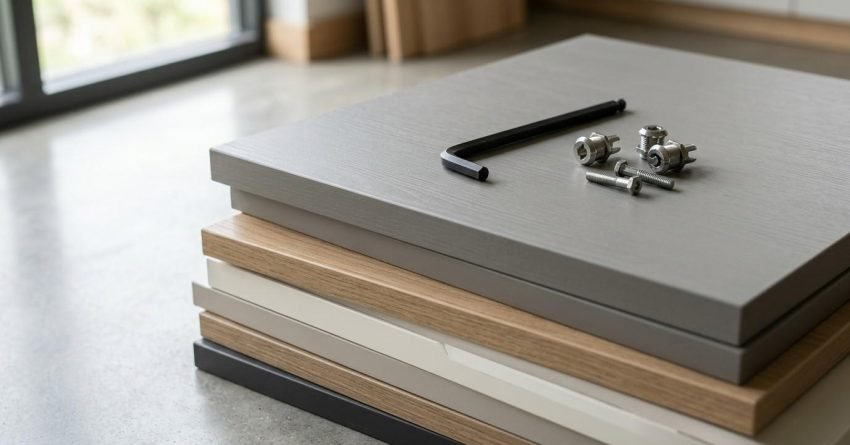
A standard flat pack cabinet box typically contains the carcass panels (base, sides, top, and back), pre-drilled shelf pin holes, cam locks or similar fasteners, shelf pins, and any included hardware such as hinges or drawer runners. Doors, handles, and benchtops are usually ordered and packed separately.
It is important to check exactly what is and is not included in a flat pack order before purchasing. Some suppliers include soft-close hinges as standard; others charge separately. Drawer runners, internal fittings, and kick boards are often sold as add-ons. Knowing what is in the box prevents budget surprises at the point of installation.
Assembly Overview, What the Process Involves
Flat pack assembly involves connecting the pre-drilled carcass panels using the included fasteners, attaching the back panel, fitting shelves, and then hanging doors and fitting drawer fronts once the carcass is installed. Most flat pack systems use cam lock or confirmat screw fastening systems that require no specialist tools beyond a screwdriver and a rubber mallet.
The assembly process is designed to be completed by a competent DIYer, but the installation phase, securing cabinets to walls, ensuring level runs, managing plumbing and electrical clearances, is where professional involvement becomes important for most bathroom and kitchen applications

Types of Flat Pack Cabinetry Available in Australia
The flat pack format is not limited to kitchens. Australian suppliers now offer flat pack solutions across most cabinetry applications in the home, giving renovators genuine flexibility regardless of which room they are working on.
Kitchen Flat Pack Cabinets
Kitchen cabinetry is the most mature and widely available flat pack category in Australia. Renovators can choose from base cabinets, wall cabinets, pantry units, corner solutions, and island configurations — all in flat pack format. Major suppliers offer modular sizing systems that allow kitchens to be designed in standard increments, typically 100mm or 150mm width steps.
The kitchen flat pack market is well-developed enough that most standard kitchen layouts can be achieved without compromise. Complex or irregular spaces may require filler panels or custom modifications, which adds cost and planning time.
Bathroom Flat Pack Vanities and Cabinets
Bathroom flat pack options have expanded significantly in recent years. Flat pack bathroom vanities are now available in wall-hung and freestanding formats, with a range of door configurations, basin cutout options, and finish choices. Shaving cabinets, mirror cabinets, and linen storage units are also available in flat pack format from several Australian suppliers.
Moisture resistance is the critical quality consideration for bathroom flat pack. We always recommend checking that carcass materials are rated for wet area use, standard particleboard without moisture-resistant treatment is not appropriate for bathroom applications.
Laundry and Storage Flat Pack Options
Laundry cabinetry is a growing flat pack category, with suppliers offering purpose-designed laundry cabinet systems that accommodate trough sinks, washing machine spaces, and overhead storage. These systems are typically built on the same carcass platform as kitchen cabinets, which keeps costs manageable.
General storage flat pack, including utility room shelving, garage storage, and home office cabinetry, is also widely available, though this category sits outside the scope of most bathroom and kitchen renovation projects.
Wardrobe and Built-In Flat Pack Systems
Built-in wardrobe systems in flat pack format are available from several Australian suppliers, including IKEA’s PAX system and various Bunnings offerings. These systems use a combination of carcass units, internal fittings, and sliding or hinged door options to create built-in wardrobe solutions at a fraction of the cost of custom joinery.
For property investors and renovators focused on maximising value per dollar spent, flat pack wardrobe systems represent a strong cost-to-value proposition in bedroom renovations.

Flat Pack Cabinetry Materials and Construction Quality
Material quality is the single biggest variable in flat pack cabinetry performance and longevity. Understanding what you are buying, and what the differences between materials actually mean in practice, is essential before committing to a supplier or product range.
Board Types, MDF, Particleboard, and Plywood
The three primary board materials used in flat pack cabinetry are particleboard (also called chipboard), MDF (medium-density fibreboard), and plywood.
Particleboard is the most common carcass material in entry-level and mid-range flat pack cabinetry. It is cost-effective, machines well, and holds screws adequately when used with cam lock fasteners. Moisture-resistant (MR) particleboard is the minimum standard for bathroom and laundry applications. Standard particleboard swells and degrades when exposed to sustained moisture, which is a common cause of premature cabinet failure in wet areas.
MDF offers a smoother surface finish than particleboard and is commonly used for door panels and painted finishes. It is denser and heavier than particleboard, which can be a consideration for wall-hung applications. Like particleboard, MDF requires moisture-resistant treatment for wet area use.
Plywood carcasses represent the premium end of the flat pack market. Plywood is stronger, more dimensionally stable, and more moisture-resistant than particleboard by nature. It holds screws more reliably and performs better in high-humidity environments. Flat pack systems using plywood carcasses carry a higher price point but offer meaningfully better long-term performance, particularly in kitchens and bathrooms.
Door Finishes and Carcass Materials
Door finish options in flat pack cabinetry include thermofoil (vinyl-wrapped MDF), polyurethane (2-pack PU), laminate, and timber veneer. Each finish has different cost, durability, and aesthetic characteristics.
Thermofoil is the most common entry-level door finish, it is cost-effective and available in a wide range of colours, but it can peel at edges over time, particularly in high-heat environments near ovens or in direct sunlight. Polyurethane doors offer a harder, more durable finish and are the standard choice for mid-range to premium flat pack kitchens. Timber veneer doors add a natural aesthetic at a higher price point.
Hardware Quality, Hinges, Runners, and Handles
Hardware quality has an outsized impact on the day-to-day experience of using flat pack cabinetry. Soft-close hinges and drawer runners are now standard in most mid-range and above flat pack systems, and they make a genuine difference to the feel and longevity of the finished installation.
We recommend specifying Blum, Hettich, or Grass hardware where possible, these are the recognised quality benchmarks in the Australian cabinetry industry. Entry-level flat pack systems often use generic hardware that functions adequately initially but degrades faster under regular use.
Flat Pack Cabinetry Costs in Australia
Cost is the primary driver behind most flat pack cabinetry decisions in Australia. Understanding realistic price ranges, and what drives costs up or down, is essential for accurate renovation budgeting.
Typical Price Ranges for Flat Pack Kitchens
A flat pack kitchen in Australia typically costs between $3,000 and $15,000 for the cabinetry alone, depending on the size of the kitchen, the supplier, the material specification, and the door finish selected. This figure covers cabinet boxes, doors, and hardware but excludes benchtops, splashbacks, appliances, and installation labour.
Entry-level flat pack kitchens from suppliers like Bunnings Kaboodle or IKEA can be completed for $3,000 to $6,000 in cabinetry costs for a standard 10–15 linear metre kitchen. Mid-range flat pack systems, using better board quality, improved hardware, and more refined door finishes, typically sit in the $6,000 to $10,000 range. Premium flat pack options with plywood carcasses, polyurethane doors, and quality hardware can reach $10,000 to $15,000 or beyond for larger kitchens.
According to the Housing Industry Association, kitchen renovations remain one of the most common and value-adding home improvement projects undertaken by Australian homeowners, with cabinetry representing the largest single cost component in most kitchen renovation budgets.
Bathroom and Laundry Flat Pack Cost Benchmarks
Flat pack bathroom vanities in Australia range from approximately $400 to $2,500 depending on size, material quality, and configuration. A standard 750mm single-basin wall-hung vanity in a mid-range flat pack finish typically costs between $600 and $1,200 for the cabinet unit alone, excluding the basin, tapware, and installation.
Laundry flat pack cabinetry for a standard single-wall laundry layout typically costs between $800 and $3,000 in cabinetry, depending on the number of units and the inclusion of overhead storage.
These figures represent cabinetry supply costs only. Installation labour, plumbing connections, and any associated tiling or waterproofing work are separate budget items that need to be factored into the total renovation cost.
What Drives the Price Up or Down
Several variables have a material impact on flat pack cabinetry costs. Cabinet count and linear metreage are the most obvious, more cabinets means higher cost. But material specification, door finish, hardware grade, and the complexity of the layout also drive significant price variation.
Upgrading from particleboard to plywood carcasses typically adds 20 to 40 percent to the base cabinet cost. Upgrading from thermofoil to polyurethane doors adds a similar premium. Choosing soft-close hardware throughout, adding internal fittings like pull-out bins and drawer organisers, and specifying custom panel sizes all contribute to a higher final cost.
The supplier choice also matters. IKEA and Bunnings offer the most accessible entry-level price points but with more limited customisation. Specialist flat pack suppliers, including Kinsman Kitchens, Freedom Kitchens, and various trade-focused suppliers, offer broader specification options at mid-to-premium price points.
Flat Pack vs. Custom Cabinetry, Cost Comparison
The cost difference between flat pack and custom cabinetry is substantial. A custom-built kitchen that would cost $20,000 to $40,000 through a cabinet maker can often be replicated in flat pack format for $5,000 to $15,000 — a saving of 50 to 70 percent on cabinetry supply costs alone.
This cost gap narrows when installation labour, benchtops, and finishing work are factored in, but the supply cost advantage of flat pack remains significant. For investment properties, first-time renovators working within tight budgets, and owner-occupiers prioritising cost efficiency, flat pack cabinetry delivers a compelling value proposition that custom cabinetry simply cannot match at the same price point.
Flat Pack Cabinetry Suppliers in Australia
The Australian flat pack cabinetry market is well-served by both retail and trade-focused suppliers. Knowing who the key players are, and what each offers, helps renovators make informed sourcing decisions.
Major Retail Suppliers, IKEA, Bunnings, and Beyond
IKEA’s SEKTION kitchen system and Bunnings’ Kaboodle range are the two most widely recognised flat pack cabinetry options in Australia. Both offer accessible price points, broad availability, and extensive online planning tools that allow renovators to design their own layouts before purchasing.
IKEA’s system is notable for its modular flexibility and the depth of its internal fittings range. Bunnings Kaboodle is popular for its availability, with stock accessible at most Bunnings warehouse locations nationally, and its straightforward assembly system.
Beyond these two, retailers including Beaumont Tiles, Reece, and specialist kitchen and bathroom showrooms stock flat pack and semi-custom cabinetry options at various price points.
Online and Trade Flat Pack Suppliers
A growing segment of the Australian flat pack market operates online or through trade channels. Suppliers including Flat Pack Kitchens and various cabinet wholesalers offer direct-to-consumer and trade pricing on flat pack systems, often with broader specification options than retail suppliers.
Trade-focused suppliers typically offer better pricing for volume purchases, more flexibility in sizing and finish options, and dedicated account management for builders and renovation contractors. For renovation professionals managing multiple projects, establishing a trade account with a quality flat pack supplier is a meaningful cost and efficiency advantage.
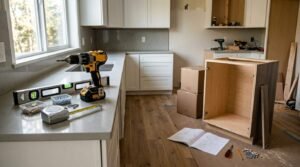
DIY vs. Professional Installation of Flat Pack Cabinetry
One of the most consequential decisions in any flat pack cabinetry project is whether to self-install or engage a professional. Both paths are viable, but they suit different situations, skill levels, and project types.
What DIY Installation Involves
DIY flat pack installation involves assembling the cabinet carcasses, planning and marking the wall layout, securing cabinets to wall studs or using appropriate wall anchors, ensuring level and plumb runs across the full cabinet layout, and fitting doors, drawer fronts, and hardware.
For a competent DIYer with basic carpentry skills and the right tools, including a laser level, drill, and stud finder, a straightforward flat pack kitchen or bathroom installation is achievable. IKEA and Bunnings both provide detailed installation guides and online planning tools that support the DIY process.
The realistic time commitment for a DIY flat pack kitchen installation is typically two to four full days for an average-sized kitchen, not including any associated plumbing, electrical, or tiling work that requires licensed tradespeople regardless of the cabinetry installation approach.
When to Hire a Professional
Professional installation becomes important, and in some cases essential, when the project involves complex layouts, non-standard wall conditions, significant height variations in floor or ceiling levels, or integration with plumbing and electrical work.
In bathroom renovations specifically, flat pack vanity installation almost always involves plumbing disconnection and reconnection, which requires a licensed plumber in New South Wales. The cabinetry installation itself can be completed by a carpenter or handyman, but the plumbing component cannot be self-performed legally.
We also recommend professional installation for investment properties and renovation projects where the quality of the finished result directly affects property value or rental appeal. A poorly installed flat pack kitchen, with uneven doors, misaligned drawer fronts, or inadequate wall fixings, undermines the value of the cabinetry investment regardless of the quality of the product itself.
Labour Costs for Flat Pack Installation in Sydney
In Sydney, professional flat pack kitchen installation typically costs between $1,500 and $4,000 in labour, depending on the size and complexity of the kitchen, the number of cabinets, and whether the installer is also managing associated trades. Bathroom vanity installation by a carpenter typically costs between $300 and $800 per vanity unit, excluding plumbing.
These labour figures are separate from and in addition to the cabinetry supply costs outlined in the cost section above. Factoring installation labour into the total project budget from the outset is essential for accurate cost planning, it is one of the most commonly underestimated line items in flat pack renovation budgets.
Pros and Cons of Flat Pack Cabinetry
Every cabinetry format involves trade-offs. Understanding the genuine advantages and real limitations of flat pack cabinetry allows renovators to make decisions based on facts rather than assumptions.
The Key Advantages
Cost is the most significant advantage of flat pack cabinetry. The supply cost savings compared to custom cabinetry are substantial, typically 50 to 70 percent on cabinetry alone, and this cost efficiency is the primary reason flat pack dominates the renovation market in the owner-occupier and investment property segments.
Availability is the second major advantage. Flat pack cabinetry is stocked by major retailers nationally and available for immediate purchase, which eliminates the four-to-twelve-week lead times typical of custom cabinetry. For renovators working to a tight schedule, this availability advantage is genuinely significant.
Design flexibility within the flat pack format has also improved substantially. Modern flat pack systems offer a wide range of sizes, finishes, door styles, and internal fittings that allow most standard renovation briefs to be met without compromise. The gap between flat pack and custom cabinetry in terms of visual outcome has narrowed considerably at the mid-range and above.
Replaceability is an underappreciated advantage, particularly for investment properties. Individual flat pack cabinet units can be replaced if damaged without requiring a full kitchen or bathroom refit, a practical benefit that custom cabinetry cannot easily replicate.
The Limitations to Know Before You Buy
Sizing constraints are the most common limitation of flat pack cabinetry. Standard flat pack systems are built in fixed width increments, which means irregular or non-standard spaces require filler panels, custom modifications, or design compromises. Kitchens with unusual dimensions, angled walls, or complex corner configurations are harder to resolve cleanly in flat pack format.
Material quality at the entry level is a genuine concern. The lowest-price flat pack options use standard particleboard carcasses and basic hardware that will not perform well in high-use or high-moisture environments over the long term. Selecting appropriate materials for the application, particularly moisture-resistant board for bathrooms and laundries, is essential and adds cost.
Assembly and installation quality is entirely dependent on the person doing the work. A flat pack cabinet is only as good as its installation. Poorly assembled carcasses, inadequate wall fixings, and misaligned doors are common outcomes of rushed or unskilled installation, and they are difficult and costly to rectify after the fact.
Finally, flat pack cabinetry does not suit every aesthetic brief. High-end renovation projects targeting premium finishes, bespoke profiles, or complex joinery details will typically require custom cabinetry to achieve the intended result.
Is Flat Pack Cabinetry Right for Your Renovation?
Flat pack cabinetry is not the right solution for every project, but it is the right solution for a large proportion of Australian residential renovations. Knowing where it fits and where it does not saves time, money, and frustration.
Ideal Use Cases for Flat Pack
Flat pack cabinetry performs best in standard residential renovations where budget efficiency is a priority, layouts are relatively straightforward, and the renovation brief does not require bespoke joinery or highly customised finishes.
Investment property renovations are a natural fit. The cost savings are maximised, the visual outcome is more than adequate for rental appeal, and the replaceability advantage is practically useful in a tenanted property context.
First-time renovators and owner-occupiers working within defined budgets also benefit strongly from flat pack. The combination of accessible pricing, retail availability, and DIY-friendly assembly makes flat pack a realistic option for renovators who want to manage costs without sacrificing a quality finished result.
When Flat Pack May Not Be the Best Fit
Flat pack is harder to justify in high-end renovation projects where the brief calls for premium custom finishes, complex joinery, or bespoke sizing that standard modular systems cannot accommodate. In these projects, the cost savings of flat pack are often outweighed by the design compromises required to make the format work.
Kitchens and bathrooms with significant structural irregularities, sloped ceilings, non-standard wall angles, or unusual room proportions, can also be difficult to resolve cleanly in flat pack format without extensive modification work that erodes the cost advantage.
Questions to Ask Before You Commit
Before committing to flat pack cabinetry for your renovation, we recommend working through these practical questions. Does the layout fit within standard flat pack sizing increments, or will significant filler panels and modifications be required? Is the application a wet area, and if so, are moisture-resistant materials specified throughout? Is the installation being completed by a professional, and has installation labour been included in the total budget?
Getting clear answers to these questions before purchasing prevents the most common flat pack renovation mistakes, and ensures the cost and convenience advantages of flat pack are fully realised rather than eroded by avoidable problems.
Conclusion
Flat pack cabinetry covers a broad domain, from materials and manufacturing to costs, suppliers, installation, and renovation fit. We have oriented you across every major dimension of this topic so you can plan and budget with confidence.
The flat pack format continues to evolve, with improving material quality, broader design options, and stronger supplier competition driving better outcomes for Australian renovators at every budget level.
At Sydney Home Renovation, we help homeowners and investors navigate flat pack cabinetry decisions as part of end-to-end renovation planning, so your project stays on budget, on schedule, and built to last.
Frequently Asked Questions
What is flat pack cabinetry?
Flat pack cabinetry is a cabinet system where pre-cut, pre-drilled panels are packed flat and assembled on-site. It is widely used in Australian kitchen, bathroom, and laundry renovations for its cost efficiency and accessibility.
Is flat pack cabinetry good quality?
Quality varies significantly by supplier and material specification. Mid-range and premium flat pack systems using moisture-resistant board, plywood carcasses, and quality hardware deliver durable, long-lasting results suitable for most residential applications.
How long does flat pack cabinetry last?
Well-specified and correctly installed flat pack cabinetry typically lasts 15 to 25 years in a kitchen or bathroom. Material quality, hardware grade, and installation standard are the primary factors that determine longevity.
Can I install flat pack cabinetry myself?
Yes, for competent DIYers with basic carpentry skills and the right tools. Bathroom installations involving plumbing disconnection require a licensed plumber in New South Wales regardless of who installs the cabinetry.
How much does flat pack cabinetry cost in Australia?
Flat pack kitchen cabinetry typically costs between $3,000 and $15,000 depending on size, supplier, and specification. Bathroom vanities range from approximately $400 to $2,500 for the cabinet unit alone, excluding installation.
What is the difference between flat pack and custom cabinetry?
Flat pack cabinetry uses standardised modular components assembled on-site, while custom cabinetry is built to exact measurements by a cabinet maker. Custom cabinetry offers greater design flexibility but costs 50 to 70 percent more than comparable flat pack options.
Is flat pack cabinetry suitable for bathrooms?
Yes, provided moisture-resistant materials are specified. Carcass panels must be rated for wet area use, standard particleboard without moisture-resistant treatment is not appropriate for bathroom applications and will degrade over time.