Flat pack cabinets can cut your kitchen or bathroom cabinetry spend by 30–50% compared to custom joinery, but that saving comes with real trade-offs around assembly, durability, and hidden costs that catch a lot of renovators off guard.
The cabinet choice you make early in a renovation locks in your budget, your timeline, and your finish quality for years. Getting it wrong is expensive to fix.
I’ll walk you through every pro, every con, the real cost picture in Sydney, and how to decide which option actually suits your renovation.
What Are Flat Pack Cabinets?
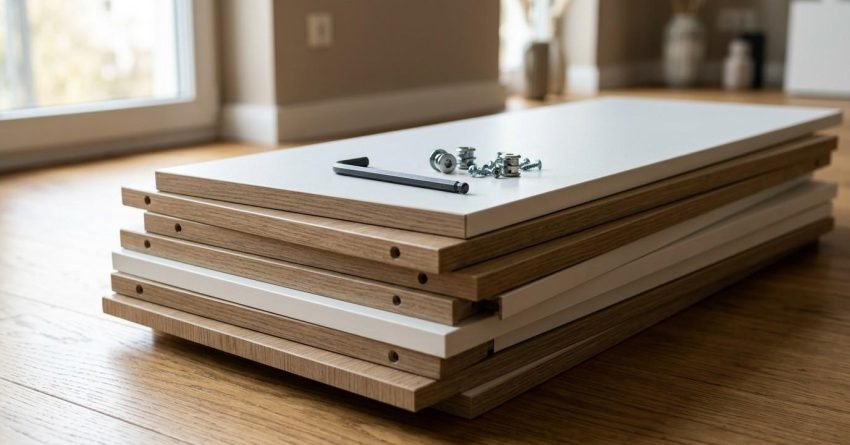
Flat pack cabinets are factory-manufactured cabinet carcasses and door panels supplied in flat, unassembled components that you, or a tradesperson, put together on-site. The boards are pre-cut, pre-drilled, and pre-finished at the factory. Hardware like hinges, cam locks, and drawer runners comes included in the box.
The term covers everything from entry-level particleboard units at Bunnings to mid-range melamine and moisture-resistant board options from suppliers like Kaboodle, IKEA, and Polytec. The core concept is the same across all of them: manufactured off-site, assembled on-site.
How They Differ from Pre-Assembled Cabinets
Pre-assembled or ready-built cabinets arrive at your site already constructed. You fix them to the wall and connect them, the internal assembly is done. Flat pack cabinets require you to build the carcass from scratch before any installation begins.
That distinction matters for labour time and skill level. A pre-assembled cabinet goes up faster. A flat pack cabinet gives you more flexibility in transport and storage, but adds an assembly step that takes real time and attention to get right.
Common Materials and Finishes Available
Most flat pack cabinets use particleboard or MDF as the substrate, with a melamine or laminate surface finish. Moisture-resistant (MR) board is the standard specification for bathroom and laundry applications, standard particleboard is not suitable for wet areas.
Door finishes range from flat laminate and textured melamine through to polyurethane, two-pac paint, and timber veneer at the premium end. Shaker profiles, handleless designs, and gloss finishes are all widely available across the major Australian flat pack suppliers.
The Pros of Flat Pack Cabinets
Lower Upfront Cost Compared to Custom Joinery
This is the headline advantage, and it’s real. A standard flat pack kitchen in Sydney typically costs $3,000–$8,000 in supply-only materials for a mid-size layout. Custom joinery for the same kitchen runs $15,000–$35,000 or more depending on the joiner and specification.
For investment properties, rental renovations, and budget-conscious owner-occupier projects, that gap is decisive. The savings are genuine, as long as you account for installation labour separately, which I’ll cover shortly.
Wide Range of Styles and Configurations
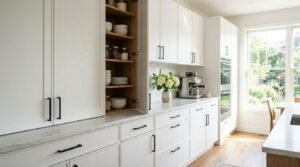
The flat pack market has expanded significantly. You’re no longer choosing between a handful of white laminate doors. Shaker profiles, handleless slabs, two-pac finishes, and a broad colour palette are all available from suppliers like Kaboodle at Bunnings and IKEA’s SEKTION range.
Configuration flexibility is solid too. Base cabinets, wall cabinets, pantry towers, corner solutions, and island units all exist in flat pack form. You can design a functional, attractive kitchen without going custom.
Easier to Transport and Handle On-Site
Flat components fit through narrow doorways, up tight staircases, and into apartments where a pre-built cabinet simply won’t go. This is a genuine practical advantage for Sydney renovations in older terrace houses, units, and townhouses with restricted site access.
Delivery is also simpler. Flat pack orders ship on pallets and can be staged inside the property before assembly begins.
Availability and Lead Times
Off-the-shelf flat pack cabinets are available immediately from major retailers. There’s no manufacturing lead time. For renovations with tight schedules, or projects where the scope changed late, that availability is a real advantage.
Custom joinery typically requires 6–12 weeks from order to delivery. Flat pack can be on-site within days.
The Cons of Flat Pack Cabinets
Assembly Time and Skill Required
Building flat pack carcasses is not complicated, but it is time-consuming and unforgiving of errors. A standard kitchen with 15–20 cabinet units takes an experienced person a full day to assemble, longer for a first-timer.
Cam locks need to be tightened correctly. Dowels need to be seated squarely. Backs need to be fitted before the carcass closes. One misaligned component creates a cabinet that won’t sit level or close properly, and fixing it after the fact is frustrating.
Durability and Longevity Compared to Custom Cabinets
Standard flat pack particleboard has a lifespan of 10–15 years under normal residential use. Custom joinery using solid timber or high-grade plywood typically lasts 20–30 years or more. The difference comes down to board density, joinery method, and hardware quality.
Moisture is the main enemy of flat pack cabinets. Edge banding that lifts, swells, or chips exposes the particleboard substrate to water, and once that happens, the board deteriorates quickly. In bathrooms and laundries, specifying MR board and quality edge banding is non-negotiable.
Limited Sizing and Customisation Options
Flat pack cabinets come in standard increments, typically 100mm or 150mm width steps. If your wall run doesn’t divide evenly into standard sizes, you fill the gaps with filler panels or scribing strips. That works, but it’s a compromise that custom joinery doesn’t require.
Non-standard ceiling heights, angled walls, and unusual corner configurations are all harder to solve with flat pack. The more your space deviates from a standard layout, the more the sizing limitations cost you in workarounds.
Hidden Costs That Can Erode the Savings
The supply price is only part of the story. Add professional installation labour ($80–$150 per hour in Sydney), hardware upgrades if the included hinges and runners aren’t adequate, delivery fees, filler panels, and any modifications needed to fit non-standard spaces, and the gap between flat pack and custom narrows considerably.
I’ve seen renovators budget $5,000 for flat pack cabinets and end up at $9,000 once installation and extras are included. The savings are still real, but they’re smaller than the sticker price suggests.
Flat Pack vs. Custom Cabinets: Which One Suits Your Renovation?
When Flat Pack Makes Sense
Flat pack is the right call for investment properties and rental renovations where durability over 10–15 years is sufficient and budget efficiency is the priority. It also works well for standard-layout kitchens and bathrooms where the wall runs divide cleanly into standard cabinet sizes.
First-time renovators working to a tight budget get genuine value from flat pack, provided they account for installation costs honestly and choose MR board for any wet area application.
When to Invest in Custom Joinery Instead
Non-standard spaces are where custom joinery earns its premium. If your kitchen has an angled wall, a ceiling that drops mid-run, or dimensions that don’t align with standard cabinet increments, custom joinery delivers a cleaner result with less compromise.
Owner-occupiers planning to stay in the property long-term, or renovators targeting the top end of the resale market, generally get better return from custom cabinetry. The quality difference is visible, and buyers at that price point notice it.
Installation: DIY or Hire a Professional?
What DIY Installation Actually Involves
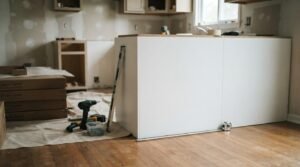
DIY flat pack installation means assembling every carcass, locating wall studs, fixing cabinets level and plumb to the wall, scribing to uneven surfaces, fitting doors and drawer fronts, and adjusting hinges and runners to tolerance. It’s achievable for a competent DIYer with the right tools, a laser level, a drill, clamps, and patience.
The realistic time commitment for a standard kitchen is two to three full days for someone doing it for the first time. Errors in levelling early in the run compound through every subsequent cabinet.
When Professional Installation Is Worth the Cost
Professional installation makes sense when the layout is complex, the site has access challenges, or the finish standard needs to be high. A skilled installer works faster, scribes more accurately, and handles the problem-solving that catches DIY renovators off guard.
For bathroom renovations in Sydney where cabinetry is part of a broader trade-coordinated project, professional installation keeps the schedule tight and the finish consistent. The labour cost is real, but so is the time and risk you’re not carrying.
How Flat Pack Cabinets Fit Into a Renovation Budget
Typical Cost Ranges in Sydney
Supply-only flat pack cabinetry for a standard Sydney kitchen runs $3,000–$8,000 depending on the supplier, door finish, and number of units. Add professional installation at $1,500–$4,000 for a standard layout, and the all-in cost lands between $4,500 and $12,000.
Bathroom vanity units in flat pack format typically cost $400–$1,200 supply-only, with installation adding $300–$600. These figures are indicative for Sydney in 2025, actual costs vary with site conditions, layout complexity, and the specific supplier.
Where Flat Pack Saves Money, and Where It Doesn’t
Flat pack delivers its best savings on straightforward layouts with standard dimensions, where the supply cost advantage isn’t eroded by extensive filler work, hardware upgrades, or complex installation. The more standard the space, the more the savings hold.
Where flat pack struggles to compete on total cost is in complex layouts, high-specification finishes, and long-term durability requirements. For a kitchen renovation budget where the goal is maximum resale value, the maths often shifts toward custom joinery once all costs are on the table.
Frequently Asked Questions
Are flat pack cabinets good quality?
Quality varies significantly by supplier and specification. Mid-range flat pack from established Australian suppliers using moisture-resistant board and soft-close hardware delivers a solid result for most residential applications. Entry-level particleboard with basic hardware is functional but not built for longevity.
How long do flat pack cabinets last?
Standard flat pack cabinets last 10–15 years under normal residential use. Moisture-resistant board in wet areas, quality edge banding, and soft-close hardware extend that lifespan. Custom joinery typically lasts 20–30 years.
Can flat pack cabinets be installed in a bathroom?
Yes, provided you specify moisture-resistant (MR) board, not standard particleboard. MR board handles the humidity and occasional water exposure in bathrooms. Standard particleboard swells and deteriorates in wet conditions.
Is it cheaper to buy flat pack or custom cabinets?
Flat pack supply costs are significantly lower, often 40–60% less than custom joinery. Once professional installation is included, the gap narrows. For standard layouts, flat pack remains cheaper overall. For complex or non-standard spaces, the cost difference shrinks considerably.
Do flat pack cabinets add value to a home?
They add value relative to no cabinetry or outdated cabinetry. At the top end of the market, buyers notice the difference between flat pack and custom joinery. For mid-market properties and investment renovations, flat pack delivers a clean, functional result that supports resale value without the custom price tag.
Can I install flat pack cabinets myself?
A competent DIYer with the right tools can install flat pack cabinets. The realistic time commitment is two to three days for a standard kitchen. Levelling, scribing, and wall fixing require patience and attention to detail. Complex layouts or high-finish requirements are better handled by a professional installer.
What are the most popular flat pack cabinet brands in Australia?
Kaboodle (Bunnings), IKEA SEKTION, and Polytec are the most widely used flat pack cabinet suppliers in Australia. Kaboodle and IKEA offer strong retail availability and a broad range of door styles. Polytec supplies through trade and kitchen retailers with a wider finish and profile selection.
Making the Right Cabinet Choice for Your Renovation
Flat pack cabinets deliver real cost savings for standard layouts, investment properties, and budget-conscious renovations, but durability, sizing limitations, and hidden installation costs deserve honest attention before you commit.
The right choice depends on your layout, your budget, your timeline, and how long you plan to hold the property. Both options have a place in a well-planned renovation.
We help Sydney homeowners and investors make that call with clear eyes. Contact Sydney Home Renovation for honest advice on cabinetry, costs, and the full renovation picture.