The three-four-five rule for tiling uses a simple mathematical ratio to check if corners are perfectly square before we lay a single tile. This technique, based on the Pythagorean theorem, helps us avoid costly mistakes that lead to misaligned grout lines, awkward tile cuts, and wasted materials.
Whether you’re planning a DIY bathroom refresh or working with a professional tiler in Sydney, understanding this rule saves time and money. Out-of-square layouts create compounding problems that become visible the moment tiles meet walls, vanities, or shower screens.
This guide explains exactly how the 3-4-5 rule works, when we use it, and how we apply it on Sydney bathroom renovation projects of all sizes.
What Is the Three Four Five Rule for Tiling?
The three-four-five rule is a practical method for verifying right angles using fixed measurements. We measure 3 units along one edge, 4 units along the adjacent edge, and check the diagonal between those two points. When that diagonal equals exactly 5 units, the corner is square.
This works because 3, 4, and 5 form a Pythagorean triple. The relationship between these numbers always produces a 90-degree angle. Tilers, carpenters, and builders have used this principle for centuries to establish accurate layouts without expensive equipment.
For bathroom renovations, the 3-4-5 rule tells us whether walls, floors, and fixtures align properly before tiling begins. Catching an out-of-square condition early saves us from discovering problems after waterproofing and tile adhesive are already in place.
The Mathematical Principle Behind the Rule
The Pythagorean theorem states that in a right triangle, the square of the hypotenuse equals the sum of the squares of the other two sides. Written as a formula: a² + b² = c².
Plugging in the 3-4-5 values: 3² + 4² = 9 + 16 = 25 = 5². This confirms the triangle contains a perfect 90-degree angle.
The beauty of this method lies in its simplicity. We don’t need a calculator or specialised tools; a tape measure and basic arithmetic confirm whether a corner is true. A diagonal reading anything other than 5 units tells us the corner is out of square.
Why Tilers Call It the “3-4-5 Triangle Method”
We call this the 3-4-5 triangle method because the three measurements form a triangle when connected. The triangle’s shape reveals the angle’s accuracy instantly.
Some tradies also call it the “builder’s square” or “carpenter’s triangle.” The terminology varies, but the application stays identical: marking three points and measuring the diagonal takes less than a minute and gives us a reliable confirmation of square corners.
This method predates modern laser levels and digital angle finders. Many of us still prefer it because batteries don’t die, calibration isn’t required, and the mathematics never fails.
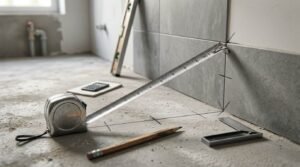
How the Three Four Five Rule Works in Practice
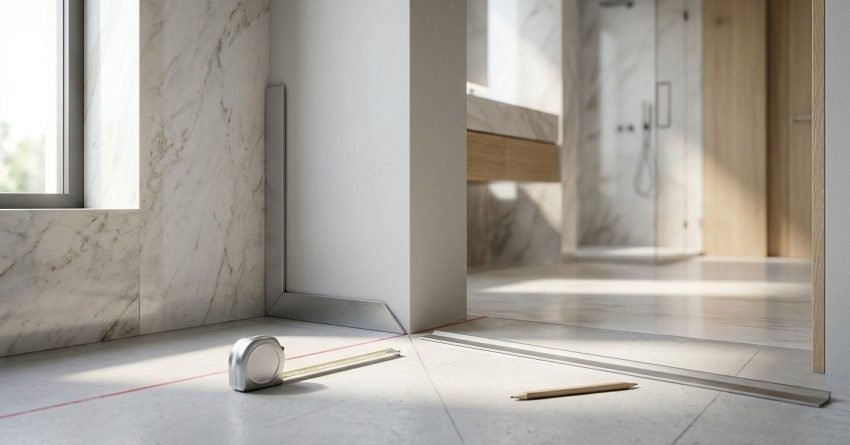
Applying the 3-4-5 rule requires nothing more than a tape measure, a pencil, and a flat surface. The process works on floors, walls, and any corner where tiles will meet.
We start by identifying the corner we need to verify. This might be where two walls meet, where the floor meets a wall, or where we’re establishing a layout line for the first row of tiles.
The rule scales to any unit of measurement. Whether we use millimetres, centimetres, or metres, the ratio stays constant, and larger measurements increase accuracy because small errors become more visible.
Step-by-Step Application for Bathroom Tiling
Step 1: Mark your starting point. Choose the corner where you’ll begin your tile layout, typically the most visible corner or the point where fixtures like vanities or toilets will sit.
Step 2: Measure 3 units along one edge. From the corner, measure exactly 300mm (or 600mm, 900mm for larger spaces) along the first wall or floor edge. Mark this point clearly with a pencil.
Step 3: Measure 4 units along the adjacent edge. From the same corner, measure 400mm (or 800mm, 1200mm) along the perpendicular edge. Mark this second point.
Step 4: Measure the diagonal. Stretch your tape measure between the two marks. A perfectly square corner gives a diagonal of exactly 500mm (or 1000mm, 1500mm).
Step 5: Adjust as needed. A diagonal reading longer or shorter than expected means the corner is out of square. From there, we decide whether to adjust the layout lines or plan for tapered tile cuts.
Tools We Use for the 3-4-5 Rule
A quality tape measure is essential. We choose one at least 5 metres long with clear markings, since cheap tape measures stretch over time and produce inaccurate readings.
A carpenter’s pencil or marking crayon creates visible marks on concrete, cement sheet, and tile backer board. Standard pencils work fine on smoother surfaces.
Masking tape helps mark reference points without damaging waterproofing membranes. Some of us use chalk lines for longer measurements across floor areas, alongside a calculator for scaling, a notepad for recording findings, and a spirit level to confirm surfaces are also level, not just square.
Alternatives to the 3-4-5 Rule
Laser levels and digital angle finders offer a faster read on square corners, projecting a line rather than requiring a physical diagonal measurement. They cost more and need batteries and calibration, which is why many tilers still reach for the 3-4-5 method as a reliable backup.
A framing square works well for smaller checks but loses accuracy over longer runs, since any small gap at the pivot point multiplies across a room. We generally treat these tools as complements to the 3-4-5 rule rather than replacements for it, using the maths to confirm what the tool shows.
Scaling the Rule for Larger Areas
The 3-4-5 ratio scales infinitely. For greater accuracy in larger bathrooms, we multiply all three numbers by the same factor.
| Scale Factor | Side A | Side B | Diagonal (C) |
| Standard | 300mm | 400mm | 500mm |
| Doubled | 600mm | 800mm | 1000mm |
| Tripled | 900mm | 1200mm | 1500mm |
| Quadrupled | 1200mm | 1600mm | 2000mm |
Larger triangles reduce the impact of small measurement errors. A 2mm error in a 300mm measurement represents a bigger percentage than the same error across a 1200mm measurement, which is why we favour the 900-1200-1500 version on full bathroom floors, with enough span to catch problems while staying practical in typical residential spaces.
Why Square Corners Matter in Bathroom Renovations
Square corners affect every aspect of a tiled bathroom’s appearance and function. Tiles come manufactured with precise 90-degree corners, so when room corners deviate from square, tiles cannot align properly.
The visual impact shows up immediately at grout lines. Instead of running parallel to walls, grout lines angle slightly, and this effect compounds across the room, becoming more obvious with each row of tiles.
Functional problems follow the aesthetic ones. Shower screens, vanity units, and bath surrounds are built square, so installing them against out-of-square walls creates gaps, demands excessive silicone, and looks unprofessional.
The Cost of Out-of-Square Tile Layouts
Discovering out-of-square conditions after tiling begins creates expensive problems. Tiles already laid may need removal, adhesive and grout go to waste, and labour costs climb as tilers spend time correcting rather than progressing.
Tapered cuts along walls consume more tiles than straight cuts. A bathroom that’s 10mm out of square across a 2-metre wall needs progressively larger cuts from each tile in that row, and material waste increases accordingly.
Correcting out-of-square issues mid-project routinely adds meaningful time and labour cost to a tiling job. The 3-4-5 check takes five minutes, and skipping it can cost hours of remediation work later.
How Misaligned Tiles Affect Resale Value
Property investors and homeowners preparing for sale should pay particular attention to tile alignment. Buyers notice crooked grout lines, uneven borders, and gaps around fixtures.
A bathroom with visibly misaligned tiles suggests rushed or amateur workmanship, and buyers question what other shortcuts might be hidden. Professional tile installation with square layouts signals quality throughout the entire renovation, not just the bathroom.
We treat this attention to detail as one of the clearest signals of overall build quality on any property.
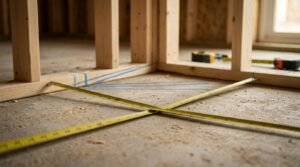
Common Mistakes When Using the Three Four Five Rule
The 3-4-5 rule is simple, but execution errors undermine its effectiveness. Understanding common mistakes helps us avoid them.
Rushing the measurement process causes most problems. Taking an extra minute to double-check each mark prevents hours of correction later.
Environmental factors also affect accuracy. Dust on the tape measure, poor lighting, and awkward positions all contribute to measurement errors.
Measurement Errors That Throw Off Your Layout
Tape measure sag: Long tape measures sag under their own weight, adding length to diagonal measurements and making square corners appear out of square. We keep the tape taut or support it at the midpoint.
Starting point inconsistency: Both measurements must begin from exactly the same corner point. Starting the second measurement even 5mm away from the first creates false readings.
Rounding errors: The 3-4-5 rule requires exact measurements. Rounding 498mm to 500mm might seem insignificant, but it masks a 4mm deviation that compounds across the room.
Reading the wrong side: Some tape measures show metric on one side and imperial on the other. Mixing units by accident produces meaningless results.
When the 3-4-5 Rule Won’t Work
The 3-4-5 rule verifies right angles only. It cannot check whether surfaces are level, plumb, or flat.
Curved walls, angled feature walls, and non-rectangular rooms need different approaches, since the rule assumes we’re checking a 90-degree corner. Applying it to a 45-degree corner produces incorrect conclusions.
Extremely small spaces limit the triangle size we can create. In a 1-metre-wide toilet room, the standard 300-400-500 triangle is often the maximum practical size, which reduces accuracy.
The rule also can’t compensate for walls that bow or floors that dip. A corner might be perfectly square while the wall curves inward 10mm at its centre, so we still run additional checks with straight edges and levels.
Professional vs DIY: When to Use the Three Four Five Rule
Both professional tilers and DIY renovators benefit from the 3-4-5 rule. The difference lies in how each group responds to the findings.
We use the rule as one step in a comprehensive layout process, combining it with laser levels, straight edges, and years of experience to establish optimal tile positioning. DIY renovators often discover the rule solves problems they didn’t know existed. Many first-time tilers assume walls are square because they look square, and the 3-4-5 check reveals the reality.
DIY Tiling Projects Suited for the 3-4-5 Method
Small splashbacks behind bathroom vanities make excellent DIY projects. The 3-4-5 rule helps establish a level starting line and verify corner alignment.
Feature walls with decorative tiles benefit from careful layout planning, since the rule keeps patterns aligned symmetrically and grout lines running true.
Laundry floors and utility areas offer forgiving environments for DIY practice. Minor imperfections matter less in these spaces, which lets beginners build skills before tackling a bathroom.
Replacement tiles in existing installations require matching the original layout. The 3-4-5 rule helps us identify whether the original installation was square, which informs how new tiles should align.
When to Hire a Professional Tiler
Full bathroom renovations involving waterproofing, floor-to-ceiling tiles, and multiple fixtures exceed most DIY skill levels. We manage complex layouts where multiple surfaces must align at once.
Expensive tile materials raise the cost of mistakes. Natural stone, large-format porcelain, and designer tiles demand professional handling; the 3-4-5 rule helps, but experience prevents the errors that waste premium materials.
Time-sensitive projects benefit from professional efficiency. A skilled tiler completes work in days that might take a DIYer weeks, and the 3-4-5 check happens automatically as part of our standard process.
Warranty considerations also favour professional installation. Many tile manufacturers require professional installation for warranty coverage, and waterproofing warranties typically mandate licensed applicators.
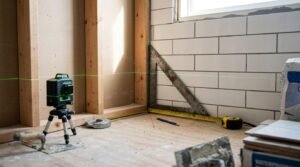
How We Apply the Three Four Five Rule on Sydney Projects
Sydney’s housing stock presents unique challenges for bathroom renovations. Older homes in suburbs like Balmain, Newtown, and Mosman often feature walls that have shifted over decades.
We routinely find corners 10- 20 mm out of square in pre-war homes. Federation and Victorian-era construction used different standards than modern building codes require.
Even newer Sydney apartments aren’t immune. Fast-tracked construction sometimes produces corners that deviate from true square, and the 3-4-5 rule identifies these issues before tiling begins.
Local Considerations for Bathroom Renovations
Sydney’s climate affects renovation timing. High humidity during summer can extend adhesive and grout curing times, so we account for these conditions when scheduling work.
Local building codes require licensed waterproofing for wet areas. We apply the 3-4-5 rule after waterproofing is complete but before tiling begins, since checking square at this stage avoids disturbing the waterproof membrane.
Sydney water quality influences grout and tile selection. Some areas have harder water that leaves mineral deposits, so we recommend appropriate grout sealers and tile finishes based on local conditions.
Access constraints in Sydney’s terrace houses and apartment buildings affect project logistics. Narrow hallways and stairs limit tile size options, and the 3-4-5 rule helps us maximise the visual impact of whatever tile format fits the space.
Conclusion
The three-four-five rule transforms bathroom tiling from guesswork into precision. This simple mathematical check verifies square corners, prevents costly mistakes, and delivers professional results whether we’re tackling a DIY project or managing a full renovation.
Understanding this fundamental technique helps us ask the right questions and recognise quality workmanship. Square layouts, aligned grout lines, and properly fitted fixtures all begin with accurate corner verification using the 3-4-5 method.
At Sydney Home Renovation, we apply the three-four-five rule on every bathroom project we take on, because transparent, quality-focused renovations start with getting the fundamentals right. Contact us today to discuss your bathroom renovation.
Frequently Asked Questions
What is the 3-4-5 rule in tiling?
The 3-4-5 rule is a method for checking if corners are perfectly square using measurements. We measure 3 units along one edge, 4 units along the adjacent edge, and if the diagonal equals 5 units, the corner is exactly 90 degrees.
How do you check if a corner is square for tiling?
Mark a point 300mm along one wall from the corner and another point 400mm along the adjacent wall. Measure the diagonal between these marks; if it equals exactly 500mm, the corner is square. Scale up for larger spaces.
Can I use the 3-4-5 rule for floor tiles?
Yes, the 3-4-5 rule works perfectly for floor tiles. We apply it at the corner where the layout starts, which keeps the first row true and every subsequent row aligned across the entire floor.
What happens if my bathroom walls aren’t square?
Out-of-square walls require tapered tile cuts along the affected edges. We adjust layouts to minimise visual impact, often centring the taper where it’s least noticeable or hidden behind fixtures.
Is the 3-4-5 rule the same as the Pythagorean theorem?
Yes, the 3-4-5 rule is a practical application of the Pythagorean theorem. The numbers 3, 4, and 5 form a Pythagorean triple, meaning they always create a perfect right triangle with a 90-degree angle.
How accurate does the 3-4-5 measurement need to be?
Measurements should be accurate within 1- 2 mm for reliable results. We use a quality tape measure, keep it taut, and double-check each mark, since larger triangle sizes like 900-1200-1500 improve accuracy.
Should I check for square before or after waterproofing?
We check for square after waterproofing is complete, since this gives us the final surface we’re tiling onto. Checking earlier risks missing changes from the waterproofing process and could damage the membrane.