
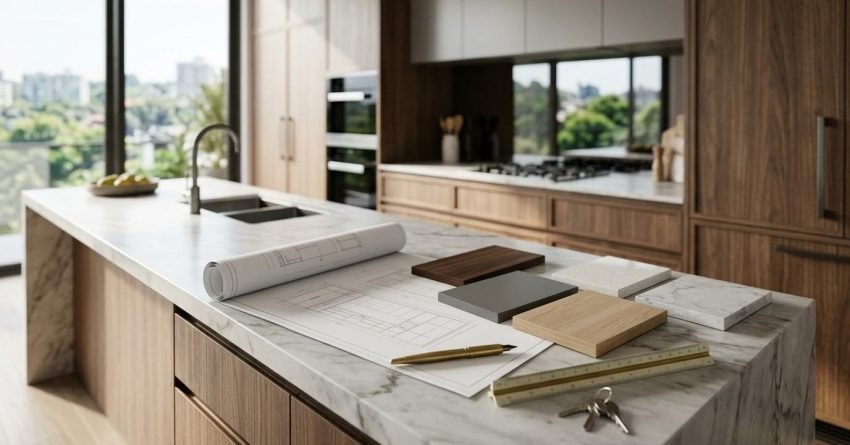
Cabinetry and joinery consistently account for the largest share of any kitchen renovation budget in Sydney, typically consuming 30 to 40 percent of total project costs. For a mid-range kitchen renovation, that figure can sit anywhere between $10,000 and $25,000 on cabinets alone, before a single benchtop is measured or an appliance is ordered.
Understanding where your money actually goes is the difference between a renovation that stays on budget and one that spirals into cost overruns. Labour, benchtops, appliances, plumbing, and electrical work each carry their own pricing variables, and most homeowners underestimate at least two of them.
This guide breaks down every major cost category in a Sydney kitchen renovation and gives you the realistic figures you need to plan, prioritise, and spend with confidence.
Why Kitchen Renovations Cost More Than Most Homeowners Expect
Kitchen renovations are among the most complex and trade-intensive projects in residential construction. Unlike a bedroom repaint or a bathroom refresh, a kitchen renovation typically involves cabinetmakers, plumbers, electricians, tilers, and a builder or project manager, all working in sequence, all charging Sydney rates.
The result is a project where costs compound quickly. A decision to upgrade your benchtop material affects the cabinetry timeline, moving the sink adds plumbing costs and potentially structural work, and choosing integrated appliances requires custom cabinet modifications.
Most homeowners enter the process with a figure in mind, often sourced from a friend’s renovation or a quick online search. That figure rarely accounts for the full scope of what a kitchen renovation in Sydney actually involves.
The Gap Between Budget Estimates and Final Invoices
The most common reason kitchen renovation budgets blow out is not poor planning; it is incomplete scoping. Early estimates are often based on visible, surface-level work like new cabinets, a benchtop, and appliances. What they frequently exclude is the work behind the walls.
Outdated electrical wiring, plumbing that cannot be reused once the old kitchen is stripped, asbestos in older homes requiring licensed removal, and structural issues uncovered during demolition are common culprits. These are not rare exceptions.
In Sydney’s older housing stock, particularly homes built before the 1990s, subsurface surprises are common enough that experienced contractors build contingency allowances into every quote. If yours does not, that is worth questioning before you sign anything.
The Most Expensive Part of a Kitchen Renovation: Cabinetry and Joinery
Cabinetry is the single largest cost in most kitchen renovations, and for good reason. It defines the layout, the storage capacity, the aesthetic, and the structural framework around which every other element is built.
It is also the component where the price range is widest, from a few thousand dollars for flat-pack to well over $30,000 for fully custom joinery. In Sydney, cabinetry cost is driven by three primary variables: the manufacturing method, the materials and finishes selected, and the complexity of the layout.
A galley kitchen with straightforward runs of cabinets will cost significantly less than an L-shaped or U-shaped kitchen with island bench, overhead cabinetry, and integrated appliance panels.
Why Custom Cabinetry Drives the Highest Costs
Custom cabinetry is designed and built specifically for your kitchen, to your exact dimensions, with your chosen materials, finishes, and internal configurations. There is no off-the-shelf component; every panel, door, drawer, and hinge is specified, manufactured, and installed to order.
A custom kitchen from a Sydney cabinetmaker typically starts at $15,000 and can exceed $40,000 for larger or more complex layouts. The cost reflects not just materials but the design time, manufacturing lead time, and the skill required to install joinery that fits perfectly in a space that is rarely perfectly square.
For homeowners renovating a property they intend to hold long-term, custom cabinetry is often the right investment. For investment properties or budget-conscious renovations, it is rarely necessary.
Flat-Pack vs Semi-Custom vs Custom Cabinets: Cost Comparison
Understanding the three tiers of kitchen cabinetry helps you make a decision that matches your budget and your renovation goals.
| Cabinet Type | Typical Cost Range (Sydney) | Best For |
| Flat-Pack (e.g., IKEA, Kaboodle) | $3,000–$8,000 supply only | Budget renovations, investment properties |
| Semi-Custom (pre-made, modified) | $8,000–$18,000 supply and install | Mid-range renovations, owner-occupiers |
| Custom Joinery | $15,000–$40,000+ supply and install | Premium renovations, complex layouts |
Flat-pack cabinets are manufactured in standard sizes and assembled on-site. They are cost-effective but require careful planning around non-standard dimensions, and installation labour is often underestimated.
Semi-custom cabinets offer more flexibility in sizing and finish options while remaining more affordable than fully bespoke joinery. They represent the most common choice for mid-range Sydney kitchen renovations.
Custom joinery delivers the highest quality and the most precise fit, but the price reflects that. For most renovations, semi-custom cabinetry with quality hardware delivers excellent results at a fraction of the custom price.
How to Manage Cabinet Costs Without Sacrificing Quality
The most effective way to manage cabinetry costs is to be strategic about where you spend within the cabinet budget. Cabinet boxes, the structural carcasses, are largely invisible once installed, so spending heavily on premium carcass materials rarely adds visible value.
Where quality matters most is in the doors, drawer fronts, handles, and internal hardware the elements you see and touch every day. A quality soft-close hinge system and full-extension drawer runners add relatively little to the overall cost but significantly improve daily use.
Working with a contractor who has established supplier relationships can also reduce material costs, since experienced renovation contractors often access trade pricing not available to homeowners purchasing directly.
Labour Costs: The Second Largest Budget Item in Any Kitchen Renovation
After cabinetry, labour is the next largest cost in a Sydney kitchen renovation. It is also the cost that surprises homeowners most, because it is less visible than a benchtop or a set of appliances.
In Sydney, labour costs are driven by the number of trades required, the complexity of the work, and current demand for skilled tradespeople. Kitchen renovations draw on multiple licensed trades simultaneously, which compounds the pricing pressure.
What Trades Are Required for a Kitchen Renovation in Sydney
A standard kitchen renovation in Sydney involves a minimum of four to five separate trades, each with their own licensing requirements, scheduling constraints, and pricing structures.
The cabinetmaker handles cabinet installation, the plumber manages sink and dishwasher connections, and the electrician handles power points, lighting, and circuit upgrades required to meet current Australian Standards. The tiler covers splashbacks and floor tiling, while a builder or renovation contractor typically coordinates the whole project.
For more complex renovations, a gas fitter may be required for cooktop connections, and a plasterer may be needed if walls are opened for plumbing or electrical work.
How Much Do Kitchen Renovation Trades Cost in Sydney, NSW
Sydney trade rates reflect the city’s high cost of living and sustained demand for skilled labour. The table below shows typical day rates and cost ranges for kitchen renovation trades in the Sydney market.
| Trade | Typical Sydney Rate | Typical Kitchen Renovation Cost |
| Builder / Project Manager | $600–$900 per day | $2,000–$6,000 |
| Cabinetmaker / Installer | $500–$800 per day | $1,500–$4,000 |
| Plumber | $120–$180 per hour | $1,500–$5,000+ |
| Electrician | $100–$160 per hour | $1,500–$4,000+ |
| Tiler | $60–$100 per square metre | $800–$3,000 |
| Gas Fitter | $120–$180 per hour | $500–$1,500 |
These figures are indicative. The actual labour cost for any renovation depends on the scope of work, site complexity, and whether the project is managed by a single contractor or coordinated independently.
Why Labour Costs Are Non-Negotiable (and Where You Can Save)
Licensed trades in Australia are not optional. Plumbing, electrical, and gas work must be completed by licensed professionals under NSW Fair Trading requirements to comply with Australian Standards and maintain your home’s insurance coverage.
Where homeowners can legitimately reduce labour costs is in the project management layer. Engaging a single renovation contractor who manages all trades typically reduces overall labour cost through established relationships, efficient sequencing, and reduced downtime between trades.
Doing your own demolition, where safe and permitted, can also reduce costs. Stripping out old cabinets before trades arrive is work that does not require a licence and can save several hundred to a few thousand dollars.
Benchtops: Where Material Choice Determines Your Budget
The benchtop is the most visible surface in any kitchen, and it is the component where material selection has the most direct impact on both cost and long-term satisfaction. In Sydney, benchtop costs range from under $1,000 for basic laminate to well over $10,000 for premium stone.
Benchtop pricing is calculated per linear metre, and the total cost includes both material supply and fabrication and installation. Stone benchtops require templating, cutting, and polishing by a specialist fabricator, which adds to the overall cost beyond the raw material price.
Stone, Laminate, and Timber Benchtop Costs Compared
| Benchtop Material | Supply and Install Cost (per linear metre) | Typical Total Cost (standard kitchen) |
| Laminate | $150–$400 | $800–$2,500 |
| Reconstituted Stone (e.g., Caesarstone, Silestone) | $500–$1,200 | $3,000–$8,000 |
| Natural Stone (marble, granite) | $800–$2,000+ | $5,000–$15,000+ |
| Timber / Butcher’s Block | $400–$900 | $2,500–$6,000 |
| Porcelain Slab | $700–$1,500 | $4,000–$10,000 |
Engineered stone, including brands like Caesarstone and Silestone, represents the most popular choice in Sydney mid-range renovations. It offers the aesthetic of natural stone with greater consistency, lower maintenance, and a more predictable price point.
It is worth noting that since July 2024, engineered stone containing crystalline silica has been banned in Australia under workplace health and safety regulations. This has affected product availability and pricing, and homeowners should confirm compliance with their supplier before specifying any engineered stone product.
Which Benchtop Material Offers the Best Value in Sydney
For most Sydney homeowners, engineered stone in the 20mm to 40mm thickness range offers the best balance of cost, durability, and visual impact. It resists staining and heat, and holds its appearance well over time.
Laminate benchtops remain a practical choice for investment properties or budget renovations where cost control is the priority. Modern laminate products have improved significantly in quality and appearance.
Natural stone, particularly marble, carries a premium price and requires more careful maintenance. For homeowners who want the look of marble without the cost, large-format porcelain slabs offer a compelling alternative.
Appliances: High-Impact Costs That Are Easy to Underestimate
Appliances are the component of a kitchen renovation where homeowners most frequently underestimate their budget. It is easy to treat appliances as an afterthought, only to discover that the oven, cooktop, rangehood, and dishwasher together represent a significant portion of the total project cost.
In Sydney, appliance costs vary enormously depending on brand, specification, and whether you choose freestanding or integrated products. A basic appliance package can be assembled for under $3,000, while a premium integrated package from a European brand can exceed $20,000.
How Much Should You Budget for Kitchen Appliances in Sydney
A realistic appliance budget for a mid-range Sydney kitchen renovation sits between $5,000 and $12,000 for a complete package including oven, cooktop, rangehood, and dishwasher. This covers quality mid-tier brands such as Bosch, Fisher and Paykel, and Smeg.
| Appliance | Budget Range | Mid-Range | Premium |
| Oven | $800–$1,500 | $1,500–$3,500 | $3,500–$8,000+ |
| Cooktop | $400–$900 | $900–$2,500 | $2,500–$6,000+ |
| Rangehood | $300–$700 | $700–$2,000 | $2,000–$5,000+ |
| Dishwasher | $600–$1,200 | $1,200–$2,500 | $2,500–$5,000+ |
These figures cover supply only. Installation costs are additional and are typically included in the labour budget under electrical and plumbing.
Built-In vs Freestanding Appliances: What Costs More to Install
Integrated or built-in appliances cost more to install than freestanding equivalents, and the difference is not limited to the appliance price. Integrated appliances require custom cabinetry panels and more complex installation work.
For homeowners choosing integrated appliances, it is essential that the cabinetmaker and appliance supplier coordinate specifications before manufacturing begins. Errors at this stage are expensive to correct and can delay the entire project.
Freestanding appliances are simpler to install, easier to replace in the future, and generally less expensive. For investment properties, freestanding appliances are almost always the more practical choice.
Plumbing and Electrical: Hidden Costs That Blow Kitchen Budgets
Plumbing and electrical work are the most common sources of budget surprises in a kitchen renovation. They are invisible until the walls are opened, and the cost of what is found behind those walls can vary dramatically depending on the age of the home.
In Sydney’s older housing stock, it is not unusual to find plumbing that does not meet current standards, wiring that requires full replacement, or drainage configurations that make a simple sink relocation more complex than anticipated.
When Does Moving a Kitchen Sink or Cooktop Add Significant Cost
Keeping the sink and cooktop in their existing locations is one of the most effective ways to control plumbing and gas costs. When these elements stay in place, existing pipe runs can typically be reused, limiting plumbing work to disconnection and reconnection.
Moving the sink to a new location requires extending or rerouting water supply and waste pipes. This can add $1,500 to $5,000 or more to the plumbing budget, and costs increase substantially if the move requires cutting through a concrete slab.
Moving a gas cooktop similarly requires a licensed gas fitter to extend or reroute the gas line, which adds cost and requires a compliance certificate upon completion.
Electrical Upgrades, Rangehood Ducting, and Compliance Costs
Modern kitchens require more electrical circuits than older homes were designed to provide. Dedicated circuits for the oven, cooktop, dishwasher, and refrigerator are standard requirements, and upgrading the panel and running new circuits can add $1,500 to $4,000 to the electrical budget.
Rangehood ducting is another cost that is frequently overlooked. A ducted rangehood requires a duct run to an external wall or roof, and installation typically ranges from $300 to $1,500 depending on the complexity of the run.
All electrical and plumbing work in New South Wales must comply with Australian Standards and relevant state regulations, and compliance certificates for completed work are not optional. Factor them into your budget from the outset.

Flooring, Splashbacks, and Finishing Costs in a Kitchen Renovation
Flooring and splashbacks are often treated as minor line items, but they contribute meaningfully to the final cost and have a significant impact on the finished aesthetic. In Sydney, the cost of these elements depends primarily on material selection and area covered.
How Much Do Kitchen Splashbacks and Flooring Cost in Sydney
| Element | Material | Supply and Install Cost |
| Splashback | Ceramic tile | $80–$150 per m² |
| Splashback | Glass or mirror | $300–$700 per m² |
| Splashback | Stone or porcelain slab | $400–$900 per m² |
| Flooring | Hybrid / LVP | $50–$100 per m² |
| Flooring | Porcelain tile | $80–$180 per m² |
| Flooring | Engineered timber | $100–$200 per m² |
For a standard kitchen of 15 to 20 square metres, flooring costs typically range from $1,500 to $4,000 depending on material selection, and splashback costs typically range from $500 to $3,000.
Grout colour, tile format, and laying pattern all affect the final cost. Large-format tiles require more precise installation and generate more waste, which increases both material and labour costs.
How Kitchen Size Affects Total Renovation Cost
Kitchen size is one of the most direct multipliers on total renovation cost, since almost every cost category scales with the area involved. A compact galley kitchen of 8 to 10 square metres will require fewer linear metres of cabinetry and benchtop than an open-plan kitchen with an island, which can easily double the joinery and stone costs alone.
Larger kitchens also tend to draw more trades for longer periods, since additional cabinetry runs, extra power points, and larger tiling areas all add billable hours. As a rough guide, a small entry-level kitchen renovation can land near the lower end of the $15,000 to $30,000 range, while a large open-plan kitchen with an island frequently pushes into mid-range or premium territory purely on scale.
Full Kitchen Renovation Cost Breakdown by Budget Tier in Sydney
Understanding where your renovation sits within the broader market helps you set realistic expectations and make informed decisions about where to allocate your budget.
Entry-Level Kitchen Renovation: $15,000 to $30,000
An entry-level kitchen renovation in Sydney typically involves flat-pack or budget semi-custom cabinetry, a laminate or basic stone benchtop, mid-tier freestanding appliances, and standard flooring. Labour costs are managed by keeping the existing layout and avoiding plumbing and electrical relocations.
This tier suits investment properties, rental renovations, or homeowners who need a functional, clean kitchen without a premium finish.
Mid-Range Kitchen Renovation: $30,000 to $60,000
A mid-range kitchen renovation represents the most common tier for owner-occupiers. It typically includes semi-custom cabinetry with quality hardware, an engineered stone benchtop, a quality appliance package, and quality flooring.
At this level, there is room for some layout changes and upgraded electrical work. This is where most Sydney homeowners achieve the best balance between cost and long-term value.
Premium Kitchen Renovation: $60,000 and Above
A premium kitchen renovation involves custom joinery, premium stone or porcelain benchtops, integrated European appliances, and high-specification flooring. It typically includes significant electrical and plumbing work and custom lighting design.
For properties in Sydney’s upper-middle and prestige markets, a premium kitchen renovation can deliver strong returns at resale, particularly where the kitchen is central to the home’s living and entertaining spaces.
How Long Does a Kitchen Renovation Take, and Does It Affect Cost
A standard mid-range kitchen renovation in Sydney typically takes four to eight weeks from demolition to completion, though custom joinery lead times can extend this significantly. Cabinetmakers often require four to six weeks just to manufacture custom cabinetry before installation even begins.
Delays directly affect cost. Extended timelines mean more days of trade coordination, more site supervision, and in rental situations, more time without a functioning kitchen. Locking in material selections and finalising the design before ordering cabinetry is the most reliable way to keep both timeline and budget on track.
Do You Need Council Approval for a Kitchen Renovation in Sydney
Most cosmetic kitchen renovations that keep the existing layout, plumbing, and structure in place do not require council approval and can proceed as exempt development. Renovations that involve structural changes, moving load-bearing walls, or altering the building’s external envelope typically require a Complying Development Certificate or full Development Application.
Approval costs and timeframes add to the overall project budget when structural or layout changes are involved, so it is worth confirming your renovation’s approval pathway with your contractor or local council before finalising a design that assumes a full layout change.
How to Reduce Kitchen Renovation Costs Without Compromising Quality
Reducing kitchen renovation costs does not require compromising on the outcome. It requires making strategic decisions about where to spend and where to save, based on which elements deliver the most visible value.
Reface Instead of Replace: Cabinet Cost-Saving Strategy
If your existing kitchen cabinets are structurally sound, cabinet refacing is one of the most cost-effective upgrades available. Refacing involves replacing doors and drawer fronts, applying new veneer to the cabinet boxes, and updating hardware.
Cabinet refacing in Sydney typically costs between $4,000 and $12,000, compared to $10,000 to $40,000 for full cabinet replacement. The limitation is that refacing does not allow for layout changes.
Prioritising Spend: What to Invest In and What to Scale Back
The highest-return investments are the elements most visible and most frequently used: the benchtop, cabinet doors and hardware, and appliances. Investing in quality here while scaling back on less visible elements, such as cabinet carcass materials, delivers the best return on renovation spend.
Flooring is another area where cost can be managed without significant visual compromise. Hybrid luxury vinyl plank delivers a high-quality appearance at a lower cost than porcelain tile or engineered timber, and is more forgiving to install.
Common Kitchen Renovation Budget Mistakes Sydney Homeowners Make
The most consistent pattern in budget overruns is not a single large mistake but an accumulation of smaller ones. Underestimating trade costs, failing to account for compliance requirements, and starting a project without a clear scope of works are all common contributors.
One of the most frequent mistakes is treating an early estimate as a fixed price. An estimate based on a brief conversation without full documentation is an indication, not a quote, and the gap between the two can be substantial.
Contingency Budgeting: Why You Need 10-15% in Reserve
Every kitchen renovation budget should include a contingency allowance of 10 to 15 percent of total project cost. This is sound financial planning based on the reality of residential construction, not pessimism.
Contingency funds cover subsurface plumbing issues, electrical upgrades required by an inspector, and structural surprises uncovered during demolition. A renovation budgeted at $40,000 should have $4,000 to $6,000 held in reserve.

How to Get an Accurate Kitchen Renovation Quote in Sydney
Getting an accurate quote requires more than calling three contractors and comparing numbers. It requires a clearly defined scope of works, a completed design or layout plan, and a specification of materials and finishes.
The most reliable approach is to engage a renovation contractor early in the planning process, before the design is finalised, so cost implications can be considered as decisions are made.
What a Detailed Renovation Quote Should Include
A detailed kitchen renovation quote should be itemised by trade and cost category, clearly separating supply costs from installation costs. Key elements that should appear include:
- Demolition and disposal costs
- Cabinetry supply and installation (with product specification)
- Benchtop supply, fabrication, and installation
- Plumbing and electrical scope and cost
- Tiling scope and cost
- Appliance supply and installation
- Flooring supply and installation
- Painting and finishing
- Project management and coordination
- Contingency allowance
- Payment schedule and terms
A quote that does not include these elements is incomplete. Insisting on a detailed, itemised quote before signing any contract is one of the most important steps a homeowner can take to protect their renovation budget.
Conclusion
Cabinetry, labour, benchtops, appliances, and plumbing and electrical work are the five cost categories that determine the budget of any kitchen renovation in Sydney. Understanding what drives pricing in each category, and how decisions in one area affect costs in another, is the foundation of a renovation that stays on budget.
At Sydney Home Renovation, we work with homeowners, first-time renovators, and property investors across Sydney to plan and deliver kitchen renovations with transparent pricing, detailed scoping, and honest guidance at every stage. Our approach is built on giving you the information you need to make confident decisions, not on managing expectations after the invoice arrives.
If you are planning a kitchen renovation in Sydney and want a detailed, itemised quote based on a clearly defined scope of works, contact Sydney Home Renovation today. We will help you understand exactly where your budget is going and how to get the best possible outcome for your investment.
Frequently Asked Questions
What is the most expensive part of a kitchen renovation?
Cabinetry and joinery is consistently the most expensive component, typically accounting for 30 to 40 percent of the total project budget. In Sydney, custom kitchen cabinetry can cost between $15,000 and $40,000 or more depending on size and specification.
How much does a kitchen renovation cost in Sydney in 2025?
A kitchen renovation typically costs between $15,000 and $30,000 for an entry-level renovation, $30,000 to $60,000 for mid-range, and $60,000 or more for premium work with custom joinery and integrated appliances.
Is it cheaper to reface kitchen cabinets or replace them?
Cabinet refacing is significantly cheaper, typically costing between $4,000 and $12,000 compared to $10,000 to $40,000 for new cabinetry. Refacing works well when cabinet boxes are structurally sound, and the layout doesn’t need to change.
How much should I budget for kitchen appliances in Sydney?
A realistic appliance budget for a mid-range renovation is between $5,000 and $12,000 for a complete package including oven, cooktop, rangehood, and dishwasher. Premium integrated packages can exceed $20,000.
What hidden costs should I expect in a kitchen renovation?
Common hidden costs include electrical circuit upgrades, plumbing relocation, asbestos removal in older homes, and structural repairs uncovered during demolition. A 10 to 15 percent contingency allowance is strongly recommended.
Does moving the kitchen sink add a lot to the renovation cost?
Moving the kitchen sink adds $1,500 to $5,000 or more to the plumbing budget, depending on distance and drainage configuration. Costs increase substantially if the move requires cutting through a concrete slab.
What should a kitchen renovation quote include?
A detailed quote should be fully itemised, covering demolition, cabinetry, benchtops, plumbing, electrical, tiling, appliances, flooring, project management, and a contingency allowance, with a clear payment schedule.


