Induction wins on speed, safety, and energy efficiency, but gas still holds real advantages for certain cooking styles and kitchen setups. The right answer depends on how you cook, what your kitchen is wired for, and what you’re trying to get out of a renovation.
I’ve worked through enough kitchen upgrades to know this decision trips people up more than almost any other appliance choice. Both cooktop types have genuine strengths, and neither is universally better.
In this guide, I cover how each type works, how they compare on performance, running costs, safety, installation, and cleaning, and I give you a clear framework for deciding which one suits your home.
How Each Cooktop Type Actually Works
Before comparing them, it helps to understand what’s actually happening under the surface. The technology behind each cooktop shapes everything, from how fast water boils to how easy the surface is to clean.
How Induction Cooktops Generate Heat
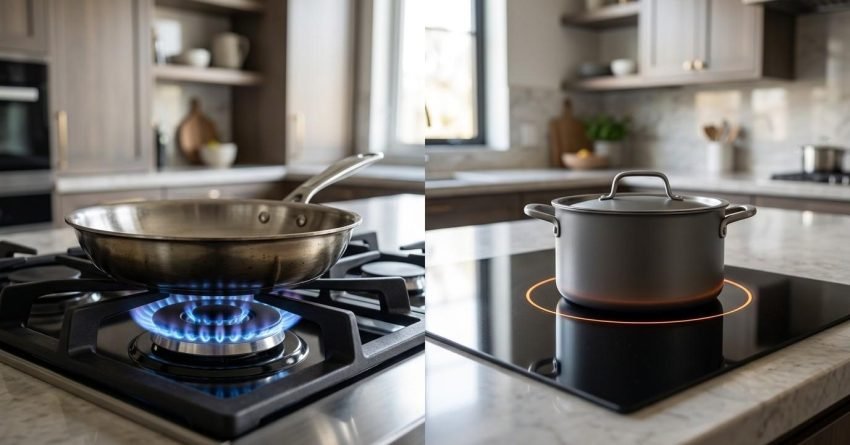
Induction cooktops use electromagnetic fields to generate heat directly inside the cookware itself. There’s no heating element, no open flame, and no radiant heat from the surface.
When you place a magnetic-based pan on the cooktop, the electromagnetic coil beneath the glass creates an electrical current inside the pan’s base. That current produces heat, fast, precise, and contained entirely within the cookware.
The glass surface stays relatively cool because it isn’t the heat source. It only warms from contact with the hot pan.
How Gas Cooktops Generate Heat
Gas cooktops burn either natural gas or LPG through a burner to produce an open flame. That flame heats the base of the cookware through direct contact and radiant heat.
The heat output is immediate and visible, which is why many cooks find gas intuitive. You see the flame, you adjust the flame, and the pan responds.
Gas does release combustion byproducts, including nitrogen dioxide and carbon monoxide, into the kitchen air, which is why adequate ventilation matters.
Cooking Performance, Speed, Control, and Results
This is where most people focus first, and rightly so. A cooktop that doesn’t perform the way you cook is the wrong cooktop, regardless of what it costs to run.
Heat-Up Speed and Temperature Precision
Induction is faster. A standard induction cooktop brings water to a boil significantly quicker than gas at comparable wattage, because nearly all the energy goes directly into the pan with minimal waste.
Temperature control on induction is also more precise. You can drop from a rolling boil to a gentle simmer almost instantly, which matters for sauces, chocolate, and anything that scorches easily.
Gas responds quickly too, but there’s a lag between adjusting the flame and the pan temperature actually changing. For most everyday cooking, that lag is minor, but for precision work, induction has a clear edge.
Flame Control and Cooking Versatility
Gas has one advantage induction can’t fully replicate: the open flame. Charring vegetables directly over the burner, using a round-bottomed wok, or getting that high-heat sear with visible fire feedback, these techniques work naturally on gas.
Induction requires flat-bottomed, magnetic cookware. Cast iron and stainless steel work well. Aluminium, copper, and most non-magnetic pans don’t work at all without an induction-compatible base.
If you cook Asian cuisine regularly, use a traditional wok, or want that direct-flame versatility, gas is genuinely harder to replace.

Energy Efficiency and Running Costs
Running costs matter, especially in a renovation where you’re already managing a budget. The efficiency gap between induction and gas is real and measurable.
Induction Energy Efficiency
Induction cooktops operate at roughly 85–90% energy efficiency, meaning the vast majority of electricity consumed becomes usable heat in the pan. According to the Australian Government’s Your Home guide, induction is among the most energy-efficient cooking methods available for residential kitchens.
The practical result: less energy wasted, lower running costs per meal, and a cooler kitchen because less ambient heat escapes into the room.
Gas Energy Efficiency and Fuel Costs
Gas cooktops typically operate at around 40–55% thermal efficiency. A significant portion of the heat from the flame escapes around the sides of the pan and into the surrounding air rather than into the food.
Gas pricing in Australia has also risen considerably. The Australian Energy Regulator tracks residential gas tariffs, and households in NSW have seen sustained price increases over recent years. When you factor in the efficiency gap, induction often costs less to run per cooking hour, particularly as electricity from solar becomes more accessible.
Safety Considerations for Home Kitchens
Safety is a practical concern, not just a theoretical one. The differences between induction and gas are significant enough to influence the decision for families with young children or older residents.
Induction Safety Features
The cooktop surface on an induction unit doesn’t get hot on its own, only the pan does. A child touching the glass surface between burners won’t burn their hand.
Most induction cooktops include automatic shut-off when no pan is detected, child lock functions, and residual heat indicators that alert you when the surface is still warm from a recently removed pan. There’s no open flame, no gas leak risk, and no combustion byproducts entering the kitchen air.
For families, rental properties, and anyone managing kitchen safety carefully, induction removes several risk categories entirely.
Gas Safety Risks and Ventilation Needs
Gas cooktops carry risks that require active management. Gas leaks, while uncommon with properly installed and maintained appliances, are a genuine hazard. Combustion produces nitrogen dioxide and carbon monoxide, both of which accumulate in poorly ventilated kitchens.
The NSW Environment Protection Authority identifies gas cooking as a contributor to indoor air quality issues, particularly in kitchens without adequate rangehood ventilation. A quality rangehood isn’t optional with gas, it’s a safety requirement.
Open flames also present burn risks, particularly for children and in busy kitchens where clothing or tea towels can come into contact with the burner.

Installation Requirements and Upfront Costs
The cooktop you choose affects more than the appliance price. Installation requirements vary significantly, and in a renovation context, those costs add up.
Induction Installation and Electrical Needs
Most induction cooktops require a dedicated 20-amp circuit and a hardwired connection installed by a licensed electrician. If your kitchen doesn’t already have this wiring, you’re looking at an additional electrical upgrade on top of the appliance cost.
In Sydney, a dedicated circuit installation typically runs between $300 and $600 depending on the distance from the switchboard and the complexity of the existing wiring. That cost is a one-time investment, and the circuit remains in place for future appliance upgrades.
Gas Installation and Connection Costs
Gas cooktop installation requires a licensed gas fitter to connect the appliance to the existing gas line. If there’s no gas connection in the kitchen, or no gas connection to the property at all, the cost of running a new line is substantial.
A basic gas cooktop connection by a licensed plumber or gas fitter in Sydney typically costs between $200 and $500. Running a new gas line from the street or meter to the kitchen can add $1,000 to $3,000 or more depending on distance and access. For properties without existing gas infrastructure, induction becomes the significantly cheaper installation option.
Cleaning and Maintenance
Day-to-day cleaning is one of those practical factors that sounds minor until you’re scrubbing burner grates at 9pm on a Tuesday.
Induction Cooktop Cleaning
The flat glass surface of an induction cooktop wipes clean in seconds. Spills don’t bake onto the surface the way they do on gas because the glass itself doesn’t get hot enough to carbonise food residue.
A damp cloth handles most everyday cleaning. Stubborn marks respond to a ceramic cooktop cleaner and a soft scraper. There are no removable parts, no grates, and no burner caps to disassemble.
Gas Cooktop Cleaning and Burner Maintenance
Gas cooktops require more effort. Burner grates, caps, and the cooktop surface all collect grease and food residue, and spills that hit a hot burner carbonise quickly into hard-to-remove deposits.
Regular cleaning involves removing the grates, soaking the burner caps, and scrubbing the cooktop surface. Burner ports can clog over time and need periodic clearing to maintain even flame distribution. It’s manageable, but it takes more time and effort than induction.
Which Cooktop Is Better for Your Home?
There’s no single right answer, but there is a right answer for your specific situation. The decision comes down to how you cook, what your kitchen already has, and what you’re prioritising in the renovation.
Decision Framework by Household Type
Choose induction if: You want lower running costs, easier cleaning, and a safer surface for children. Your kitchen has or can accommodate a dedicated electrical circuit. You use flat-bottomed cookware and don’t rely on open-flame cooking techniques. You’re renovating a kitchen for a rental property or investment where safety and low maintenance matter most.
Choose gas if: You cook with a wok regularly, want open-flame versatility, or your property already has gas infrastructure and adding an electrical circuit isn’t practical. You’re an experienced cook who values the tactile feedback of a visible flame and doesn’t want to replace existing cookware.
For most Sydney homeowners renovating in 2025: induction is the stronger long-term choice. Running costs are lower, safety is better, cleaning is easier, and the technology has matured to the point where the cooking performance gap with gas is minimal for everyday use.
Frequently Asked Questions
Is induction cooking better than gas?
For most home cooks, yes. Induction is faster, more energy-efficient, safer, and easier to clean. Gas still has advantages for specific cooking styles, particularly wok cooking and open-flame techniques, but for everyday residential use, induction performs better across most criteria.
Do professional chefs prefer gas or induction?
Professional kitchens have historically used gas, but that’s shifting. Many commercial and high-end residential kitchens now use induction for its precision and speed. The preference for gas among chefs is largely tied to wok cooking, charring, and the tactile familiarity of flame, not a performance deficit in induction.
Can I use my existing cookware on an induction cooktop?
Only if your cookware has a magnetic base. Cast iron and most stainless steel pans work. Aluminium, copper, and glass cookware don’t work unless they have an induction-compatible base layer. A simple magnet test tells you instantly, if a magnet sticks to the base of the pan, it works on induction.
Is induction cheaper to run than gas in Australia?
In most cases, yes. Induction operates at 85–90% efficiency compared to gas at 40–55%, and Australian gas prices have risen significantly in recent years. The exact savings depend on your electricity tariff, whether you have solar, and how much you cook, but induction typically costs less per cooking hour under current energy pricing.
Which cooktop adds more value to a home renovation?
Induction is increasingly the preferred choice among buyers and renters in Sydney. It signals a modern, well-considered kitchen and removes the ongoing cost and maintenance concerns associated with gas. For a renovation aimed at maximising resale or rental appeal, induction is the stronger investment in most Sydney markets.
Conclusion
Induction and gas are both capable cooktops, the difference is in what each one prioritises. Induction leads on efficiency, safety, and ease of use. Gas leads on open-flame versatility and familiarity for certain cooking styles.
For most Sydney homeowners and investors renovating right now, induction is the practical choice that holds up better over time, lower running costs, less maintenance, and a cleaner, safer kitchen.
We help homeowners make these decisions as part of a complete kitchen renovation plan. Contact Sydney Home Renovation to talk through your cooktop options and get a clear, honest quote for your kitchen upgrade.